
Key Insights
Email security has crossed an inflection point. Generative AI has removed the friction that once constrained attackers, making novelty routine rather than rare. In this environment, systems built on recognizing prior patterns lose reliability.
Today’s attacks blend into trusted communication. They mirror tone, follow established workflows, and present no obvious warning signs. The signals defenders once relied on are no longer dependable.
Modern detection cannot rely on static rules or loosely stitched systems that score signals one by one. When identity, content, and reputation are evaluated separately, their interaction is never assessed. Against novel attacks, behavioral intelligence becomes decisive.
To detect modern threats, a system must understand how an organization normally communicates—how authority flows, how requests move, how relationships form—and recognize when those patterns shift. The real question isn’t whether something is overtly malicious, but whether it is anomalous within that organization’s normal patterns of behavior.
Abnormal has always approached security as a behavioral problem, one solved by identifying normal behavior at scale and alerting on or preventing anything abnormal. With Attune 1.0, that approach becomes the foundation for what comes next.
Introducing Attune, the Behavioral Foundation Model of the Abnormal Platform
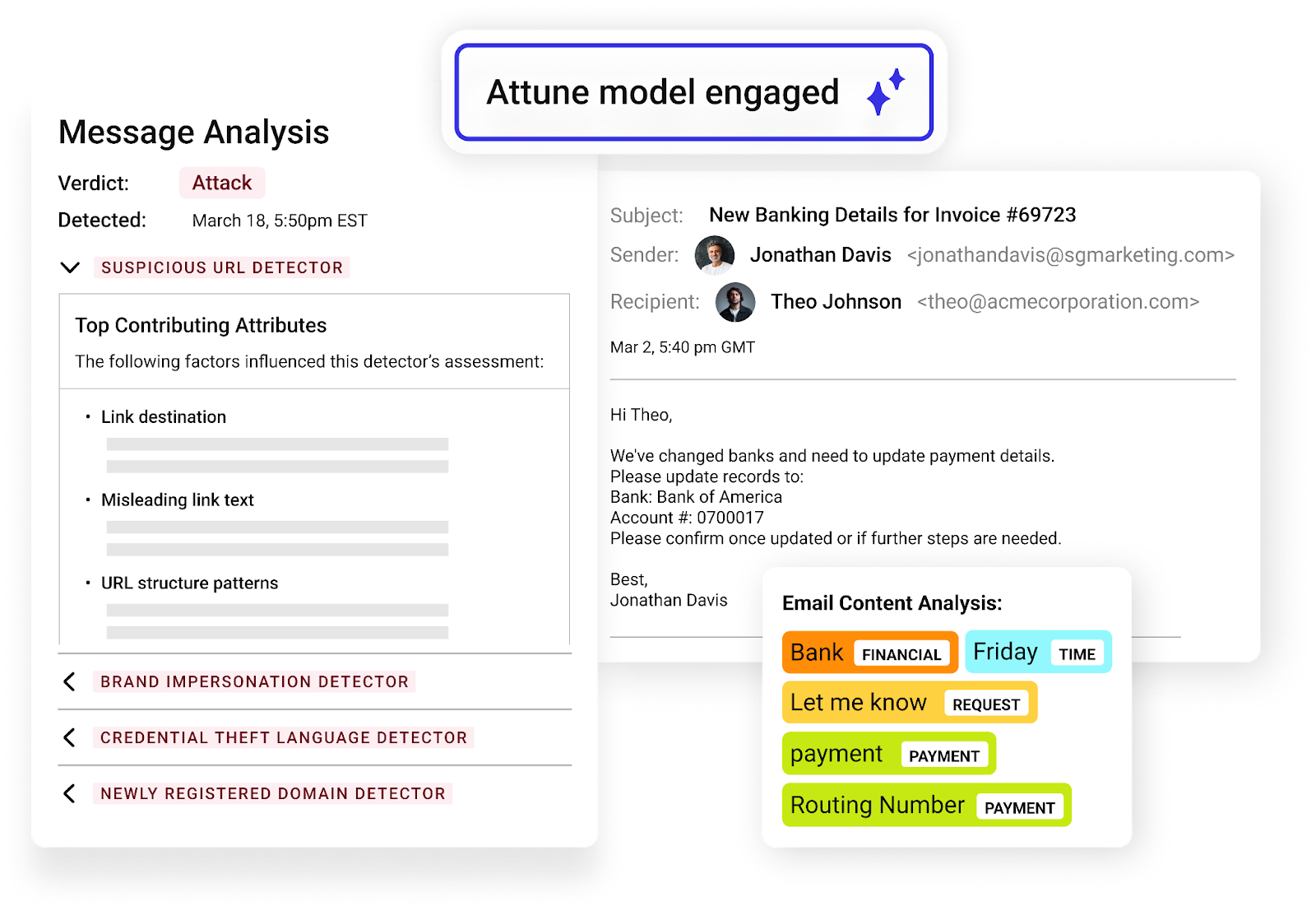
Built for the era of generative AI attacks, Attune unifies identity, behavior, and content signals into a single model instead of evaluating them separately and stitching the results together. This unified view helps Attune understand how these signals interact within the unique context of each organization.
Earlier detection systems treated identity, content, and behavioral signals as separate checks, combining them through layered heuristics. Attune evaluates them within a single system, shifting detection from correlating outputs to modeling how signals relate from the outset.
Trained on more than 1 billion derived behavioral signals1, Attune models how organizations operate across roles, workflows, and industries. It captures relationship history, frequency, and intent as part of a broader behavioral baseline rather than as isolated data points. Attune represents more than eight years of accumulated learning from these behavioral patterns across the Abnormal platform.
Because Attune evaluates behavior holistically, detection does not require explicit rule creation, manual tuning, or prior exposure to a specific variant. In internal evaluations, this approach is already operating with 50% higher precision than previous models. Attune stops more attacks—especially the most sophisticated and costly—while reducing investigation noise for security teams.1
This is not an incremental improvement. Attune replaces layered heuristics and independently tuned systems with a unified behavioral foundation. Detection is where this architectural shift becomes visible first. Attune establishes the shared intelligence layer that underpins detection today and extends across additional platform use cases over time.
How Attune Changes Detection in Practice
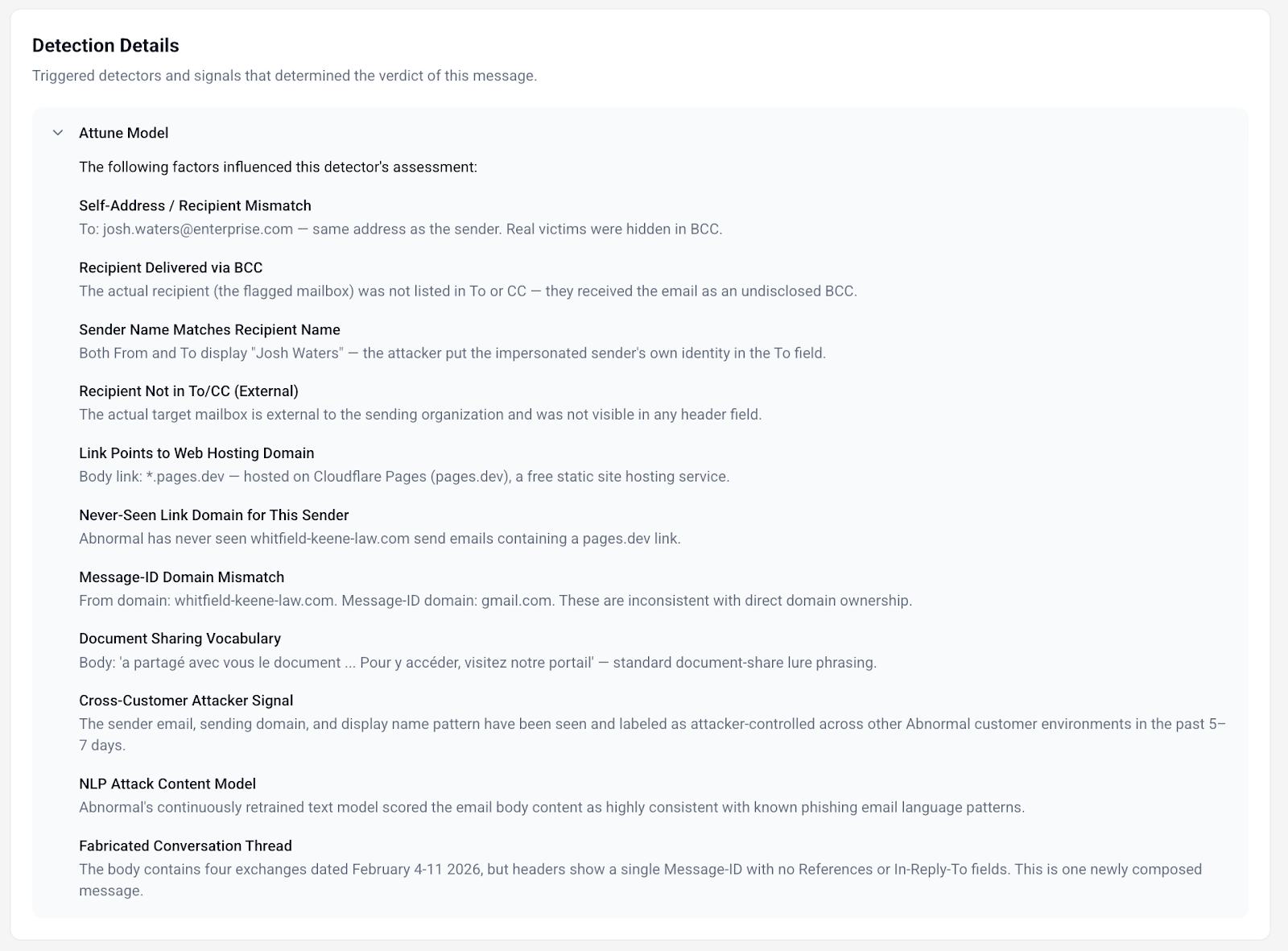
In one recent campaign, Attune identified a vendor email compromise (VEC) attack sent from the legitimate Microsoft 365 account of a real employee at a real vendor. The sender domain was genuine. Authentication passed. The message was routed through the vendor’s own Microsoft 365 infrastructure.
From a technical standpoint, everything checked out.
That is the kind of environment modern detection must be built for. Infrastructure confirmed authenticity, but authenticity alone did not make the interaction legitimate.
Attune surfaced the risk by evaluating how the message aligned with historical patterns for the tenant. Recipients rarely received mail from this sender. The email directed users to a pages.dev domain with no prior association to the vendor. And the combination of a document-sharing pretext and instructions to manually copy and paste the URL matched patterns associated with credential-harvesting VEC campaigns.
No single artifact revealed compromise. Each component could be validated on its own. Compromise became evident in how those legitimate elements conflicted with the organization’s behavioral baseline.
When attacks operate through legitimate accounts and trusted infrastructure, independent checks can confirm every part of an exchange and still fail to determine whether the interaction belongs. Attune models identity, communication, and workflow as a single system and detects when an authenticated interaction falls outside how the organization actually operates.
Why Attune Represents a New Class of Behavioral Intelligence
Scale: Attune is trained on more than 1 billion derived behavioral signals from Abnormal-protected environments. This scale allows it to learn how organizations actually operate—across roles, workflows, and industries—and establish a stable behavioral baseline.
Unified Architecture: Attune learns identity, behavior, content, and threat signals together within a single model. Instead of evaluating each signal separately and combining the results later, it models how they interact from the start.
Designed to Generalize: Attune is built for an environment where new attack variants are expected. Rather than waiting for patterns to be labeled, it evaluates whether communication aligns with established behavioral norms.
Platform-Wide Intelligence Layer: Attune already powers 85% of attack detections across the Abnormal Behavior Platform1, providing the behavioral context behind identity insights, workflow analysis, communication credibility scoring, and automation.
Emergent Capabilities Unlocked by Attune
By learning identity, behavior, and content together within a single model, Attune surfaces signals that stitched systems cannot reliably detect.
These include:
Detecting subtle impersonation when tone and authority don’t match historical patterns
Identifying workflow deviations even when the content appears legitimate
Recognizing new forms of social engineering without relying on prior signatures
Reducing false positives through a stable behavioral baseline
Incorporating emerging threat patterns as behavioral context evolves
As attackers increasingly imitate trusted communication, effective detection depends on evaluating how signals align—not just whether they appear valid in isolation.
What Innovation Means for the Enterprise
The behavioral foundation model strengthens protection across the platform. Customers see more effective detection of subtle social engineering, fewer false positives, and consistent coverage without relying on manual rule tuning.
As attackers introduce new techniques, Attune adapts to associated behavioral shifts rather than waiting for new signatures. Protection evolves to align with the way organizations communicate.
Attune is not just a feature layered onto the platform. It is the foundational intelligence layer behind detection, identity risk insights, workflow analysis, and automation. In an environment where a single compromised inbox can create cascading operational impact, behavioral intelligence underpins the entire system.
Evolving the Future of Behavioral Security
Generative AI has changed the shape of attacks. Communication can now be syntactically unique and context-aware at scale. Recognition of known patterns no longer delivers durable coverage; protection must be anchored in behavioral consistency.
Attune provides that foundation.
Future development will expand training scale, introduce derivative models for specialized use cases, and extend behavioral intelligence across additional surfaces. As communication shifts and adversaries adapt, the platform’s intelligence layer adapts with them.
Attune 1.0 marks the shift from stitched detection systems to a unified behavioral intelligence architecture. This foundation reshapes how we build, extend protection, and stay ahead in an AI-driven threat landscape—where novelty is constant and behavioral consistency endures.
Experience Attune in action and see why behavioral intelligence is essential for modern threat detection.
Schedule a Demo1 Based on internal Abnormal data.
The above is intended to outline our general product direction. It is intended for information purposes only, and may not be incorporated into any contract. It is not a commitment to deliver any material, code, or functionality, and should not be relied upon in making purchasing decisions. The development, release, and timing of any features or functionality described for Abnormal AI’s products remains at the sole discretion of Abnormal AI and is subject to change.
