Key Insights
Identity threat detection and response (ITDR) is the security discipline focused on catching and stopping attackers who operate through legitimate identities. It exists because some of the hardest intrusions to spot begin when an attacker signs in with credentials a system accepts as valid. Because identity systems govern access across an organization, misplaced trust can spread quickly. The central challenge is that granting access is a one-time decision, while trust in that access needs to hold up every day afterward.
Key Takeaways
- ITDR protects the identity infrastructure itself and treats directories, credentials, sessions, and tokens as systems that attackers target and defenders must actively watch.
- The discipline runs as a cycle in which visibility and posture feed detection, detection feeds investigation, and investigation drives containment and restoration.
- Preventive identity controls decide who gets access; ITDR assumes those controls can fail and watches what identities do afterward.
- Coverage now extends beyond workforce accounts to service accounts, workload identities, application credentials, and autonomous artificial intelligence (AI) agents.
What Is Identity Threat Detection and Response?
ITDR combines practices, processes, threat intelligence, and technology into a security discipline that protects identity infrastructure and acts when trusted access is abused.
Identity Systems as a Security Control Plane
Directories, identity providers, credential stores, sessions, tokens, and entitlements together decide who can reach what across an organization. That makes them a control plane: compromise the system that issues access and you inherit everything it governs. An attacker who steals one privileged account gains a direct path into the environment without breaching a network perimeter or dropping malware on an endpoint.
Cloud adoption increased identity risk. In cloud environments, lateral movement largely involves assuming roles or minting tokens in the identity and access layer. Hybrid environments compound the exposure: when on-premises directories synchronize or federate with cloud tenants, a compromise on either side can cross through the trust relationship itself.
That concentration also changes how defenders evaluate risk. A single identity event can affect many systems at once, so defenders need to understand each account's permissions and the trust relationships that let those permissions propagate. This dependency map shows how a directory change can carry broader risk and why identity infrastructure requires dedicated scrutiny.
ITDR's Role After Authentication Succeeds
Modern identity threats can subvert preventive controls, including multifactor authentication (MFA). Attackers can present technically valid credentials after phishing a session cookie or forging a token signed with a stolen certificate. They can also wear down a user with repeated push notifications.
ITDR assumes this can happen and watches what identities do after access is granted: where the account signs in from, what it touches, which privileges it acquires, and whether its behavior matches its history. A sign-in may be ordinary in isolation but suspicious when it immediately precedes a new MFA registration, a role assignment, or access to resources the identity has never used. Looking across that sequence helps distinguish misuse from routine variation without treating every unfamiliar action as an incident.
When behavior diverges from the baseline, ITDR can act by cutting sessions, demanding fresh proof of identity, or disabling the account. Then it does the part preventive tools cannot: it returns the identity infrastructure to a trustworthy state, so the attacker's foothold does not survive the cleanup.
How Identity Threat Detection and Response Works
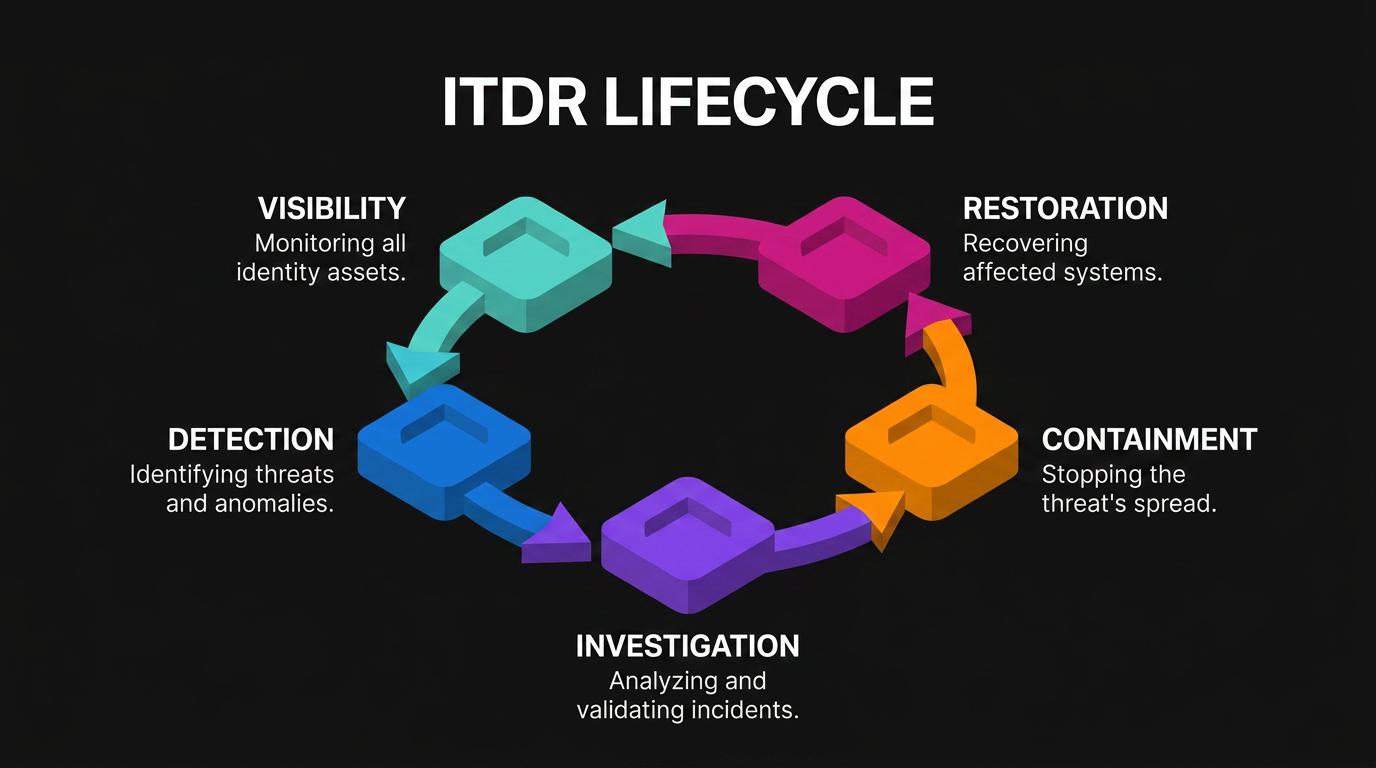
ITDR follows a connected cycle: visibility feeds detection, detection feeds investigation, and investigation drives containment and the restoration of trust.
Visibility, Posture, and Detection Signals
ITDR builds this picture in three layers:
- Inventory and Posture: An inventory of every account and role, mapped to what each can access, exposes the weaknesses attackers exploit, such as excessive permissions and dormant admin accounts.
- Live Detection Telemetry: Detection watches sign-ins, directory changes, and privilege modifications against behavioral baselines. CISA's IAM guidance calls for flagging deviations in resource access, location, and timing.
- Threat Intelligence Context: Outside signals, such as credentials in breach dumps or sign-ins from known-malicious infrastructure, add context individual events lack on their own.
A finance analyst pulling engineering repositories at 3 a.m. from a new country makes the point concrete. Every credential checks out, but the pattern itself is what gives the account away.
Investigation, Containment, and Restoration
When a detection fires, risk scoring aggregates signals per identity so analysts can prioritize the riskiest accounts. Investigation reconstructs the identity's sign-in and permission history, then correlates resource activity with endpoint and network evidence to tell a traveling employee from a takeover. The order matters because the same actions carry different risk depending on whether authentication, privilege gain, and data access occurred as part of a familiar workflow or an unexpected chain.
Containment then applies force proportional to confidence. A medium-risk sign-in might trigger step-up authentication that asks the real user to prove presence, while a confirmed compromise calls for harder measures:
- Revoke active sessions and refresh tokens.
- Force credential resets or secret rotation.
- Disable the account and block attacker infrastructure.
- Preserve evidence throughout containment.
Restoration is the step that separates ITDR from generic alerting. If the attacker touched identity infrastructure, cleanup means rotating the material that anchors trust:
- Reset the domain's Kerberos ticket-signing account (KRBTGT) twice, per CISA guidance on living-off-the-land techniques, to invalidate any forged tickets.
- Replace stolen token-signing certificates.
- Roll back changes a compromised administrator made.
What investigation learns flows back into posture assessment for the next pass.
Identity Attacks ITDR Helps Detect and Contain
The attacks ITDR targets group by stage: techniques that obtain trusted access, then techniques that extend and preserve it once an attacker is inside.
Credential compromise remains one of the most common ways intrusions begin, and it rarely stops at a single stolen password. Attackers first work to get in, using methods like password spraying and phishing to obtain a session that authentication systems treat as legitimate. Once inside, they convert that initial foothold into durable power, harvesting hashes and forging tickets or tokens so they no longer need to steal credentials at all. The table below maps the techniques ITDR is built to catch at each stage, along with the behavioral signal that typically gives each one away.
| Technique | Stage | How It Works | Detection Signal |
|---|---|---|---|
| Password Spraying: Tries one common password against many accounts, throttled so no account locks out. | Access | Slow, low-volume guessing across a user population. | A drizzle of failed logins spread across many accounts rather than a burst against one. |
| MFA Fatigue: Wears down a user with repeated multifactor authentication (MFA) push notifications. | Access | The attacker triggers prompts until an exhausted user approves one. | A spike in prompts followed by an approval from an unfamiliar device. |
| Adversary-in-the-Middle Phishing: A proxy site sits between the user and the real login page. | Access | Captures the credentials and session cookie, then replays the cookie before it expires. | Session activity from a device that never authenticated, when telemetry allows it. |
| Credential Dumping: Harvests password hashes and Kerberos tickets from memory inside a compromised network. | Access | Feeds directly into pass-the-hash or ticket-forging attacks. | Unusual process activity on a host, followed by authentication from elsewhere using the stolen material. |
| Kerberoasting: Requests service tickets encrypted with a service account's password hash. | Escalation | Cracks the hash offline, since ticket requests mirror legitimate directory activity. | One account requesting tickets for many services in a short window. |
| DCSync: Abuses the directory replication interface to pull password hashes. | Escalation | The attacker's system impersonates a domain controller to request replication data. | Replication requests from an account that is not itself a domain controller. |
| Golden Ticket Forgery: Uses a stolen KRBTGT hash, the credential for the account that signs all Kerberos tickets, to mint new tickets. | Escalation | Forged tickets grant authentication material for any account in Active Directory. | Ticket lifetimes or properties that don't match normal issuance patterns. |
| Forged SAML Tokens: Signs Security Assertion Markup Language (SAML) tokens with a stolen certificate. | Escalation | Opens cloud environments directly, bypassing MFA entirely. | Unusual token lifetimes or a missing authentication event that should have preceded the token. |
| OAuth and Role Abuse: Malicious applications trick users into granting OAuth tokens, or a compromised account attaches admin roles to itself. | Escalation | Converts a single compromised session into standing, reusable privilege. | A privilege grant or consent event with no matching change request behind it. |
Across both stages, the specific technique matters less than the pattern it leaves behind. Each of these methods produces valid-looking credentials or tokens, so detection depends on correlating the access itself against what is normal for that account, not on catching the theft in progress.
ITDR and Adjacent Security Disciplines
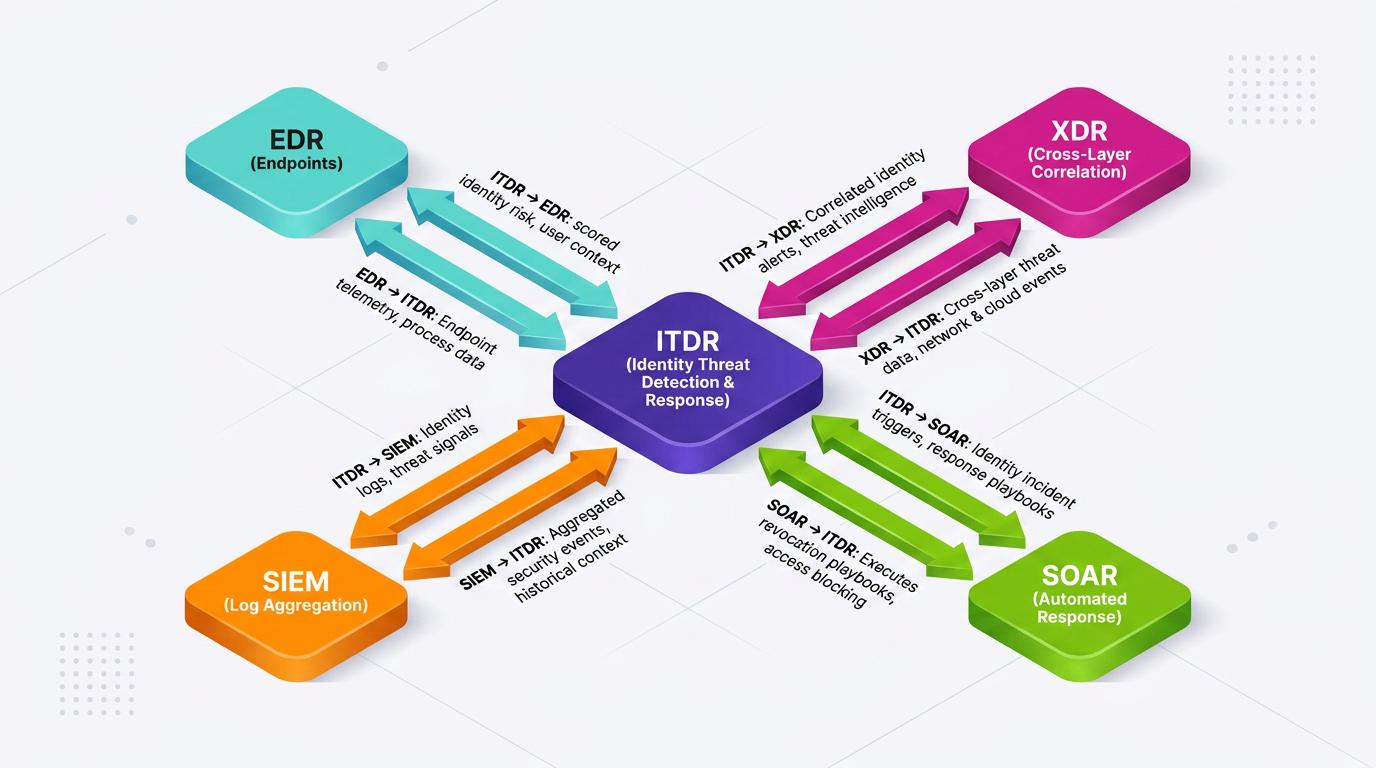
ITDR is not a replacement for the tools that already sit in the identity and security operations stack. It works alongside the preventive identity stack, which controls access before an attacker ever authenticates, and the broader security operations stack, which correlates identity signals with everything else happening on a network. Each adjacent tool sees a different slice of the same environment, so ITDR trades signal with each one to cover a distinct blind spot rather than duplicating its coverage.
IAM, PAM, and ISPM as Preventive Foundations
Three preventive tools work alongside ITDR by shaping access before an attack begins:
- IAM (Identity and Access Management): Decides who authenticates and what they are authorized to reach.
- PAM (Privileged Access Management): Adds tighter access control and session recording over the most powerful accounts.
- ISPM (Identity Security Posture Management): Finds the misconfigurations, excessive permissions, and shadow identities that make attacks easier, and fixes them before anyone exploits them.
All three primarily strengthen prevention by shaping access in advance, though PAM's session recording and ISPM's posture findings can also support monitoring and investigation.
ITDR assumes prevention can fail, since attackers holding valid credentials or forged tokens can still pass through well-configured IAM. The relationship also runs in the other direction. Posture findings from ISPM tell ITDR where to look hardest, since an attack path ending at a token-signing certificate makes every anomaly along it more urgent. ITDR's investigations feed prevention in return, since each incident exposes the standing permission or stale account that made it possible.
EDR, XDR, SIEM, and SOAR as Operational Partners
ITDR works alongside four operational tools, each covering a different layer:
- EDR (Endpoint Detection and Response): Watches process execution, file activity, and network connections on devices, while ITDR watches authentication flows, directory changes, and access patterns across identity systems.
- XDR (Extended Detection and Response): Correlates signals across endpoints, servers, cloud workloads, and networks, with ITDR supplying the specialized identity component within it.
- SIEM (Security Information and Event Management): Aggregates logs from everywhere but ingests identity logs without necessarily understanding them, which is why ITDR analyzes that data with behavioral models built for it, then feeds scored identity risk back into SIEM correlation.
- SOAR (Security Orchestration, Automation, and Response): Closes the loop by executing playbooks based on identity context, such as revoking a session, rotating a secret, or disabling an account after a confirmed compromise.
EDR and ITDR illustrate the split well. EDR might catch the tool that dumped credentials from memory, while ITDR catches the stolen hash replayed against a server the user never touches.
Implementing Identity Threat Detection and Response
Implementation works best as a maturity progression: full identity visibility first, then prioritized detection, then response playbooks that get tested and measured.
Identity Coverage and Detection Priorities
Coverage starts with an honest inventory, and the non-human side is usually where it breaks down. A 2025 Gartner survey of IAM leaders found teams responsible for only 44% of their organizations' machine identities, with the rest sitting outside anyone's management. The inventory should span workforce accounts, service accounts, workload identities, application credentials, and application programming interface (API) keys across on-premises directories and every cloud tenant.
Static keys that nobody rotates are the recurring weak point. Because some cloud service-account tokens cannot be pulled back by ordinary revocation, careful issuance limits and rotation of underlying credentials become especially important. Teams can use tiers to map which identities control the identity infrastructure itself, keep those credentials off lower-trust systems, and avoid sharing service accounts across tiers.
Telemetry comes next. On-premises directories and cloud identity providers each need authentication events, directory changes, and token activity collected, since attackers cross between them through synchronization and federation.
Detection priorities should follow attack paths that reach domain controllers or token-signing infrastructure, with cloud admin roles and interactive service-account logins earning immediate coverage.
Response Playbooks and Maturity Measures
A playbook turns a detection into a contained incident. One scenario shows how this plays out: an alert flags a finance administrator signing in from two countries an hour apart, followed by a new mailbox forwarding rule.
- The analyst revokes the account's active sessions and refresh tokens and forces a password reset.
- The analyst temporarily disables the account because the risk remains active.
- The analyst blocks known malicious Internet Protocol (IP) addresses and preserves evidence before cleanup: incident IDs, alerts, sign-in exports, and a statement from the user.
- Investigation then checks for registered MFA devices and application credentials the attacker added, finds any new directory roles, and rolls all of those changes back before the account returns behind step-up authentication.
Playbooks need rehearsing on a schedule; a tabletop that walks through revoking an executive's sessions surfaces the approval bottleneck before a real incident does. None of this works if ownership is unresolved at 2 a.m., so playbooks should name who approves disabling an executive account, and under what safeguards, before an incident happens. Measurement keeps the program honest: time to detect, time to contain, false-positive rate, and identity coverage.
Standards and the Expanding Identity Attack Surface
ITDR maps cleanly onto established frameworks, which helps teams structure and justify the work. The NIST Cybersecurity Framework places identity posture under Protect, monitoring under Detect, investigation under Respond, and trust restoration under Recover. CISA's zero trust maturity model makes identity the first of five pillars, and its highest stage calls for continuous validation via phishing-resistant MFA rather than a one-time login check.
The next stretch of the discipline is already taking shape around identities that don't belong to people. Cloud tokens, workload identities, and autonomous AI agents largely sit outside anyone's management today, and they need the same inventory, behavioral baselines, and credential lifecycle controls that protect human accounts. A second challenge is emerging alongside that gap. Deepfake-enabled social engineering is eroding the assumption that a verified credential means a verified person, pulling identity proofing itself into ITDR's scope.
Building Operational Identity Resilience
Identity defense matures in the same order the cycle runs: see every identity, harden its posture, detect misuse, contain it fast, and restore trust. If a privileged account, or a service account nobody remembers creating, were compromised tonight, would your team detect it, contain it within hours, and prove the infrastructure clean again?
