Key Insights
The attacker no longer needs malware. A convincing email, a stolen password, and a few built-in Windows tools are often all it takes to walk past your endpoint defenses unnoticed.
Phishing campaigns now favor credential-harvesting links over malicious attachments; adversaries lean on legitimate system utilities rather than detectable binaries. Plus, stolen credentials open the front door to corporate systems without triggering a single signature-based alert.
That shift demands a new playbook. This article breaks down five endpoint protection best practices grounded in the current NIST CSF 2.0 and CIS Controls v8.1, with specific implementation steps that security teams can act on immediately.
Key Takeaways
- Secure endpoint configurations and complete asset inventories form the foundation for endpoint protection controls, per NIST CSF 2.0 and CIS Controls v8.1.
- Removing standing local administrator rights from standard user accounts is a high-impact, low-dependency action in endpoint privilege management.
- Email remains a primary entry point for cyberattacks that ultimately compromise endpoints.
- Incident response plans should be updated to align with NIST SP 800-61r3, which maps directly to all six NIST CSF 2.0 Functions.
Why Endpoint Protection Needs More Than Signature Matching
Endpoint protection needs controls that address attacks with little or no file-based evidence.
Signature-based and static rule-based endpoint protection platforms share a fundamental limitation: they require prior knowledge of a threat to detect it. When attacks involve no malicious file, no known indicator, and no detectable payload, these tools often have limited detection surface to work with.
To understand why modern endpoint defenses fall short, it helps to look at two related problems: the legacy gaps that file-focused detection leaves wide open, and the detection gap created when attackers turn trusted tools against the systems those tools were built to support.
Identify Legacy Gaps
The first piece of the puzzle is recognizing where traditional, file-focused detection runs out of road.
For decades, endpoint defenses were optimized for one core assumption: that an attack would arrive as a file, and that file would carry something recognizable. Modern intrusions break that assumption. Fileless attacks, living-off-the-land (LotL) techniques, and credential-based intrusions exploit this architectural gap.
A SANS Institute whitepaper on evaluating next-generation antivirus approaches states that traditional antivirus products are "rarely successful in detecting smart malware, unknown malware, and malware-less attacks." Polymorphic malware execution analysis shows that process injection and PowerShell-based download cradles can execute entirely in memory without writing to disk.
When there is no file, there is little artifact for signature-based scanning to evaluate, leaving legacy tools watching for an attack that never materializes on disk.
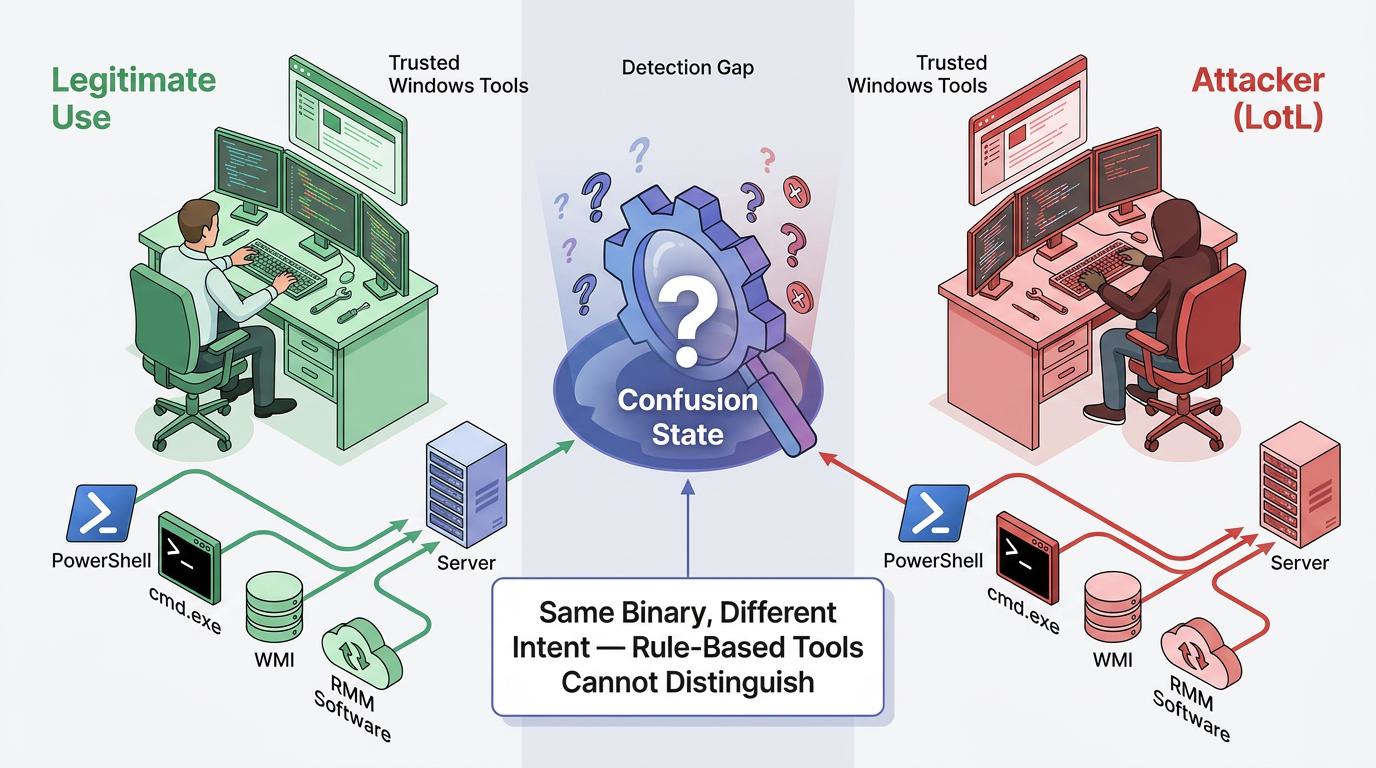
Explain the Detection Gap
Closing the legacy gap is only half the battle. The harder problem emerges when attackers stop bringing their own tools and start borrowing yours.
LotL techniques are difficult for rule-based tools because the "malicious" activity uses the same binaries administrators rely on daily. PowerShell illustrates the dilemma: a rule that blocks PowerShell also blocks legitimate administrative activity, while a rule that allows it offers no protection against misuse.
The same trade-off applies to cmd.exe, WMI, and commercial remote monitoring and management (RMM) software. Cisco Talos's Q2 2025 incident response data documents Qilin ransomware operators using multiple legitimate RMM tools for lateral movement, which signature-based detection may not reliably flag.
The takeaway for both gaps: effective endpoint protection must look beyond files and binaries to the surrounding behavior, exactly what the next five practices address.
Practice 1: Harden Endpoint Configurations and Track Every Asset
Endpoint protection starts with secure configurations and a complete asset inventory.
Secure, documented configurations and a complete asset inventory are prerequisites for every other endpoint protection control. Without knowing what devices exist and how they are configured, patching, monitoring, and access control all operate on incomplete information.
Enforce Secure Configurations Across All Devices
Consistent endpoint configurations help reduce avoidable exposure across the environment.
NIST CSF 2.0 addresses endpoint configuration through three subcategories under the Protect function (PR.PS-01, PR.PS-02, PR.PS-03), specifying that organizations should apply uniform configurations and disable services or features that do not support mission functions.
Following a cyberattack against a U.S. medical technology organization in March 2026, CISA issued an alert urging organizations to harden endpoint management system configurations.
Practical steps for security teams:
- Apply uniform, documented configurations to endpoint devices and control configuration changes through change management processes.
- Disable services and features not required for business functions.
- Use CIS Benchmarks as configuration baselines (updated through May 2026).
- Restrict administrator privileges to dedicated administrator accounts. Conduct general browsing, email, and productivity work from non-privileged user accounts.
These steps establish a hardened, repeatable baseline that shrinks the endpoint attack surface and makes configuration drift easier to detect and correct over time.
Maintain a Complete Asset Inventory With Lifecycle Management
Asset inventory and lifecycle tracking help keep unsupported systems from becoming unmanaged risk. NIST SP 1299 specifies that organizations should maintain inventories of hardware, software, services, and systems, noting that these are "frequently the entry points of malicious actors." Inventory scope must include owned, leased, and employee personal devices and applications.
CISA Directive 26-02 requires federal agencies to strengthen asset lifecycle management for active edge devices and to remove hardware or software that is no longer supported by the original equipment manufacturer.
While mandatory for federal agencies, the directive represents CISA's authoritative position for all organizations. Track end-of-support dates for hardware and software. Remove or network-isolate unsupported devices rather than leaving them connected with known, unpatched vulnerabilities.
Practice 2: Enforce Least Privilege and Strong Authentication on Every Endpoint
Least privilege and strong authentication can reduce the impact of compromised accounts on endpoints.
Removing excessive privileges and enforcing strong authentication are high-impact endpoint protection controls with low implementation dependency. They can be deployed without waiting for monitoring infrastructure, allow listing, or other more complex controls to mature.
Remove Standing Administrator Rights
Removing standing administrator rights can sharply reduce the blast radius of credential misuse.
The CISA Zero Trust Model states that "privileged identities should only be provided access to the systems when specifically required. Access should be as limited as possible, and access should be immediately revoked when it is no longer needed." Removing standing local administrator rights from standard users is often the most impactful action in endpoint privilege management. It directly limits the blast radius when credentials are compromised.
Steps to implement:
- Discover and inventory all privileged accounts, including local admin, service accounts, scheduled task accounts, and application service identities.
- Remove standing local administrator rights from standard user accounts.
- Implement just-in-time (JIT) privilege elevation for specific approved tasks with automatic expiration.
- Disable dormant accounts where technically supported, per CIS IG1 Safeguards.
Strengthen Authentication at Every Access Point
The authentication policy should match the risk posed by endpoint and account access. CIS Controls v8.1 specifies a minimum password length of 8 characters for MFA-enabled accounts and 14 characters when MFA is not in use.
MFA prompt bombing statistics show this technique, where attackers flood a user with push notifications until they approve one, appeared in 14% of Social Engineering incidents in the Verizon 2025 DBIR. Phishing-resistant MFA methods (FIDO2 security keys, certificate-based authentication) can address this technique at the protocol level rather than relying on users to reject fraudulent prompts.
Practice 3: Automate Patch Management and Control Software Execution
Patch automation and execution control can reduce exposure to known vulnerabilities and unauthorized code.
Automated patching and application allowlisting together close two of the most commonly exploited attack surfaces: known software vulnerabilities and unauthorized code execution.
Prioritize Patches Based on Active Exploitation
Patch prioritization should focus first on vulnerabilities already being exploited.
NIST SP 800-137 establishes that automated processes make continuous monitoring "more cost-effective, consistent, and efficient." CIS Control 7 (Continuous Vulnerability Management) requires automated vulnerability scanning to identify and remediate vulnerabilities.
Practical implementation:
- Establish a patch monitoring feed from the CISA Known Exploited Vulnerabilities (KEV) catalog, vendor advisories, and CIS advisories.
- Classify assets as servers versus endpoints because SLAs and deployment mechanisms differ between the two.
- Automate deployment through centralized device management (MDM, configuration management systems).
- Prioritize CISA KEV catalog entries. Vulnerabilities with confirmed active exploitation require expedited patching outside standard cycles.
- Document exceptions explicitly with time-bound expiration. Open-ended exceptions do not satisfy CIS Control 7.
The practices turn patching from a reactive scramble into a risk-prioritized program that closes known exploitation paths before attackers can reach them.
Control Which Software Can Execute
Execution control works best when it is tied to a validated software inventory. CIS Safeguards 2.5 and 2.6 specify that organizations should use technical controls to ensure that only authorized software and libraries can execute or be loaded into system processes. Allowlisting at the executable level alone leaves DLL hijacking open. Both executable and library-level controls are needed.
Build an authorized software inventory first, because allowlisting is difficult to configure without a completed, validated inventory. Deploy in audit or monitor mode before enforcement to identify all software currently executing.
Schedule bi-annual reassessment at minimum. Synchronize allowlist updates with patch deployments in the same change window to prevent patches from being blocked by outdated allowlist entries.
Practice 4: Build Continuous Endpoint Protection Monitoring Across Multiple Sources
Continuous endpoint protection monitoring is stronger when it combines endpoint, identity, and email visibility.
Incident response data has documented ransomware operators deploying multiple RMM tools across an environment before detection could occur, underscoring the need for monitoring that spans multiple layers.
Collect and Correlate Logs From Multiple Sources
Correlated logs provide a fuller view of endpoint compromise than endpoint data alone. NIST CSF 2.0 specifies that organizations should "monitor networks, systems, and facilities continuously to find potentially adverse events" and "collect log information from multiple organizational sources to assist in detecting unauthorized activity." Endpoint logs alone are insufficient. Identity provider logs, email gateway logs, and cloud application logs all contain signals relevant to endpoint compromise.
MITRE ATT&CK's detection guidance for internal spearphishing (T1534) explicitly requires correlating email metadata, identity provider logs (such as Entra ID), and endpoint telemetry. Organizations that treat these data sources as separate detection domains may miss attack chains that cross between them.
Establish Behavioral Baselines Before Hunting for Anomalies
Behavioral baselines make continuous monitoring more useful.
NIST SP 800-207 requires the enterprise to "monitor and measure the integrity and security posture of all owned and associated assets" continuously, rather than through scheduled scans. A known-good state is required as the comparison reference before monitoring for anomalies produces a useful signal.
Steps to implement:
- Define behavioral baselines for endpoint activity, authentication patterns, and communication flows before deploying anomaly detection rules.
- Centralize telemetry across endpoints, identity providers, cloud resources, and email systems.
- Monitor device posture continuously, not on scheduled scan cycles.
- Feed monitoring outputs into automated policy enforcement. Per CISA's Zero Trust guidance, monitoring that requires manual analyst review before a policy response does not meet the Advanced or Optimal maturity stages.
- Define monitoring data collection scope through legal and privacy review before deploying telemetry agents, per NIST SP 800-207 guidance.
Practice 5: Connect Endpoint Protection to Email Security and Incident Response
Endpoint protection works better when email-driven attack paths and response plans are handled together. According to the FBI IC3 2024 Report, BEC losses in 2024 totaled approximately $2.77 billion.
Map the Email-to-Endpoint Attack Chain
Security teams need to map how email-driven activity progresses into endpoint compromise. The MITRE ATT&CK framework classifies phishing (T1566) under Initial Access and documents a direct chain from email delivery through execution, persistence, credential access, lateral movement, and data exfiltration.
Email rarely delivers payload directly. It often initiates a multi-stage progression through credential theft, abuse of valid accounts, and lateral movement before the terminal objective is reached.
CISA Advisory AA24-131A on Black Basta documents a specific BEC-to-endpoint chain in which threat actors conduct email bombing (sending large volumes of spam to create confusion), then use Microsoft Teams to pose as IT support, tricking victims into installing RMM tools. The endpoint event that matters is RMM tool installation, which gives adversaries persistent, legitimate-appearing remote access. Detection that focuses only on the email or only on the endpoint may miss the connection between the two.
Align Incident Response Plans With Current Frameworks
Incident response plans should reflect current guidance and the way attacks now unfold across systems.
NIST SP 800-61r3 is the current incident response standard. It replaces the older four-phase model with explicit alignment to all six NIST CSF 2.0 Functions: Govern, Identify, Protect, Detect, Respond, and Recover. Organizations still operating under the previous four-phase model should update their plans.
Practical steps:
- Adopt NIST SP 800-61r3 (April 2025) as the incident response baseline.
- Ensure incident response plans address email-delivered threats as a documented initial access vector, with playbooks that span both email and endpoint detection layers.
- Establish procedures to characterize new threats detected on endpoints and feed lessons learned back into policy and practice, per CSF 2.0 subcategory ID.IM-02.
- Test incident response plans regularly against realistic scenarios, including phishing-to-ransomware and account takeover-to-lateral-movement chains.
- SOC playbooks that require human escalation approval before containment actions (endpoint isolation, account suspension) may not execute within the available window given documented attacker dwell times. Automated containment triggers on high-confidence behavioral indicators can be operationally important.
Taken together, these practices provide response teams with a current framework, cross-layer playbooks, and the automation needed to contain incidents before email-borne intrusions escalate into full endpoint compromise.
Close the Gap Between Endpoint and Email Detection
Endpoint protection is necessary, but many attacks begin before malicious activity reaches the device.
Traditional email security tools, including secure email gateways (SEGs), often struggle to detect socially engineered messages that contain no malicious payload, no known-bad indicator, and no attachment to scan.
Behavioral AI can help close this gap by analyzing identity signals, communication patterns, and content context at the email layer, thereby surfacing threats before they trigger the endpoint attack chain.
Abnormal is designed to detect these email-borne threats, including BEC, credential phishing, and account takeover attempts, and integrate with existing endpoint and SOC infrastructure. Book a demo to see how Abnormal complements your endpoint protection strategy.