
Key Insights
Credential harvesting is already embedded in most organizations’ threat reality. Effective defense depends on detecting identity misuse after authentication succeeds, not simply blocking known-bad indicators.
This shift reflects the modern identity threat landscape. Credential harvesting has become commoditized, social engineering campaigns are coordinated and automated at scale, and attackers no longer require advanced tradecraft to gain valid cloud access.
Recent investigations underscore the pervasiveness of credential harvesting and identity abuse across cloud environments:
Popular credential harvesting kits boast 99.7% success rates, demonstrating how easily attackers capture cloud credentials across major identity platforms.
Social engineering campaigns tied to ShinyHunters regularly exploit identity and MFA workflows, contributing to the exposure of hundreds of millions of records.
Designed to harvest credentials and expand access before conventional controls could respond, a coordinated phishing operation targeted more than one hundred users inside a single organization.
When attackers successfully authenticate with valid credentials, many traditional controls lose their primary enforcement signal. At that point, the question is no longer whether the login was legitimate, but whether the identity’s behavior remains consistent with its historical baseline. Detecting that shift from legitimate use to subtle misuse requires a behavioral approach rather than a rules-based one.
Why Rule-Based Detection Breaks Down
Traditional account takeover detection relies on static indicators such as impossible travel, risky IP addresses, repeated authentication failures, or policy violations. These detection techniques are effective against unsophisticated activity and known malicious infrastructure, but struggle when adversaries operate within legitimate technical boundaries.
In many modern attacks, authentication succeeds. Attackers use valid credentials harvested through phishing kits, residential proxies that resemble legitimate traffic, and MFA bypass techniques to establish sessions without triggering obvious enforcement controls. To rule-based systems, access appears authorized.
When alerts are generated, they often surface as isolated risk events rather than coordinated compromise patterns, such as:
A new device registration
A mailbox rule change
An unexpected OAuth permission grant
Each signal may be explainable on its own, leaving security teams to manually determine whether the activity represents benign variance or identity misuse.
Security practitioners recognize these limitations, and 86% feel that legacy tools cannot adequately protect against account takeovers. Novel attacks evade detection because they do not match predefined rules, while defenders are left managing fragmented signals that lack sufficient behavioral context. Detecting account takeover requires evaluating identity behavior over time, not simply whether a threshold has been exceeded.
How Behavioral AI Detects Account Takeover
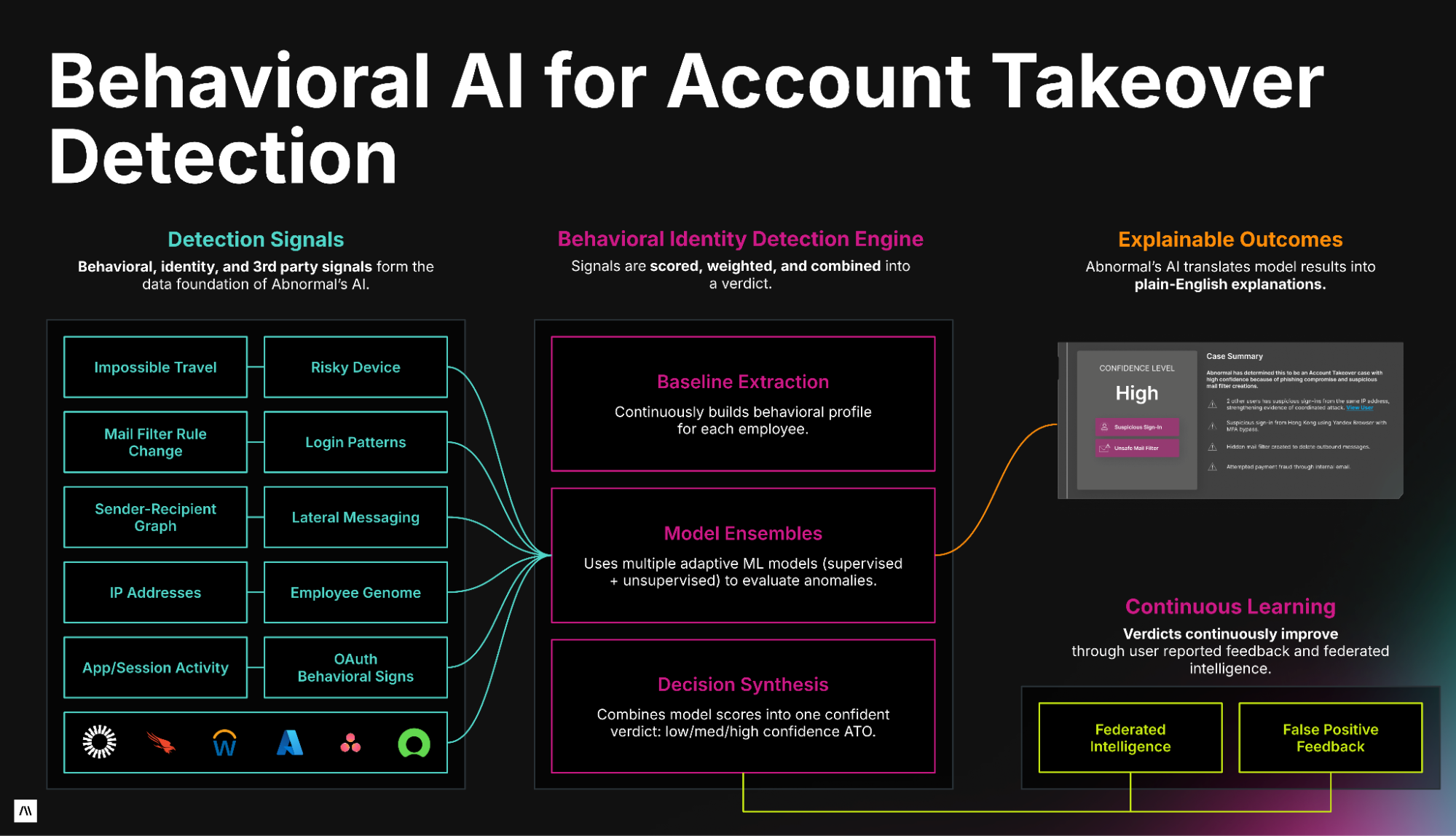
Rather than relying on static thresholds and isolated risk indicators, Abnormal approaches account takeover detection as a continuous behavioral problem. Its four-stage architecture evaluates how identities behave over time, correlates deviations across systems, and synthesizes those patterns into high-confidence verdicts.
Stage 1: Continuous Signal Ingestion
Through API integration with Microsoft 365, Google Workspace, and connected third-party cloud applications, Abnormal continuously ingests authentication events, mailbox activity, device and session telemetry, communication patterns, and application permissions.
This native cloud integration provides ongoing visibility into identity behavior across the environment, enabling detection beyond isolated log events or single-system alerts.
Stage 2: Behavioral Identity Detection Engine
Ingested signals feed a behavioral engine that builds and refines per-identity baselines. Login patterns, device usage, mailbox rule history, communication cadence, and relationship norms establish what normal looks like for each employee, vendor, and application. Model ensembles evaluate deviations collectively, identifying identity drift across authentication, configuration, and communication activity.
When new compromise patterns are observed, those behavioral characteristics are incorporated directly into the detection models. Instead of expanding a growing library of static rules, identity evaluation logic is continuously updated, allowing detection to evolve as attacker techniques change.
Stage 3: Decision Synthesis and Explainability
Correlated signals are synthesized into a single low, medium, or high-confidence account takeover verdict. Each case includes a behavioral timeline and plain-language GenAI summaries that explain how activity deviated from baseline, providing clarity without requiring analysts to interpret fragmented risk events.
Stage 4: Continuous Learning and Adaptation
Detection accuracy improves through federated intelligence across customer environments and structured user feedback. When new attack techniques emerge, patterns observed in one tenant inform model updates across others. Rather than expanding a library of static rules, behavioral models are continuously refined to maintain precision without increasing alert volume.
Why This Architecture Changes the Outcome
Traditional account takeover detection often relies on discrete risk indicators generated by individual systems. Authentication alerts, mailbox changes, and application permission updates are surfaced separately, leaving security teams to determine whether those signals represent benign variance or coordinated misuse.
Abnormal’s architecture addresses this synthesis gap directly. Per-identity baselines ensure that deviations are evaluated against individual behavioral history rather than generic thresholds. Multi-signal correlation transforms fragmented telemetry into unified account takeover cases with clear confidence levels and contextual timelines.
This shift produces fewer but higher-confidence decisions, enabling security teams to focus on validated compromise patterns rather than isolated anomalies. When thresholds are met, remediation actions reduce dwell time and operational burden, saving the average organization 1,454 hours per year.
Preserving Identity Integrity
Account takeover is increasingly characterized by legitimate authentication followed by subtle misuse of trusted identities. As credential harvesting and coordinated phishing campaigns become more scalable, effective defense depends on modeling identity behavior and detecting deviations with sufficient precision to act decisively.
By combining continuous signal ingestion, behavioral modeling, adaptive model updates, explainable verdicts, and integrated containment, Behavioral AI delivers a structurally different approach to account takeover detection. The focus shifts from reacting to static indicators to continuously preserving identity integrity across the cloud environment.
See how Abnormal uses behavioral AI to expose coordinated account takeovers that traditional tools miss. Schedule a personalized demo.