Key Insights
Modern security operations center (SOC) automation can reduce alert fatigue and investigation times by helping security teams work from clearer priorities. SOC leaders increasingly need this modernization as email threats become harder to prioritize with manual workflows alone.
Key Takeaways
Modern SOC automation helps security teams prioritize high-risk email threats, speed up investigations, and focus analysts on work that requires judgment.
- Business email compromise (BEC) losses reached $3.05 billion in 2025, driven by attacks that exploit human trust rather than malicious payloads or links.
- Behavioral analysis that models identity, communication context, and intent can flag socially-engineered attacks that carry no traditional threat indicators.
- API-based email integration deploys without mail exchange (MX) record changes and can surface internal, mailbox-to-mailbox traffic that gateway-only architectures typically miss.
- Automation that handles phishing report triage and alert enrichment frees analysts for investigations that require judgment, reducing the burnout risk tied to high alert volumes.
Security operations centers face pressure from rising alert volumes and resource constraints, while leadership demands measurable returns and traditional approaches struggle to scale against AI-powered cyberattacks. Modern SOC automation offers a path from reactive cost center to proactive business enabler.
Email remains a primary entry point for cyberattacks. Sophisticated attackers often move past firewalls, endpoint detection and response (EDR), and cloud controls by targeting human behavior through socially-engineered attacks that carry no malware, no suspicious link, and no traditional malicious indicator.
Defining the Modern SOC Challenge
Modern SOC automation starts with a clear view of why traditional operations models create more noise than analysts can manage.
Today's security operations centers are overwhelmed with telemetry from across the technology stack. Firewalls, intrusion detection and prevention systems (IDS/IPS), EDR, data loss prevention (DLP), extended detection and response (XDR), cloud access security brokers (CASB), and user and entity behavior analytics (UEBA): the data flowing into the modern SOC provides deep visibility into the environment, and that visibility comes at a cost. According to the SANS 2024 SOC Survey, a lack of automation and orchestration is the most commonly cited barrier facing security operations teams, and a growing share of organizations now send all telemetry into their security information and event management (SIEM) system without filtering it first.
It is simply too much data for human analysts to consume effectively. Security teams comb through massive haystacks looking for needles, spending countless hours on manual investigation while sophisticated threats slip through the cracks. The traditional model of adding more tools and generating more logs only compounds the problem. Complexity grows, response slows, and costs climb.
Security information and event management (SIEM) platforms already consume logs from virtually every security tool in the alphabet soup of modern enterprise security. Yet additional logging and correlation doesn't necessarily translate into improved security outcomes. It often just creates more noise for already overwhelmed analysts to sift through.
Modern SOC automation moves analysts from reactive alert triage toward proactive threat hunting and strategic security work. Intelligent automation handles enrichment, clustering, and routine disposition so analysts can spend more time on investigations that require context and judgment.
The transformation redirects human expertise toward work where judgment truly matters rather than replacing analysts outright. For security leaders, that shift creates a more resilient operating model: automation absorbs repeatable work, while experienced analysts focus on escalation decisions, detection improvement, and risk communication. It also gives managers a clearer way to separate routine operational noise from activity that deserves deeper investigation, which helps teams use scarce analyst time with greater precision.
Key Benefits of Modern SOC Automation
Modern SOC automation delivers measurable outcomes, turning faster investigations and healthier teams into value security leaders can bring to the board.
Operational Efficiency Gains
Modern SOC automation improves operational efficiency largely by reducing repetitive investigation work, and the phishing inbox is where that repetition shows up first. Security awareness programs encourage employees to report suspicious emails, and at scale those user-reported workflows create a volume of submissions that SOC teams must review and answer promptly.
Manual review at this volume is unsustainable. Automation can speed up lengthy phishing submission review and handle the initial analysis that traditionally consumed junior analyst time, freeing analysts for work that requires critical thinking and judgment. The operational gain comes from standardizing repetitive review steps, reducing queue pressure, and giving analysts clearer context before they decide whether a message requires escalation.
Analyst Retention and Burnout Prevention
Modern SOC automation addresses one of the most persistent problems in security operations: analyst burnout. The grunt work of monitoring multiple inboxes, keeping eyes on dozens of dashboards, and manually investigating routine alerts creates the heavy workloads that wear down even the most dedicated security professionals.
Expecting human analysts to effectively monitor the volume of data flowing through modern security stacks is unrealistic. AI automation handles the repetitive, high-volume tasks that drive burnout while human talent moves to strategic security initiatives that offer professional growth and job satisfaction. This also helps managers preserve institutional knowledge by reducing the operational drag that pushes skilled analysts away from SOC roles. A healthier workload supports better decisions during high-impact investigations because analysts spend less time clearing low-value queues.
Demonstrable Business Value
Modern SOC automation helps security leaders demonstrate quantifiable value to executive leadership. Traditional security investments often struggle to show measurable return on investment (ROI), so security gets treated as a pure cost center rather than a strategic business asset.
The economics now favor automation because leaders can bring the board concrete data rather than vague assurances about "improved security posture." Useful proof points include specific reductions in investigation time, faster detection of sophisticated attacks, and measurable gains in response capability. These operational metrics help security leaders connect SOC modernization to risk reduction, staffing resilience, and better use of existing security investments. They also give compliance and executive stakeholders a clearer record of how the team evaluates threats and improves response workflows over time.
How Modern SOC Automation Works
Modern SOC automation combines machine learning, agentic AI, and API-based architecture to detect and triage threats at a scale human teams can't match.
Machine Learning for Pattern Recognition
Machine learning models analyze cloud email and related identity signals for suspicious behavioral deviations. Unlike human analysts, who can only process a limited amount of information, machine learning models can analyze behavioral baselines across the organization and detect anomalies at scale.
These models typically establish baselines across three layers:
- Identity Signals: Builds a profile of typical sign-in behavior, devices, and authentication activity for each user, so a login or message that doesn't match the profile stands out.
- Communication Context: Maps workflow cadences, vendor interaction patterns, recipient behavior, and timing to recognize when an interaction deviates from established patterns.
- Intent and Risk Signals: Applies natural language analysis to flag tone, urgency, and requests for sensitive actions like payment changes or credential sharing.
This layered approach helps surface socially-engineered email attacks with high confidence even when no traditional threat indicator exists.
Agentic AI for Initial Analysis
Agentic AI is the next step in modern SOC automation, and Gartner named it a top security trend for 2026. These systems can review phishing submissions and security alerts, performing the initial analysis that traditionally required human attention.
In a typical agentic workflow, the system automates user-reported phishing review: it triages incoming submissions, identifies similar messages across mailboxes, responds to the reporting employee with a contextual explanation, and surfaces clusters that look like a coordinated campaign rather than a one-off report.
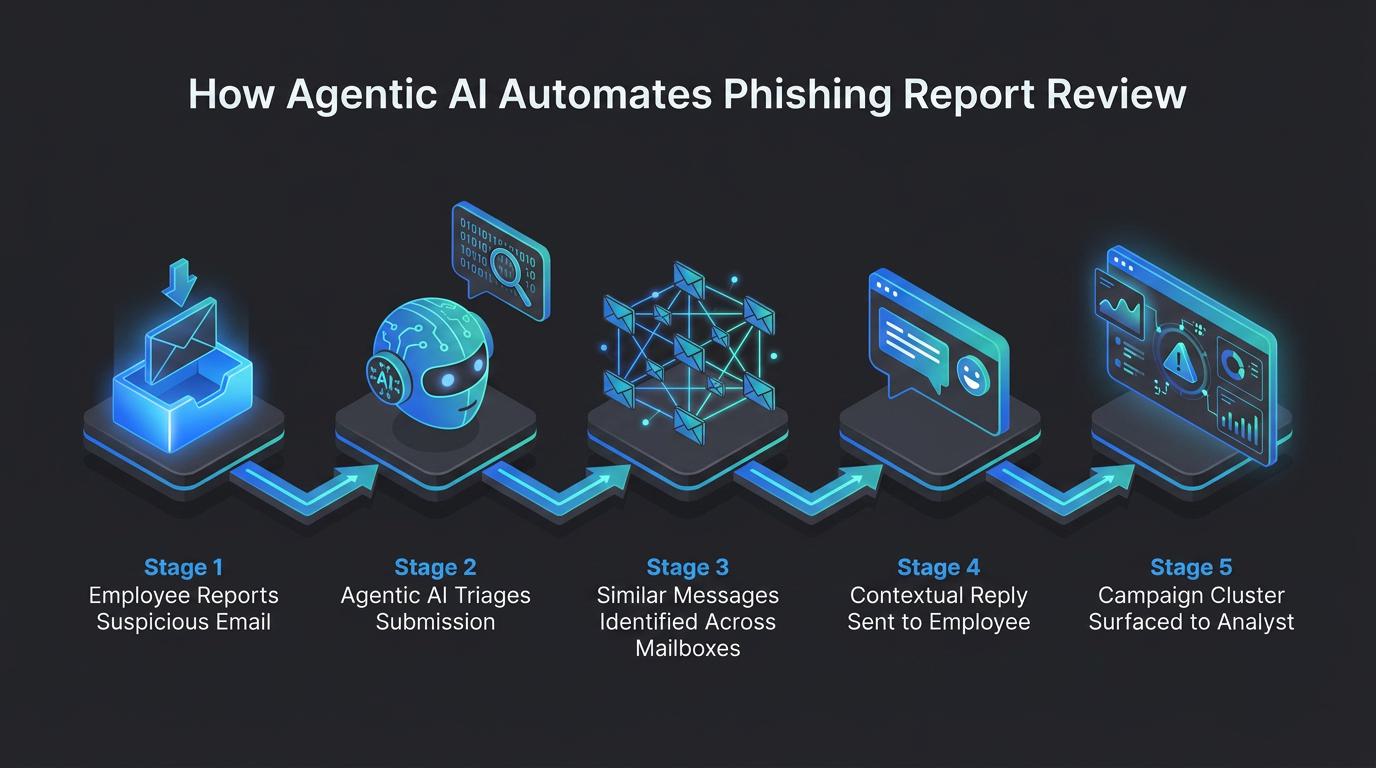
Natural language processing lets these systems consume and analyze message bodies, understanding context, sentiment, and intent rather than simply matching against known threat signatures. That context helps analysts understand why a reported message matters and which related messages require follow-up.
API-Based Integration Architecture
Modern SOC solutions increasingly use API-based architecture that changes the deployment model at its foundation. Legacy email gateway (SEG) deployments often require infrastructure deployment, mail exchange (MX) record changes, and lengthy configuration before delivering value. API-based integration avoids most of that overhead, connecting directly to the mailbox and cloud environment without disrupting mail flow.
API integration can also provide visibility that many gateway-only architectures miss. Rather than seeing only north-south traffic flowing through the gateway, the API approach can analyze internal-to-internal east-west traffic that may receive limited inspection in SEG-only deployments.
API architecture also speeds time to value through look-back capabilities. Rather than waiting for enough data to train models, organizations can use historical logging to help train models faster and evaluate detection coverage with less operational disruption.
The Current State: Why Traditional SOC Models Are Failing
Traditional SOC models are failing because they were designed for a different era of security operations, before AI-scale attack volume outpaced what manual triage can handle.
Alert Fatigue and Data Overload
Alert fatigue grows when telemetry arrives without better prioritization. Low-context alerts create more manual work for already overwhelmed analysts, and SOC teams face a widening gap between expected coverage and available resources.
The consumption-based pricing models of many SIEM platforms compound the problem: the more data organizations send, the more they pay. This creates a perverse incentive to limit visibility to control costs, directly undermining security objectives. Modern SOC automation helps address this gap by enriching and prioritizing events before analysts spend time on manual review. That shift matters because visibility alone does not improve outcomes when teams lack the capacity to interpret signals quickly and consistently.
Phishing Inbox Problem
Phishing report queues become a SOC risk when training programs punish mistakes instead of encouraging fast reporting. When testing programs become punitive, threatening termination for repeated failures, they can erode trust and distort reporting behavior. High-volume queues can overwhelm modern SOC capacity and create mountains of false positives that mask genuine threats. The UK NCSC warns that punitive phishing simulations "erode trust between employees and security."
Security teams still need to review and answer submissions promptly to maintain trust and response velocity. Analysts end up investigating legitimate emails instead of hunting for actual threats. Modern SOC automation can improve this workflow by grouping similar reports, adding message context, and helping analysts focus on submissions that indicate a broader campaign or a higher-risk user interaction.
Static Detection Limitations
Static detection creates gaps because rule-based systems depend on known indicators. As new threat vectors emerge, security teams must create or adjust detections, which demands specialized skills and significant time.
Novel attacks, social engineering, and BEC that lack traditional malicious indicators consistently slip past these defenses. According to the FBI's Internet Crime Complaint Center (IC3), BEC remains among the most financially devastating cyberthreats. These attacks succeed because they exploit human trust rather than technical vulnerabilities, often without any malware, link, or attachment for a filter to catch.
Common Misconceptions About Modern SOC Automation
Modern SOC automation gets misread in a few consistent ways, and clearing those up matters before evaluating any specific approach.
- Automation Replaces Analysts: Automation absorbs repetitive triage, enrichment, and phishing review, but analysts still own escalation decisions, ambiguous investigations, and risk communication to leadership.
- More Alerts Mean Better Coverage: A rising alert count often signals more noise, not more protection. The goal of automation is fewer, better-prioritized alerts, not a larger queue.
- Behavioral Detection Requires Months of Tuning: Machine learning models that build baselines from existing account and communication history can start producing usable signal well before a full tuning cycle would traditionally finish.
- Punitive Testing Improves Reporting: Security awareness programs that penalize mistakes tend to suppress reporting rather than encourage it, since employees who fear consequences are less likely to flag their own errors.
Clearing up these assumptions early makes it easier to evaluate any specific automation approach on its actual merits rather than on marketing shorthand.
Implementing Modern SOC Automation
Successful modern SOC automation starts with visibility, expands in phases, and keeps humans in the loop for critical decisions.
Starting with Risk Assessment
Modern SOC automation starts with understanding what's currently slipping through existing security controls. Modern API-based solutions support parallel testing without infrastructure changes, so organizations can evaluate multiple solutions simultaneously and see which performs best in their specific environment.
This approach provides immediate visibility into previously unknown risks while generating the quantifiable data needed to make the business case for transformation. When leadership can see documented evidence of threats slipping past the current tech stack, the conversation shifts from theoretical risk to concrete exposure. A practical assessment also helps teams identify which workflows create the most analyst drag, which alerts lack useful context, and which controls need additional behavioral detection coverage.
Phasing the Transformation
SOC modernization often begins with email security because email remains a critical attack surface for phishing intrusions. Organizations can layer AI solutions over existing infrastructure, enhancing current email gateway investments with behavioral detection for email-borne threats.
From this foundation, expansion into adjacent capabilities follows naturally: account takeover detection, natural language queries for security data, and automated investigation workflows. This phased model helps teams prove value in a high-volume workflow before extending automation into broader SOC processes. It also lowers implementation risk because teams can validate detection quality, reporting needs, and analyst handoffs in one workflow before applying automation to more complex operational areas.
Keeping Humans in the Loop
Modern SOC automation works best when human judgment remains central to critical decisions. The goal is to amplify analyst capabilities and redirect their expertise toward work that truly requires human intelligence.
Security leaders increasingly frame the goal this way: AI should redirect people onto more impactful work rather than justify cutting security roles. That framing matters because analysts still own strategic judgment, escalation decisions, and accountability for high-impact response actions.
Transparency in AI decision-making, coupled with human oversight for critical actions, keeps automation working for security outcomes rather than against them. Clear explanations also help analysts trust automated triage and give compliance teams better evidence for how decisions happen. This human-in-the-loop model supports faster operations without turning critical response decisions into opaque automated actions.
Building a Sustainable Path to Modern SOC Operations
Modern SOC automation succeeds when it pairs behavioral detection with operational discipline: reducing noise before analysts ever see it, keeping people accountable for judgment calls, and measuring progress in concrete terms rather than vague assurances. Security teams that start with a focused view of what's slipping past current controls, then expand automation in phases, build a SOC that scales with the threat landscape instead of drowning in it.