
Key Insights
For years, the email security market equated transparency with exposure. If detection logic was visible, with inspectable rules, tunable thresholds, and editable YAML, security teams were told they could trust the system.
That promise came with a quiet tradeoff.
Email Security Without the Configuration Tax explores a common failure mode in modern email security: when configuration becomes the primary mechanism for understanding detections, detection quality becomes coupled to ongoing maintenance. Logic must be continually revisited as users change, vendors evolve, and workflows grow more complex. Analysts are pulled upstream into detection engineering work not because it improves security outcomes, but because it’s required to preserve baseline performance.
When Configuration Becomes the Work
Email remains the primary entry point for some of the most damaging security incidents facing modern organizations. These attacks rarely rely on malware or known indicators. Instead, they exploit trusted relationships, legitimate workflows, and subtle deviations in human behavior that only become visible in context.
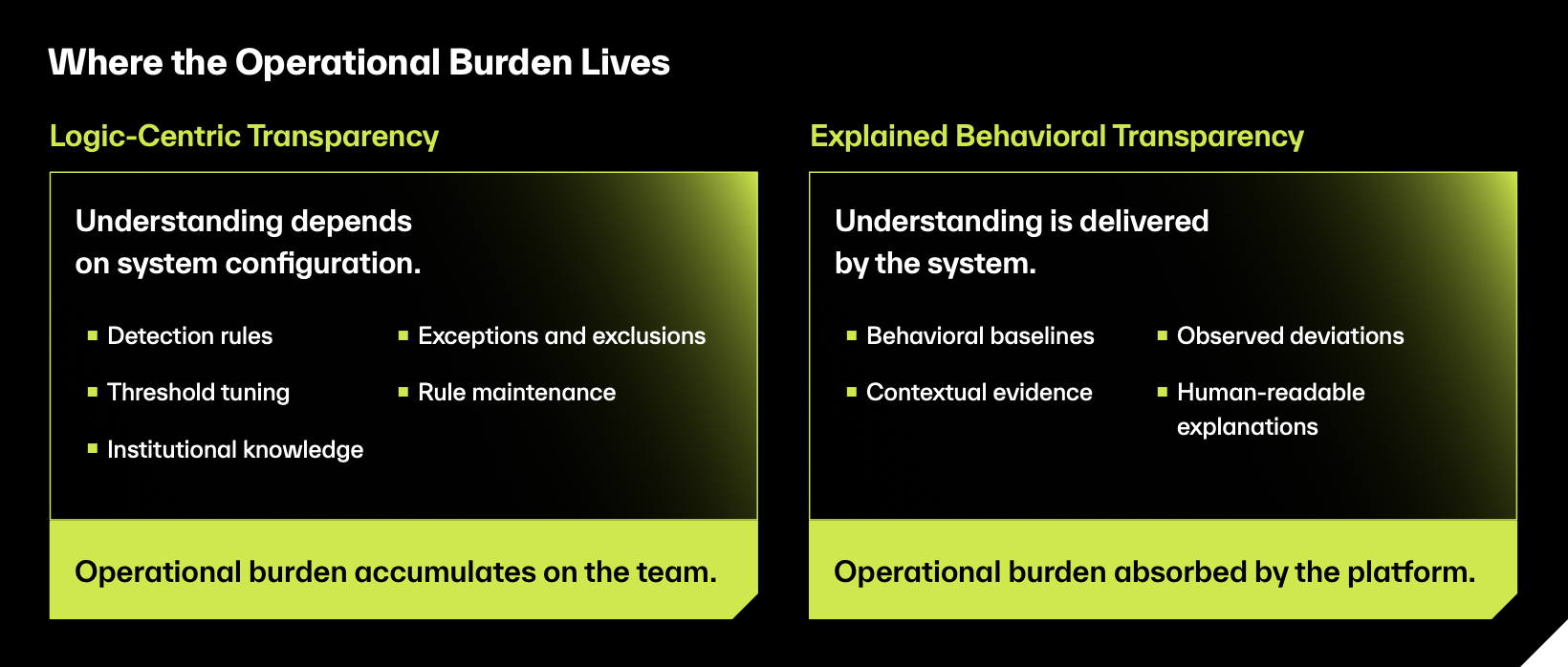
In response, many teams adopted platforms that define transparency as exposing detection logic. In practice, this model imposes an operational tax:
Continuous tuning to keep logic aligned with changing users, vendors, and workflows
Understanding concentrated in rule authors, creating fragile coverage and knowledge silos
Inconsistent decisions as outcomes depend on who understands the underlying logic
Slower investigations as analysts must interpret how logic fired before assessing risk
Configuration is necessary to express policy and response preferences. The breakdown occurs when analysts must inspect or modify detection logic in order to understand why an event is risky. In these systems, meaning lives inside conditional logic. Each change introduces the possibility of human error and coordination overhead, and none of it scales.
The Limits of Rule-Level Transparency
Email Security Without the Configuration Tax draws a clear distinction between two architectural paths modern email security platforms follow.
Logic-centric systems define transparency as exposing mechanics. Analysts can see what the system is checking, but must infer why it matters. As rule sets expand, transparency and complexity rise together. Understanding can become brittle, institutional, and increasingly disconnected from how real attacks unfold.
Behavior-native systems take a different approach. Instead of exposing code, they expose cause.
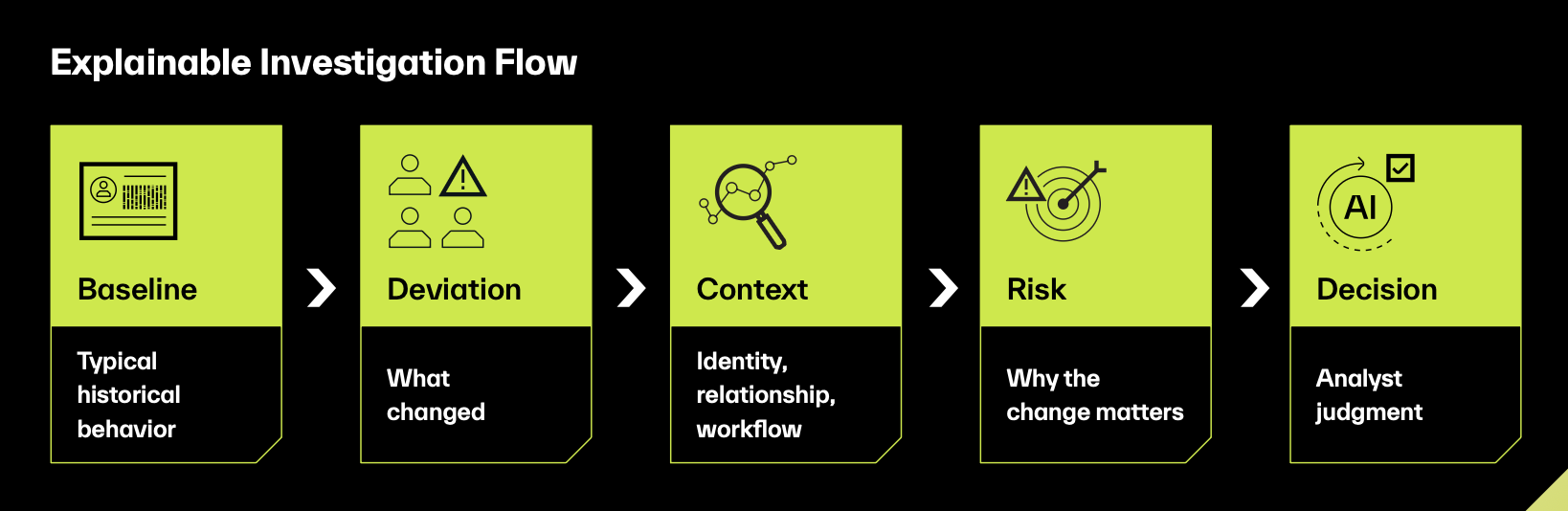
By modeling normal behavior across identities, relationships, and workflows, explainable behavioral systems assess risk based on meaningful deviation rather than predefined conditions. When a detection occurs, the system explains what behavior is typical, what changed, which contextual signals contributed to risk, and why that deviation matters in clear, human-readable terms.
This is not black-box detection. It is transparency without shifting the burden of understanding onto configuration.
Why Explainability Has Become a Requirement, Not a Feature
Expectations for AI-driven detection have changed. “Advanced” no longer means highly configurable. It means predictable, explainable, and operationally sustainable.
Boards, auditors, and regulators increasingly expect organizations to demonstrate not just that a decision was made, but why it was made and whether it was reasonable given the available evidence. Detections that cannot be clearly explained introduce organizational risk, regardless of how sophisticated the underlying logic may be.
At the same time, CISOs are prioritizing predictability over programmability. Systems that rely on handcrafted logic tend to behave inconsistently over time as incremental changes introduce unintended gaps. Explainable behavioral systems, by contrast, adapt automatically to organizational change while keeping reasoning consistent and accessible across analysts and leadership.
What Changes for Practitioners
The impact of this shift is felt most directly in daily investigative work.
Instead of opening an alert to determine which rule fired, analysts begin with behavioral context that explains why the event is risky. Investigations start at the level of intent rather than interpretation. Signal is clearer, prioritization improves, and effort shifts away from maintenance toward judgment and response.
Because explanations are grounded in observable behavior and shared context, investigations are easier to hand off. New team members can follow established reasoning without deep institutional knowledge, and decisions remain consistent across shifts and teams.
Transparency Without the Tax
For years, security teams were told that meaningful transparency required deep configurability. That tradeoff reflected the limits of earlier threat models. It no longer aligns with the reality of identity-driven attacks or the operational constraints teams face today.
The future of email security is not defined by how configurable a system is, but by how clearly it can explain risk, and how reliably that explanation holds as environments change.
Transparency no longer needs to come with a tax.
Download Email Security Without the Configuration Tax to explore:
The two transparency models shaping modern email security
Where operational burden actually lives and why it matters
Key questions security leaders can use to evaluate explainability claims