
Key Insights
For more than a decade, secure email gateways (SEGs) have served as a foundational layer in enterprise email security. Built for an era dominated by malware attachments and signature-based threats, they were designed to stop known-bad content at the perimeter.
That model no longer reflects how email works, or how attacks succeed.
In today’s cloud-native email environments, the most damaging attacks no longer rely on malicious payloads or obvious indicators. Instead, adversaries exploit identity, trust, and human behavior.
Messages arrive clean. Domains authenticate successfully. Content is often indistinguishable from legitimate business communication, personalized and perfected with AI.
As a result, many security teams are questioning the ongoing value of a standalone, third-party SEG, especially when Microsoft 365 and Google Workspace already provide strong native filtering for commodity threats.
The Essential Guide to Retiring the SEG is Abnormal’s most comprehensive examination to date of how baseline email security requirements have shifted in the cloud and AI era, why traditional gateway-based architectures struggle to keep pace, and what a modern alternative looks like in practice.
Get the ReportWhy Third-Party SEGs Are Losing Marginal Value
Modern email attacks share a common characteristic: they bypass the assumptions SEGs were built on.
Business email compromise (BEC), executive impersonation, vendor fraud, and credential phishing increasingly arrive as text-only messages sent from legitimate infrastructure. They pass SPF, DKIM, and DMARC. They reference real projects, real vendors, and real workflows. There is no payload to detonate and no signature to match.
In many cases, attackers go further, using compromised vendor mailboxes, OAuth abuse, or multi-step social engineering that unfolds across multiple messages and platforms. The email itself may contain nothing overtly malicious, serving only as the entry point for a larger manipulation.
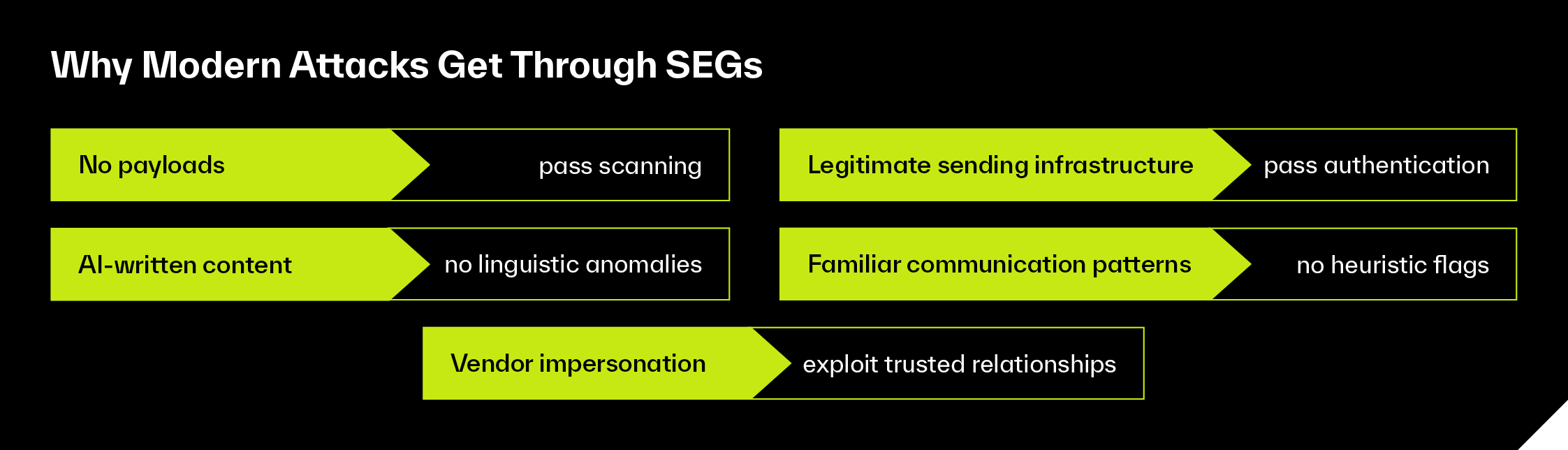
The Essential Guide to Retiring the SEG outlines why these attacks consistently evade gateway inspection, including:
No payloads to scan
Legitimate sending domains and accounts
AI-generated content with no linguistic anomalies
Familiar communication patterns that align with normal business behavior
As long as detection is anchored to static indicators and perimeter inspection, attackers retain the advantage.
When Cost and Coverage Drift Apart
Beyond detection gaps, many organizations are also re-evaluating the economics of maintaining a third-party SEG.
Native protections in Microsoft 365 and Google Workspace now handle spam, known malware, and basic phishing effectively. When those capabilities are paired with a modern, behavioral detection layer, much of the SEG’s functionality becomes redundant. What remains is the operational overhead.
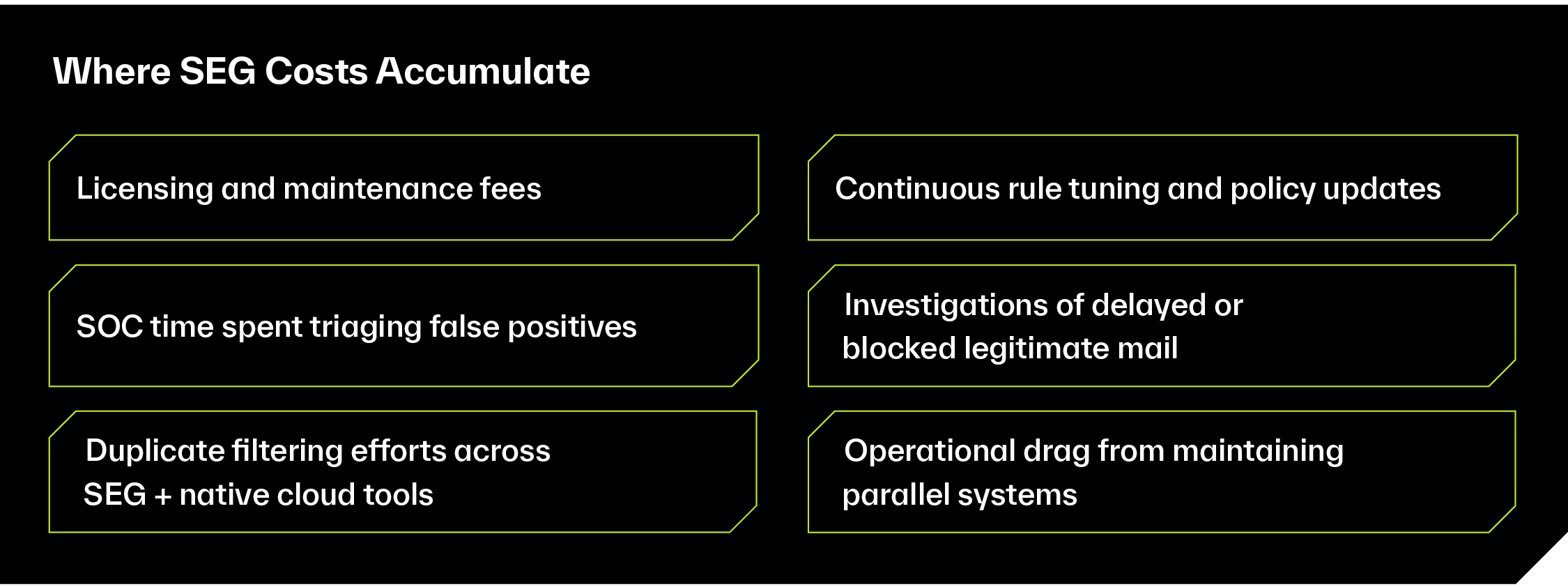
Gateways still demand constant tuning, policy management, allowlisting, and false-positive triage. SOC teams spend hours investigating delayed or quarantined messages, often for diminishing returns. At the same time, organizations continue paying licensing and maintenance costs for overlapping controls.
The Essential Guide to Retiring the SEG explores how SEG costs accumulate across licensing, analyst time, routing complexity, and delayed detection, and why many teams find the balance increasingly difficult to justify.
Extending the Native Gateway—Not Replacing It
Retiring a third-party SEG does not mean abandoning email security. Instead, it reflects a shift toward architectures that extend native cloud protections rather than duplicate them.
Modern email security platforms operate differently. They integrate via API, analyze identity and behavior over time, and continue detection after delivery rather than freezing risk decisions at the perimeter. They focus on understanding what is normal—across users, executives, and vendors—and flag subtle deviations that indicate manipulation or compromise.
The core cloud email security capabilities security teams now expect include:
Behavioral and identity-centric detection
API-based access to cloud and identity signals
Autonomous remediation to reduce SOC workload
Vendor and supply chain communication intelligence
Cloud-native deployment without mail-flow disruption
This approach aligns detection with how attacks actually work today, and how cloud environments are designed to operate.
A Practical Path to Retiring the Third-Party SEG
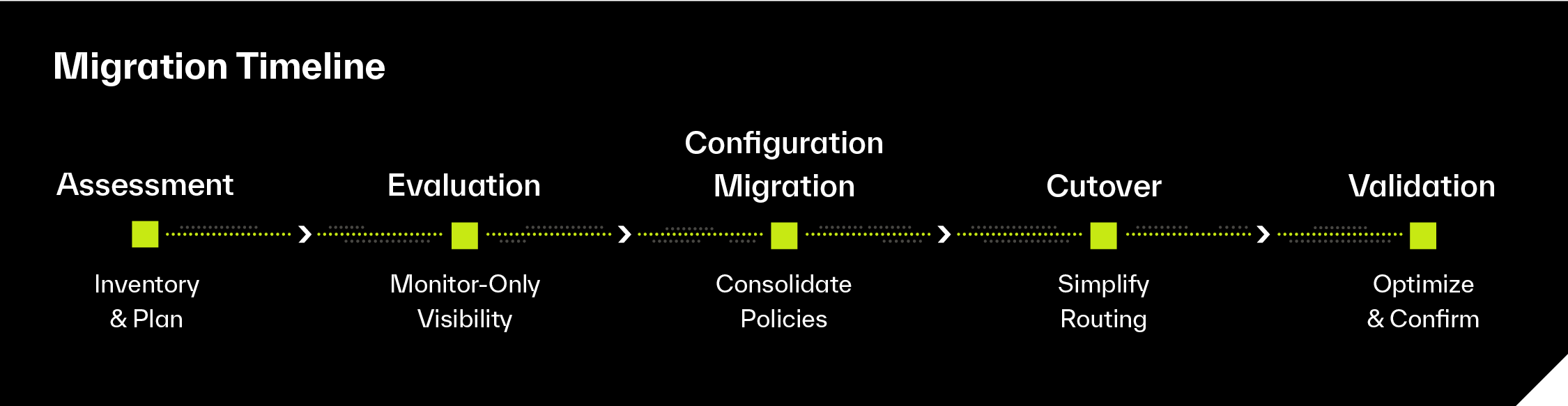
For teams concerned about disruption, the guide also provides a clear migration blueprint. By running modern platforms in parallel with existing gateways, validating coverage, consolidating policies, and simplifying routing in stages, organizations can retire third-party SEGs with minimal risk and often immediate operational relief.
Life beyond the SEG is not just simpler. It is better aligned to a threat landscape shaped by AI, identity abuse, and social engineering.
The Essential Guide to Retiring the SEG explores this transition in depth, combining architectural guidance, economic analysis, and real-world operational considerations.
Download the white paper to explore a layered email security architecture for cloud-first environments—and whether a third-party SEG still belongs in the stack.
Get the Report