Security teams face an impossible math problem. Organizations detect an average of 500 vulnerabilities daily, yet manual remediation capacity tops out at roughly 20 fixes per day. The result? A 49-day average gap between detection and remediation, nearly seven weeks of exposure for every identified vulnerability. Meanwhile, the SANS 2025 SOC Survey found that enterprises face upwards of 3,000 security alerts daily, with nearly half going completely uninvestigated.
AI-driven auto remediation promises to close this gap by allowing systems to detect, prioritize, and fix security issues without constant human intervention. But doing so without sacrificing control requires intelligent design: confidence thresholds, rollback capabilities, and human-in-the-loop escalation paths that keep security teams in command.
This article draws from insights shared at an Abnormal Innovate webinar. Watch the full recording to hear security leaders discuss building intelligent automation with appropriate guardrails.
Key Takeaways
AI-driven auto remediation bridges the gap between detection volume and remediation capacity
Successful implementation requires confidence thresholds and rollback capabilities
Start with automated recommendations before allowing full auto-remediation
Data quality and organizational understanding directly impact automation accuracy
AI scales security capabilities without replacing human judgment for critical decisions
What Is AI-Driven Auto Remediation?
AI-driven auto remediation refers to automated systems that detect, prioritize, and fix security vulnerabilities, misconfigurations, and threats without requiring manual intervention for each action. Unlike basic automation that follows rigid scripts, AI adds intelligent decision-making capabilities that adapt to context and learn from organizational patterns.
Traditional remediation workflows follow a predictable pattern: a security tool detects an issue, an analyst triages it, a ticket gets created, and eventually someone manually implements a fix. This process works when dealing with dozens of issues but collapses entirely at enterprise scale.
The distinction between AI-driven auto remediation and simple auto-orchestration lies in the intelligence layer. Basic automation executes predefined playbooks without understanding context. AI-driven systems analyze the specific environment, assess risk based on multiple factors, and determine appropriate responses dynamically.
This approach bridges the gap between what security teams can detect and what they can actually address, the same detection-versus-capacity math introduced above.
Why AI-Driven Auto Remediation Matters
The 49-day average from detection to fix creates massive exposure windows that attackers actively exploit. Every day a known vulnerability remains unpatched represents another opportunity for compromise. Reducing Mean Time to Remediation (MTTR) from weeks to minutes fundamentally changes an organization's risk profile. According to the IBM Cost of a Data Breach Report 2026, the average breach lifecycle now stands at 247 days globally, with organizations using extensive AI and automation containing breaches in 215 days on average compared to 280 days for those without, a 65-day difference that translates directly into reduced exposure and lower breach costs.
Resource constraints make traditional approaches unsustainable. The SANS 2025 SOC Survey found that two-thirds of SOC teams cannot keep pace with their daily alert volumes, and the Cybersecurity Insiders Pulse of the AI SOC Report 2025 found that 76% of respondents cite alert fatigue as their top challenge, with 73% citing analyst burnout.
As Lamont Orange, CISO at Sayera, explained in the webinar: "We don't have unlimited budgets. We don't have unlimited resources… some of them are repeatable. Why wouldn't we have the AI system do that? The AI system doesn't need to sleep. It can do those things and then can produce a result for us and then we can act on it."
The business impact extends beyond security metrics. The IBM Cost of a Data Breach Report 2026 found that organizations with extensive AI and automation deployment saved an average of $1.93 million per breach compared to organizations using none. Faster remediation reduces breach risk, minimizes operational disruption from security incidents, and allows security engineers to focus on strategic initiatives rather than repetitive patching tasks. Organizations that automate SOC operations gain capacity for threat hunting, architecture improvements, and proactive security investments.
AI-driven systems also deliver consistency that manual processes cannot match. Human analysts make different decisions based on fatigue, workload, and individual interpretation. Automated systems apply the same logic uniformly across the environment, eliminating variability in how similar issues get handled.
How Does Auto Remediation Work?
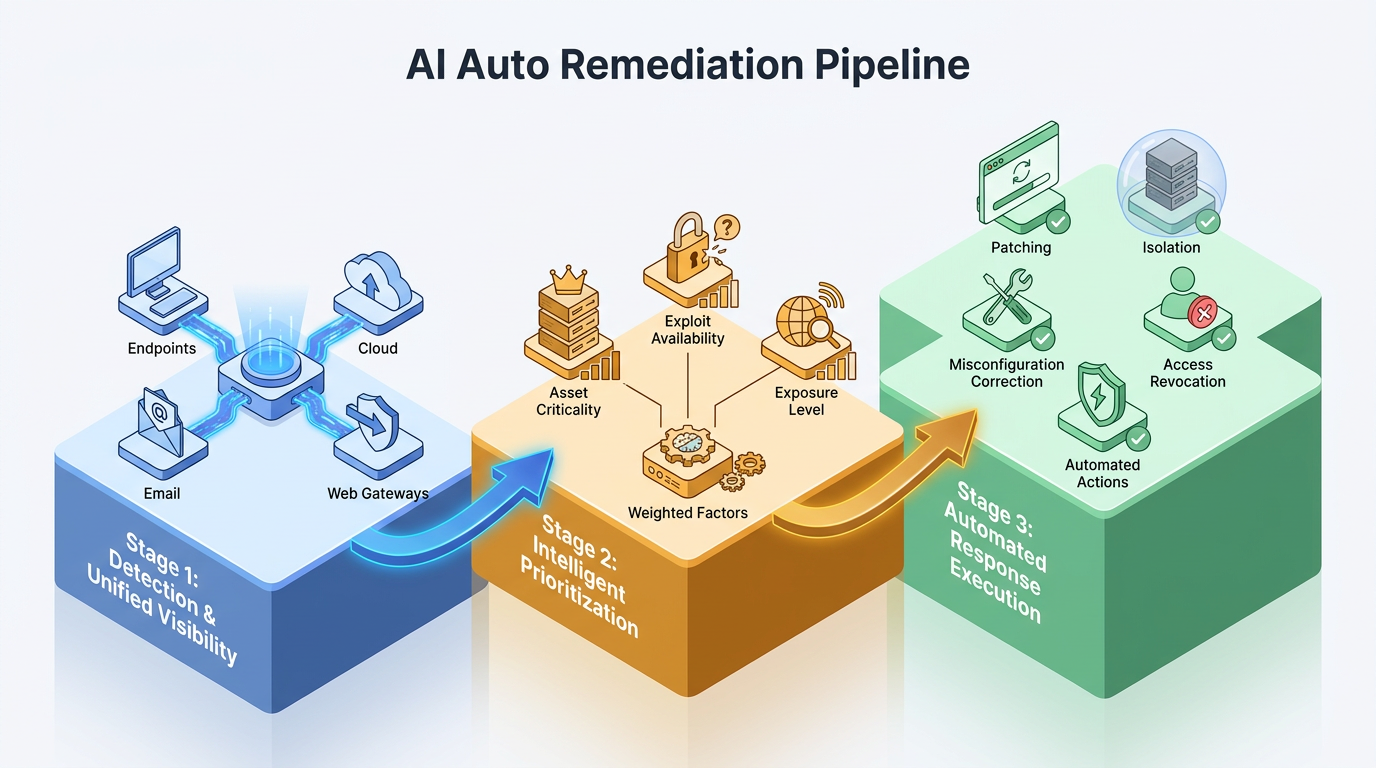
Auto remediation operates as a three-stage pipeline: the system continuously ingests signals across the environment, decides which issues warrant action and how urgently, then executes fixes within guardrails that determine when it acts alone and when it defers to a human. Each stage introduces its own design choices, and the strength of the overall system depends on how well they connect.
Detection and Prioritization
Effective auto remediation starts with unified visibility across the environment. AI systems analyze vulnerabilities, misconfigurations, and threats from multiple sources, including endpoints, web gateways, collaborative platforms, and cloud infrastructure. Rather than treating each data source independently, the system correlates information to build full context.
This correlation supports intelligent prioritization. Not every vulnerability requires immediate attention, and AI can assess factors like asset criticality, exposure level, exploit availability, and business impact to determine remediation urgency. A critical vulnerability on an internet-facing server demands faster response than the same vulnerability on an isolated development system.
Automated Response Execution
Once prioritized, AI systems execute appropriate remediation actions: patching vulnerabilities, isolating compromised assets, correcting misconfigurations, or revoking suspicious access. The key differentiator from traditional automation lies in context-aware decision making.
Modern AI systems don't just follow scripts. They evaluate whether proposed actions make sense given current conditions. If a remediation action might disrupt a critical business process, the system can adjust timing, seek approval, or implement a less disruptive alternative.
Abnormal's auto remediation capabilities demonstrate this approach in practice. The platform automatically removes malicious emails from recipient inboxes often before users interact with them, forces password resets for compromised accounts to prevent lateral phishing, and allows autonomous remediation based on customer-defined risk tolerance. Organizations maintain control by setting their own thresholds for when automation should act independently versus escalate for human review.
Confidence Thresholds and Safety Boundaries
The most sophisticated AI-driven auto remediation implementations include confidence scoring. When AI confidence exceeds defined thresholds, automation proceeds without human review. Below threshold, the system generates recommendations for analyst approval rather than acting independently.
This approach balances speed with safety, and it is increasingly recognized as a governance imperative, not just a technical option. The National Institute of Standards and Technology (NIST) AI Risk Management Framework (AI RMF) 1.0 notes that "human-AI configurations can span from fully autonomous to fully manual" and that some AI systems "may specifically require human oversight" depending on the risk level of the actions involved. NIST's GOVERN subcategory 3.2 calls for organizations to establish "policies and procedures…to define and differentiate roles and responsibilities for human-AI configurations and oversight of AI systems." Similarly, NIST SP 800-61 Revision 3, finalized in April 2025, specifies that organizational leadership "may have decision-making authority on high-impact response actions, such as shutting down or rebuilding critical services."
The threshold model allows organizations to tune automation aggressiveness based on their risk tolerance. High-confidence, routine remediations execute automatically. Complex situations with ambiguous risk factors escalate appropriately. A 2026 survey of security leaders found that 72% are comfortable with AI autonomy only for medium-severity alerts and below, underscoring why well-calibrated confidence thresholds are the foundation of any sustainable AI-driven auto remediation program.
Key Benefits of Auto Remediation
Reduced MTTR represents the most measurable benefit, shrinking remediation time from weeks to minutes for automated actions. But the advantages extend further.
Consistency improves dramatically. Automated systems apply identical remediation logic across thousands of assets, eliminating the variability inherent in manual processes. When a specific misconfiguration requires correction, automation handles every instance the same way.
The technology functions as a scaling mechanism for resource-constrained teams. The ISC2 2025 Cybersecurity Workforce Study found that 95% of respondents reported at least one cybersecurity skills need, with 59% calling deficiencies critical or significant, up from 44% in 2024. The ISACA State of Cybersecurity 2025 found that 55% of security teams are understaffed and 65% have unfilled positions. Against this backdrop, AI-driven auto remediation gives organizations capabilities they couldn't deliver manually due to staffing limitations, allowing security engineers to shift from repetitive remediation tasks to threat analysis, architecture improvements, and strategic initiatives.
Integration with SOAR (security orchestration, automation, and response) platforms extends automation value further. Auto remediation becomes one component of broader security orchestration, supporting complex multi-step responses that coordinate across tools and teams.
Auto Remediation vs. Traditional Security Approaches
Traditional security tools were designed for one-size-fits-all deployment. Out-of-the-box configurations assumed common environments and standard use cases. Every organization shares some characteristics, but every organization also has unique aspects that generic tooling handles poorly.
The two approaches diverge across three practical dimensions:
Dimension | Traditional Tools | AI-Driven Auto Remediation |
|---|---|---|
Organizational Nuance | Manual triage and scripted responses treat every environment the same; the knowledge of local exceptions lives with individual analysts and leaves when they do | LLM and ML models learn which assets support critical processes, which users have legitimate unusual access patterns, and which configurations exist for valid business reasons |
Adaptation Over Time | Rigid playbooks require manual updates as the environment changes | Systems continuously adapt to organization-specific patterns without manual re-tuning |
Cross-Platform Integration | Endpoint, network, and cloud tools typically operate in silos | Platforms correlate across data sources through API integration, building unified context for remediation decisions |
A remediation action that works perfectly in one environment might still cause problems in another, which is exactly the gap this comparison is meant to close. Organizations looking to displace their SEG with behavioral AI gain both improved detection and automated remediation in a single platform.
Challenges of Auto Remediation
The same speed that makes auto remediation valuable also raises the cost of getting it wrong, and two failure modes tend to surface first in production: actions that can't easily be undone, and actions taken on top of shaky detections or incomplete data. Each one points to a design decision that has to be settled before scope expands beyond a narrow initial use case.
The "Unscrew" Problem
Remediation mistakes happen. When they do, organizations need rollback capabilities. This "unscrew" capability, the ability to reverse automated actions, proves essential for production auto remediation. Without it, a single erroneous remediation could disrupt critical business functions without easy recovery options.
Building rollback requires understanding how assets function within the business. Auto remediation might correctly identify a misconfiguration but incorrectly classify a legitimate exception as a problem. Understanding business context prevents automation from "fixing" things that weren't actually broken. Security operations guidance consistently emphasizes that every autonomous action must have a documented, tested reversal path, and that untested rollbacks add risk rather than reduce it.
The Accuracy Problem
Every AI system produces some false positives. When that system merely generates alerts, false positives create analyst fatigue. When that system takes automatic action, false positives create automatic problems. Would your team trust an automated system to reverse an action it took on a false alarm as confidently as it took the action in the first place?
The scale of the challenge is significant: the SANS 2025 Detection and Response Survey found that 73% of security teams name false positives as their top detection challenge, with reports of "very frequent" false positives jumping from 13% to 20% year over year. When automated remediation acts on those false positives, the result is automated disruption, not automated protection.
Accuracy isn't only a model-tuning problem, though. Many false positives are downstream of the data the model is reasoning over: incomplete asset inventories, outdated configuration baselines, and inaccurate criticality classifications all push the system toward the wrong conclusion, and any automation acting on that conclusion inherits the same error. Organizations have to understand where those data gaps exist before trusting automation to make decisions on top of them.
The mitigation is the same in both cases. Exclude environments or asset types where detections or underlying data aren't yet reliable from auto-remediation while keeping automated detection turned on, and monitor remediation accuracy over time so the trusted scope can expand as confidence grows. Tools like AI Data Analyst can help security teams surface those data gaps before they become automated mistakes.
Best Practices for Implementing Auto Remediation
Sustainable auto remediation programs share a common shape: they roll out in stages, plug into the tools security teams already use, and measure themselves against outcomes rather than speed alone. The practices below cover each of those dimensions and give teams a way to expand automation scope without outrunning their ability to verify that it's working.
Roll Out in Phases, Not All at Once
Start with automated recommendations before allowing full auto remediation. Let the system suggest actions while humans approve them. This builds confidence in the system's judgment and reveals environmental quirks that might cause problems.
Apply different confidence thresholds for different remediation types. Low-risk actions like enabling logging or applying non-breaking patches can proceed automatically at lower confidence levels. High-impact actions like isolating assets or revoking access require higher thresholds. The ISACA Journal 2025 offers directly applicable guidance: "By starting with automating routine tasks and gradually progressing to more complex operations as the SOC matures, organizations can minimize risk while reaping the benefits of automation."
Integrate With Your Existing Security Orchestration
Auto remediation works best when integrated with existing workflows rather than operating as a standalone capability. SOAR platform integration allows coordination between automated remediation and broader incident response processes.
Open API integration points across security tools create the unified visibility needed for intelligent automation. Push vendors to provide reliable integration capabilities. Siloed tools that don't communicate limit how much of this automation is actually achievable.
Measure Success Beyond MTTR
MTTR improvement captures automation speed but misses accuracy and business impact. Track false remediation rates, escalation frequency, and rollback usage alongside time metrics. Monitor security posture improvement over time to validate that faster remediation actually reduces organizational risk.
Every tool represents an expense requiring resources for operation. Measure effectiveness rigorously to ensure automation investments deliver promised value.
As Dan Scheebler, Head of Machine Learning at Abnormal, advised in the webinar: "Set your goals high. Manage your expectations for what things are going to look like initially. Jump in. See what goes wrong, see what kinds of problems you see, and then work towards fixing it and adapting."
Turn Auto Remediation Into a Force Multiplier for Your SOC
AI-driven auto remediation only delivers on its promise when speed is paired with control: confidence thresholds, tested rollback, and a phased rollout that expands scope as accuracy is validated. Teams that get this balance right close the gap between detection volume and remediation capacity without introducing new risk; teams that don't end up with automated disruption instead of automated protection.
This is where Abnormal's behavioral AI approach fits. Rather than layering generic playbooks on top of existing tools, Abnormal learns each environment's identity, communication, and risk patterns, then acts on that context to remove malicious emails, force password resets on compromised accounts, and remediate threats based on customer-defined risk tolerance, without the manual tuning legacy tools require.
AI Security Mailbox extends that same model to one of the highest-volume drains on SOC time: user-reported phishing. It automatically analyzes reported messages, classifies them, remediates confirmed threats, and responds to the reporting employee, cutting time spent reviewing user-reported emails by up to 95% and freeing analysts to focus on genuine incidents rather than triage.
The next step is to see it against your own traffic. Book a demo to see how Abnormal's behavioral AI delivers intelligent detection and automated response without sacrificing the control your team needs.
Frequently Asked Questions
What Is The Difference Between AI-Driven Auto Remediation And Basic Security Automation?
Basic automation follows fixed scripts or playbooks that execute the same action regardless of context. AI-driven auto remediation analyzes the specific environment, assesses risk from multiple signals, and adjusts its response based on conditions like asset criticality and business impact, rather than applying one rule uniformly everywhere.
Is Full Auto Remediation Safe For A Security Team To Turn On Immediately?
Most organizations start with automated recommendations that require human approval, then expand to autonomous action only for low-risk, high-confidence scenarios. Confidence thresholds, tested rollback capabilities, and a phased rollout are what make broader automation safe to adopt over time rather than something to enable all at once.
What Happens When An Auto Remediation System Makes A Mistake?
A well-designed system includes a documented, tested rollback path, often called the "unscrew" capability, that lets teams reverse an automated action. Organizations that skip this step risk disrupting business functions with no easy way to recover, which is why rollback testing is treated as a prerequisite rather than an afterthought.
How Does Auto Remediation Handle False Positives?
Auto remediation systems apply confidence scoring so that only high-confidence detections trigger automatic action; lower-confidence cases route to analysts for review instead. Some environments or asset types can also be excluded from automated action entirely while still receiving automated detection, which limits the blast radius of any single false positive.