
NOTE: Demo visuals include blurred data or synthetic placeholders to protect customer privacy.
Competitive Intel was Fragmented
Before the Competitive Intelligence Agent, getting competitive intel was often a multi-step, ad hoc process. Sellers had competitive GPTs, but many Customer Success teammates lacked access, and Product Marketing (PMM) still routed requests through Competitive Intelligence. That created uneven turnaround times and increased the risk of conflicting answers when people pulled from different sources.
Three frictions showed up repeatedly:
- Slow responses and inconsistent turnaround for competitive questions, especially when requests stack up.
- Outdated or conflicting information because teams sourced answers from multiple places.
- Reduced ability to respond quickly in customer moments that matter, like QBRs, health checks, and accounts under reevaluation.
A Self-Serve CI agent
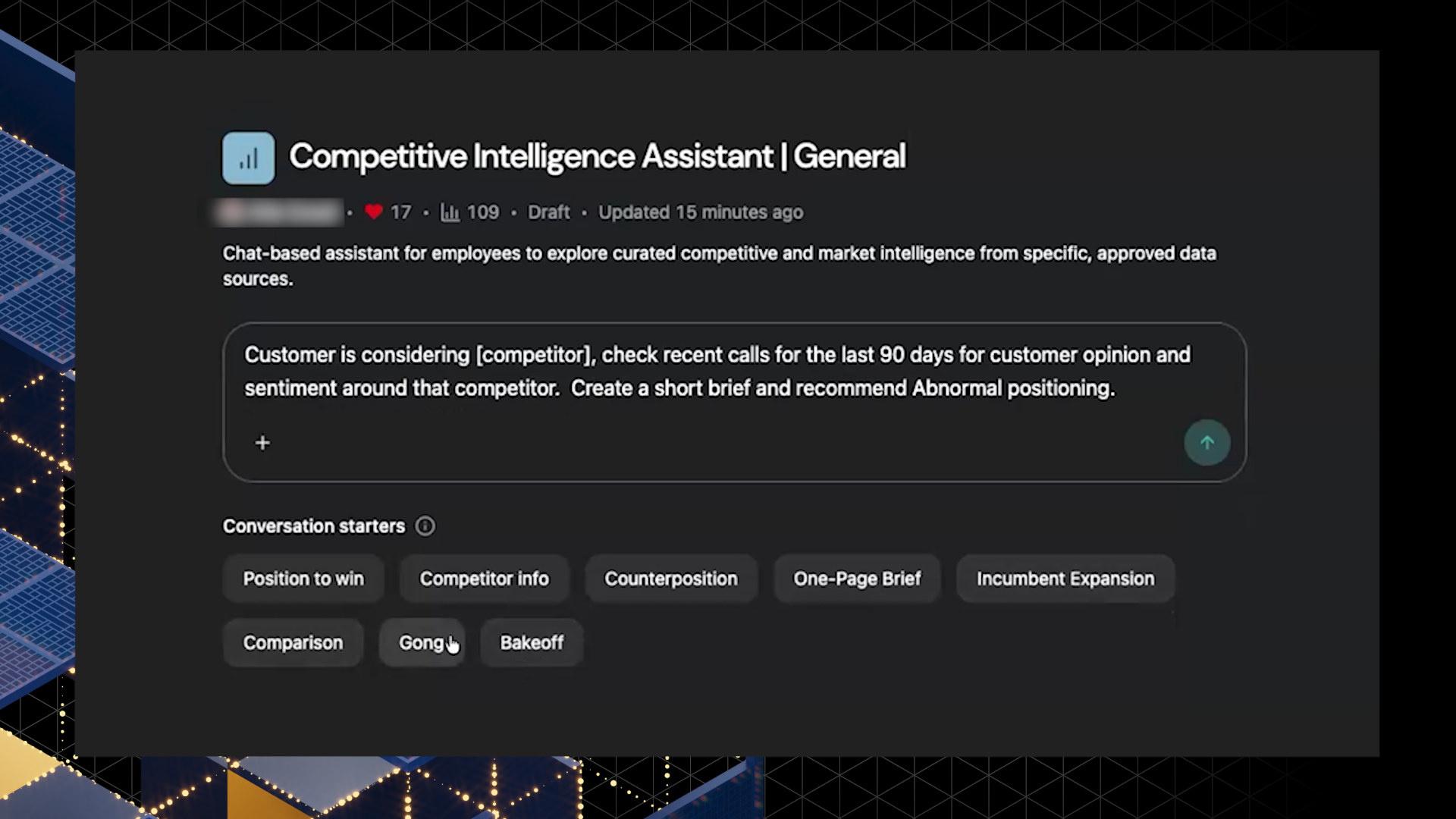
CIA is an AI solution within Glean that provides teams with a single place to ask competitive questions and receive consistent, curated answers. Toby designed it to be easy to find and easy to favorite, and focused on the questions Customer Success needs to answer quickly.
Key capabilities include:
- Conversation starters tailored to common Customer Success questions, such as comparisons, one-page briefs, and “position to win” guidance.
- A curated competitive intel location that acts as a single source of truth, rather than relying on scattered inputs.
- Support for larger documents, including competitor materials that can run hundreds or thousands of pages.
- Optional account-aware context by pulling signals from Gong and Salesforce for users who have access.
- Coverage beyond CS, so PMM and other teams can self-serve when they need competitor-specific details.
As Toby put it: “We wanted to make sure that they had something that they [could]… that was self-serving for them.”
Faster Customer-Facing Responses
CIA’s impact is straightforward: fewer internal handoffs and faster, more consistent customer conversations. Instead of waiting for a Competitive Intelligence response or stitching together sources, teams can start with a grounded answer and move to the next customer action.
Early signals from rollout:
- Adoption grew from 5 to 6 initial users to almost 100 users, with continued growth as the agent gets promoted in competitive sessions.
- Customer Success gains faster access to comparisons and succinct briefs to support live conversations.
- PMM and other internal partners reduce inbound requests by retrieving competitive details directly.
In the next phases, Toby aims to use top-user feedback to prioritize the highest-value conversation starters and identify the most-referenced competitors and artifacts to keep the curated intel set current.
Following Up with Power Users
A peer reaction highlighted what matters next: understanding who is leaning in and how they are using CIA in real workflows. The request was practical, not performative, and it points toward an impact loop grounded in usage data.
That follow-up also reinforces a healthy pattern for Abnormal: ship a tool, watch who adopts it, then learn from the teams closest to customer conversations. The next signal to look for is repeat usage in QBR prep and competitive bake-off scenarios, where consistent answers reduce customer risk and internal churn.
