
Signals Without Structure
Across product, engineering, and customer success, the signals are all there. Customer feedback exists in Jira tickets, RFEs, escalation reports, Gainsight CTAs, and Salesforce metadata. But those signals are fragmented, making it difficult to answer key questions:
- What are customers consistently struggling with?
- Which issues matter most from a business perspective?
- Where should we prioritize engineering effort?
As Hala observed, this leads to reactive workflows. QBR planning happens after issues escalate, escalation reviews require manual parsing, prioritization lacks a unified, data-driven view. But, they also saw an opportunity to fix that.
A Unified Portal for Customer Signals
The solution is a centralized planning tool that brings all of these inputs together. The system aggregates data from Jira, Salesforce, Databricks, Gainsight, (and optionally Glean as a fallback source).
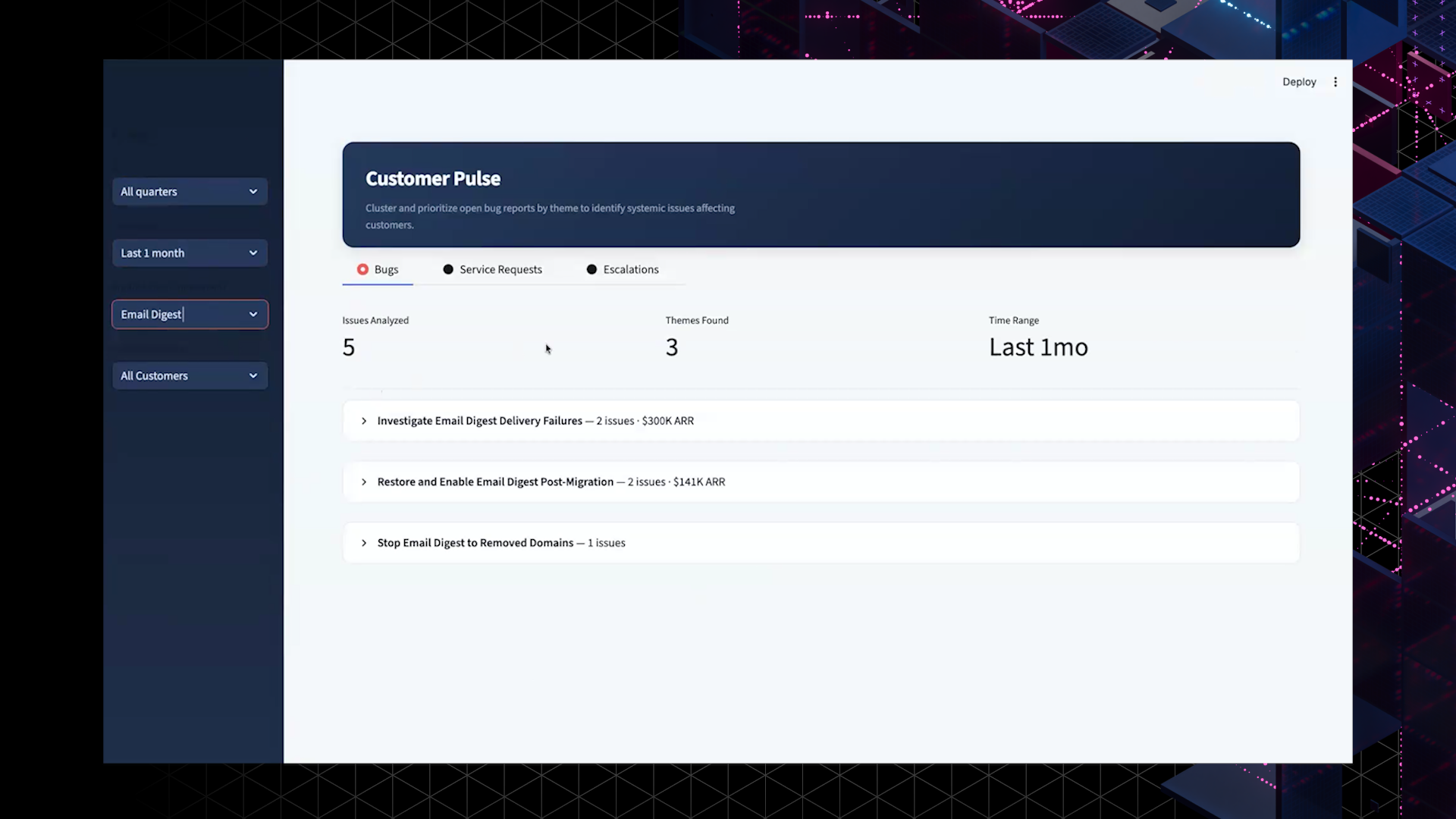
It then processes this data using an LLM-based clustering to group issues into themes and algorithmic enrichment to attach customer metadata like ARR and health score. The result is a single portal where teams can explore bugs, RFEs, and escalations, all organized into meaningful, actionable themes.
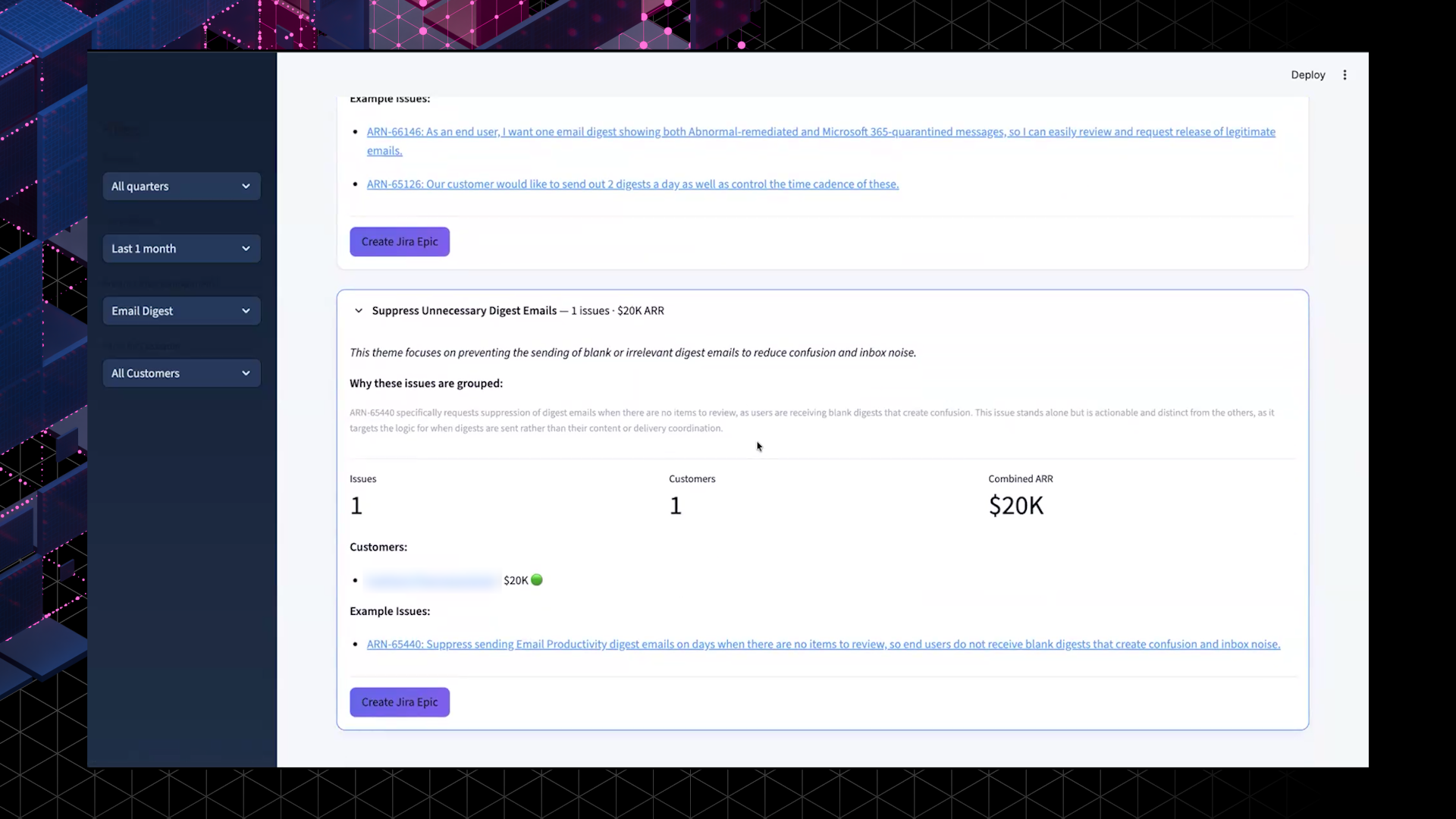
The key innovation isn’t just aggregation; it’s contextualization. Each theme is enriched with a total impacted ARR, customer health indicators, associated accounts, and underlying issues or tickets.
For example, a theme like, “Email digest sends even when no content exists” can be viewed not just as a bug, but as:
- how many customers are affected
- how important those customers are
- and whether this issue should be prioritized in upcoming planning
This shifts decision-making from anecdotal to impact-driven.
Exploring the System in Practice
The portal allows users to filter and explore data dynamically, by time (month, quarter), product area, and customer. Within each product area, users can view top themes, see associated issues and tickets, drill into specific examples, and understand the broader impact.
Importantly, the system enables action. From any theme, teams can create Jira tickets, attach relevant context, and move directly into execution.
This project fundamentally changes how teams interact with customer feedback. Instead of reacting to escalations, manually parsing tickets, and prioritizing based on partial information, teams can now identify patterns early, understand impact at a glance, and plan proactively.
It also makes the process scalable. By leveraging AI and existing data sources, the system avoids the need for new infrastructure while still delivering a significantly improved planning workflow.
What’s Next
The current system is already delivering value, but there’s clear room to expand. Next steps include adding more data sources for richer context, refining clustering and prioritization logic, expanding filtering and visualization capabilities, and deeper integration into QBR and planning workflows.
The long-term vision is clear: a continuous, AI-powered feedback loop where customer signals are automatically transformed into prioritized product decisions, before issues ever escalate.
