
NOTE: Demo visuals include blurred data or synthetic placeholders to protect customer privacy.
Content Loop, Governed
As Abnormal pushed toward direct-to-customer experiences, Andy noticed a bottleneck: customers often ask solid product questions, but the best answers live in internal systems. Teams had documentation across Confluence, Google Drive, Slack threads, and Jira tickets, as well as call context in Gong. Customers could not access any of it, for good reason.
That created a familiar pattern. Questions that a customer should be able to resolve in minutes ended up as support tickets, rep follow-ups, or sales engineer callbacks. Even when an internal AI workflow could answer questions accurately by grounding in the codebase, Abnormal could not simply expose it externally without risking sensitive leakage.
Three frictions showed up repeatedly:
- Customer-facing docs were sparse compared to internal documentation, limiting self-serve success.
- The most useful sources were also the most sensitive, so “just give customers access” was not an option.
- Step-by-step support articles were hard to generate reliably because they require product nuance, screenshots, and careful walkthroughs.
How Code to Content Works
Code to Content is a workflow that turns real customer questions into governed, customer-ready FAQs. Instead of trying to auto-generate long integration guides, it focuses on a format that AI can draft well, and humans can review quickly: question-and-answer content organized by product and sub-feature.
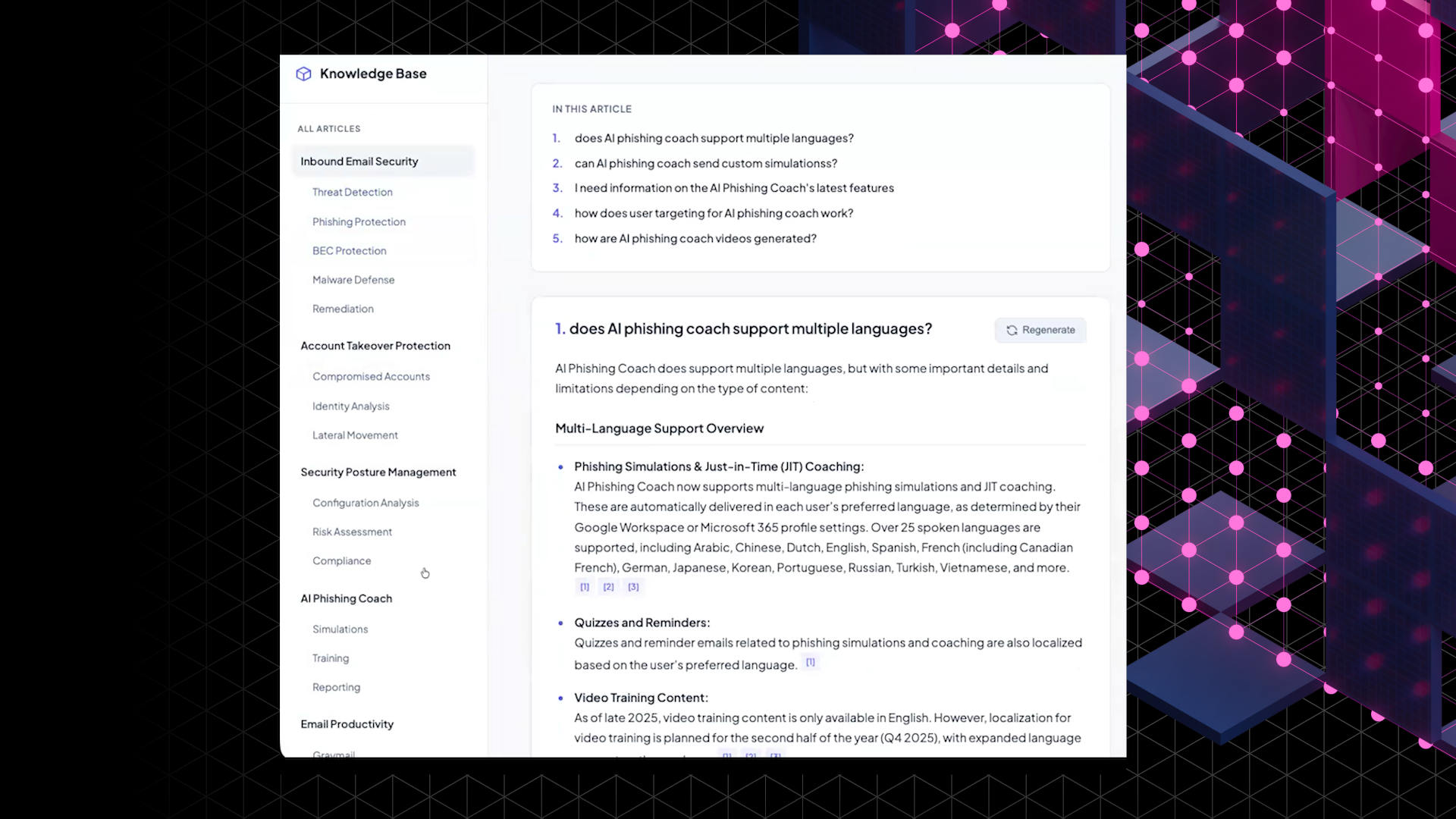
Core capabilities include:
- Collecting unanswered questions from a public-facing bot experience
- Classifying whether a question is valid for an FAQ entry
- Generating an FAQ draft automatically from approved inputs
- Routing drafts through human review so publication stays controlled
- Publishing approved FAQs so future answers can cite stable, customer-safe content
Andy framed the operating model simply: “Any time that a question gets unanswered from the customer side, like, we’re generating one of these articles, and all a human has to do is hit approve.”
The governance win is structural. Instead of exposing Slack, Jira, or internal docs, the system produces a sanitized knowledge layer that customers can consume, and bots can cite, with humans accountable for what ships.
What Changed for Teams
Code to Content improves customer speed and consistency while reducing repeat work for internal teams. It creates a durable content flywheel: every unanswered question becomes an opportunity to add a vetted answer back into the system.
Expected value lands in different places:
- Customers: faster, clearer self-serve answers without waiting on tickets or reps.
- Sales and SEs: fewer follow-up loops and less time re-answering the same product questions.
- Support and product: a steady stream of real-world question signals, organized into publishable knowledge.
The next step is to connect this “last mile FAQ” loop with proactive content generation efforts, so Abnormal can pre-seed coverage and unify outputs into a shared knowledge repository that feeds feature pages, take-home materials, and FAQs.
Unifying the Last Mile
Peers highlighted how Andy’s FAQ work complements parallel efforts on proactive feature descriptions, and the direction is clear: unify both into a general knowledge repository that multiple customer-facing surfaces can draw from. That shared layer would make content creation more consistent across teams and centralize governance rules.
It also sets a cultural precedent. Build once, publish safely, and let every real customer question improve the system for the next customer. That is how Abnormal can scale high-quality answers without scaling headcount or risking internal data exposure.
