
NOTE: Demo visuals use either blurred real data or synthetic placeholders to protect customer privacy.
Insights Trapped in Unstructured Data
At Abnormal, we believe AI should make complex decisions faster and easier. That’s the philosophy behind Nora Deep Research, a cross-functional AI tool led by Shrivu Shankar and Tushar Amrit that helps everyone from GTM to engineering uncover insights buried across unstructured data sources.
Nora Deep Research V3 is smarter, faster, and far more powerful, connecting customer conversations, product feedback, and code-level detail into a single, unified research workflow.
Every team at Abnormal depends on information that lives in different systems:
- GTM teams use Gong, Salesforce, and Jira to understand customer feedback.
- Engineers rely on PagerDuty, Confluence, and CloudWatch to analyze issues and performance.
While these tools are rich in data, the insights inside them are often disconnected. Previously, Nora Deep Research required manual effort to correlate information between these sources. Its early versions had clear limitations:
- Poor grounding: It occasionally hallucinated data or misattributed quotes.
- Limited scope: Searches were restricted to Gong, with no integration across systems.
- Slow response times: Even basic research queries could take hours to return results.
- Formatting challenges: Reports were lengthy and inconsistent, making them hard to use.
V3 solves all of that and then some.
Unified Deep Research Across Every Data Source
Nora Deep Research V3 transforms how teams ask questions and find answers across Abnormal’s data ecosystem.
Built with an updated agentic architecture and enhanced with modern AI frameworks, it enables users to ask deep research questions that span data from:
- Gong (customer calls and insights)
- Salesforce (account and opportunity data)
- Jira (product requests and support issues)
- Slack (internal context and collaboration)
- Engineering tools (PagerDuty, Confluence, and CloudWatch)
The tool then:
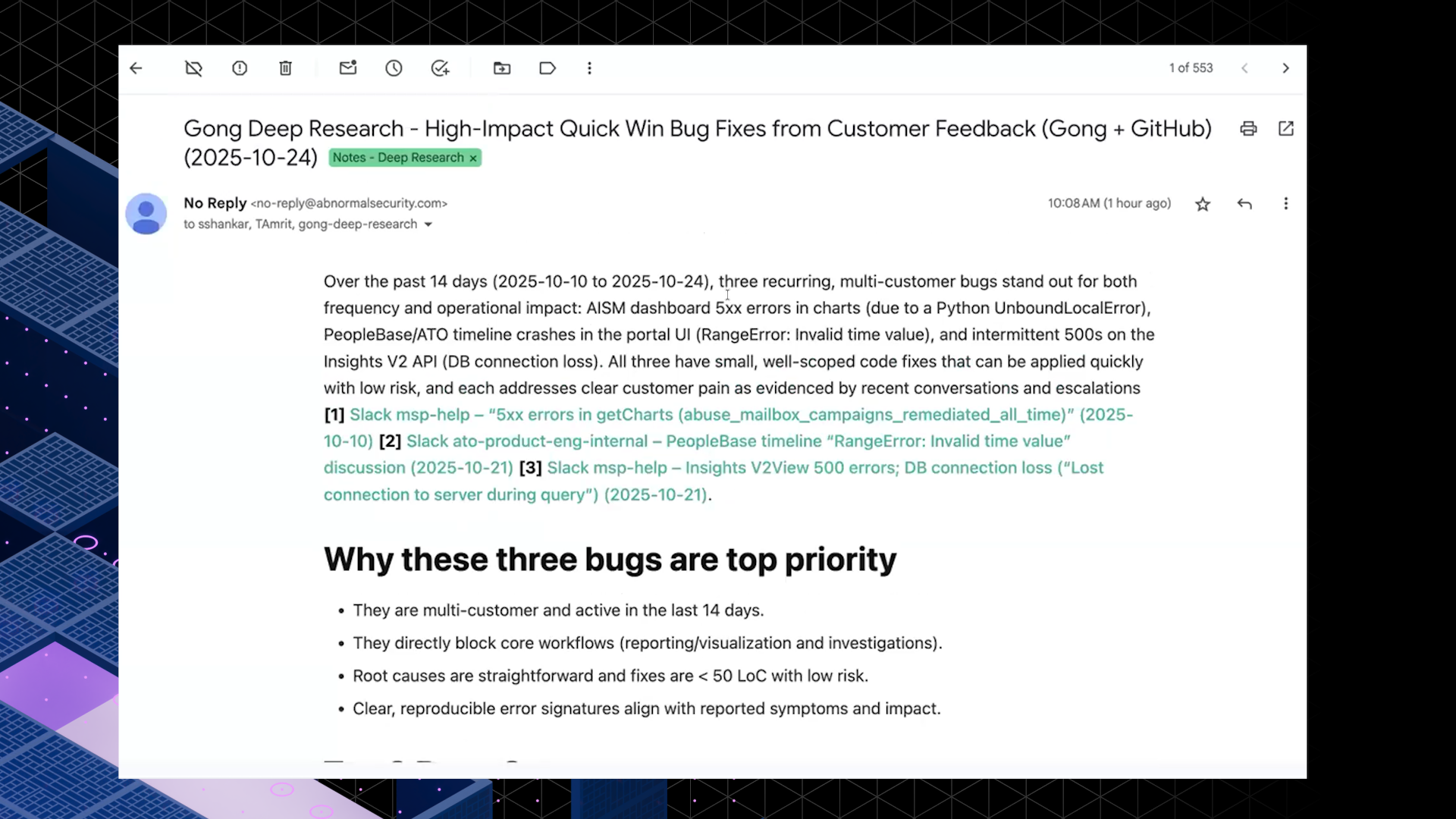
- Gathers all relevant data based on the user’s question.
- Synthesizes that information into structured insights.
- Links related artifacts: customer requests, product documentation, and even lines of code.
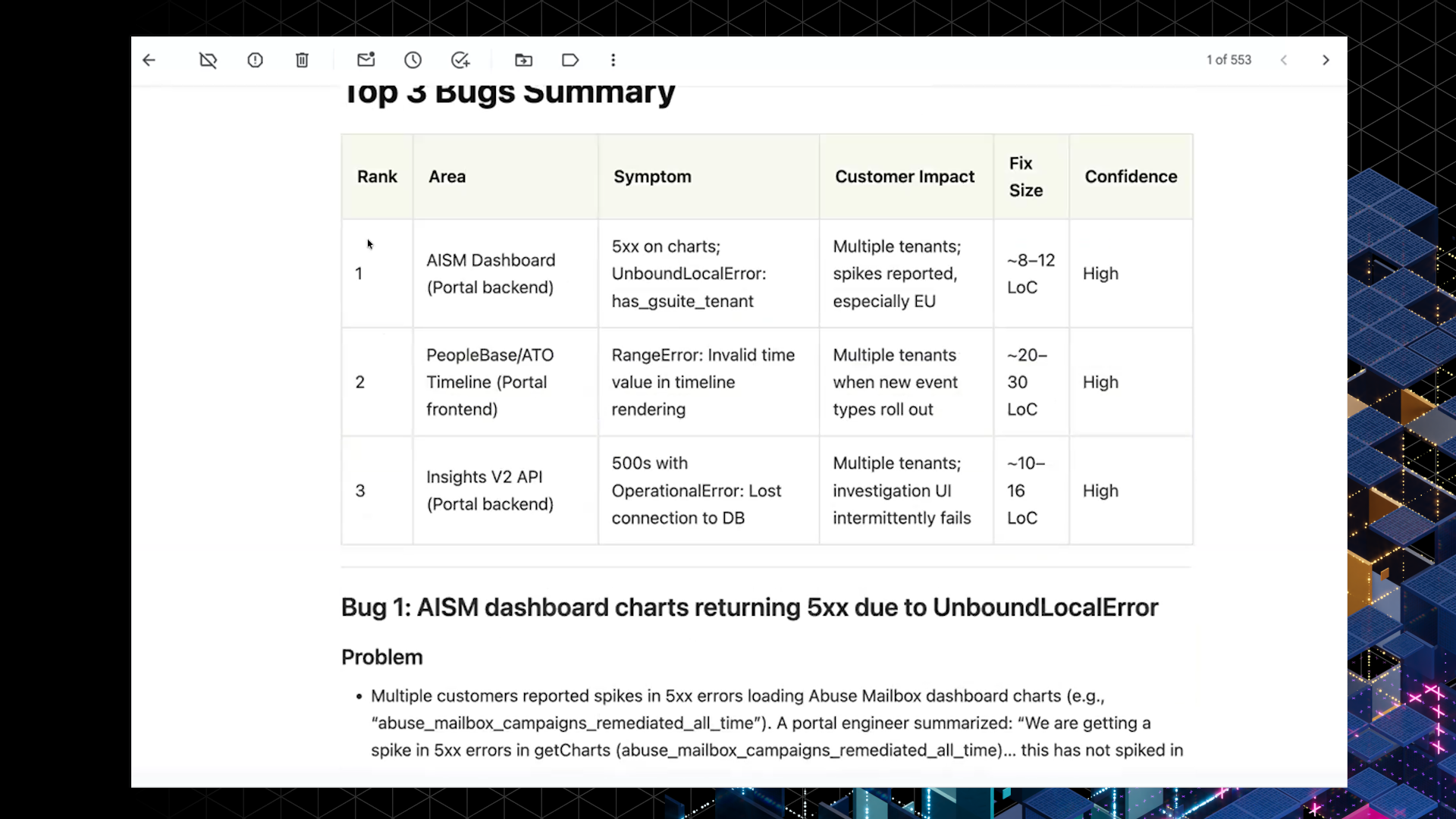
The result is a fully contextualized, evidence-backed report that surfaces what matters most without the manual digging.
From Customer Frustration to Code Fix
What makes Nora Deep Research V3 groundbreaking is how it connects feedback to action.
- Product impact sizing: Product managers can instantly aggregate and size customer pain points across all data sources, helping them quantify the impact of proposed features.
- Strategy development: By combining customer feedback and product requirements, teams can generate draft PRDs and product direction summaries grounded in real data.
- Code-level traceability: Engineers can now correlate customer frustration directly to pull requests (PRs). For instance, if customers consistently flag a bug, the system can identify the related code area and even suggest a small fix, sometimes within 50 lines of code.
In one recent test, Shrivu ran a 14-day analysis across Slack, Jira, and Gong. Nora automatically identified three customer issues that were:
- Common across multiple accounts
- Clearly defined in scope
- Easy to fix.
The output included:
- The root cause of each issue
- Suggested code changes with before-and-after diffs
- Linked Slack messages and call transcripts showing where customers raised the problem
It even highlighted where those fixes could live in the repo, essentially bridging the gap between customer sentiment and engineering action.
A Faster Path From Insight to Execution
The improvements in Nora Deep Research V3 have already made it one of Abnormal’s most widely adopted internal tools.
- 110+ active users across GTM, Product, and Engineering (up from earlier versions).
- No longer limited to Gong, the tool now works across multiple systems.
- Reduced hallucinations through better grounding and correlation logic.
- Faster response times, better formatting, and cleaner summaries.
The result is a single platform that anyone, from a PM to a developer, can use to ask complex research questions and get actionable, cross-functional answers.
From Data Discovery to Full Automation
The future of Nora Deep Research lies in closing the loop between insight and execution. Upcoming iterations will explore:
- Automatically generating PRs for simple fixes based on identified customer issues.
- Building impact dashboards to visualize pain points and track resolution over time.
- Expanding integrations to additional systems (ex. GitHub Issues).
- Enabling bi-directional analysis, where engineers can trace code changes back to specific customer feedback.
“We’re bridging all the way from unstructured feedback to real code change. The goal is to make that line between insight and action as short and as intelligent as possible.”
What Makes Nora Deep Research Awesome
What sets Nora Deep Research V3 apart is its ambition. Shrivu and Tushar didn’t just fix bugs, they reimagined what research means in a modern AI organization. By connecting data, product strategy, and engineering execution, this version turns AI from a search tool into a decision engine, one that accelerates how Abnormal learns, builds, and improves.
It’s a perfect example of Abnormal’s culture in action: empowering teams to use AI not just to gather information, but to turn it into impact.
