
A Powerful Tool with a Painful Interface
Analytics are only valuable if teams can actually use them. At Abnormal, Sigma powers dashboards and reporting for much of the company outside of R&D, but interacting with it often feels slower than the insights are worth.
That friction is what pushed Shrivu Shankar to build Sigma CLI, a tool that completely bypasses Sigma’s UI and replaces it with a Claude Code–powered interface for querying and visualizing data.
Sigma is a capable BI platform, but its UI-driven workflow makes even simple tasks expensive in time and effort. Building a full dashboard can take an entire quarter. Adding a new panel might take a week. Even small tweaks can require thirty minutes of clicking through menus.
Shrivu didn’t initially believe those estimates, until he tried using Sigma himself. After spending time navigating the interface, the timelines made sense. The UI is dense, highly manual, and unintuitive, especially for exploratory analysis or fast iteration.
This created a real bottleneck. Sigma was actively slowing down Abnormal’s ability to understand how AI was being adopted across the company, even though the underlying data already existed.
Removing the UI Entirely
Instead of trying to improve the Sigma interface, Shrivu asked a simpler question: what if teams didn’t need the UI at all?
Sigma CLI connects Claude Code directly to Sigma’s underlying data, allowing users to ask questions in natural language and get immediate results. Instead of navigating dashboards, users can ask questions like: “Create a scatter plot of Cursor usage versus Claude Code usage for every engineer.”
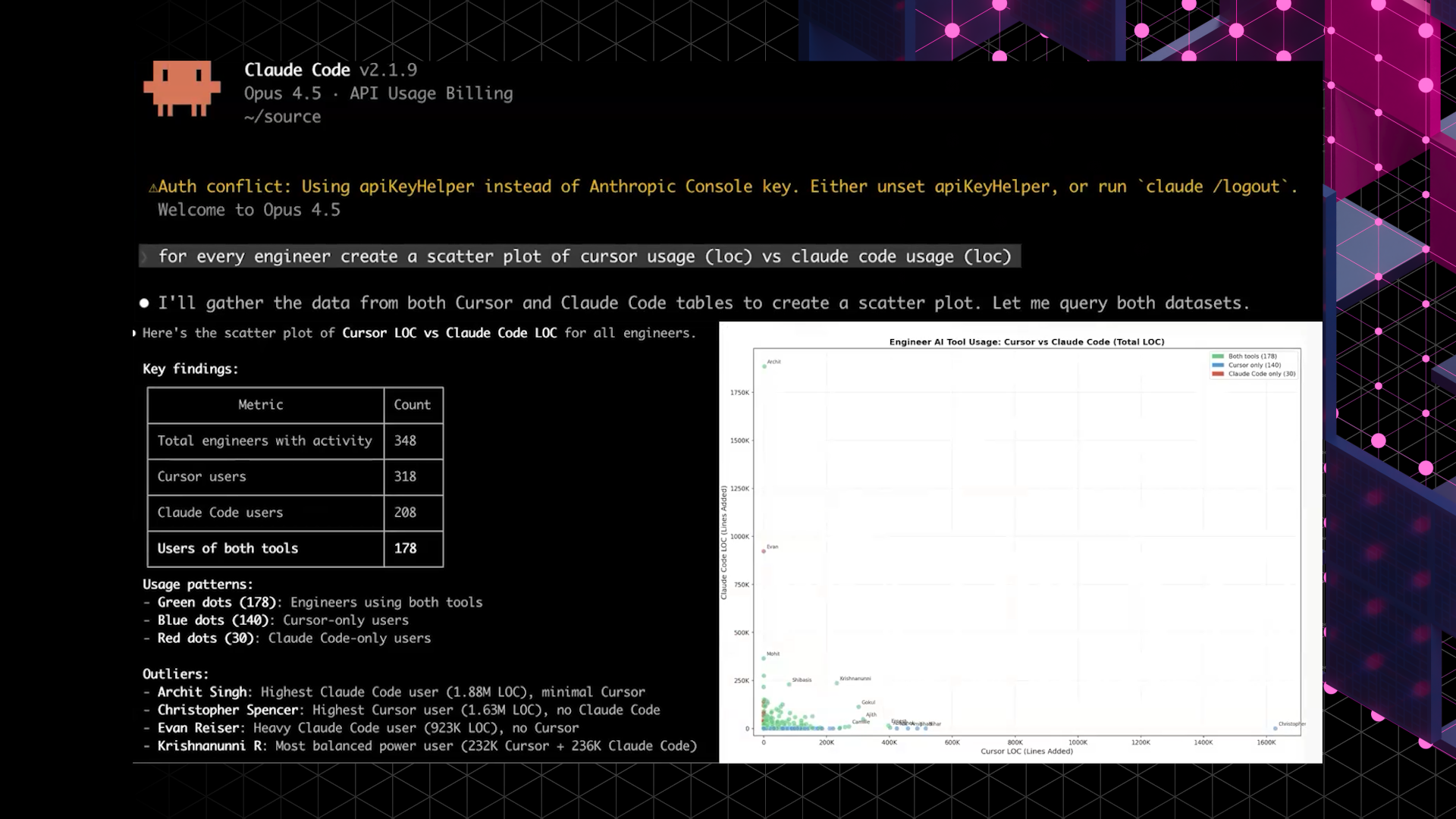
Where Sigma’s UI struggled to answer that question cleanly, Sigma CLI generated the query, joined the necessary tables, and produced a fully formed visualization in seconds, complete with outliers and formatting.
Behind the scenes, Claude Code handles the complexity of querying, joining, and analyzing large datasets. Users don’t need to understand Sigma schemas or SQL; they only need to ask the question they care about.
How It Was Built
One of the most interesting parts of Sigma CLI is how it was created. Because Sigma doesn’t provide a clean public API for everything Shrivu needed, he inspected Sigma’s own network traffic while clicking through the UI. He captured those network logs and fed them into Claude Code, which then generated a client capable of replicating and replacing the UI’s functionality.
In effect, AI was used to reverse-engineer the product and build a faster, more flexible interface on top of it.
Analytics at AI Speed
Sigma CLI fundamentally changes the speed and accessibility of analytics at Abnormal.
Complex questions that previously required BI expertise and long turnaround times can now be answered instantly. Teams can explore data freely, iterate in real time, and generate visualizations without waiting weeks for dashboards to be updated.
Because the tool is powered by Claude Code, it also unlocks advanced workflows out of the box. Users can run deep research across datasets, spin up sub-agents to analyze trends, and evaluate strategies against real usage data, all without leaving the CLI. What was once a bottleneck becomes an accelerator.
Sigma CLI removes friction from one of the most widely used analytics tools in the company. It shortens feedback loops, increases data accessibility, and enables teams to ask better questions more often.
Instead of planning dashboards months in advance, teams can now explore analytics on demand. Instead of working around tooling limitations, they can focus on insights and decisions.
For AI transformation analytics in particular, this shift is critical. The faster teams can see how AI is actually being used, the faster they can improve it.
What’s Next
Sigma CLI is already useful as a drop-in replacement for many Sigma workflows, but it also points toward a larger future. By combining analytics, deep research, and natural-language querying in a single interface, it hints at a world where BI tools are no longer destinations, but just data sources for AI reasoning.
In that future, dashboards don’t need to be built in advance. The answers simply appear when someone asks the right question.
Sigma CLI is an early step toward that reality, and a reminder that sometimes the fastest way forward is to remove the interface entirely.
