
Disjointed Data and Subtle Signals
Customer health is one of the most important signals for Customer Success teams, but also one of the hardest to measure. Signals live everywhere: in emails, Gong calls, Salesforce notes, support tickets, and product usage trends. And because those signals are fragmented, subtle risk indicators often slip by unnoticed.
To solve this, Tim Davison, AI Product Manager, developed an AI Risk Report for Customer Health: a system that aggregates all relevant customer data and produces a detailed, timeline-driven risk narrative for any account.
Today’s customer health indicators are scattered across Salesforce, Gong, support tickets, usage metrics, and email conversations. Most integrations only surface partial information. And even when data exists, subtle signals are the hardest to identify, such as:
- A customer repeatedly asking for the same RFE
- Exec-level engagement decreasing over time
- A neutral-toned call masking competitive dissatisfaction
- Long gaps between responses or meetings
CSMs juggle so many accounts that it becomes nearly impossible to synthesize all signals manually. Leaders and CSOps teams also lack a unified way to forecast risk or prep for escalation calls.
A Single AI-Driven Risk Report
Tim’s AI agent solves this by collecting all customer signals and generating a comprehensive risk overview for a single account, or eventually, for every account a CSM manages.
The system:
- Pulls data from Salesforce, Gong, support tickets, usage logs, and email context.
- Analyzes sentiment, patterns, competitive mentions, and historical activity.
- Builds a timeline of all risk-relevant events, linking each to the source (e.g., call, ticket, email).
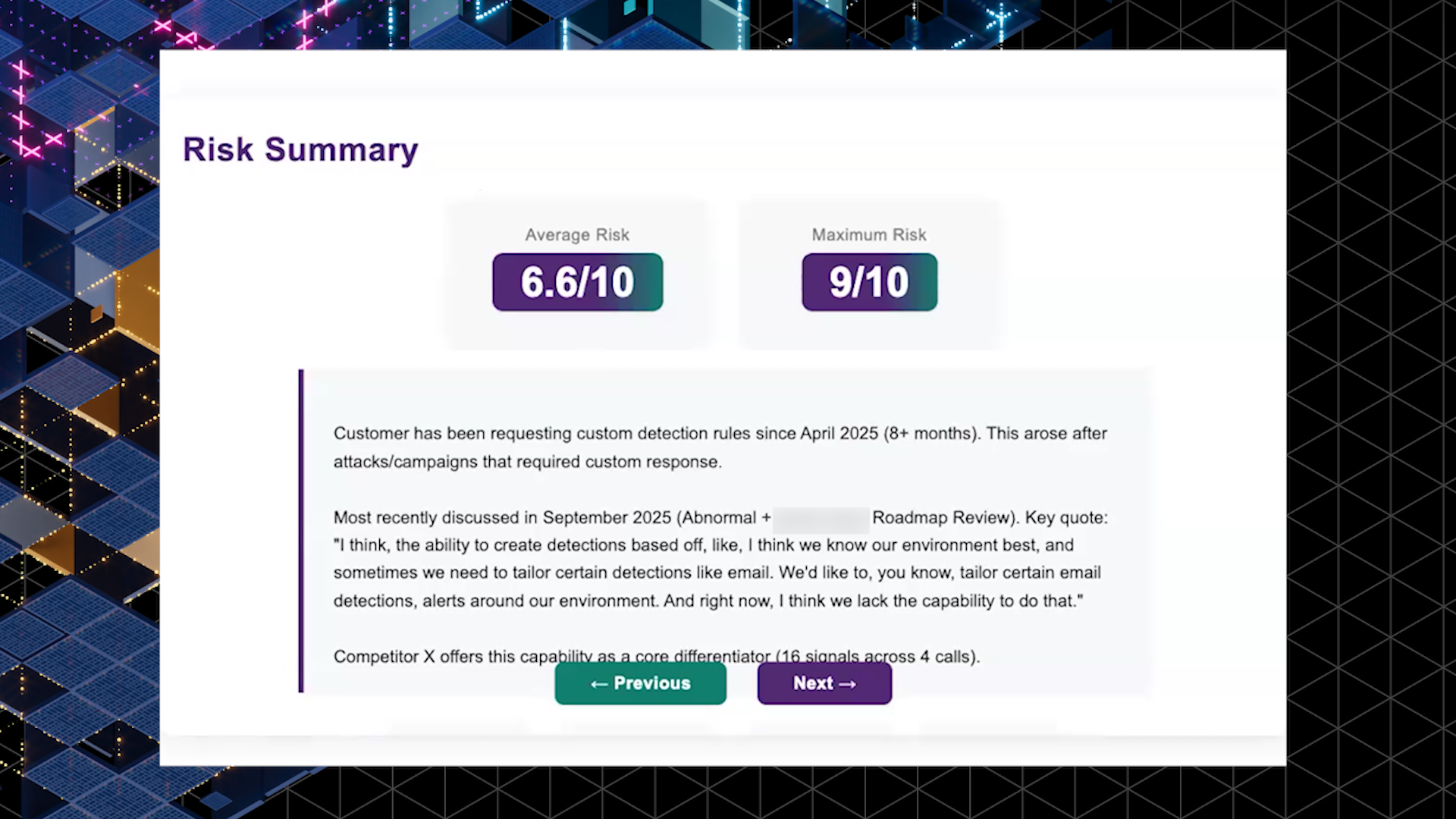
- Produces an executive-level summary that includes risk level (High / Medium / Low), key drivers of sentiment change, customer quotes, competitor-related signals, and recent escalations or unmet needs. It also identifies root causes based on months of history, not just recent interactions.
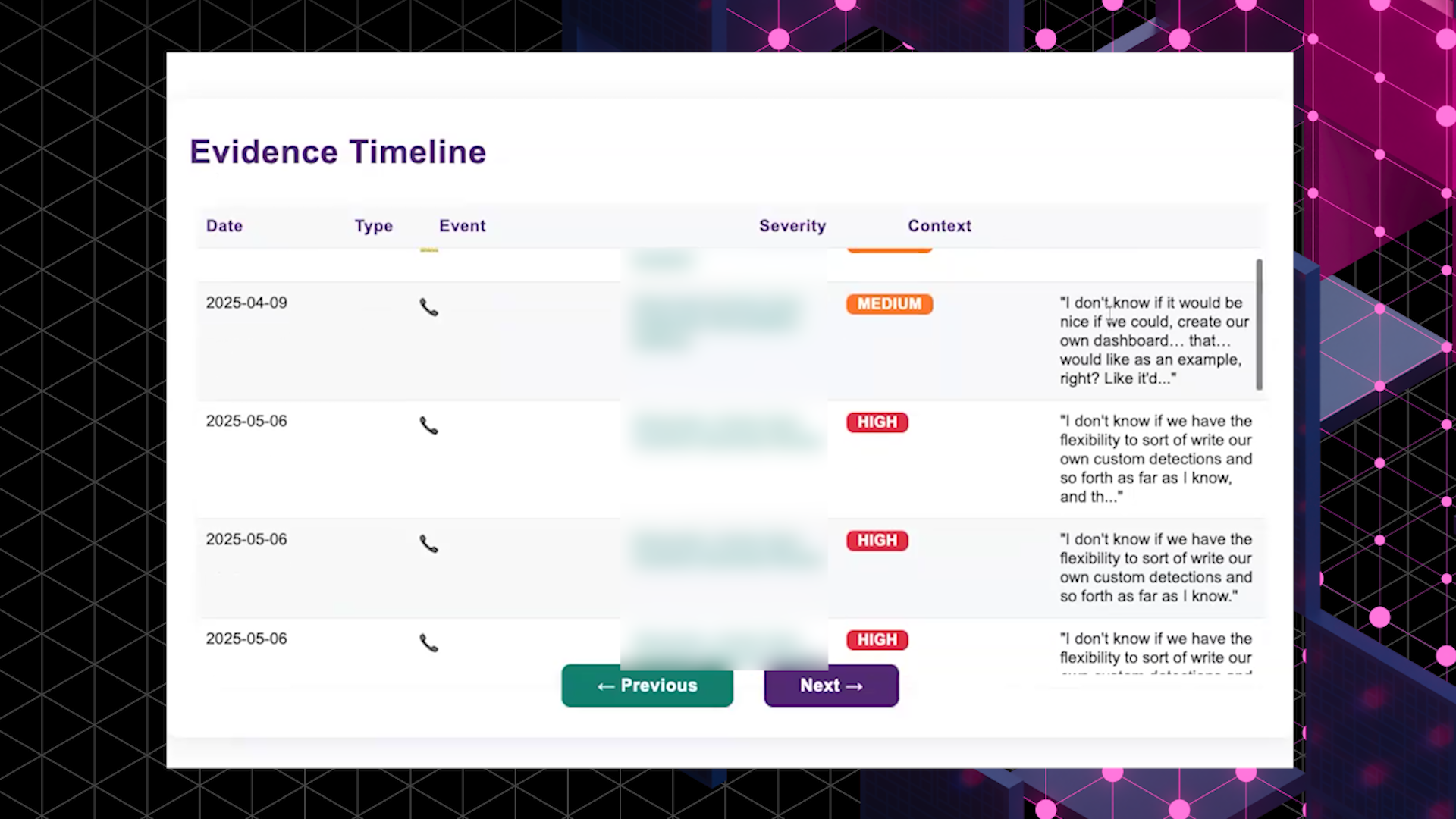
In the demo, Tim intentionally chose a customer with visible risk signals. The AI-generated slides included a summary of rising risk, a timeline showing an RFE that went unaddressed for months, missed detections from earlier in the year that contributed to dissatisfaction, indicators of competitor activity, and support case patterns and executive involvement.
The report didn’t just show what was happening. It explained why, and over what time horizon.
A Complete Story, Not Just a Score
The AI uncovers insights no single human or system could piece together quickly:
- Subtle tone changes during calls
- Slow-building risk from repeated feature requests
- Gaps in response or follow-up
- Signals of competitive evaluation, even when not explicitly stated
- Root-cause connections between missed detections, RFEs, and escalations
It’s both a health score and a narrative intelligence layer for Customer Success.
The long-term vision includes a second user story, including a ranked list of accounts by risk level, action guidance for CS leaders before escalation calls, and forecasting insights for CSOps. This makes the tool valuable not just for CSMs, but for the entire CS leadership chain.
Early Detection, Better Prep, Smarter Forecasting
Even in early testing with 10 accounts, the tool is already changing how the CS team works:
- CSMs get instant clarity on where to focus their attention.
- Leaders get a single source of truth for escalations and forecasting.
- Product and Support get earlier signals of underlying issues.
- Risk becomes visible long before churn indicators appear.
And because most accounts are actually healthy, the system will also help teams:
- Identify what’s working well
- Highlight positive patterns across successful customers
- Inform playbooks for renewals and upsells
What Makes the AI Risk Report Awesome
Tim’s AI Risk Report continues his momentum in transforming Customer Success enablement with AI, following the AI Coach, quantitative call feedback, and monthly coaching rollups.
This project is a perfect example of Abnormal’s innovation culture: see a pattern, spot the inefficiency, and build an AI system that scales insight across the organization. By turning fragmented signals into unified risk intelligence, Tim is helping the CS org stay proactive, aligned, and deeply informed.
