
NOTE: Demo visuals include blurred data or synthetic placeholders to protect customer privacy.
When Stages Hide Reality
Salesforce stage fields are useful, but they can also mask what is really happening in a deal. In practice, that mismatch shows up as skewed forecasts and targets that are missed because the system of record reflects intent rather than the current customer reality. Shaheen focused on the moments where leaders and RevOps teams spend time reconciling “what we think” with “what the calls show,” especially when the quarter is moving fast.
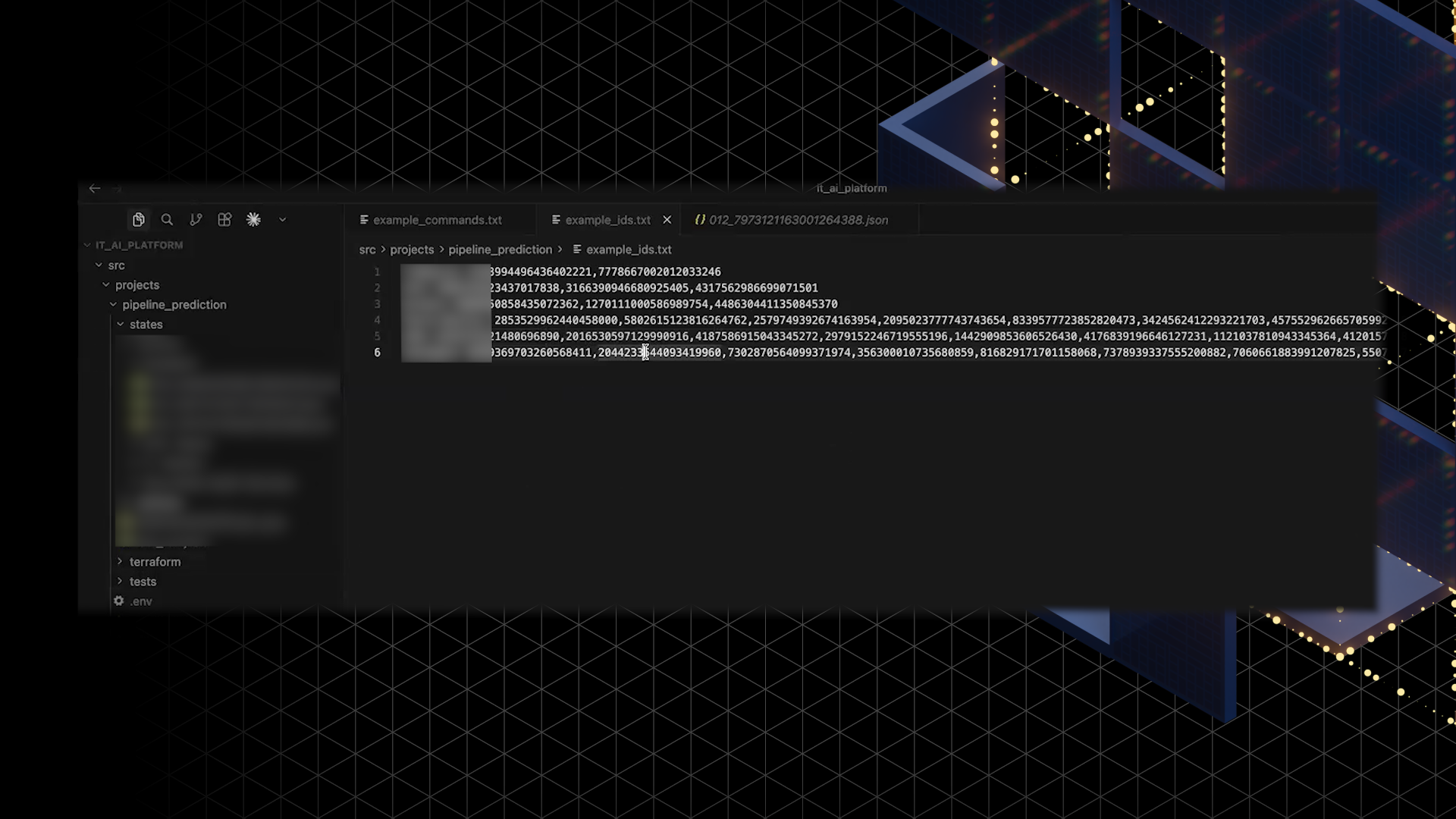
Three frictions showed up consistently:
- Optimism bias: reps lean toward best-case narratives rather than the true objective status of the deal.
- Data gaps: key indicators exist, but they are buried in unstructured notes instead of structured fields that teams can trust.
- Stale records: opportunities can sit in active stages even when there has been zero recent engagement.
Daily Stage Prediction Loop
Salesforce Pipeline Prediction is an AI solution that predicts the most likely opportunity stage based on evidence from Gong call transcripts, then writes the result back into Salesforce with reasoning. It is designed to run daily, pull new calls, update the deal's “state,” and compare the predicted stage to the current Salesforce stage to highlight mismatches.
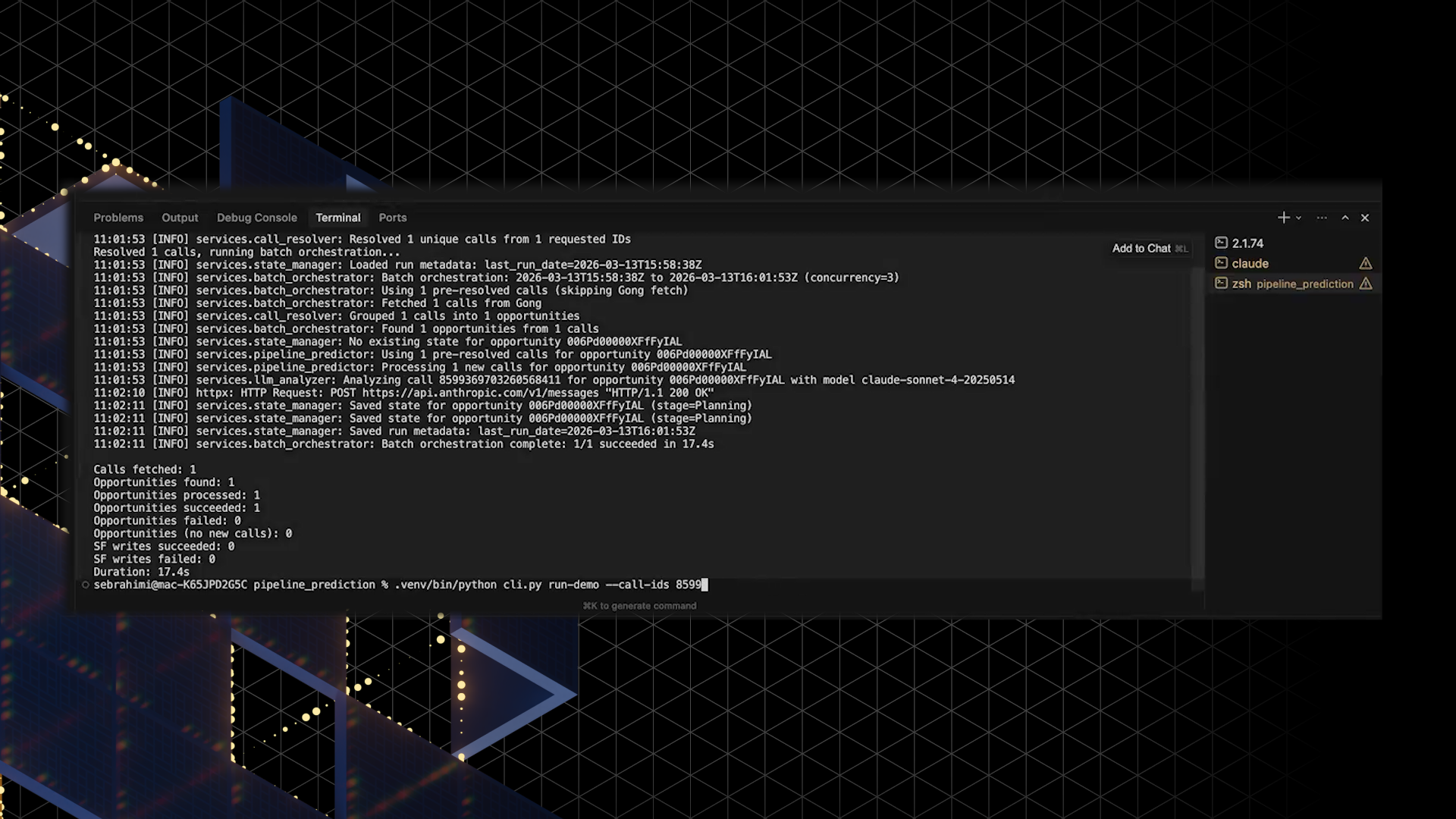
Core capabilities in the current approach:
- Pull Gong transcripts and analyze them with an LLM to extract structured deal signals.
- Predict the most likely stage based on the calls, not just what was last entered in Salesforce.
- Generate stage reasoning that explains why the deal belongs in that stage.
- Persist an evolving deal state so each new call updates the latest view.
- Push predicted stage and reasoning directly into Salesforce for visibility.
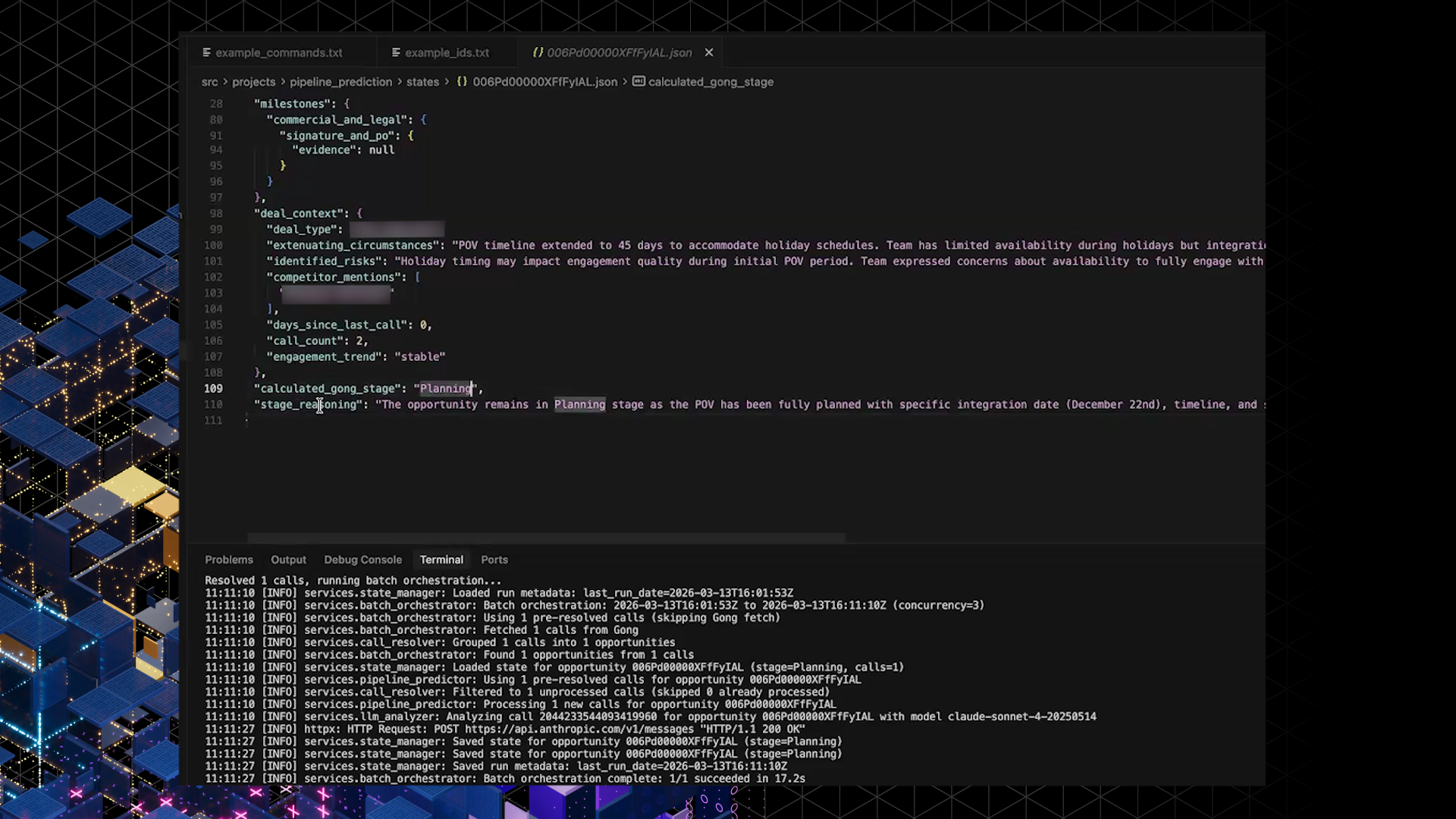
In one example run, the output updates an opportunity to planning and explains the rationale in plain language: “the opportunity remains in planning stage, as the POV has been fully planned, with specific integration date, timeline, that is not yet launched.” That explanation is the point. It gives RevOps and sales leaders something concrete to react to, and it gives reps a clear signal when their stage doesn’t match the latest customer conversation.
Less Scrubbing, Faster Action
The immediate value is operational. Instead of managers and operations teams spending time scrubbing the pipeline by hand, the feature creates a daily health check that flags stage mismatches every 24 hours so teams can remediate quickly. It also shifts pipeline reviews from anecdote to evidence by attaching the “why” behind a predicted stage.
Expected impact for multiple audiences:
- RevOps and sales managers: fewer hours spent on manual pipeline cleanup and faster identification of deals that need attention.
- Sales leadership: earlier visibility into forecast risk, with inconsistencies caught before they hit the bottom line.
- Account teams: clearer guidance on what the latest customer signals imply, reducing back-and-forth on stage debates.
One realistic next step is to productionize the daily run and create a feedback loop that lets RevOps monitor mismatches over time, so accuracy can be improved once more granular stage-by-stage outcomes are available.
Optimism, with a Path to Trust
An early user takeaway from Shaheen’s reviews with go-to-market partners was that the concept resonates because it mirrors how teams already work: leaders trust calls, but they do not have time to replay them at scale. Bringing call-derived structure into Salesforce makes pipeline hygiene feel like a product feature instead of a recurring fire drill.
Culturally, this reinforces Abnormal’s builder-first approach: ship something that reduces busywork, then iterate with real users once it is in their workflow. The next usage signal to watch is whether RevOps adopts the daily mismatch view as a standard part of pipeline inspection, and whether those flagged deals get corrected faster week over week.
