
Listening to Reality
Salesforce hygiene has long been a known problem, but also an unsolved one. At a high level, the issue wasn’t just that fields were missing. It was that the entire process depended on humans doing something unrealistic: remembering to update Salesforce accurately and immediately after every interaction.
As Haren framed it, the turning point came when the team stopped asking, “Why aren’t people updating Salesforce?” and instead focused on, “What actually happened in the customer interaction?” That shift led to the first version of the Salesforce Updater: an agent that listened to Gong calls and automatically populated fields like next steps.
Evolving the Signal
As the system rolled out, a second layer of insight emerged. Humans were still editing the AI’s updates. Instead of treating that as an error, the team used it as a signal. By analyzing what fields AI updated, what humans changed afterward, and why those changes were made, the system uncovered a critical gap: missing context from email conversations.
That led to the next major evolution: integrating email data alongside Gong transcripts. Now, updates weren’t based on just one source of truth, but a more complete picture of the customer interaction.
With more signals came a new problem: too much output. If every update triggered its own notification, reps would be overwhelmed. The solution was a simple but impactful UX improvement: instead of one notification per change, it bundles all updates into a single digest per user.
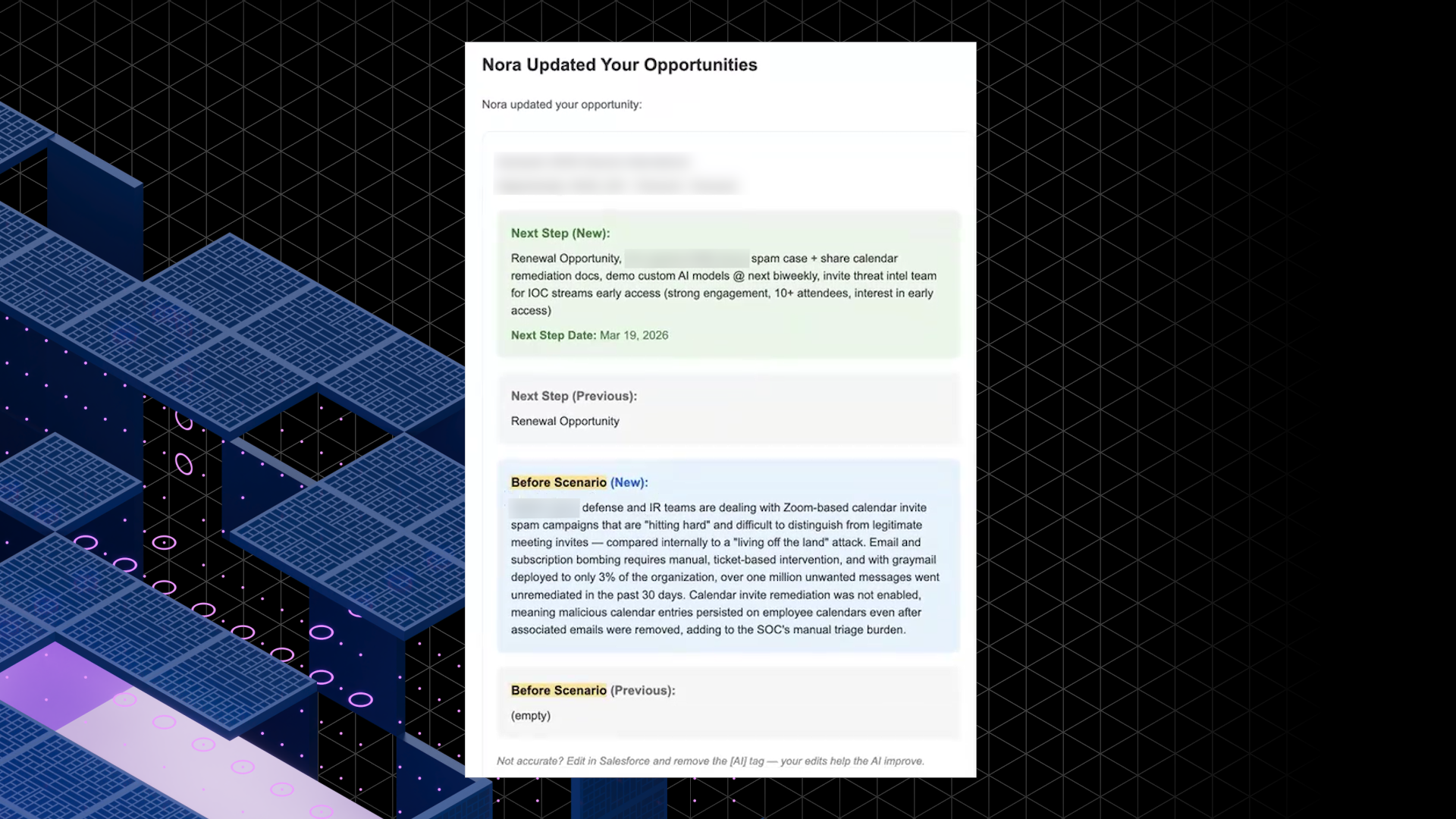
Now, each rep receives one consolidated email showing multiple opportunities updated, what changed, and where to review or edit. This reduced noise while preserving transparency and control.
Expanding Beyond Next Steps
Once the system proved effective for updating next steps and related fields, the team expanded into more nuanced CRM data.
The latest addition is the “before scenario”: capturing the customer’s prior state and context. This required a deeper level of reasoning through analyzing historical examples of well-filled fields, identifying patterns across deal stages, and determining when and how this information should be populated.
The result is a richer, more contextual Salesforce record, automatically generated and continuously refined.
Why This Matters
At its core, the Salesforce Updater is both an automation tool and a learning system.
Each cycle includes:
- AI updates fields based on calls and emails
- humans review and edit where needed
- the system captures those edits
…and uses them to improve future outputs. Over time, this creates a compounding feedback loop with fewer missing fields, higher accuracy, less manual effort, and better downstream insights.
This project highlights a broader shift in how AI systems are applied internally. Instead of asking humans to maintain systems, it builds systems that observes real behavior, learns from corrections, and improves automatically over time. For Salesforce specifically, that means more reliable forecasting, stronger cross-team alignment, and a CRM that reflects reality, not memory.
Perhaps most importantly, it removes one of the most persistent friction points in GTM workflows without asking reps to change how they work.
