Identify the email security threats small and midsize businesses (SMBs) overlook and learn how to prevent costly breaches.
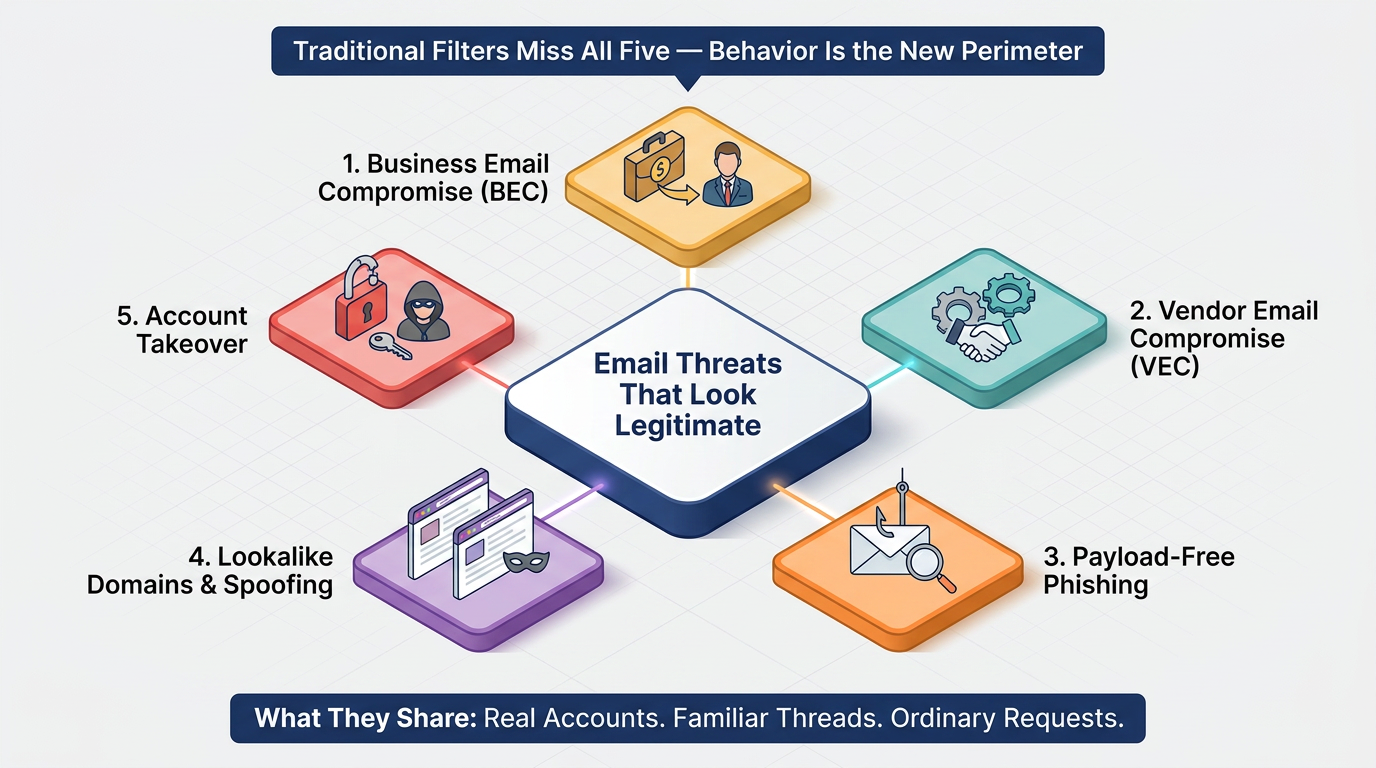
Email security threats cost small and midsize businesses (SMBs) more than most budgets account for, and the costliest ones rarely look like attacks at all. A message that appears to come from a real internal account, a familiar vendor thread, or a routine request skips the warning signs that traditional filters are built to catch.
SMBs often run lean finance and security teams, which means a convincing message can reach the person able to act on it before anyone questions it. Filters built to flag bad links, unknown senders, and suspicious attachments have little to catch when the message itself looks ordinary. Closing that gap starts with recognizing how these threats behave, not just what they contain.
Key Takeaways
The costliest email attacks succeed by looking like ordinary business activity, not by carrying malware or suspicious links that filters are built to catch.
Business email compromise and vendor email compromise both pass standard authentication checks because attackers operate from real, already-trusted mailboxes rather than forged ones.
Payload-free tactics such as QR codes and conversational phishing, along with lookalike domains and display-name spoofing, exploit blind spots in tools designed to flag links, attachments, and unfamiliar senders.
Spotting these threats depends on watching how a sender behaves over time, including tone, timing, and communication patterns, rather than scanning what a single message contains.
These threats manipulate trust rather than technology, turning everyday business communications into tools for fraud. Whether the lure is an impersonated executive or a hijacked supplier thread, the most damaging email security threats are the ones that look legitimate. Each section below breaks down how attackers pull off the deception and what actually helps catch it.
Business Email Compromise That Looks Internal
BEC attacks that appear to originate from within the organization use stolen or spoofed identities to redirect funds or extract sensitive data before anyone notices.
The FBI IC3 reported more than $3 billion in business email compromise (BEC) losses in its 2025 annual report, making the threat especially costly for organizations with lean finance and security teams.
How Attackers Blend In
Attackers research org charts, workflows, and writing styles before acting, then gain access to executive or finance accounts through phishing or brute-force tactics. Once inside, they send messages from legitimate "@yourcompany.com" addresses that pass authentication checks like SPF, DKIM, and DMARC. These emails blend into existing conversations: brief, urgent requests like "Can you send this wire before noon?" that prompt quick, unquestioned action.
The danger is the combination of a legitimate internal sender, ordinary business language, and payment urgency. None of these signals alone would raise suspicion. A request from a known colleague is routine. A short, direct message is normal for a busy finance team. Urgency around a deadline is common in day-to-day operations. It's only when all three appear together, from an account that has already cleared every authentication check, that the pattern becomes dangerous. Behavioral analysis that tracks how a person typically communicates, including tone, timing, and who they usually contact, can help surface a compromised account even when every technical signal checks out.
How SMBs Reduce BEC Risk
BEC attacks damage finances, vendor trust, and data privacy, and recovery can involve legal, operational, and reputational fallout well beyond the initial loss. Because SMBs often run smaller finance and security teams, a single successful attack can consume disproportionate time and attention while the organization works out what happened and how much exposure it faces. The strongest controls add verification without slowing routine business.
Here are steps you can take to mitigate the risks:
Apply multi-factor authentication (MFA) guidance across cloud and email accounts.
Require dual approval for financial transactions and vendor banking changes.
Confirm sensitive requests through separate channels, like phone verification.
Monitor email and identity signals for behavioral anomalies such as unusual access patterns, unexpected recipient interactions, or payment-related requests that deviate from normal email workflows.
If a fraudulent transfer does occur, the FBI recommends immediately notifying the financial institutions involved, filing a complaint at ic3.gov, and contacting the nearest FBI field office, since acting within the first hours significantly improves the odds of recovering funds before they move beyond reach.
Vendor Email Compromise That Hides in Real Vendor Threads
VEC attacks exploit supplier trust by inserting fraudulent payment instructions into legitimate vendor conversations.
Vendor relationships create an attack path that traditional email security often treats as fully trusted, since the message truly originates from an authenticated supplier account. That trust is exactly what makes vendor email compromise hard to catch with tools built around sender reputation alone.
How VEC Evades Email Controls
Once attackers gain access to a vendor's email account, they monitor correspondence and wait for the right moment, typically when a payment is due. They then insert fake invoices or banking changes into ongoing threads.
These messages often pass SPF, DKIM, and DMARC checks because the attacker sends from the vendor's real, authenticated mailbox rather than forging it. Familiar formatting and references to known purchase orders or signatures make the fraud difficult to spot. The mailbox itself is legitimate, so the strongest clues are timing, payment context, and whether the request fits the supplier's normal email workflow.
How Verification Reduces VEC Risk
Protect against VEC by requiring verbal confirmation for any changes to payment details, regardless of email authenticity.
Start by maintaining a vetted vendor contact list with confirmed phone numbers and enforce multi-step approval for high-value transactions. Behavioral analysis of vendor communication can help identify deviations in supplier email patterns, such as off-hours invoice messages, sudden changes to banking details, or unusual vendor engagement flows. Then formalize out-of-band verification protocols so finance teams confirm changes before money moves.
These controls give finance and security teams a shared process for handling supplier requests that look legitimate but behave differently from normal vendor communications.
Evasive Payload-Free Phishing
Payload-free phishing removes obvious artifacts and relies on social engineering to extract credentials and financial information.
These attacks matter because static defenses often look for links, attachments, hashes, or macros, while the malicious intent sits in the conversation itself.
How Payload-Free Phishing Avoids Static Signals
These campaigns arrive as routine messages without attachments or hyperlinks for scanners to flag. Attackers embed URLs inside QR codes, conceal scripts in benign-looking SVG or HTML files, or host lure pages on trusted cloud services. Others deploy conversational emails that prompt replies or phone calls, as described in CSA research; the malicious activity happens entirely out of band.
An FBI advisory classifies QR code phishing as a high-confidence, MFA-resilient identity intrusion vector because it frequently ends in session token theft and replay, which can bypass MFA without triggering typical alerts. Generative AI also personalizes messages and randomizes wording, subject lines, and sender personas, so signature-based tools detect fewer common patterns across large campaign volumes.
How Intent Signals Improve Email Threat Detection
Once employees respond, attackers harvest login credentials, infiltrate applications, and launch internal phishing or fraud campaigns. A missed lure can escalate into account takeover, data exfiltration, or ransomware deployment.
Behavior-based detection that models email workflow cadences, recipient behavior, timing, and engagement flows is designed to help disrupt this cycle. It can help surface anomalies such as unexpected QR codes, sudden payment-related requests, or language that deviates from a sender's established tone. Weighing behavioral patterns rather than static artifacts can help surface quiet threats before users engage.
For SMBs, the practical signal is intent: no-link/no-attachment messages that steer users toward QR scans, replies, phone calls, or credential entry outside the original email.
Lookalike Domains and Display-Name Spoofing
Lookalike domains and display-name spoofing prey on the split-second trust recipients place in familiar names.
These attacks can reroute money or credentials before anyone notices because the sender appears recognizable, especially on mobile clients that hide full addresses.
How Spoofing Wins Trust
Attackers register domains such as "payro11-portal.com" or "rn-company.com," swap a Latin "a" for a Cyrillic "а," or pick a new top-level domain that feels legitimate. These homograph phishing attacks use near-invisible Unicode swaps to create URLs that appear legitimate yet deliver recipients to credential-harvesting pages instead of the real site.
Display-name spoofing is even simpler: a message from "Finance Support" <attacker@gmail.com> lands in an inbox that only shows the name, not the address. Because many mobile clients hide the full sender field, the deception survives initial scrutiny, especially when paired with urgent language about invoices or account suspension. Once trust is won, consequences escalate quickly, including misdirected payments, leaked credentials, and compliance violations that drain both revenue and reputation.
How SMBs Verify Sender Identity
To combat these incidents, confirm exact domain spelling, including characters and top-level domain, verify that reply-to and return-path fields match the display name, and check any "urgent" financial request through a secondary channel.
Natural-language and computer-vision models can also help surface visual and text-based inconsistencies, including subtle anomalies that static filters were not designed to evaluate. For SMBs, the practical control remains consistent: slow down identity-based requests, inspect the full sender context, and confirm payment or credential-related requests outside the original email thread.
Account Takeover Email Security Threats
Account takeovers are among the most dangerous and difficult-to-detect email security threats.
Once attackers gain access to a legitimate employee's mailbox, their messages appear authentic and can mimic the employee's usual tone and behavior.
How Account Takeover Starts
These compromises often begin with credential phishing or password-spray attacks, especially against users without MFA. Once inside, attackers monitor conversations, launch internal phishing, request sensitive files, or initiate unauthorized transfers, all from a valid account. Traditional filters rarely flag this activity, and colleagues may not question familiar messages.
SMBs are especially at risk due to weak password practices, reused credentials, limited behavioral monitoring, and a lack of conditional access controls. NIST's digital identity guidelines describe risk-based authentication that evaluates signals like IP address, geolocation, timing patterns, and device behavior to flag suspicious logins more consistently than static rules alone.
How SMBs Reduce Account Takeover Risk
To reduce risk, focus on authentication, mailbox governance, and account-based behavior. These controls work together because attackers who use valid credentials still need to behave in ways that support their objective.
Here are steps you can take:
Enforce MFA across cloud and email accounts. CISA's StopRansomware Guide directs organizations to "implement phishing-resistant MFA for all services, particularly for email, VPNs, and accounts that access critical systems."
Regularly audit OAuth permissions and mailbox activity.
Set up flags for anomalies like unusual sending volume or data access.
Use behavioral baselining tools to flag deviations across email, identity signals, and connected collaboration platforms.
Combining authentication, OAuth auditing, and behavioral monitoring raises the cost of operating undetected inside your organization.
How Generative AI Scales These Email Security Threats
Generative AI lowers the cost of the email security threats above while raising their quality.
The UK's National Cyber Security Centre assesses that AI will primarily offer threat actors capability uplift in social engineering, producing lure documents free of the translation, spelling, and grammar mistakes that once revealed phishing.
How AI Removes Old Training Cues
The NCSC assessment explains why employees can no longer rely on obvious language errors as a primary phishing signal. Attackers can now produce polished, context-aware messages that read like routine business correspondence.
How SMBs Shift Detection Criteria
That uplift shows in controlled research: fully automated, AI-generated spear phishing matched emails crafted by human phishing experts at persuading recipients to click. The FBI report also confirmed an AI nexus in a subset of reported BEC losses, noting that businesses reported more than $30 million in losses to AI-involved BEC scams in 2025. For SMBs, the operational risk is clear: training cues based on sloppy wording keep losing value as attacker language quality improves.
That shift requires both process and tooling. Security teams can refresh training to emphasize sender context, payment workflow verification, and out-of-band confirmation. They can also pair those controls with email threat detection that evaluates tone, recipient patterns, timing, and engagement flows instead of relying only on static indicators.
Behavior Is the New Perimeter
Every threat covered here defeats defenses built to catch bad links, unknown senders, or obvious errors. What they share is a reliance on looking routine: a real account, a familiar thread, an ordinary request. Closing that gap means training filters, and people, to notice how a message behaves rather than only what it contains. The organizations that adapt fastest treat sender behavior as a security signal in its own right, not an afterthought to spam filtering.
Frequently Asked Questions
What Is the Difference Between Business Email Compromise and Vendor Email Compromise?
Business email compromise typically targets or impersonates someone inside the organization, such as an executive or finance employee, to redirect internal funds or data. Vendor email compromise instead compromises a supplier's mailbox and uses that trusted, ongoing relationship to insert fraudulent payment instructions into a real conversation thread. Both rely on authenticated accounts rather than forged senders, which is why they pass standard email authentication checks.
Why Do Phishing Emails Without Links or Attachments Bypass Filters?
Most email security tools are built to scan for known-bad indicators: malicious URLs, suspicious attachments, or flagged file hashes. A payload-free message, such as a QR code image or a plain-text request for a phone call, has none of those artifacts for a scanner to flag. The actual attack happens later, outside the email itself, once the recipient scans a code or picks up the phone.
How Can Employees Spot a Lookalike Domain?
Look closely at the exact spelling of the sender's domain, including the top-level domain, since a single swapped character or a slightly different extension is often the only visible difference from the real one. Checking that the reply-to and return-path fields match the display name, and confirming urgent financial requests through a separate channel like a phone call, catches most lookalike domain attempts even when the message itself looks convincing.
Why Are Small and Midsize Businesses Common Targets for Email Fraud?
SMBs often run smaller finance and security teams, which means fewer people are available to double-check unusual requests or investigate anomalies before money moves. Limited budgets can also mean less mature behavioral monitoring and less frequent security awareness training, so attackers who research an organization's structure and vendor relationships can often move from initial access to a completed fraud attempt with fewer checkpoints in the way.