Points clés
Human-centric security starts from a problem: security teams have spent decades trying to engineer humans out of the equation, building sophisticated tools and automated workflows to reduce the "human error" factor. Yet breaches continue, analysts burn out, and the skills gap widens.
What if we've been approaching this problem backwards?
Human-centric security reverses that approach by designing defense around the people responsible for interpreting risk and directing response. For chief information security officers (CISOs), it offers a practical path to reduce operational strain, preserve accountability, and make security work more sustainable.
This guide unpacks what human-centric security looks like in practice: the copilot model that keeps decision rights with analysts, the behavioral context and workflow integration that make the model work, the metrics boards actually respond to, and a staged rollout that protects against expensive missteps. Together, these pieces turn a philosophy into an operating model that reclaims analyst capacity for the work only humans can do, from closing coverage gaps to catching the socially engineered attacks that quietly cost organizations the most.
Key Takeaways
Human-centric security designs tools around analyst workflows and treats people as essential decision-makers within the defense model.
The copilot framework keeps humans in control: artificial intelligence (AI) handles computational tasks such as summarization, context gathering, and alert triage, and analysts retain authority over actions and decisions that require contextual judgment.
Organizations implementing human-centric AI security can improve detection accuracy for socially engineered attacks, support analyst retention and satisfaction, and create a path toward proactive threat hunting.
Successful implementation follows a staged approach, starting with AI in shadow mode, progressing to human-approved actions, and narrowing to autonomous actions after building trust and validation.
What Is Human-Centric Security?
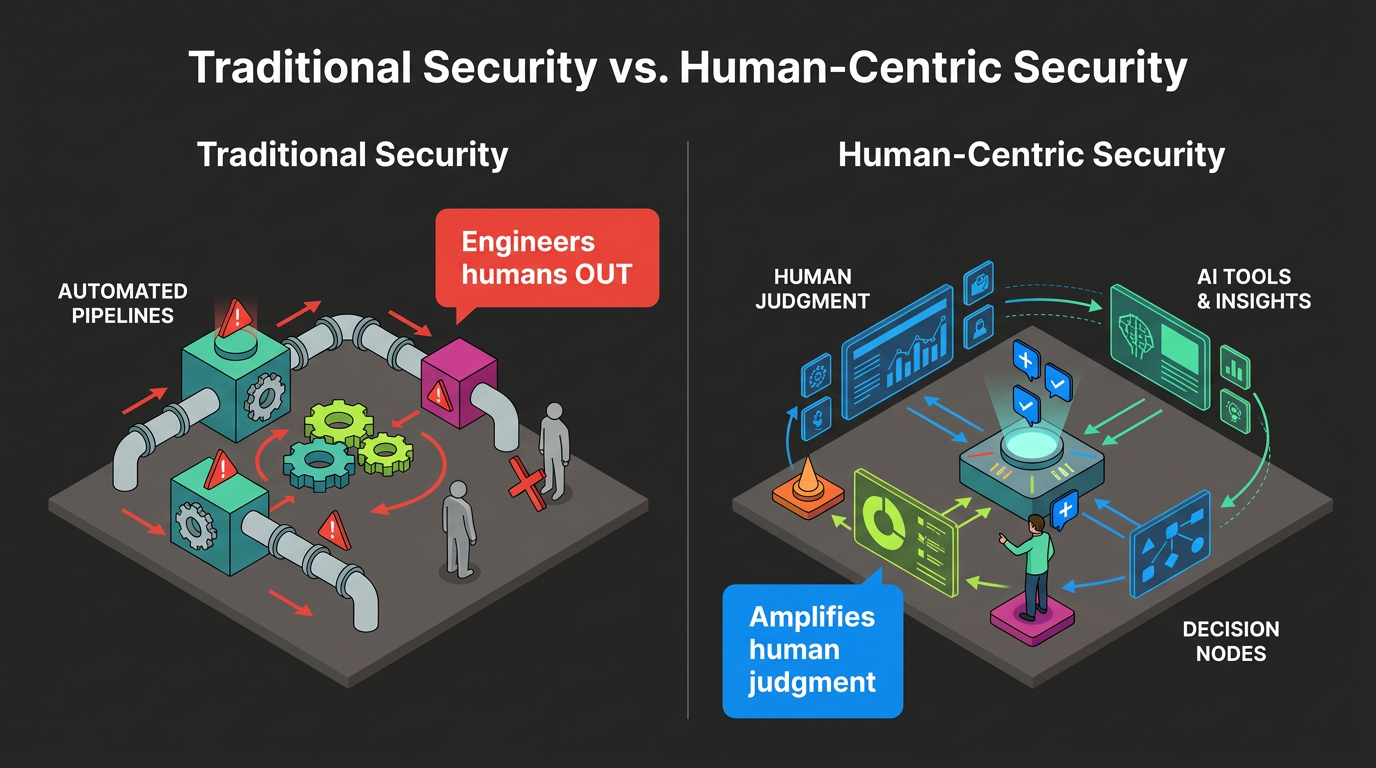
Human-centric security designs systems, processes, and tools around human behavior and workflows, so technology fits the way people work. It moves beyond traditional security awareness training, which often treats employees as problems to be educated, toward a model where technology amplifies human capabilities. Verizon's 2026 Data Breach Investigations Report found the human element present in 62% of breaches, so the practical question is how to equip people to make better calls under pressure.
Human-centric programs assign clear responsibilities to people and tools:
Role of People: Analyst judgment remains the final decision point.
Tool Design: Tools align with the way analysts investigate and make decisions.
Automation Scope: Automation handles data gathering. Analysts retain authority over actions.
One principle captures the philosophy: AI scales the work, humans seal the judgment. In practice, an analyst in a security operations center (SOC) reviews prepared context, timelines, and supporting evidence, then records the rationale for the chosen action.
Why Human-Centric Security Matters for CISOs
Human-centric security matters because repetitive operational work drains the expertise that security programs depend on. Manual and reactive tasks leave little time for strategic work such as threat hunting, detection engineering, and professional development.
Reactive work wears people down: analysts close near-identical tickets shift after shift, and each hour on that treadmill is an hour not spent learning new techniques or sharpening investigative skills.
The effects extend from the SOC to the boardroom. When experienced analysts leave due to exhaustion, organizations lose institutional knowledge that took years to build, and a senior engineer who understands an environment's quirks, blind spots, and incident response playbooks is hard to replace and expensive to develop.
The business risk compounds that loss: the Federal Bureau of Investigation (FBI) Internet Crime Complaint Center (IC3) 2025 Internet Crime Report recorded $3.046 billion in business email compromise (BEC) losses, and attacks of this kind depend on subtle signals that are easy to miss amid alert fatigue in security operations.
A team running on empty can overlook a sophisticated BEC attack or a credential phishing campaign that doesn't fit an expected pattern. Human-centric security addresses that risk by making the security function sustainable.
Key Benefits of Human-Centric Security
Human-centric security improves security operations by directing analyst attention toward consequential decisions, meaningful investigations, and proactive work.
Improved Detection Accuracy
When analysts aren't drowning in false positives and low-value alerts, they can apply genuine attention to the signals that matter, including email threats like BEC, vendor impersonation, and account takeover. Human judgment can identify contextual details automation may miss, such as a login pattern that coincides with a known business trip.
For email threats, Abnormal applies behavioral AI for email to patterns such as workflow cadences, vendor interactions, recipient behavior, timing, and engagement flows, giving analysts more time to examine ambiguous signals instead of clearing predictable alerts.
Higher Analyst Retention and Satisfaction
Human-centric tools can improve analyst satisfaction by returning meaningful investigative work to professionals who entered the field to investigate threats and outsmart adversaries, not clear predictable alerts.
Reduced burnout also lowers turnover costs: recruiting, hiring, and training a new analyst is a significant investment, and retaining experienced talent protects it while freeing senior analysts to mentor junior team members.
Shift from Reactive to Proactive Security
Human-centric security shifts the security posture from constantly playing catch-up to actively searching for threats before they materialize. With AI phishing triage workflows handling routine processing, analysts can redirect time toward threat hunting, proactive initiatives, and mentoring junior team members.
Many teams are working to move from reactive defense toward proactive strategy, and human-centric AI supports that shift by freeing the analyst capacity needed for hypothesis development, detection engineering, and threat research. Findings from that work feed back into tuned detections and closed coverage gaps.
How Human-Centric Security Works
Human-centric security combines a copilot model, behavioral context, integrated workflows, and verification controls.
The Copilot Model
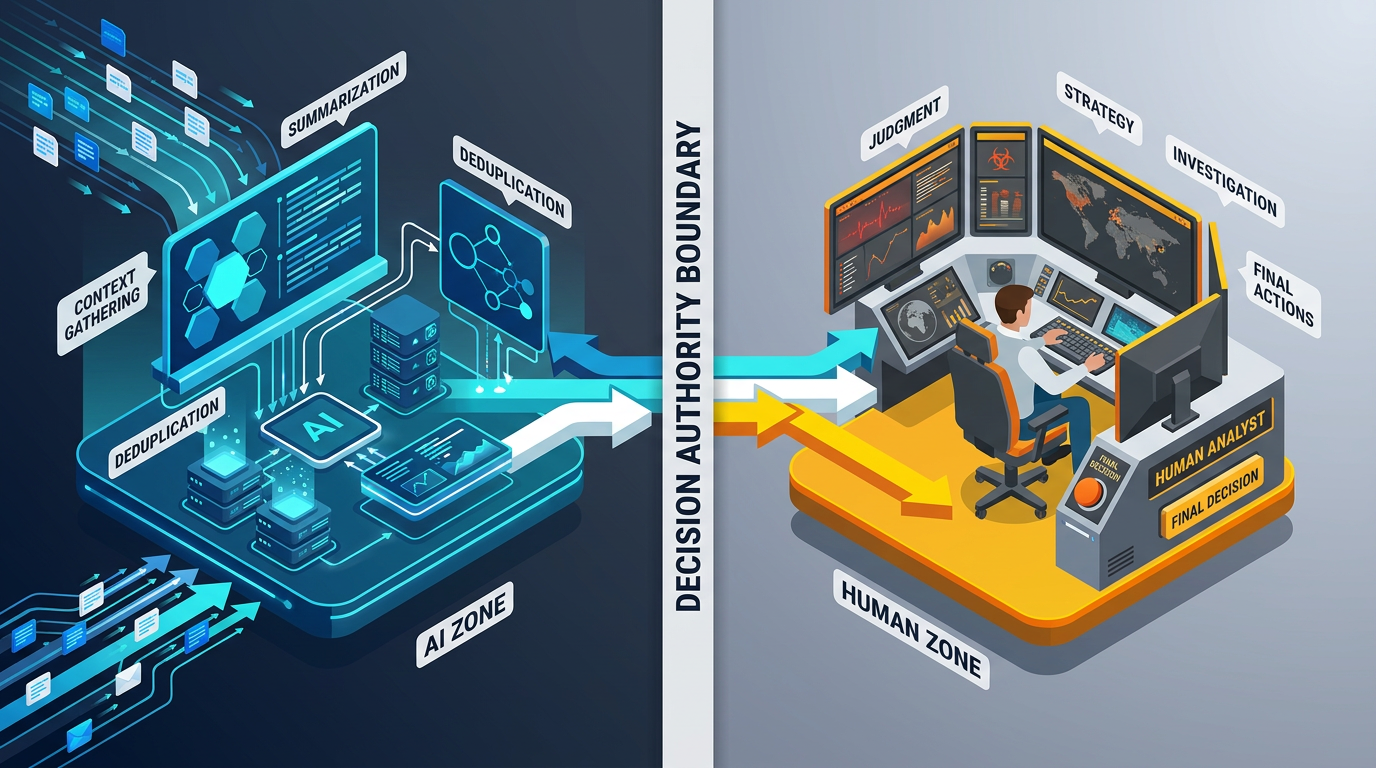
In the copilot model, the framework behind human-centric security implementation, AI handles summarization, context gathering, deduplication, and analytics: it processes information, identifies patterns, and presents findings. Humans retain decision-making authority on actions.
Reserving actions for humans recognizes where judgment adds value current AI systems may not provide consistently: deciding whether to quarantine an endpoint, escalate to leadership, or dismiss an alert as benign depends on business priorities and accepted risk a model may not have.
Behavioral AI: Layers of Intelligence
Abnormal's behavioral AI uses identity and context to understand normal email behavior and assess risk across cloud email event analysis:
Identity: Who is this sender? The platform builds a baseline from identity signals to help verify sender authenticity.
Context: Is this request normal for this relationship? It maps relationships and analyzes communication patterns to spot unexpected activity.
Risk: Does the content signal suspicious intent? Natural language processing methods and content analysis identify persuasive language patterns designed to deceive.
Together, these layers identify email attacks built on persuasive language rather than malicious payloads, giving analysts context for requests that look technically clean but deviate from normal business activity.
Workflow Integration
Within an autonomous SOC workflow, AI-powered summarization and context gathering can reduce the manual switching required between log sources and tools. Abnormal adds behavioral context alongside existing email and security infrastructure to enhance the current security stack. Teams can apply this model across three workflow areas:
Context Assembly: AI can pull together relevant data, correlate events, and present findings so analysts can evaluate the evidence without repeatedly moving between tools.
Document Generation: AI tools can convert the manual effort behind standard operating procedures (SOPs), process documents, and incident response into structured drafts ready for analyst validation.
Access and Approval Boundaries: Teams benefit from defining which data an AI system can access, which outputs require review, and which actions remain unavailable without human approval.
These controls connect workflow efficiency with accountability while keeping validation embedded in deployment and response processes.
Trust but Verify Framework
Human-centric security requires teams to test AI outputs against evidence and document approval decisions. Validation stays essential throughout the workflow, especially when an action could disrupt business operations, expose sensitive data, or affect an investigation.
Organizations can structure verification around three practices:
Risk Review: When integrating AI and large language models (LLMs) into security operations, organizations should consider risks including prompt injection, sensitive information disclosure, and data and model poisoning. The OWASP Top 10 framework, published by the Open Worldwide Application Security Project, provides a structure for understanding these risks.
Data Guardrails: Data minimization and personally identifiable information (PII) reduction can help reduce inadvertent exposure while preserving AI's benefits.
Documented Verification: Teams can record the evidence required for approval, define escalation paths for uncertain outputs, and periodically review whether automated recommendations match analyst decisions.
These practices support trust through observable performance and accountable oversight.
Measuring Human-Centric Security ROI for the Board
Human-centric security ROI combines operational efficiency, workforce sustainability, and financial risk reduction into measures the board can track.
Operational Metrics
Operational metrics show whether AI-powered triage is cutting manual work without cutting corners:
Triage Efficiency: Track reductions in manual triage hours. If a team previously spent substantial time on alert processing and now spends far less, that difference represents measurable efficiency.
Signal Quality: Monitor false positive reduction as AI-powered filtering improves signal-to-noise ratios.
Coverage Expansion: Demonstrate how teams achieve broader coverage and stronger investigative quality without changing headcount.
When the same analysts monitor more systems, investigate more thoroughly, or respond faster, that is real operational improvement, not just work shifted to a different stage of the investigation.
Strategic Metrics
Strategic metrics show whether human-centric security creates a more sustainable, capable workforce: retention and satisfaction scores, and how much time shifts from reactive to proactive work.
Threat hunting metrics matter too: how many hypotheses the team tests, and whether findings translate into improved detections. Strategic measures should connect activity to outcomes: a growing volume of threat hunts means little if findings never improve detections or training.
Financial Metrics
Financial metrics should connect analyst capacity to cost savings and lower breach exposure. One practitioner described an analyst who proactively flagged stale Amazon Web Services (AWS) accounts, a win for both security posture and cost. Human-centric AI creates this kind of value by freeing analysts to pursue initiatives beyond immediate alert response.
The breach-cost data points in the same direction. IBM's 2025 breach-cost report found that organizations using security AI and automation extensively lowered average breach costs by USD 1.9 million compared with organizations that did not.
The financial model rests on maximizing what each analyst delivers: mapping MITRE ATT&CK tactics, techniques, and procedures (TTPs) to detections and tuning detection logic are high-value, hard-to-outsource activities, alongside avoided recruiting and tool-switching costs.
How to Build Your Own Human-Centric Security Framework
A human-centric security framework develops through staged automation, targeted talent investment, and clear governance.
Start Small and Validate
Implementing human-centric security can begin without a wholesale overhaul. A staged deployment allows teams to validate performance and build trust before expanding the system's authority:
Begin in Shadow Mode: Validate AI recommendations against analyst decisions without allowing the system to take action.
Progress to Human Approval: Allow AI to suggest actions, with analysts reviewing and confirming each decision.
Narrow to Selective Autonomy: After building confidence, identify bounded actions that can operate autonomously with rollback capabilities.
This approach manages risk while leaving room to refine the model for the organization's environment, in line with the Cybersecurity and Infrastructure Security Agency (CISA)'s agentic AI guidance, which recommends starting with lower-risk tasks and preserving human control over high-impact or irreversible actions.
Invest in Talent Transformation
Building human-centric security requires training analysts to work alongside AI, not just deploying the tools. Organizations can focus that development across three areas:
AI Skills and Roles: Upskilling strategies should focus on creating AI generalists and power users who can apply these tools effectively. Organizations can create AI-focused roles and refine hiring practices to reflect the changing nature of security work.
Practical Engineer Training: Engineers need practical training with the systems they validate and oversee: evaluating model output, identifying weak evidence, recognizing unsafe automation, and documenting the reasoning behind consequential decisions.
Safe AI Use: Existing security awareness training programs can reinforce this effort by addressing the safe use of AI tools and the handling of sensitive information.
Together, these measures prepare security professionals to use, validate, and oversee AI-supported workflows.
Establish Centers of Excellence
As AI adoption matures, organizations benefit from dedicated teams that manage deployment and oversight. A center of excellence can organize this work around three responsibilities:
Deployment Governance: These teams focus on privacy, compliance, and emerging risks, prioritizing vendor transparency and compliance with industry standards.
Agent Oversight: AI agents increasingly hold credentials and act with delegated human authority, creating hybrid identities that sit between identity and AI security teams. A center of excellence can own that gap by inventorying which agents exist, who approved them, and what access each holds.
Compliance Evidence: That inventory can also help compliance teams assemble audit evidence when regulations such as the General Data Protection Regulation (GDPR) or the Health Insurance Portability and Accountability Act (HIPAA) require them to show who could access sensitive data and why.
Treating governance, agent oversight, and compliance evidence as a single discipline matters because fragmented ownership is where accountability gaps appear: unapproved agents accumulate access, audit requests stall, and risk reviews lag behind deployment. Abnormal's AI security suite shows one way to bring these areas together under a connected responsibility model.
Put People at the Center of Your Security Strategy
Human-centric security treats people as partners in defense. Designing systems that amplify human judgment helps build sustainable security programs that attract talent while improving detection of socially engineered attacks, including business email compromise.
Teams can use operational, strategic, and financial measures to confirm reduced analyst strain is translating into durable security gains, not just a different kind of workload.
Abnormal extends this same behavioral approach to the socially-engineered attacks that depend most heavily on human judgment to catch, and was named a Customers' Choice in the 2026 Gartner® Peer Insights™ Voice of the Customer for Email Security for the third year in a row. Book a demo to see how Abnormal fits into a human-centric security program.
Frequently Asked Questions
How Does the Copilot Model Differ From Full Automation (Autopilot) in Security Operations, and When Should Organizations Use Each Approach?
The copilot model reserves decision-making authority for humans while AI handles computational tasks, whereas autopilot executes actions without human intervention once predefined conditions are met. Use copilot when consequences are irreversible, business context shapes the response, or regulatory accountability requires oversight. Autopilot fits narrowly scoped, low-risk, reversible actions such as blocking known malicious domains, once validated through controlled testing.
What Are the Specific Steps for Implementing Shadow Mode When Deploying AI in a Security Operations Center?
Shadow mode runs AI recommendations in parallel with existing workflows without triggering automated actions, logging suggestions while analysts keep deciding manually. Teams then compare AI outputs against analyst choices to measure accuracy, surface edge cases, and adjust thresholds. Shadow mode typically runs for weeks or months and concludes only once leadership verifies acceptable accuracy against a representative sample of real events.
What Risks Should Organizations Consider When Integrating Large Language Models Into Security Workflows, and How Can They Mitigate Prompt Injection or Data Poisoning Attacks?
Key risks include prompt injection, data poisoning, and sensitive information disclosure through model responses or logs. Mitigations include input validation, strict access controls on training data pipelines, separate development and production environments, and output filtering before data reaches analysts. Limiting data scope, using anonymized training data, and requiring human review for high-consequence actions round out the defense.
How Does Behavioral AI Detect Business Email Compromise Attacks That Contain No Malicious Payload or Links?
Abnormal's behavioral AI detects payload-free BEC by analyzing deviations from established communication norms rather than scanning for technical artifacts. It builds baselines from historical email patterns and flags unusual actions such as wire transfers outside normal business hours or sudden changes to banking details. By correlating identity signals with relationship and risk indicators, it surfaces socially engineered attacks that lack the malicious code or known signatures traditional tools rely on.