Points clés
An effective insider risk management program addresses threats from employees, contractors, and partners whose legitimate access creates risk when someone misuses, mishandles, or hijacks it. Network perimeter controls focus on unauthorized entry, so they offer limited help once an actor operates inside the boundary with valid identity credentials.
Insider risk management programs reduce that harm through behavioral context, cross-functional governance, and careful legal oversight within the boundary of authorized access. A mature program distinguishes insider risk from insider threat, accounts for different risk categories, follows the Cybersecurity and Infrastructure Security Agency (CISA) framework, and combines email and account-based indicators with controls for other systems.
Key Takeaways
Non-malicious insiders, including negligent employees and compromised accounts, cause most insider incidents, so detection must go beyond catching bad actors.
CISA structures an insider risk program around defining, detecting and identifying, assessing, and managing risk and Carnegie Mellon's CERT/Software Engineering Institute (CERT/SEI) guidance adds implementation depth on top of that structure.
Rule-based detection and traditional data loss prevention (DLP) tools often struggle to flag insider risk because the underlying behavior uses authorized access.
Employee monitoring laws can create notice, impact-assessment, and AI-system obligations that belong in program design from the start.
What Insider Risk Means and How It Differs from Insider Threat
Insider threat names the individual who might cause harm; insider risk names the broader operating model that manages that possibility across an entire workforce, and that distinction shapes program design. The related concepts differ in focus:
Insider Threat: Insider threat is actor-centric. The National Institute of Standards and Technology (NIST) describes it as "the threat that an insider will use her/his authorized access, wittingly or unwittingly, to do harm to the security of organizational operations and assets, individuals, other organizations, and the Nation." This framing centers on a specific individual and the potential for harm.
Insider Risk: Insider risk is program-centric and probabilistic. It continuously evaluates risk conditions and measures how well insider threat controls perform. The field's shift toward proactive risk reduction has expanded traditional insider threat programs into broader risk management programs.
This distinction helps teams apply the same operational rigor to non-malicious incidents and intentional sabotage while maintaining appropriate identity and access management controls.
Ponemon Institute's latest Cost of Insider Risks Global Report found an average annual cost of $19.5 million per organization. A risk-centric model can flag risk concentrations early and connect preventive controls to measurable business exposure.
Types of Risk an Insider Risk Management Program Can Address
Programs need separate detection and response logic for each main category of insider risk. The latest CISA mitigation guide addresses hybrid work and advances in artificial intelligence and finds that most recent insider threats are unintentional and negligent. Ponemon attributes 53% of incidents to negligent insiders. The main categories include:
Malicious Insiders: These individuals intentionally misuse authorized access to cause harm, usually through a deliberate decision rather than a spontaneous one. Program teams should account for sabotage, fraud, intellectual property theft, espionage, and other intentional misuse.
Negligent Insiders: These employees knowingly bypass policy to get work done faster. Effective security awareness training can address the habits and pressures that contribute to this behavior.
Accidental Insiders: These employees cause harm through honest mistakes, such as misaddressed emails, clicking phishing links, or misconfiguring permissions. Unlike negligent insiders, they do not deliberately bypass policy.
Compromised Insiders: The insider may be entirely innocent, but an external actor has weaponized the user's credentials through account takeover fraud. Investigations need to distinguish the account from the person to avoid misattributing blame or missing the real source of compromise.
Third-Party and Contractor Risks: Contractors, vendors, and other external partners with organizational access carry the same risks as internal staff, usually with less visibility into their daily activity. A structured third-party risk management process can clarify ownership and access expectations.
These categories keep teams from treating every policy violation, mistake, or compromised account as malicious conduct.
How to Build an Insider Risk Management Program
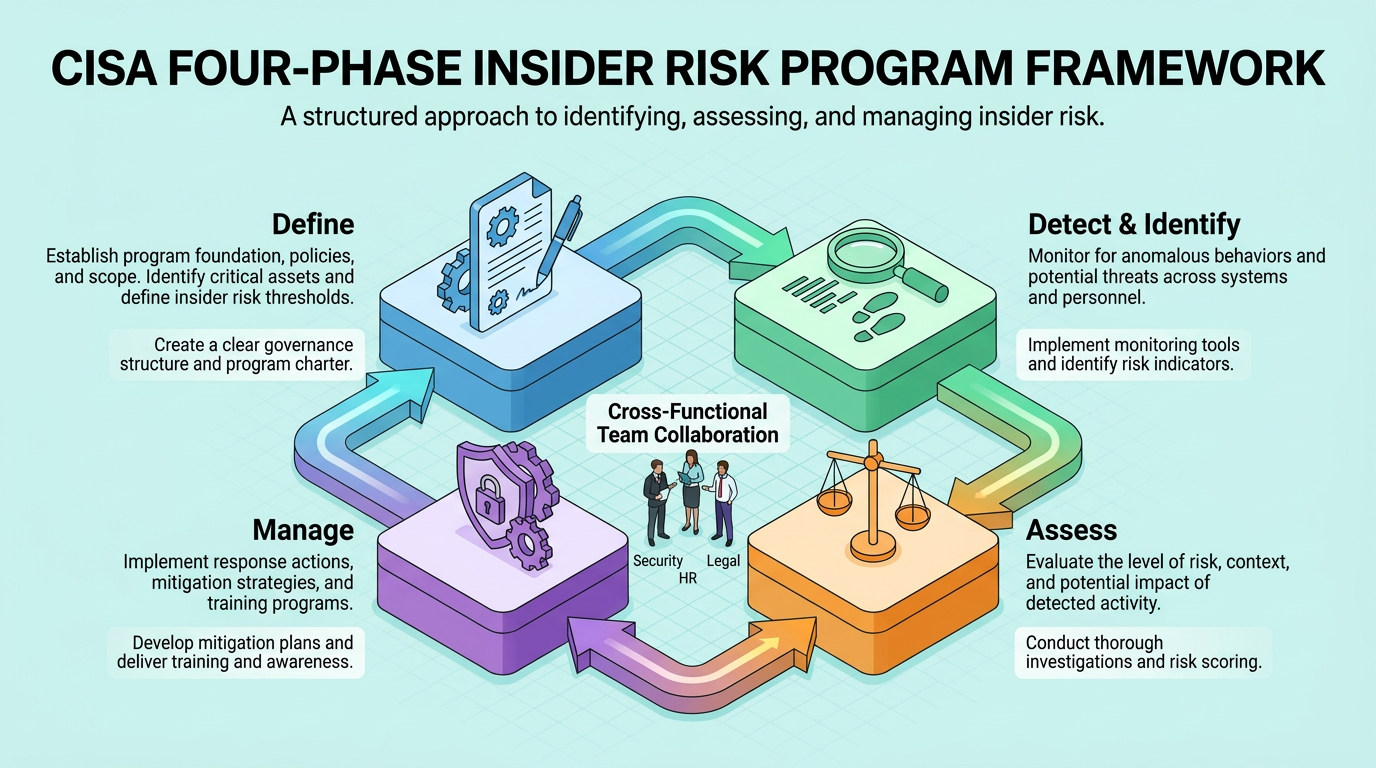
CISA organizes program-building into four phases, define, detect and identify, assess, and manage, and CERT/SEI's guidance supplies the operational detail that CISA's framework leaves open. CISA organizes the work around defining the program, detecting and identifying risk, assessing it, and managing the response. Together, these phases give security leaders a practical structure covering governance, scope, detection, assessment, response, and phased maturity.
Establish Insider Risk Governance and Cross-Functional Ownership
Governance determines whether insider risk signals become coordinated action or stay siloed. A program-wide governance group needs defined authorities, a mission, leadership support, and a budget.
Cross-functional teams that include the chief information security officer (CISO), HR, legal counsel, IT, compliance, and physical security can keep behavioral signals from going unnoticed between departments. The group needs authority to request cross-department investigations, and to assign responsibility for reviewing alerts, filtering false positives, documenting findings, and completing legal and compliance reviews. Clear separation of duties protects employees from unsupported conclusions while giving investigators timely context.
Define Insider Risk Scope and Conduct Risk Assessment
The Define phase sets program scope, identifies assets to protect, and establishes governance. A readiness assessment helps stakeholders gauge their ability to handle an incident and benchmark program maturity.
CISA recommends a dynamic insider threat risk registry with regular assessments, updated after resolving a case, after resourcing changes, and on a set cadence. Asset identification should cover intellectual property, customer data protection, and the operational, AI, and cloud systems where that data moves. Scope decisions should identify approved data sources, retention requirements, review authorities, and limits on how teams may use monitoring results.
Detect, Assess, and Manage Insider Risk
Detection, assessment, and management connect observable behavior to proportionate action: detection flags people or accounts showing concerning behavior, assessment weighs whether they have the interest, motive, access, and ability to cause harm, and management coordinates approved measures to monitor and reduce that risk.
Key decisions in these phases usually include:
Detection Inputs: Programs draw on security telemetry signals, behavioral indicators, and reports from managers or peers.
Assessment Context: HR, legal, and management input helps analysts judge whether activity reflects risk, error, or a benign business need.
Management Actions: Responses range from access restrictions and closer monitoring to formal personnel processes aligned with approved governance.
Documented decision criteria keep responses consistent and defensible.
Phase Insider Risk Program Implementation Over Time
Insider risk programs rarely succeed when teams launch every capability at once, so a phased rollout should align governance authority, monitoring capabilities, and response workflows before real incidents test them.
A practical sequence starts with governance and asset identification, then adds detection and assessment, and finally expands into broader behavioral monitoring, automation, and cross-functional response. Each phase needs measurable success criteria:
Priority Asset Coverage: The program can track whether approved monitoring reaches the information and systems with the greatest business impact.
Detection Performance: Teams can use mean time to detect and alert quality to evaluate whether new data sources improve investigations.
Review Completion: Workflow metrics can show whether HR and legal teams complete required reviews within established internal targets.
These criteria show leadership that the program is gaining real capability, not just expanding scope.
Why Rule-Based Detection Falls Short Against Insider Risk
Insider risk detection usually requires context that signature-based detection methods and static data loss prevention tools do not provide. Authorized users often perform the same technical actions during legitimate work and risky activity, which limits the value of isolated event matching.
Rule-based and threshold methods in intrusion detection and security information and event management systems can catch explicit policy violations, but they often miss context-dependent behavioral shifts and generate false positives when they lack information about user roles and work patterns.
DLP and insider risk management operate at different levels of analysis:
Data Loss Prevention: DLP enforces content-based policies on individual events, such as blocking a file that matches a classification label.
Insider Risk Management: Insider risk management asks whether an identity's pattern of access, timing, recipients, and volume has shifted enough to warrant human review.
The second question requires per-identity baselines that content-matching rules do not maintain. User and entity behavior analytics tools can help fill that gap by learning normal activity for users and devices and flagging departures against role context, peer-group norms, and timing.
Emerging Insider Risk Amplifiers: AI Tools, Remote Work, and Cloud Sprawl
AI adoption, distributed work, and cloud sprawl can increase insider risk exposure even when formal access controls stay the same. Security teams should account for several amplifiers:
Generative AI Tools: Employees may paste proprietary data into external AI services without malicious intent. Clear data protection practices can help teams define which information employees may share with approved tools.
Autonomous AI Agents: Agents that hold credentials and permissions add a new class of access holder, complicating the question of who or what performed an action.
Remote and Hybrid Work: Access spread across personal devices, home networks, and unmanaged endpoints widens the attack surface and reduces the visibility that on-premises monitoring once provided. Consistent identity and access management policies can reduce access drift across these environments.
Cloud and Software-as-a-Service (SaaS) Sprawl: Excessive privileges across infrastructure, platform, and software services often stem from insecure authentication and weak least-privilege enforcement. Over-privileged accounts in cloud and SaaS environments compound the detection challenge across insider risk categories.
Programs can address these amplifiers by extending governance, asset inventories, and access reviews to the services where employees and automated agents now work.
Insider Risk Indicators in Email and Communication Patterns
Email remains a primary entry point for cyberattacks and a common place to observe insider risk indicators tied to communication behavior. It is also a primary exfiltration pathway because insiders can send sensitive data to personal accounts or external parties through routine workflows. Communication patterns leave behavioral fingerprints even when each action looks legitimate.
For email-borne indicators, Abnormal uses behavioral AI to help surface deviations in workflow cadences, recipient behavior, timing, and engagement flows while complementing existing security infrastructure.
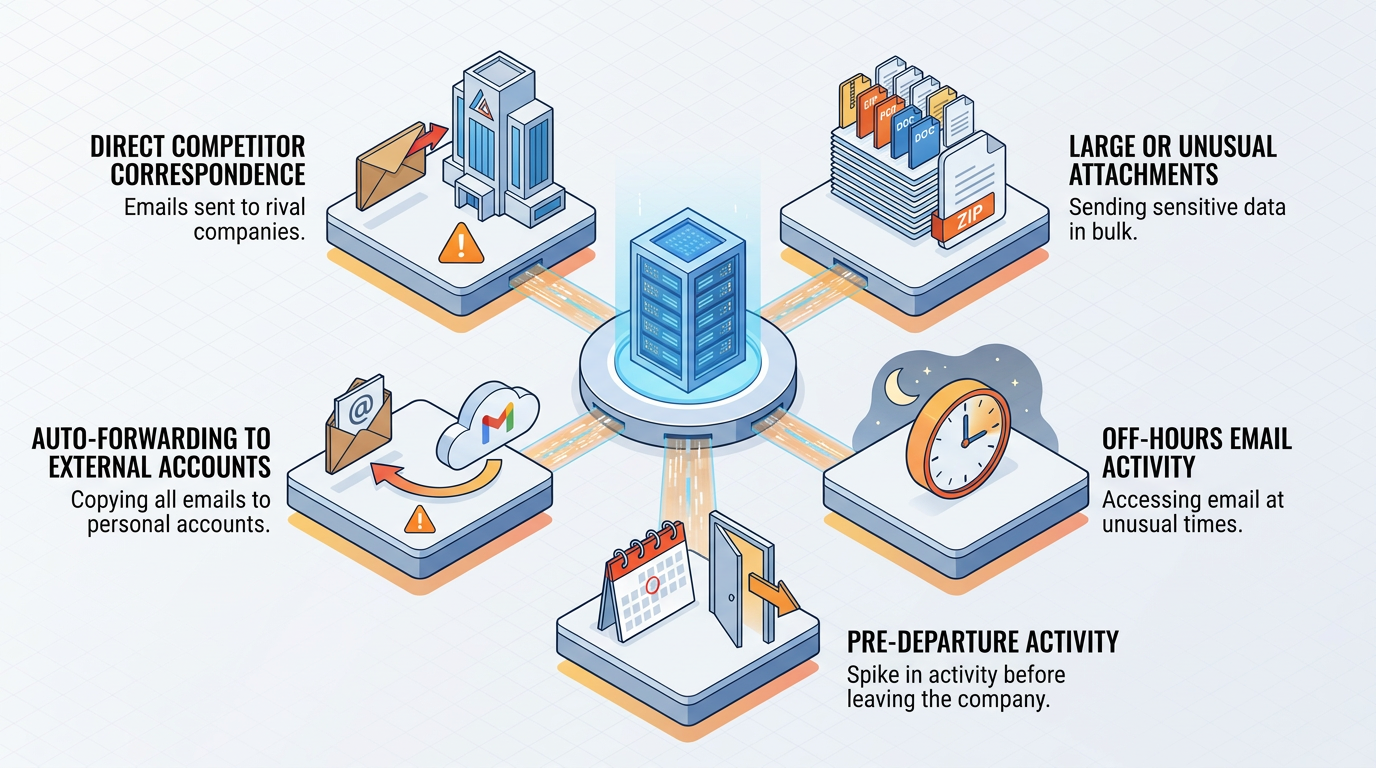
High-signal email indicators include:
Direct Correspondence with Competitors: Outbound email to known competitor domains, particularly with attachments, may warrant review when it falls outside an employee's normal responsibilities.
Large or Unusual Attachments: An email to an external recipient that exceeds per-user or per-role baselines can indicate accidental sharing, negligence, compromise, or intentional exfiltration.
Auto-Forwarding Rules to External Accounts: Forwarding rules can keep an adversary reading a victim's email after a credential reset. Audits should flag newly created rules that forward messages to external or freemail domains.
Off-Hours Email Activity: Sends, file access, or authentication events outside established working patterns deserve attention, especially when they coincide with access to sensitive repositories.
Pre-Departure Activity: Employees preparing to leave may present elevated intellectual property risk, so approved logs for users who have given notice can be checked for suspicious access, large transfers, or unusual after-hours activity.
No indicator proves intent on its own; context from HR, management, and phishing link indicators helps analysts separate routine work and mistakes from deliberate misuse.
Detection models work best when they track atypical behavior over time instead of isolated triggers. Composite signals, such as an off-hours login followed by unfamiliar system access and a large attachment send, can produce higher-confidence alerts than any of those events alone.
Legal and Privacy Constraints on Insider Risk Monitoring
Legal and privacy requirements shape insider risk program design from the start, and the boundaries differ by jurisdiction. These requirements affect what organizations monitor, how they document the purpose, and who can review the resulting information.
A legal and privacy review should address these areas:
European Union Monitoring: Employee monitoring can qualify as high-risk processing under the General Data Protection Regulation (GDPR), often requiring a Data Protection Impact Assessment before systematic behavioral monitoring begins. Consent is rarely a suitable legal basis in an employment relationship, so organizations typically document a legitimate interest or legal obligation instead.
AI-Driven Monitoring: The EU AI Act places added obligations on high-risk employment-related AI systems, so legal and privacy teams should review any automated system before it's used to evaluate employee behavior or support personnel decisions.
California Notice Requirements: California monitoring rules can require advance notice. Employers in regulated industries may face additional obligations under separate rules that layer on top of that baseline.
Healthcare Audit Controls: The Health Insurance Portability and Accountability Act (HIPAA) Security Rule requires mechanisms that record and examine activity in systems holding electronic protected health information, making insider risk monitoring a compliance concern as well as a security one.
Early legal and privacy involvement aligns monitoring with data protection requirements and connects identity records to approved investigation and breach-notification workflows.
Turn Insider Risk into a Managed Program
Insider risk programs work best when they replace ad hoc investigations with a structured operating model built on CISA's framework and CERT/SEI guidance. Security leaders can improve program maturity by combining security telemetry signals with HR context, documented legal review, and response procedures that account for both people and compromised accounts.
Effective programs also measure whether controls cover priority assets, improve mean time to detect, and support consistent decisions across security, HR, legal, compliance, and physical security. Email and identity indicators contribute useful context, and Abnormal can help surface the email and account-based components, but organizations should pair them with endpoint, cloud, physical, and personnel controls. That coordinated approach turns insider risk into a governed, measurable discipline rather than a series of isolated investigations.
For the email and identity layer of that discipline, Abnormal applies behavioral AI to detect compromised accounts, anomalous communication patterns, and the subtle workflow deviations that often precede data loss, integrating with existing security infrastructure rather than replacing it. This approach is why Abnormal was Named a Customers' Choice in the 2026 Gartner® Peer Insights™ Voice of the Customer for Email Security.
Book a demo to see how Abnormal can strengthen the email and account-based components of your insider risk program.
Frequently Asked Questions
How Should Organizations Handle the Legal and Privacy Challenges of Monitoring Employee Behavior for Insider Risk, Especially Across Multiple Jurisdictions Like the EU and California?
Treat compliance as a design constraint, not an afterthought, and form a cross-functional review team of data protection officers, employment counsel, and HR leadership before deploying any monitoring capability. Document the business justification against legitimate interests or legal obligations rather than employee consent, complete a Data Protection Impact Assessment for EU operations, and provide clear advance notice in California. Across jurisdictions, adopt the most restrictive applicable standard as the baseline and revisit practices as AI governance rules evolve.
What Specific Email and Communication Indicators Should Security Teams Monitor to Detect Potential Insider Risk Without Generating Excessive False Positives?
Layer multiple indicators together rather than relying on isolated triggers, since composite signals reduce false positives while improving accuracy. High-value combinations include access-privilege escalation paired with a surge in data movement, unusual authentication patterns, and repeated failed access attempts followed by successful access through an alternate path. Comparing an employee's communication volume, attachment size, and recipient distribution against peers in the same role also surfaces meaningful departures from normal behavior.
How Do Compromised Insider Investigations Differ From Malicious Insider Investigations, and How Can Teams Avoid Misattributing Blame to Innocent Employees?
Compromised insider investigations require forensic separation of credential activity from human intent, while malicious insider investigations focus on establishing motive and deliberate action. When credentials are hijacked, investigators can use session and identity signals to distinguish attacker-controlled activity from legitimate use. Treating initial alerts as credential compromise first and intent second, preserving a forensic timeline, and involving legal counsel before any personnel decision helps keep blame from landing on an employee whose account, not judgment, was the problem.