Points clés
Security leaders need a repeatable way to determine where sensitive information resides, who can access it, and how it leaves the organization. That visibility gives Chief Information Security Officers (CISOs) a practical foundation for prioritizing and closing gaps as emerging email threats change.
A data risk assessment for email can uncover email security vulnerabilities before attackers exploit them. Email remains a primary entry point for cyberattacks, and mailboxes contain intellectual property, regulated records, and financial data that employees share externally each working day.
This article explains how to inventory sensitive data, audit access controls, evaluate user behavior, scope third-party integrations, and rank findings by likelihood, impact, and compliance exposure. Getting this sequence right shapes whether a breach surfaces as a controlled remediation item or as a regulator-facing incident with material financial and reputational consequences.
Key Takeaways
A data risk assessment reveals the access, behavior, and integration gaps that expose sensitive email data.
Orphaned accounts and overly permissive mailbox delegation create exploitable gaps that call for regular access control audits.
Bulk forwarding, personal-account transfers, and misdirected messages make behavioral monitoring more useful than policy alone.
Third-party mailboxes and connected applications widen exposure beyond the organization's own tenant.
Continuous anomaly detection and automated remediation extend email risk defense beyond periodic audits.
Why Email Creates Unique Security Challenges
Email functions as both a communication tool and a repository for sensitive business information, which makes it a prime target for attackers. The European Union Agency for Cybersecurity (ENISA) found in its 2025 Threat Landscape report that phishing — including vishing, malspam, and malvertising — accounted for roughly 60% of the 4,875 incidents it analyzed between July 2024 and June 2025. Routine external sharing creates further exposure because unintended recipients can receive forwarded or misaddressed messages.
Unstructured content complicates protection further. Traditional security tools struggle to detect and manage information scattered across conversation threads, attachments, and forwarded chains. Legacy archives compound the problem because retaining historical email longer than necessary increases the volume of data that a breach of that store could expose.
Employees also handle substantial message volumes daily. Three recurring risks expand the attack surface for email:
Credential phishing campaigns exploit this exposure.
Social engineering attacks compound the same exposure.
Accidental exposure through misdirected email can send sensitive data to unintended recipients.
Technical controls alone often struggle to address these vulnerabilities.
Primary Phases of a Data Risk Assessment
A complete email data risk assessment moves through four connected phases: locating sensitive data, auditing who can reach it, evaluating how employees handle it, and scoping the third parties that touch it. Each phase closes a different gap, and skipping one leaves the others working with incomplete information — an access review means little without knowing which mailboxes hold regulated records, and behavioral monitoring loses context if vendor integrations sit outside the picture.
1. Identify Sensitive Data
Locating the sensitive data itself is the first phase, because mitigation stays incomplete without that inventory.
Corporate communications regularly carry several categories of sensitive content:
Personally Identifiable Information (PII): Names, addresses, Social Security Numbers, and national identification details.
Financial Data: Credit card numbers, payroll records, and other transaction details.
Health Records: Patient and clinical information covered by cybersecurity regulatory compliance frameworks.
Intellectual Property: Trade secrets, contracts, source code, and patents, which are equally prominent targets for data breaches.
Application programming interface (API) scanning can support efforts to discover and label unstructured data buried in message threads and attachments. Automated tagging can then sort messages by sensitivity tier. Classifying content before an email security incident, rather than after one, gives prevention controls something concrete to act on.
2. Analyze Access Controls and Permission Risks
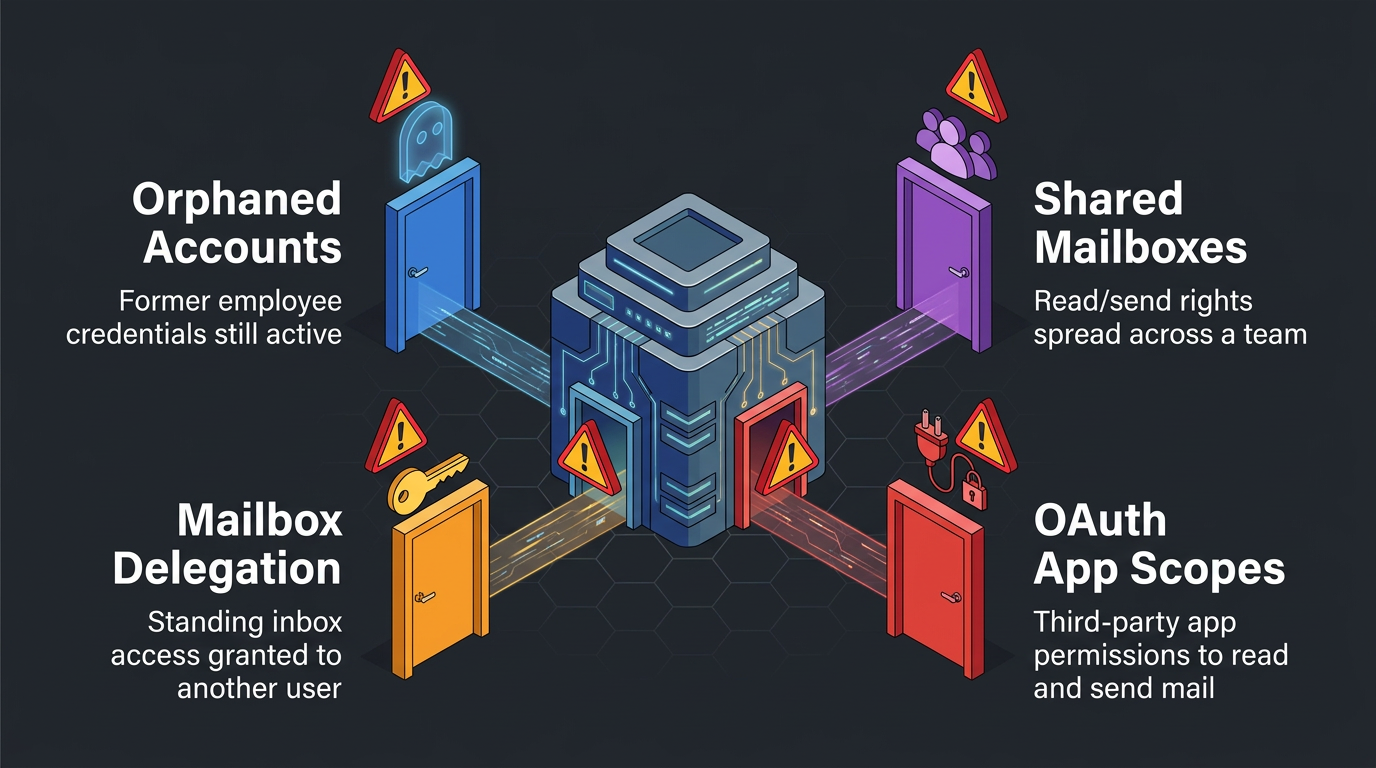
Access control forms the backbone of email data security. Security teams can begin by inventorying access points into the mail environment and reviewing what each one can reach:
Mailbox delegation permissions grant standing access to another user's inbox.
Shared mailbox access spreads read and send rights across a group rather than an individual.
Orphaned accounts retain live access after their owner has left.
Application authorization scopes define what connected apps can read and send on a user's behalf.
Attackers can exploit any of the four when organizations leave them unmanaged. Orphaned accounts, often belonging to former employees, provide entry points long after offboarding. Pairing permission reviews with lifecycle workflows that strip licenses and delete accounts at departure can close that gap. Limiting what users can approve themselves and routing other requests to an administrator can keep OAuth grant decisions with the security team.
Disabling automatic external forwarding can close a common exfiltration path for careless employees and attackers who plant client-side forwarding rules. Least privilege principles provide the longer-term fix: when users reach only the data their roles require, the blast radius of a compromised account shrinks.
3. Evaluate User Behavior and Data Handling Practices
Behavioral analytics and anomaly detection can help surface risky sharing patterns before they lead to breaches. Security teams can monitor for several comparable behaviors:
Bulk forwarding can move large volumes of sensitive information outside approved workflows.
Insecure channels can expose data without the protections applied to corporate email.
Responses to phishing attempts can disclose credentials or initiate unauthorized activity.
Sharing work credentials can give another person access to protected systems and information.
Transfers between personal and work accounts can indicate an accident or deliberate data staging.
An employee who accidentally forwards sensitive content to a personal account can look much like an insider staging data for exfiltration, which is why teams need to score the behavior itself. Much of this exposure traces to insider actions and errors rather than external intrusion.
The UK Information Commissioner's Office (ICO) reported in its 2024/25 annual report that emailing, posting, or faxing information to the wrong recipient is the most commonly reported incident type, accounting for just over 18% of reported breaches.
Mitigating these threats takes more than a policy document. Behavior-based controls can limit bulk forwarding and personal-account transfers, enforced encryption in transit protects data as it travels, and just-in-time security coaching reinforces safe behavior when someone is about to make a mistake. Abnormal's behavioral AI can help flag unusual behavior within internal communications that may signal data exfiltration or policy violations, alongside security awareness training programs tied to employees' real work.
4. Assess Third-Party Integration and Supply Chain Risks
External applications and compromised vendor mailboxes expand the communication risk surface well beyond an organization's own tenant. Supplier account compromises, unauthorized auto-forward rules, access logging gaps, and third-party application permissions all belong in scope. The ENISA Threat Landscape report found that supply chain risks made up 10.6% of incidents.
Once an attacker holds an access token for a malicious or compromised application, refresh tokens can keep that access alive long term. From there, the attacker can read mail and enumerate contacts through the API.
Four controls can reduce this exposure:
Security teams can identify and document each third-party integration, then confirm it remains necessary for current operations.
Scoping vendor and application permissions to essential resources can keep sensitive systems out of reach.
Regular API audits can reveal unusual behavior or unauthorized access attempts that could signal an account compromise.
Continuing vendor assessments can evaluate security practices and compliance with industry standards beyond onboarding.
Running these checks on a recurring cadence means a supplier whose credentials are stolen can surface between formal vendor reviews.
How to Prioritize Findings from an Email Data Risk Assessment
A scoring system that weighs likelihood of exploitation, potential impact, and compliance exposure puts remediation effort where it reduces the most risk. A publicly reported email breach involving protected health information (PHI) forwarded externally, or unrestricted vendor access to finance mailboxes, lands at the top because the consequences are severe and the exposure is easy to exploit. Linking this process to email data loss prevention can help teams turn risk rankings into targeted controls.
Score Each Email Data Risk by Likelihood and Impact
The National Institute of Standards and Technology's SP 800-30 Rev. 1 (NIST) defines risk as a function of the adverse impact if an event occurs and the likelihood that it does, which in practice means Risk = Likelihood × Impact. Teams can rate impact by the sensitivity and volume of data a mailbox, rule, or integration exposes, then rate likelihood by how reachable that exposure is to an attacker or a careless insider. The same guidance notes that the resulting risk level is typically no higher than the impact level and that several moderate risks in one area can aggregate into a higher risk than any of them alone.
It helps to sort findings into three tiers:
High Priority: Teams can remediate unrestricted access or externally forwarded health records immediately.
Medium Priority: Teams can review and clear dormant mailboxes holding intellectual property on a set schedule.
Low Priority: Routine coaching can address minor policy violations involving low-sensitivity data.
Risk matrices, weighted scoring models, and data classification tiers make the ranking defensible when the board or an auditor asks why the organization fixed one finding before another.
Map Each Finding to Compliance Exposure
Compliance exposure is the third input, and for regulated organizations it often decides the order. The Health Insurance Portability and Accountability Act (HIPAA) Security Rule requires an accurate and thorough assessment of risks to electronic protected health information (ePHI), as HHS risk analysis guidance sets out, which covers all ePHI. General Data Protection Regulation (GDPR) Article 32 requires organizations to regularly test, assess, and evaluate the effectiveness of security measures, which a single point-in-time email audit is unlikely to satisfy. Distinguishing quick wins from strategic projects lets teams close the compliance-sensitive gaps first.
Implementing Continuous Email Data Risk Monitoring
Point-in-time audits of email data security fall short because the environment they measured keeps moving after teams file the report. Security teams can reassess exposure when vendors connect, staff leave, and forwarding rules change rather than waiting for an annual review.
Abnormal's behavioral AI for email is built for this continuous layer. Its monitoring capabilities include:
It learns the organization's normal workflow cadences, vendor interaction patterns, recipient behavior, and message timing.
Adaptive risk scoring shifts as the organization changes, so the picture stays current between formal reviews.
Deviations such as unusual data movement, a sudden change in a vendor's banking details, or a new external forwarding destination can help surface a problem, often before significant damage occurs, including email threats that static rules have never seen.
Automated email remediation workflows can act on confirmed issues instead of queuing them for the next review cycle.
API deployment requires no MX record changes or endpoint agents, and detections feed the security information and event management (SIEM) and security orchestration, automation, and response (SOAR) tools the team already runs.
Together, these capabilities enhance the existing security stack rather than replacing it.
Strengthen Your Email Data Security Now
Managing email data risk requires assessment, prioritization, and monitoring as the environment changes after an audit closes. Mapping data, auditing access, and monitoring behavior give CISOs a defensible way to strengthen their Microsoft 365 security posture and report progress to the board and regulators.
The 2026 Gartner® Peer Insights™ Voice of the Customer for Email Security named Abnormal a Customers' Choice. Ready to improve your email security with continuous risk monitoring? Get a demo to see how Abnormal can help identify and address vulnerabilities before they lead to breaches.
Frequently Asked Questions
How Often Should an Organization Run an Email Data Risk Assessment?
A formal assessment on an annual cadence gives most organizations a useful baseline, but the underlying risks change faster than that schedule allows. Reassessing whenever a vendor connects a new application, an employee leaves, or a forwarding rule changes catches gaps between scheduled reviews. Continuous monitoring closes the remaining distance by flagging unusual behavior as it happens rather than waiting for the next audit.
How Is an Email Data Risk Assessment Different From a Compliance Audit?
A compliance audit checks whether an organization meets the specific controls a regulation requires, such as HIPAA's risk analysis rule or GDPR's Article 32 testing requirement. An email data risk assessment is broader: it looks at how sensitive data actually moves through mailboxes regardless of which regulation applies, then ranks findings by real-world exploitability. The two overlap, and a well-run risk assessment usually satisfies much of what a compliance audit will later ask for.
Who Should Be Involved in an Email Data Risk Assessment?
Security and IT teams typically lead the technical review of access controls, forwarding rules, and third-party integrations. Compliance or legal stakeholders help score findings against regulatory exposure, since a health record and a financial record carry different consequences depending on the framework involved. Department managers can also flag which mailboxes hold the most sensitive day-to-day data, since they often know this better than a central security team does.