Principais insights
Detection engineering represents a fundamental shift in how mature organizations approach threat identification, moving beyond ad-hoc rule writing to treating production security detections like software. It applies version control, testing frameworks, and continuous improvement cycles to detection logic.
Organizations need a systematic blueprint for reducing noise without sacrificing coverage. A mature practice combines detection-as-code discipline with AI-powered enrichment, and lean security operations center teams (SOC teams) can build it incrementally without adding headcount.
The article below walks through that sequence in order, from version control to AI-assisted tuning, because getting the order right is what determines whether false positives actually drop.
The guidance draws from Abnormal's webinar on human-centered AI in the SOC. Watch the full recording to hear implementation strategies directly from security practitioners.
Key Takeaways
Detection engineering applies software engineering rigor through version control, testing frameworks, and continuous integration and continuous delivery (CI/CD) pipelines.
AI-powered enrichment reduces analyst triage work by automating context gathering and preliminary analysis.
Systematic MITRE ATT&CK mapping supports proactive coverage management and data-driven prioritization.
A working program raises detection coverage and quality while the team stays the same size.
Human-centered automation reduces repetitive toil while preserving analyst judgment for critical security decisions.
What Is Detection Engineering?
Detection engineering is the disciplined practice of designing, building, testing, and maintaining security detections using software engineering principles. It applies repeatable methods across security incident response workflows to produce measurable, continuously improving detections.
Modern detection engineering means "taking an engineering approach and moving towards detection-as-code," as Sricharan Sridhar, who leads cyber defense at Abnormal, describes it in the webinar. Rules stop being artifacts someone wrote once and become managed, versioned, and tested assets with owners.
Three engineering controls manage the detection lifecycle:
Version Control: Lets teams track changes and roll back problematic modifications.
Testing Frameworks: Catch logic errors before deployment.
CI/CD Pipelines: Automate the deployment itself.
Together, these controls build durable coverage without accumulating technical debt.
Teams often blur four terms that mark distinct, measurable stages:
Detection: The logic itself, such as the query or model that evaluates security telemetry data for a specific condition.
Alert: The object a detection emits when it fires, carrying metadata like severity, confidence, and mapped technique.
Enrichment: The context added after the alert, including asset ownership, historical occurrences, and related activity.
Investigation: The documented enrichment plus the analyst-led or AI-drafted analysis that leads to a disposition.
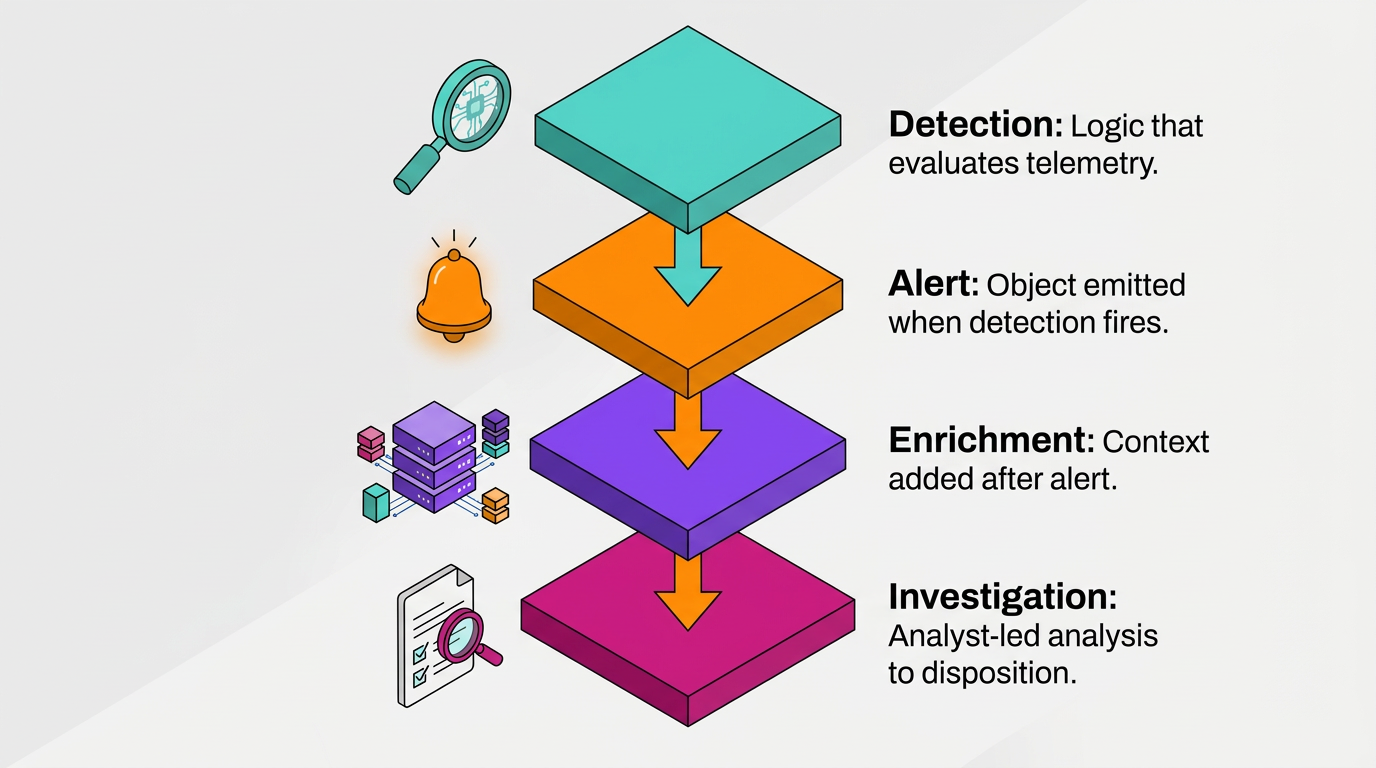
Detection engineering operates as an iterative, continuous, and collaborative lifecycle. A detection lifecycle can include stages such as:
Form a hypothesis and design the detection.
Implement the logic and route it through peer review.
Validate against known attack patterns, then deploy.
Tune on measured false positive data.
Retire the detection when it stops producing signal.
Each stage produces a record, so later tuning decisions rest on measured evidence.
Detection Engineering vs. Traditional Alert Writing
Traditional alert writing treats detections as isolated responses to specific incidents, while detection engineering manages them as a portfolio that balances false positives and negatives.
The differences become clear across four shared attributes:
Attribute | Traditional Alert Writing | Detection Engineering |
|---|---|---|
Development | Teams create rules reactively after specific incidents. | Teams design rules from hypotheses and coverage priorities. |
Validation | Rules receive limited testing and inconsistent review. | Peer review and automated testing validate logic before deployment. |
Maintenance | Hard-coded exceptions contribute to rule sprawl and technical debt. | Version control and structured context keep changes auditable and maintainable. |
Measurement | Teams suppress whichever alert generated recent noise. | Per-rule data guides refinement, splitting, or retirement. |
This managed approach helps teams identify effective rules, noisy logic, and coverage gaps across signature-based security detections. Coverage maps against the MITRE ATT&CK framework, and evidence guides prioritization.
Why Detection Engineering Reduces SOC Burnout
Detection engineering reduces repetitive triage, giving analysts more time for investigation and threat hunting.
The False Positive Problem
Benign alerts can create operational paralysis in modern SOCs through three related consequences:
Benign Volume: In the webinar, Sreeharsha Dugga, Cyber Defense Operations Manager at Abnormal, reports a 60-70% benign alert rate, which means analysts can spend much of their time chasing noise, leaving less time to identify genuine threats. The SANS SOC Survey also found that nearly half of alerts go completely uninvestigated. This high volume highlights a gap that traditional alert writing does not close on its own.
Tuning Risk: Security leaders "have to be very cautious tuning on these alerts" to maintain security posture management. Aggressive tuning risks missing actual attacks, while conservative approaches leave analysts with unnecessary work. Detection engineering addresses that balance through data-driven tuning and continuous validation.
Context-Switching Overhead: Without engineering practices, alerts consume significant time as analysts switch between services and tools to gather context. High-volume alert queues make that manual overhead difficult to sustain.
Together, these pressures make systematic tuning and enrichment operational priorities.
Business and Operational Benefits
Organizations that pair detection engineering with AI and automation can cut breach costs substantially. According to IBM's 2026 Cost of a Data Breach Report, organizations using AI and automation extensively saved an average of $1.93 million per breach compared to organizations that used none.
Manual processes contribute to SOC analyst burnout, so an automation-first approach also addresses a retention problem. Threat hunting fills gaps that rules leave, including techniques that attackers execute through legitimate administrative tooling and states of compromise that no single event reveals. By reducing alert fatigue effects, detection engineering gives analysts more time for hunting hypotheses, purple teaming, and detection development.
How Detection Engineering Reduces False Positives
AI enrichment and integrated workflows reduce false positives by adding context, correlating related activity, and returning investigation outcomes to detection logic.
AI-Powered Enrichment Layer
AI-powered enrichment adds business and historical context to raw alerts through several functions:
Summarization and Context: "The SOC platform was able to summarize and help us with context gathering, deduplication, and analytics on any past occurrences," Sreeharsha explains. Enriched alerts arrive with relevant business context, historical patterns, and a preliminary risk assessment attached.
Alert Correlation: Teams can group related alerts by entity and time window to keep analysts from investigating the same underlying activity several times.
Telemetry Analysis: Platforms with AI-powered data analysis can surface findings from security telemetry.
This enrichment gives analysts a supported starting point for each decision.
Integration Architecture
Detection engineering delivers the most value when teams integrate it across the entire security stack. Unified security visibility and automated response workflows depend on that integration.
An integrated architecture assigns distinct roles across the stack:
Shared Workflows: Connecting security information and event management (SIEM) platforms, endpoint detection and response tools, and data access platforms into shared workflows makes it possible to automate SOC operations and correlate alerts across sources.
Workflow Automation: Workflow automation handles context gathering, event deduplication, and alert routing by severity and expertise.
Endpoint and Email Context: Endpoint detection sees process execution and lateral movement, while the email layer sees the credential phishing message or vendor impersonation that preceded them.
These connections also create a feedback loop. When an endpoint investigation confirms that an email alert was a true positive, teams can feed that outcome back into detection scoring and tuning.
How to Build Your Detection Engineering Practice
Teams can build a detection engineering practice incrementally, starting with version control and adding enrichment, framework mapping, and tuning as each layer stabilizes.
Step 1: Establish Detection-as-Code Workflows
Teams can migrate existing detection logic into a version-controlled inventory and require peer approval before changes reach production. Each rule can carry structured metadata, including author, mapped ATT&CK technique, expected false positive sources, and a status field that distinguishes experimental rules from stable ones.
AI can accelerate workflow automation from there. When creating runbooks, teams can "ask AI to convert this as a JSON, validate data, test it, and then deploy it," as Sreeharsha notes. That conversion reduces friction between documented procedures and automated responses.
Step 2: Implement AI Enrichment for Context
Teams can structure enrichment around two distinct roles: automated preparation and human decision authority. On the preparation side, teams can configure the enrichment layer to supply asset ownership, prior occurrences of the same pattern, and related activity from the same sender or host before analyst review. According to the webinar, investigation time drops when AI handles context gathering and preliminary analysis, preserving investigation quality while reducing repetitive work such as switching between tools and gathering baseline information.
Decision authority stays with the analyst. As Sreeharsha puts it in the webinar: "AI drafts the context, timelines, and suggestions. Humans decide on actions." That division preserves human judgment while automating preparatory work, so teams can focus their review on the evidence and recommended disposition.
Step 3: Map to the MITRE ATT&CK Framework
Framework alignment provides the foundation for systematic coverage management. Teams can apply it through three practices:
Granular Mapping: Mapping detections to techniques means each rule contributes to a documented defensive posture. Teams can map at the sub-technique level where possible. The ATT&CK framework integrates detection strategies and analytics alongside techniques and sub-techniques.
TTP Prioritization: Teams can prioritize tactics, techniques, and procedures because IP addresses, domains, and file hashes expire quickly. Behavioral TTPs stay useful across campaigns and threat actors.
Coverage Gap Analysis: The mapping can reveal techniques present in threat intelligence but absent from detection capability, such as credential phishing, malicious attachments, vendor email compromise, and emerging generative AI attacks.
Prioritizing from that gap analysis directs resources to relevant risks.
Step 4: Tune Detection Logic with AI Assistance
Teams can use AI to tune detection logic continuously, which can reduce false positives while improving coverage. Three practices support that process:
Feedback Loops: Feedback loops can connect analyst investigations back to detection refinement, so patterns analysts repeatedly close as benign inform later tuning.
Context Separation: Teams can keep organizational context out of rule logic itself. Business exceptions such as approved VPN egress, known service accounts, or scheduled administrative jobs belong in a separate context layer that detections reference. Hard-coded exclusions can break when the environment changes.
Behavioral Email Context: For email-borne threats, Abnormal's behavioral AI models vendor interaction patterns, recipient behavior, and timing, so a change to banking details sent outside business hours can surface as a deviation from an established pattern.
Proactive security posture management can help identify configuration weaknesses before attackers exploit them.
Measuring Detection Engineering Success
A working program uses per-rule data to show that detection quality and validated coverage are rising without increasing team size.
Key Metrics
Teams can track three core measures to assess detection engineering performance:
Detection Quality: Teams can track false and true positive rates by detection type to identify tuning candidates and measure improvement over time.
Validated Coverage: Validated, active coverage against the MITRE ATT&CK framework shows defensive posture.
Operational Efficiency: Analyst triage time per alert category reveals operational efficiency.
These measures connect detection performance to both security outcomes and analyst workload. Metrics that reward volume can obscure quality. For instance, alert count alone may encourage teams to generate more alerts regardless of their value. The ultimate measure, as Sreeharsha puts it, is "higher coverage and quality without actually changing the headcount."
Continuous Improvement
Static detection programs lose effectiveness as threats change and environments shift, so teams can use a fixed, documented audit cadence to keep reviews predictable. More frequent review of high-volume detections focuses effort where drift consumes the most analyst time.
For each audited rule, teams can record three points:
Confirmed Signal: Record whether the rule has produced a confirmed true positive.
Available Telemetry: Confirm whether the underlying telemetry source still exists.
Measured Noise: Compare its false positive rate with the previous review.
Teams can retire detections that no longer produce actionable signal or rely on telemetry that has disappeared. Those records also support false positive reduction practices with evidence.
Building the Detection Engineering Team
Effective detection engineering teams combine security expertise, AI fluency, and shared operational responsibility. Teams can apply that model through several complementary practices:
Flat Operations: Flat structures where analysts can deliver operations at the same level keep coverage spread across capabilities instead of creating bottlenecks around specialized expertise.
Analyst Upskilling: Upskilling existing analysts provides a direct path to capability building. Sreeharsha encourages team members to "be more of an AI generalist or power user." Gartner's Alex Michaels made the same point in the firm's cybersecurity trends for 2026: "To realize the full potential of AI in security operations, cybersecurity leaders must prioritize people as much as technology."
Practical Training: Tools like Abnormal's AI Phishing Coach can help teams recognize sophisticated attacks while reinforcing security awareness across the organization.
Human Decision Authority: Sreeharsha explains, "We are not replacing the analyst. We are replacing the toil and elevating the expertise." He also notes, "We are a lean team. We rely heavily on automation and AI to cut noise and keep analysts focused on high signal work."
This operating model can reduce SOC analyst burnout by automating mechanics while analysts retain decision authority.
Turn Detection Engineering into a Measurable SOC Advantage
Detection engineering moves security operations from reactive rule maintenance toward measurable coverage, controlled change, and evidence-based tuning. Teams can start with a version-controlled detection inventory, establish baseline quality metrics, and prioritize the rules that consume the most analyst time. From there, AI enrichment, integrated workflows, and ATT&CK mapping support broader false positive reduction and a more sustainable SOC modernization roadmap, showing which detections work, where coverage remains incomplete, and how each change affects analyst workload.
The enrichment and tuning work at the center of that roadmap is exactly what Abnormal's behavioral AI is built to handle: it gathers context, deduplicates related alerts, and flags Microsoft 365 misconfigurations through Security Posture Management before attackers can exploit them, while AI Phishing Coach turns real attacks Abnormal has already stopped into targeted training that reinforces analyst upskilling.
Book a demo to see how Abnormal fits into your detection engineering roadmap.
Frequently Asked Questions
What Is Detection Engineering, and How Does It Differ From Writing Rules After an Incident?
Detection engineering designs, builds, tests, and maintains detections that evaluate security telemetry data with software engineering methods, so rules carry owners, version history, and metadata without accumulating untested sprawl.
How Does Detection Engineering Lower False Positive Rates?
Measured per-rule false positive rates decide which detections get refined, split into variants, or retired, and peer review plus automated testing catches noisy logic before deployment.
Which Metrics Show That a Detection Engineering Program Is Working?
Track true positive rate and per-rule false positive rates alongside validated MITRE ATT&CK framework coverage, and avoid alert counts or total rules deployed, which reward volume.