Key Insights
Email attacks now unfold inside trusted cloud environments, where context matters as much as content. Cloud detection and response (CDR) delivers continuous, cloud-native protection designed to detect threats after they move beyond perimeter controls.
Traditional tools were built to inspect messages before delivery, not to track what happens after a user authenticates and starts acting inside trusted systems. Closing that gap requires visibility that follows behavior across the whole session, not just the inbox.
Key Takeaways
- Legacy email gateways (SEGs) often lose visibility once authentication completes, leaving business email compromise (BEC) and insider threats harder to catch inside trusted sessions.
- Behavioral AI builds baselines for each user and vendor relationship, surfacing unusual identity, session, and device signals that static rules typically miss.
- Post-delivery remediation can pull malicious messages from affected mailboxes and prompt credential resets after a threat has already reached the environment.
- API-based deployment lets security teams roll out cloud detection and response without rerouting mail flow or disrupting existing operations.
What Is Cloud Detection and Response?
Cloud detection and response secures email environments through behavioral analytics, automated investigation, and response orchestration that traditional perimeter controls often do not provide on their own.
Behavioral Email Visibility
CDR establishes behavioral baselines for each user, mailbox, and integrated application by tracking communication patterns, sign-in activity, and vendor interaction dynamics. Automated investigation correlates signals across cloud email, identity, and integrated collaboration platforms where deployed to help identify genuine threats. Response orchestration isolates compromised accounts and helps remove malicious messages before employees engage with them.
Continuous telemetry streaming delivers prioritized alerts while automated remediation addresses threats, often before significant damage occurs. Analytics enriched with sandboxing and threat intelligence keep security teams focused on genuine risks instead of alert fatigue. This visibility also helps analysts see whether suspicious activity reflects normal workflow cadence, a vendor interaction change, or a signal that needs response.
API-Based Response Orchestration
Through cloud APIs, CDR evaluates activity that develops after initial delivery and authentication. This approach helps surface post-delivery phishing, insider threats, and lateral movement that legacy tools may miss once attackers authenticate.
The response layer prioritizes signals that show intent, including post-delivery message changes, unusual recipient behavior, identity signals, and session and device signals tied to the mailbox. These signals help analysts understand whether suspicious activity reflects an isolated phishing attempt, an account takeover pattern, or vendor email compromise. The rollout framework below covers how teams can validate permissions, confirm mailbox coverage, map response actions to incident types, and stage automation so containment supports existing identity and email operations.
Where Traditional Email Security Struggles in Cloud Environments
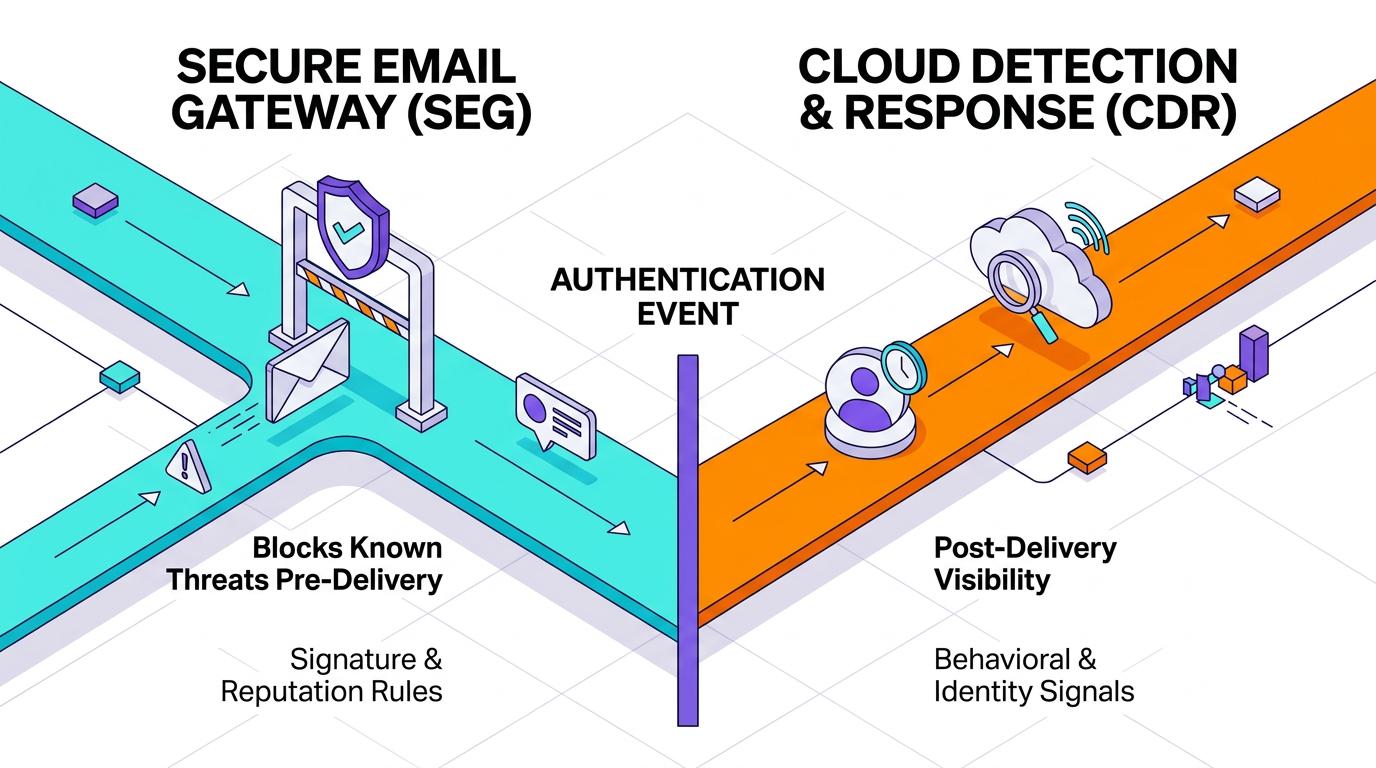
Legacy email defenses often miss post-delivery threats that appear after users authenticate, which exposes organizations to attacks operating inside trusted sessions.
Gateway Visibility Limits
Email gateways (SEGs) scan inbound traffic before messages reach cloud email environments, then often lose visibility once authentication completes. Signature rules block known malware but can struggle to catch trusted vendors changing bank details or insiders forwarding confidential files to external accounts. SEGs still play an important role in layered email security, especially for known malicious content, but their vantage point may not capture the behavioral context that emerges later in a trusted session. The stakes keep climbing: according to the FBI IC3, BEC losses reached $3.05 billion in 2025, the second-largest loss category in its annual Internet Crime Report.
Rule-Based Detection Gaps
Static rules also struggle to interpret behavioral context. BEC carries no malicious attachment or link, so gateway filters frequently approve these threats without question. Spear-phishing campaigns mimicking internal communication tone can slip past these policies through slight variations in wording, new domains, or AI-generated lures that evade signature-based detection.
Analysts face high alert volume because legacy systems struggle to distinguish legitimate unusual requests from genuine threats. Perimeter-centric tools lose effectiveness after attackers validate credentials. For security teams, the challenge is not simply scanning more content, but understanding whether a request fits the sender's timing, relationship patterns, and expected workflow. Effective detection requires behavioral analysis that follows intent, not just traffic patterns, to identify threats hiding within authenticated sessions.
How Behavioral AI Powers Cloud Detection and Response
Behavioral AI helps cloud detection and response identify suspicious deviations across user, mailbox, and vendor interaction patterns in cloud email.
During initial deployment, behavioral models analyze activity patterns including message timing, writing style, workflow cadences, and email behavior surrounding payment requests for each mailbox. This learning phase captures the communication fingerprint of each user and vendor relationships, building baselines that would be difficult to create manually.
After the platform establishes these baselines, it highlights unusual activity that can escape human detection: identity signals that diverge from expected behavior, a wire-transfer request that breaks from a vendor's typical invoicing pattern, or a sudden shift in recipient behavior. The system correlates email signals with identity signals and integrated collaboration signals pulled through cloud APIs, turning isolated suspicious activity into clearer account takeover indicators.
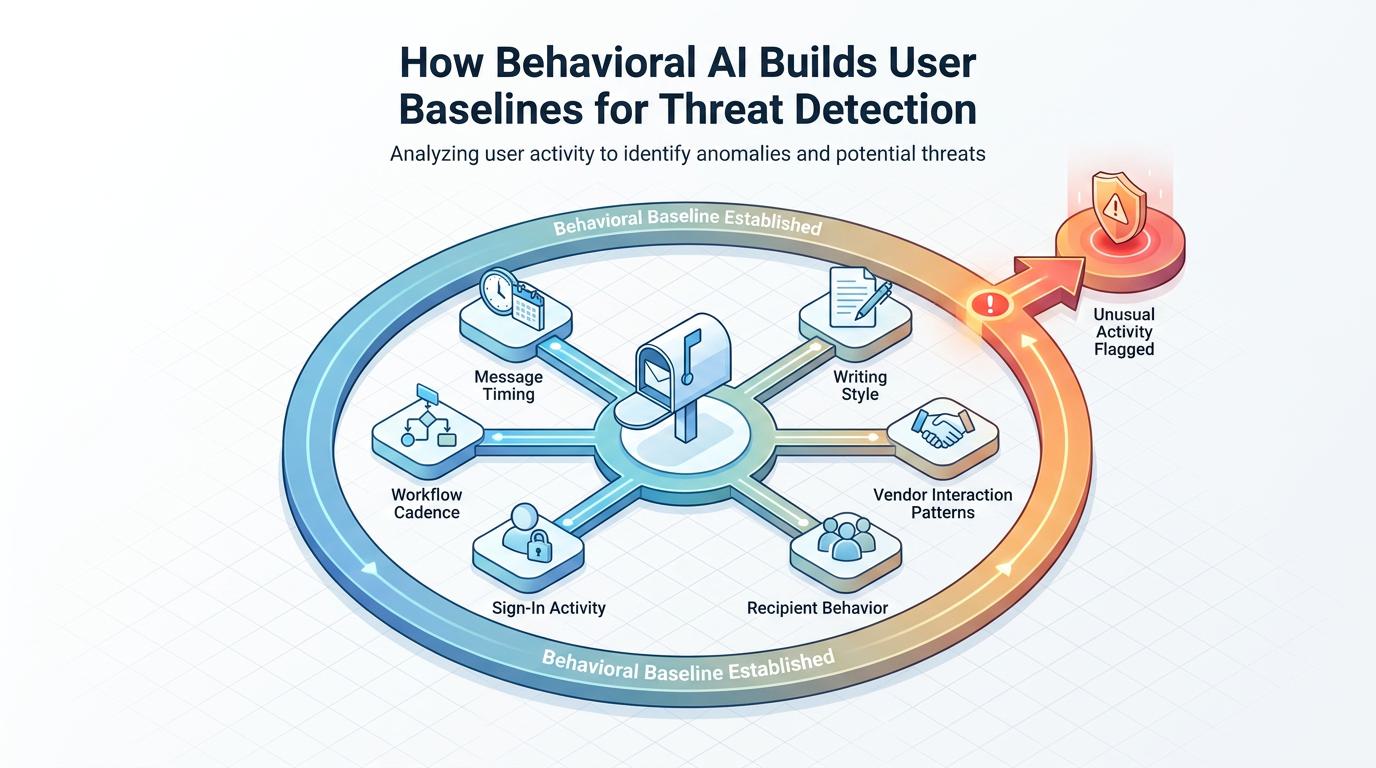
Algorithms retrain continuously to help catch zero-day phishing that contains no malware or malicious URLs. This approach strengthens detection after delivery while adapting as attacker behavior shifts and helping remove threats before employees can interact with them.
Core Capabilities of Effective Cloud Detection and Response
Effective cloud detection and response platforms deliver protection through continuous monitoring, automated investigation, and rapid remediation that work together across your email infrastructure.
- Continuous Monitoring: Mature platforms provide ongoing mailbox visibility by prioritizing behavioral signals from email activity, identity context, and message content. By streaming telemetry through cloud APIs, these systems inspect email metadata, identity signals, and message content as it arrives, then surface suspicious activity for review. This cloud-native approach helps teams compare new events against user, vendor, and recipient behavior patterns while scaling protection as new accounts or tenants come online.
- Automated Investigation: Machine learning models correlate signals from email, identity, and integrated collaboration services, grouping related alerts into single incidents so analysts focus on what matters most. Intelligent playbooks can trigger deeper sandbox analysis, enrich events with threat intelligence context, and assign confidence scores, which reduces manual triage. The system learns from analyst feedback and keeps improving its ability to distinguish real threats from benign anomalies.
- Post-Delivery Remediation: Modern solutions reduce risk after delivery through retroactive threat removal. When a malicious link appears after an email arrives through domain hijacking or URL manipulation, the system can pull the message from affected mailboxes, reset tokens, or trigger MFA enforcement through integrated systems where configured. Threats often evolve after initial delivery, and this capability helps keep sophisticated attacks that bypass initial detection from maintaining persistence in your environment.
Together, these capabilities give security teams a practical way to detect, investigate, and contain email threats without rerouting mail flow.
Cloud Detection and Response Implementation Framework
Successful cloud detection and response deployment integrates behavioral AI through native APIs, establishes user baselines, and automates response workflows without disrupting existing email operations.
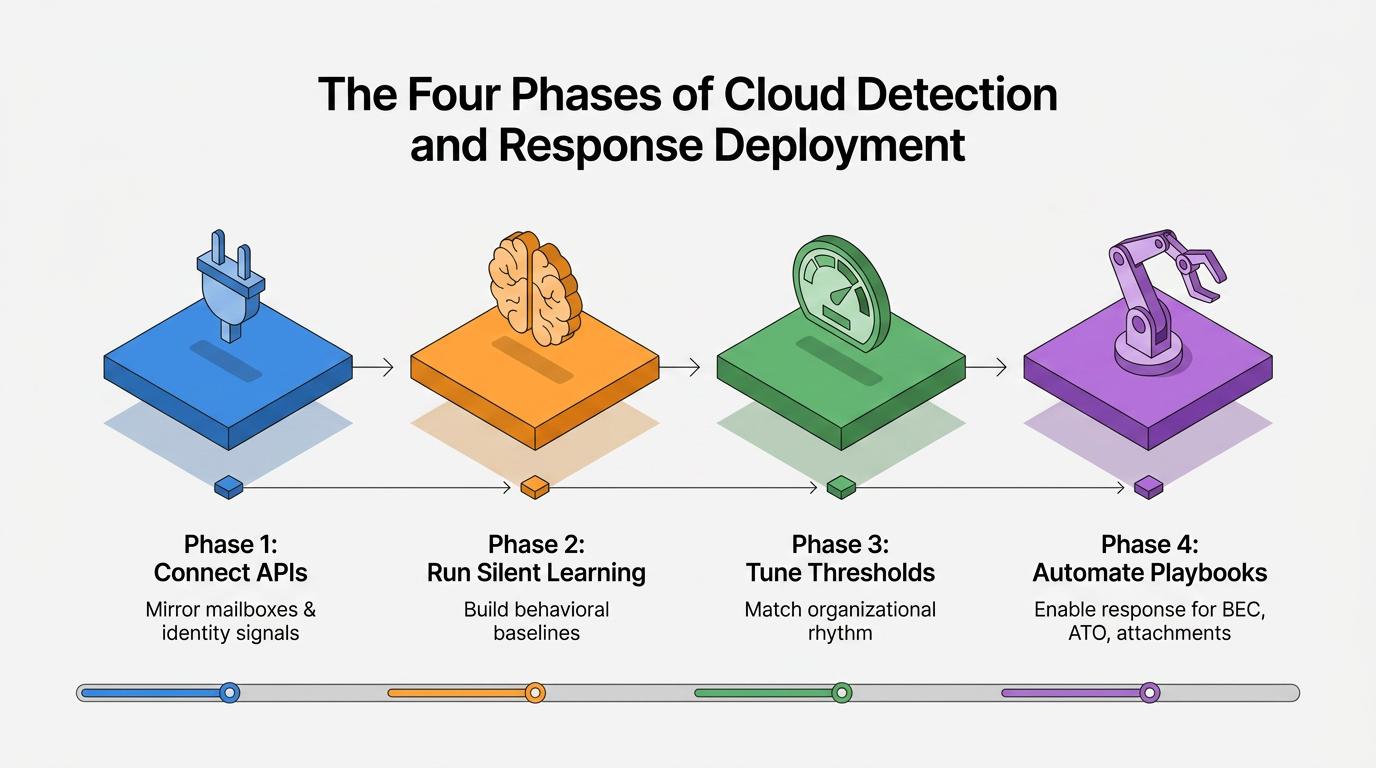
The implementation process begins with lightweight API connections that mirror mailboxes and identity signals while avoiding the routing changes that often derail traditional gateway deployments. This approach provides visibility across mailboxes while preserving existing mail flow architecture. It captures authentication activity, message metadata, and user behavior patterns without introducing latency or single points of failure, and it aligns with the NIST Cybersecurity Framework guidance for monitoring personnel activity and technology usage to find potentially adverse events.
A practical rollout typically follows four phases:
- Connect APIs: Teams can establish native API connections to mirror mailboxes and identity signals while keeping existing email routing intact.
- Run Silent Learning: The initial setup focuses on silent learning, with behavioral AI establishing baselines for each user's sign-in patterns, communication style, and relationship dynamics.
- Tune Thresholds: Once baseline learning completes, teams can refine detection thresholds to match organizational rhythm, such as weekly finance reports, monthly board communications, or seasonal marketing campaigns.
- Automate Playbooks: The final phase involves automating common response playbooks for account takeover, vendor email compromise, and malicious attachments.
During the learning phase, it can help to hold off on automated responses while the system learns organizational norms. This staged approach helps security teams build confidence before expanding automated remediation.
Closing the Gap Between Delivery and Detection
Perimeter-focused email security ends its job the moment a message clears the gateway and a user authenticates. Cloud detection and response picks up from there, treating the post-authentication session as an active surveillance zone rather than a trusted default.
As attackers lean further into AI-generated lures and requests that look completely routine, the organizations that fare best won't just be the ones scanning messages harder. They'll be the ones that can tell when a trusted account starts behaving like it isn't.
