The 2025 Verizon Data Breach Investigations Report found that stolen credentials were the initial access vector in 22% of confirmed breaches, and Mimikatz remains one of the most common tools attackers reach for once they land inside a Windows environment. Detecting Mimikatz activity is difficult because the tool rarely behaves like traditional malware. It operates in memory, borrows trusted Windows utilities, and often produces no file on disk to scan. That leaves security teams dependent on behavioral visibility into the Local Security Authority Subsystem Service (LSASS), authentication events, and credential reuse across endpoint and identity systems.
This guide explains how Mimikatz works, why signature-based defenses fall short, and which behavioral signals give hunters a real chance of catching credential dumping before attackers pivot deeper into the environment.
Key Takeaways
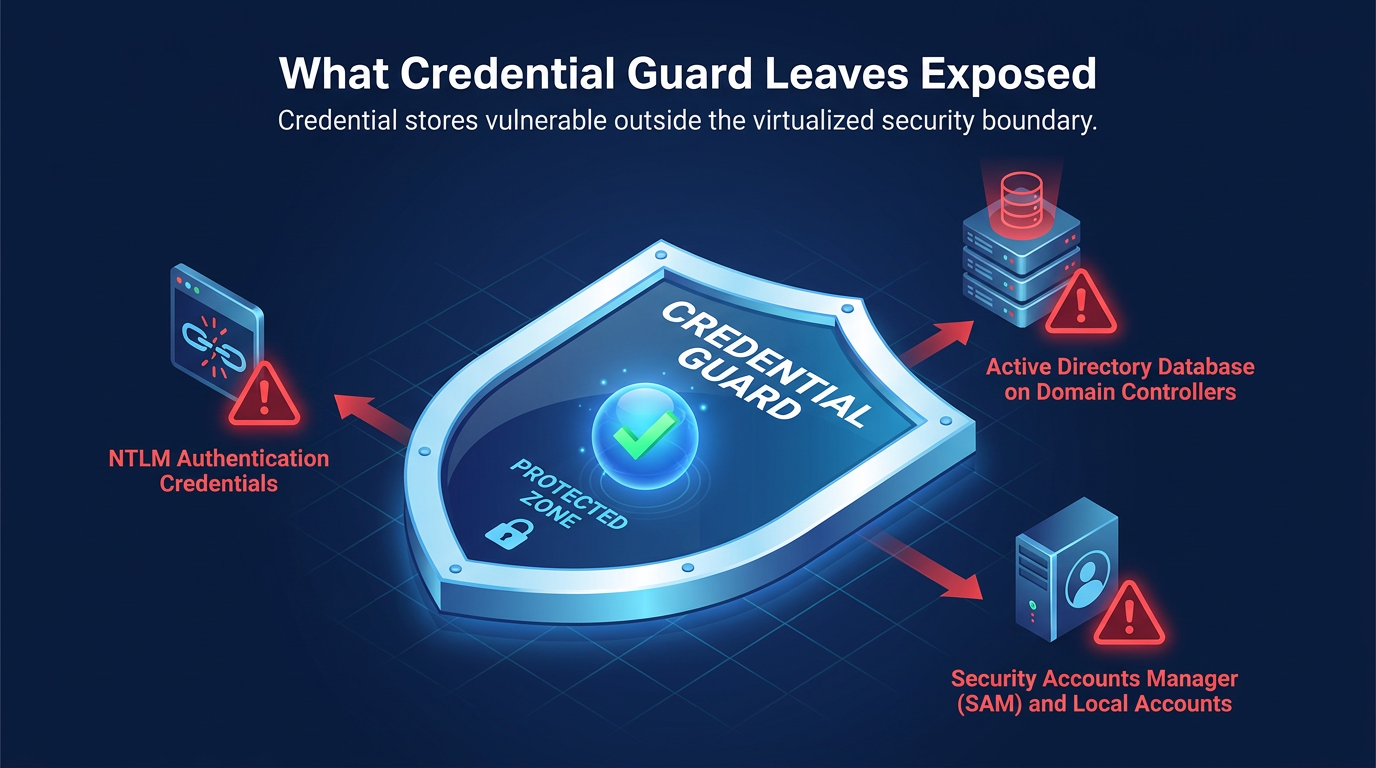
Mimikatz remains relevant because Credential Guard leaves the Active Directory database, the Security Accounts Manager (SAM), and local accounts unprotected.
Attackers often evade signature detection, making behavioral monitoring essential.
Resetting the KRBTGT password twice, with replication between changes, invalidates tickets signed with the current and previous keys, while stolen or forged certificates can outlast user password resets.
Endpoint defenses alone may not stop phishing-driven credential theft, so email and identity monitoring platforms belong alongside them.
Hypothesis-driven hunting mapped to MITRE ATT&CK, such as monitoring LSASS handle access, can help proactive threat hunting surface credential theft before automated alerts trigger.
Why Does Mimikatz Still Matter?
Mimikatz stays relevant because Windows credential protections still leave stores attackers can reach. Microsoft enables Credential Guard by default on supported, domain-joined, non-domain-controller Windows 11 devices that meet its hardware, license, and software requirements. Microsoft also warns that persistent threat actors may shift to new techniques and advises organizations to use other security strategies and architectures alongside it.
Credential Guard does not cover or protect:
The Active Directory database on domain controllers
The Security Accounts Manager (SAM) or local accounts
Credentials that a user supplies for NT LAN Manager (NTLM) authentication
These gaps keep credential-store monitoring relevant even on protected Windows devices.
Mimikatz combines several credential-theft functions in one tool. That combination is what lets attackers expand and maintain access rather than steal a single credential and stop.
The tool extracts authentication data, including passwords, hashes, and Kerberos tickets, from system memory. It harvests NTLM hashes and Kerberos tickets directly from Local Security Authority Subsystem Service (LSASS) memory and stays memory-resident while extracting credentials in the background. Resetting the KRBTGT account password twice, with replication between changes, can invalidate Golden Tickets signed with the current and previous keys. Pass-the-hash and pass-the-ticket let attackers reuse captured credentials for lateral movement without knowing the actual passwords.
Stolen or forged authentication certificates add a persistence layer that outlasts user password resets. Authenticating with one creates a form of service impersonation attack that identity monitoring may interpret as normal activity.
How to Close Detection Gaps Beyond Signature-Based Tools
Traditional detection often struggles with credential dumping because attackers exploit blind spots in signature-based controls at each stage of modern attack chains.
Understand Signature Detection Gaps
Signature databases expect known file hashes, while many Mimikatz delivery methods avoid producing a recognizable file.
In-memory PowerShell execution may avoid leaving a conventional payload on disk. Reflective loading can have the same effect because the payload may never touch disk. Adversaries can also dump LSASS with built-in tools such as comsvcs.dll, following the living off the land (LOTL) approach.
The joint Federal Bureau of Investigation (FBI), Cybersecurity and Infrastructure Security Agency (CISA), and Multi-State Information Sharing and Analysis Center (MS-ISAC) Medusa ransomware advisory documents this mix: Medusa actors were observed using Mimikatz to dump credentials from LSASS memory, and separately disabled Windows Defender and other antivirus tools during the encryption phase of their attacks. Because these binaries ship with Windows, file-based controls may remain silent. Application controls built around executables on disk can also miss PowerShell scripts that run entirely in memory, creating opportunities for multi-factor authentication (MFA) bypass techniques.
Recognize Common Evasion Techniques
Attackers rarely deploy Mimikatz in its raw form, instead adapting it to evade traditional antivirus and endpoint defenses:
Recompiled Binaries: LSASS dump variants can unhook monitored functions and issue direct system calls, while rebuilt binaries no longer match hash-based detection methods.
In-Memory Execution: Reflective injection loads credential dumping modules into memory inside legitimate process space, often leaving no file artifacts to scan.
Legitimate Tool Abuse: Windows utilities such as Task Manager and ProcDump can create LSASS memory dumps through documented APIs, and these signed binaries resemble normal administration.
Framework Integration: Post-exploitation frameworks embed Mimikatz modules within larger payloads, while PowerShell wrappers provide the same functionality in script form. Credential dumping then hides among other reconnaissance and persistence activity. Isolated detection becomes difficult as a result.
Detecting credential theft requires behavioral analysis and behavioral anomaly detection rather than static signatures. Endpoint detection and response (EDR), extended detection and response (XDR), and identity threat detection platforms supply the host, memory, and authentication telemetry needed to catch a dump in progress.
Address Behavioral Detection Gaps
These evasion methods reduce the value of file-based and user-mode monitoring.
Mimikatz is modular, so LSASS dumping, Golden Ticket creation, and certificate export each leave distinct artifacts. Chasing those artifacts after the fact means attackers may already hold credentials, with lateral movement likely underway. Behavioral hunting instead watches for unusual LSASS access, suspicious PowerShell, and credential reuse before compromise expands.
Hunters can correlate these signals across processes, accounts, and authentication events to identify related activity that isolated alerts may miss.
What Proactive Threat Hunting Really Means
Proactive threat hunting uses hypothesis-driven searches across endpoint telemetry data, identity logs, and security information and event management (SIEM) or XDR data before an alert fires.
Hunters form hypotheses such as "Which processes touched LSASS this week?", gather evidence, refine the query, and repeat. Mapping each hypothesis to the MITRE ATT&CK framework ties the work to specific tactics, including credential dumping and pass-the-ticket.
Hunting programs that find credential theft share a few habits:
Behavioral baselines for users, hosts, and privileged processes make deviations from normal activity easier to identify.
Correlating infrastructure, behavioral, and procedural indicators rather than chasing single indicators of compromise can support false positive reduction.
Structured, recurring hunts tend to surface findings that ad hoc sweeps miss.
Fresh tactics, techniques, and procedures feed new hypotheses, while hunt outcomes feed detection engineering. This cycle can shorten the gap between intrusion and discovery and surface early signs, such as unexpected LSASS handles, before credentials leave the environment.
Signals That Suggest Credential Dumping Activity
Credential dumping hides within normal operations, but proactive threat hunting can surface behavioral signals across endpoint, identity, and authentication telemetry.
The Cybersecurity and Infrastructure Security Agency (CISA) includes signs of Active Directory enumeration and LSASS credential dumping among its ransomware detection indicators. Security teams can monitor for the following patterns:
Unusual System Access: Accounts or processes that rarely need administrative rights suddenly try to read sensitive memory.
Suspicious File Activity: Large dump files appear in temporary folders or user directories.
Unexpected Commands: Rare command-line activity, such as attempts to export authentication data, stands out in full logging.
Unusual Logins: Authentication attempt patterns from one workstation to multiple servers in quick succession can indicate reuse of stolen credentials.
Privilege Escalation: Accounts with limited access suddenly gain or duplicate administrator-level privileges.
Credential dumping thrives when teams overlook related signals. Behavioral analysis can turn weak technical traces into stronger early warnings.
Monitor LSASS Handle Access and Dump File Creation
LSASS handle monitoring can expose memory reads associated with credential dumping.
Sysmon ProcessAccess telemetry can reveal tools reading LSASS memory for credentials. Security teams can filter on a TargetImage of lsass.exe, then review the SourceImage, GrantedAccess mask, and CallTrace. Excluding legitimate security and system processes helps keep the signal usable.
Teams can pair handle monitoring with file creation telemetry. Large dump files named lsass.dmp, debug.bin, c.dmp, or memory.tmp may appear in writable directories such as C:\Windows\Temp. A cleared Security log shortly after suspected dump activity can also indicate attacker activity, often involving wevtutil cl. Correlating these events gives analysts more context than either signal provides alone.
Correlate Kerberos Events to Expose Forged Tickets
Kerberos event correlation on domain controllers can surface Golden and Silver Tickets that endpoint tooling may not see.
Golden Ticket hunting focuses on a handful of anomalous patterns in ticket issuance:
Unexpected ticket lifetimes
Unusual encryption types, such as RC4 in modern domains
Malformed fields in logon and logoff events
Ticket-granting service (TGS) requests without a preceding ticket-granting ticket (TGT) request
Reviewing TGT and TGS issuance events for these patterns provides a practical starting point.
MITRE's Golden Ticket mitigation guidance recommends resetting the KRBTGT account password twice and allowing replication between changes so previously forged tickets become invalid. Silver Tickets are harder to catch because attackers forge the service ticket without interacting with the Key Distribution Center (KDC). Useful Silver Ticket signals include:
Suspicious service-side logons without a corresponding domain-controller ticket issuance event
Malformed ticket or logon fields
Service accounts accessing resources outside their baselined scope
Correlating these signals with the Golden Ticket indicators above gives domain-controller monitoring a fuller picture of forged-ticket activity.
How to Prioritize Credential Dumping in Your Threat Hunting Program
Credential dumping hunts work best when teams define required data, focus on areas of greatest business risk, and measure results.
Threat hunting aims to shorten organizational dwell time and convert discovered patterns into stronger detections. The following steps can help teams establish that process.
Collect the Right Data
Credential dumping hunts require endpoint, identity, authentication, and network telemetry in a shared investigation workflow:
Endpoint: Configure EDR tools to track new processes, unusual commands, and attempts to access credential stores such as LSASS.
Identity: Review identity activity for failed logins and sudden privilege changes.
Network: Monitor login activity, traffic between internal systems, and file-sharing sessions.
Consolidating this telemetry helps prevent one layer from becoming a blind spot.
Filter data as the program matures because unfiltered telemetry can bury hunters in noise. False positive prevention also helps analysts spend more time on related process and identity activity. Teams can restrict domain administrator accounts to domain controllers and monitor Kerberos traffic for activity that falls outside authorized processes.
Prioritize and Measure
High-value systems warrant more frequent credential dumping hunts and tighter remote administration controls.
Concentrate on domain controllers, shared admin servers, executive devices, and other tier-zero assets. Restrict remote administration of these systems to designated, role-based accounts, and automate repetitive checks so analysts have time for deeper investigation.
Measure progress through mean time to detect, identify, and resolve, the percentage of systems reviewed, and alert accuracy. Tracking the speed of detection helps leaders assess whether new hunt logic and telemetry improve visibility. Regular reviews keep the program aligned with changes in the environment and help convert successful hypotheses into repeatable detections.
Reduce Credential Theft Risk at the Initial Access Stage with Abnormal's Behavioral AI
Detecting Mimikatz requires endpoint and identity tools that monitor LSASS access, process behavior, and authentication anomalies, while Abnormal can help reduce the email-based initial access that often precedes credential dumping.
Email remains a common delivery mechanism for credential phishing campaigns that harvest usernames and passwords. Once inside, attackers can escalate privileges with tools such as Mimikatz, move laterally, and establish long-term persistence.
Detect Credential Phishing Before Compromise
Abnormal is designed to identify email-borne credential phishing by analyzing identity, behavioral, and content signals.
Abnormal's Inbound Email Security uses Abnormal's behavioral AI to help identify credential phishing attempts that often evade traditional email security. The platform can help surface business email compromise (BEC), AI-generated lures, and payload-free attacks built to steal credentials.
Abnormal builds behavioral profiles around employee workflow cadences, recipient behavior, timing, engagement flows, and vendor interaction patterns. A message that breaks an established pattern can therefore receive additional scrutiny. The platform can remediate malicious messages in the inbox rather than relying solely on employee reports. By analyzing sender relationships, message intent, and observable communication patterns, Abnormal is designed to identify sophisticated phishing before users interact with malicious content.
Identify Compromised Accounts Through Behavioral Analysis
Abnormal's account protection capabilities are designed to help surface compromised cloud email accounts through identity and behavioral signals.
Account Takeover Protection uses sign-in and communication behavior to help identify account compromise. The platform uses behavioral baseline technology across email and identity platforms including Microsoft 365, Google Workspace, Okta, and Microsoft Entra ID, learning normal sign-in, session, device, and behavioral patterns.
When an account shows unusual session or device signals, new mail rules, or unexpected communication patterns, Abnormal can support automated account remediation, including blocking access, forcing password resets, and ending active sessions. These actions can help contain account compromise, often before significant damage occurs.
Complement Endpoint and Identity Security
Abnormal enhances the existing security stack by contributing email and cloud-account context to broader investigations.
Security teams can correlate phishing messages and suspicious account behavior with endpoint evidence such as LSASS access and dump file creation. They can then compare that activity with Kerberos and other authentication anomalies to reconstruct the attack path. This shared context helps analysts connect initial access, account compromise, credential dumping, and lateral movement without expecting one control to cover each stage.
Abnormal addresses the email and account-based components of this workflow. Endpoint, identity, and network controls remain responsible for host activity, authentication events, and lateral movement. This layered coverage spans the first phishing email through the sophisticated post-exploitation attacks that may follow account compromise.
Build Layered Defenses Against Credential Theft
Security teams can strengthen credential theft defenses by combining structured threat hunting, endpoint and identity telemetry, and email-focused initial-access controls.
Turn successful hunt hypotheses into repeatable detections, and feed endpoint, identity, and email context into a shared investigation workflow. Pairing human threat hunting expertise with email-focused behavioral analysis strengthens coverage across initial access and post-compromise activity. Each control should feed useful context into the broader investigation process rather than operate as an isolated layer.
The 2026 Gartner® Peer Insights™ Voice of the Customer for Email Security named Abnormal a Customers' Choice. Ready to reduce the initial access risk that leads to credential compromise? Get a demo to see how Abnormal's behavioral AI is designed to identify sophisticated phishing, account takeover, and credential harvesting attempts while complementing endpoint and identity security tools.
Frequently Asked Questions
Can Antivirus Software Detect Mimikatz?
Rarely, once an attacker has adapted the tool. Recompiled binaries, in-memory execution, and abuse of signed Windows utilities like Task Manager or ProcDump routinely evade signature-based antivirus, which is why behavioral monitoring of LSASS access and authentication activity matters more than file scanning alone.
What Is the First Sign of a Mimikatz Compromise?
The earliest reliable signal is usually an unexpected process requesting a high-privilege handle to lsass.exe, especially from an account or application that doesn't normally need administrative access. Large, unexplained dump files in temporary directories are a close second.
Does Windows Credential Guard Stop Mimikatz Completely?
No. Credential Guard protects credentials in memory on protected endpoints, but it leaves the Active Directory database on domain controllers, the Security Accounts Manager, and locally supplied NTLM credentials outside its coverage. Mimikatz can still target those stores.
What Should a Security Team Do Immediately After Detecting Mimikatz?
Isolate the affected host to stop further lateral movement, then reset the KRBTGT account password twice with replication between changes to invalidate any forged Kerberos tickets. From there, rotate credentials for any accounts the compromised system had access to and review Kerberos ticket-issuance logs for related anomalies.