Points clés
The AI kill chain is a framework that maps how attackers use AI to accelerate and strengthen each phase of a cyberattack. The classic seven-stage cyber kill chain framework provides the foundation for this model, which shows how AI in cybersecurity changes attacker tradecraft and defense.
Where traditional attacks often progressed step by step, AI lets attackers run reconnaissance, content creation, and targeting in parallel, compressing timelines and raising the bar for detection and response. Agentic tooling pushes this further. Models now carry out much of the hands-on work between stages, and humans make only a few decisions.
This shift makes behavior-first defense more important: understanding the AI kill chain lets organizations prioritize controls that catch intent and unusual activity earlier, when disruption is cheaper and containment simpler.
Key Takeaways
AI compresses the gaps between kill chain stages, so defenders gain the most by detecting intent during reconnaissance, weaponization, and delivery rather than after installation.
Malicious LLM services and agentic tooling let a commodity attacker run high-quality social engineering and, in documented cases, automated intrusion without building custom infrastructure.
Deepfake and AI-generated impersonation cases show attackers compromising approval workflows rather than systems, which places identity and communication behavior at the center of detection.
The same term also covers attacks on AI systems themselves, and MITRE ATLAS and the OWASP Agentic Top 10 give security teams a shared vocabulary for both directions.
Mapping behavioral detections to kill chain stages, pairing them with AI-aware playbooks, and governing AI adoption turn the framework into measurable coverage.
Understanding the Kill Chain Framework
The kill chain framework gives security teams a structured method for mapping, analyzing, and disrupting sophisticated attacks across each phase.
Origins of the Kill Chain
The kill chain concept comes from military doctrine, formalized as F2T2EA (Find, Fix, Track, Target, Engage, Assess) to shrink the time between spotting a threat and neutralizing it. Lockheed Martin adapted the idea for cybersecurity in 2011: intrusions follow recognizable phases, giving defenders multiple chances to disrupt an attack, and stopping an adversary at any single stage breaks the chain.
That premise still holds when AI drives the attack. What's changed is how little time separates one stage from the next.
Stages of the Cybersecurity Kill Chain
The Cyber Kill Chain consists of seven ordered stages: Reconnaissance, Weaponization, Delivery, Exploitation, Installation, Command and Control, and Actions on Objectives.
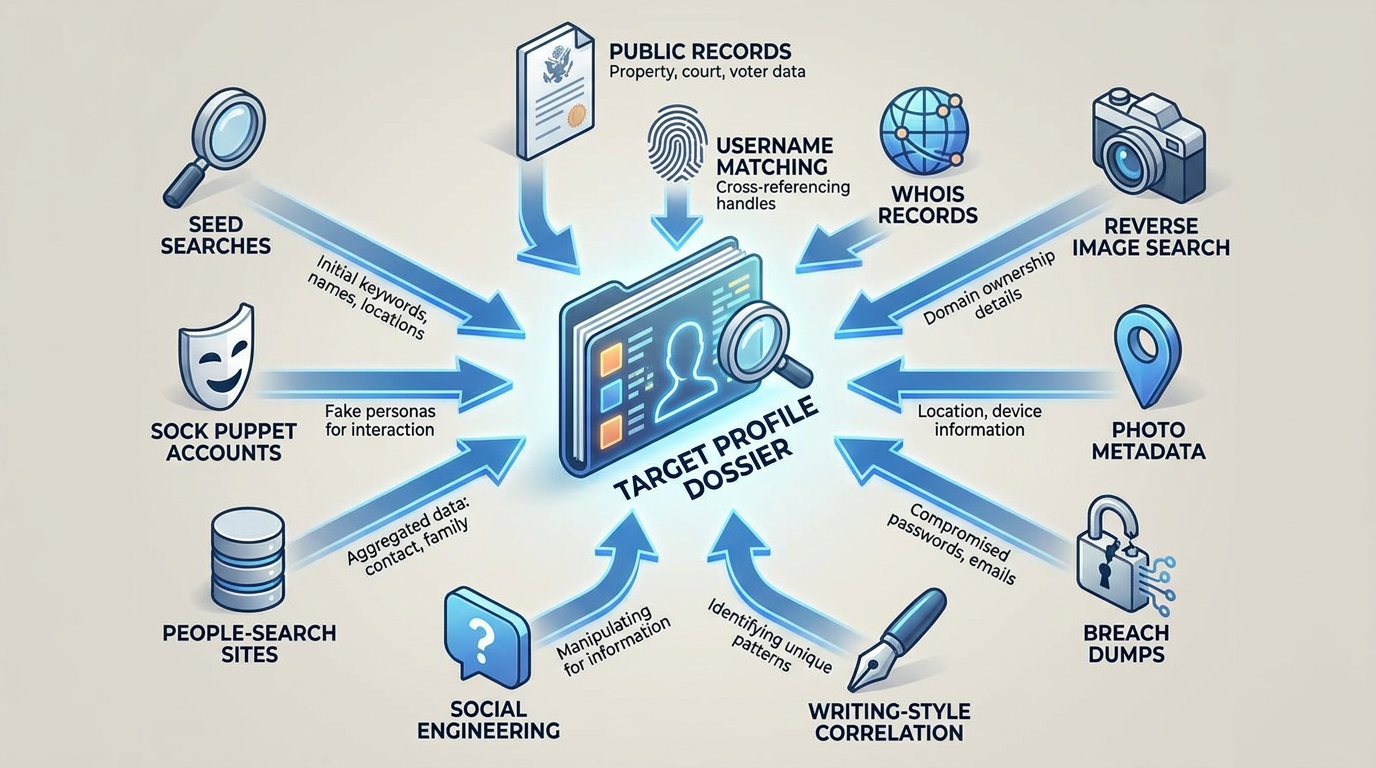
Reconnaissance: Attackers gather information about targets through automated OSINT collection, social media analysis, and scraping of public sources.
Weaponization: Threat actors generate malicious code and iterate on payloads using automation and AI-assisted development workflows.
Delivery: The payload reaches the target through targeted phishing emails, voice or video impersonation, malicious links, or compromised websites.
Exploitation: The payload triggers a vulnerability to execute code, often adapting rapidly to the target environment.
Installation: Attackers establish persistence using traditional malware, remote tooling, or legitimate utilities combined with compromised account credentials.
Command and Control (C2): Attackers maintain remote control through channels that blend into normal traffic.
Actions on Objectives: Attackers reach their goal, such as fraud, data theft, or a destructive impact.
Mapping these stages to MITRE ATT&CK connects each phase to specific, testable techniques defenders can build countermeasures around.
How AI Accelerates the Kill Chain
AI accelerates thekill chain by increasing attacker automation, personalization, and adaptation across each stage.
Reconnaissance
AI turns scattered public information, job postings, press releases, repositories, social profiles, into usable targeting detail with little human supervision. The MITRE ATLAS knowledge base lists Autonomous Reconnaissance as a distinct technique. Defenders can watch for unusual enumeration activity and spikes in targeted pretexting, since stopping an attack here often prevents everything downstream.
Weaponization
AI lowers the effort needed to produce credible malicious artifacts: phishing lures, rewritten payloads, and iterated exploit code that signature-based tools have never seen, even when the pretext hasn't changed. Early-stage defenses benefit from watching for unusual tool execution and outbound connections during staging.
Delivery
AI improves delivery by increasing realism and tailoring: convincing messages at scale, a matched tone, and impersonation content for voice and video. This is where social engineering attacks become operationally efficient for adversaries. Email remains a primary entry point for cyberattacks, and campaigns increasingly pair a phishing message with voice and video impersonation. Defenders can watch for unusual sender-recipient relationships and requests that break from established behavior; voice and video need their own verification steps.
Exploitation
AI accelerates exploitation by adapting each attempt to the environment: probing for misconfigurations and adjusting execution paths, often within the same session after a failure. Teams can prioritize exploit-adjacent telemetry and authentication anomalies, correlating them with the message that preceded the login.
Installation
AI supports stealthier installation by enabling rapid iteration on persistence, favoring legitimate tools and compromised account credentials over traditional malware. Hijacked identities and suspicious OAuth grants leave nothing for an antivirus engine to scan, so treating persistence as a behavior problem surfaces it instead.
Command and Control (C2)
AI can improve C2 resilience by helping attackers vary infrastructure and rotate past blocked known compromise indicators on demand, which makes static blocklists decay faster. Defenders can flag unusual outbound destinations and beaconing that follow an earlier delivery or exploitation indicator.
Actions on Objectives
In the final stage, AI helps attackers move faster from access to impact: identifying valuable targets and speeding AI-assisted lateral movement with valid credentials. The attacker's model can read, summarize, and rank stolen material before a human reviews it. Behavior analytics tuned to business impact catch this stage fastest when correlated with email signals from a compromised mailbox.
The Rise of Malicious LLMs and Dark AI Tools
Malicious LLMs and dark AI services make the AI kill chain more accessible by packaging offensive capabilities for purchase.
Instead of building tooling from scratch, attackers can buy or rent capabilities for phishing content, pretexts, and code assistance. Sellers advertise these services as bypassing safety controls through jailbreaking, and the brand names churn quickly: WormGPT appeared first, FraudGPT followed, and the tools that replaced it show criminals keep adopting whatever ships next. The UK National Cyber Security Centre expects skilled criminals to offer AI-enabled tools as a service to novices and hacktivists. Capability no longer reliably signals sophistication: teams should plan for high-quality social engineering even from commodity threat actors.
How Agentic AI Compresses the AI Kill Chain
Agentic AI compresses the AI kill chain by letting one system carry an intrusion across multiple stages with only occasional human direction.
An agentic workflow can automate a sequence of attack activities:
Reconnaissance and Discovery: The workflow automates reconnaissance and vulnerability discovery.
Exploitation and Movement: It carries out exploitation and credential-driven lateral movement.
Analysis and Exfiltration: It analyzes data and supports targeted data exfiltration.
Human operators step in only for decisions like whether to progress to exploitation or what data to extract, and models can hallucinate credentials or claim success without evidence. For the kill chain model, AI mainly compresses the pauses between stages that are otherwise unchanged. Defenses built around hours between delivery and exploitation now need detection that fires on behavior at the first stage, not on indicators collected at the third.
Real-World AI Kill Chain Attacks
Real-world incidents show how AI-enabled impersonation can translate directly into financial loss and operational risk.
Deepfake-Enabled CEO Fraud
Deepfake video impersonation can compromise approval workflows without breaching the systems that support them. In January 2024, engineering firm Arup lost roughly $25.6 million after attackers used a deepfake video call to impersonate senior executives; a finance employee authorized a series of transfers over the following week, which investigators later confirmed as fraud, and the firm's own systems went untouched.
AI doesn't need to hack a system if it can reliably hack a workflow: the inbox, chat thread, and meeting invitation remain practical control points even when the impersonation happens on video, and that channel still needs its own verification.
LLM-Assisted Social Engineering
LLM-assisted social engineering helps criminals produce more convincing phishing and impersonation with less effort. Generative AI now also corrects the grammar and spelling errors that once served as warning signs, the FBI has warned, so teams need to assess behavior and context instead of content quality.
The FBI Internet Crime Complaint Center's (IC3) 2025 Internet Crime Report tracked AI-enabled fraud as its own category for the first time, logging 22,364 complaints and nearly $893 million in losses, a sign the technique has moved from novelty to routine.
AI Kill Chain vs. Attacks on AI Systems
The phrase AI kill chain also describes attacks against AI systems themselves, and security teams increasingly have to defend both directions at once.
In the attacker-uses-AI model, AI accelerates the seven classic stages above. In the attacks-on-AI model, the target is the organization's own LLM application, RAG pipeline, or autonomous agent: an attacker probes what it can reach, poisons the content it ingests, hijacks its goals or tool calls, and persists through memory or shared documents until it acts on the attacker's behalf.
Two frameworks cover this ground:
MITRE ATLAS: Spans attacks against AI-enabled systems and harmful autonomous behavior, including prompt injection, RAG poisoning, and agent tool invocation.
OWASP Agentic Top 10: Flags risks such as Agent Goal Hijack, Tool Misuse and Exploitation, Identity and Privilege Abuse, Memory and Context Poisoning, and Rogue Agents.
Together they give security teams a shared vocabulary for testing AI cybersecurity controls.
Identity is the common control point where these two directions converge. An autonomous agent holding forgotten permissions creates an installation and C2 foothold, and an attacker who hijacks it inherits each workflow that the agent can touch. Tools like Abnormal's AI Security suite extend the behavioral approach used for email and identity to this surface.
Why Behavior-First Defense Matters for the AI Kill Chain
Behavior-first defense disrupts the AI kill chain earlier by focusing on unusual intent and activity rather than static indicators. Signature and rule systems still play a role, but they struggle when attackers generate endless variations of lures, domains, and content. CISA's Logging Reference Architecture directs agencies to build identity-focused analytics, including user and entity behavior analysis, to detect credential misuse, lateral movement, and privilege abuse.
Behavior-focused approaches ask specific questions: does this request match how this person normally works, does this vendor normally change bank details this way, does this account normally send this volume of outbound mail. This shifts analysis from isolated artifacts to deviations in established behavior, and it gets stronger when it correlates signals across stages: a new sender relationship followed by urgency and a financial ask, a link click followed by unexpected token usage, unusual data access followed by atypical outbound transfers.
This also speeds triage. When a detection explains who or what deviated and how it differs from expected behavior, teams validate incidents faster without relying on any single signal alone.
How to Operationalize AI Kill Chain Defense
Operationalizing AI kill chain defense works best when teams prioritize high-risk entry points, integrate signals across tools, and update playbooks for AI-enabled impersonation.
1. Prioritize High-Risk Vectors
Prioritizing email, identity misuse, and vendor relationships reduces exposure along the most common paths to impact.
Two vectors in particular concentrate the risk and deserve dedicated attention:
Email and Identity Misuse: A common path from initial access to impact, especially with high external communication volume and frequent financial workflows. Finance, procurement, and executive-assistant mailboxes concentrate the pretexts attackers rehearse during reconnaissance, so they need tighter verification and closer monitoring.
Vendor Relationships: A supplier whose domain, tone, or banking instructions change without warning is a common delivery path for business email compromise. Pairing these checks with broader email security controls evaluates both message content and relationship context.
Tightening controls around these two surfaces addresses most of the entry points attackers use to turn AI-enabled reconnaissance into financial loss.
2. Implement Behavioral Detection
Behavioral analytics help a SIEM or XDR platform correlate identity, email, SaaS, and network telemetry. Organizations also evaluate AI-native security vendors that model communication and identity behavior rather than static indicators. Abnormal, for example, connects to cloud email through APIs and feeds detections into existing SIEM and SOAR workflows, letting the behavioral layer sit alongside an existing gateway without MX changes or endpoint agents.
3. Build AI-Aware Response Playbooks
AI-aware playbooks help teams respond when the attacker's payload is persuasion rather than malware:
Deepfake Validation: Out-of-band verification for sensitive requests involving payments, bank changes, or privileged access.
Impersonation Triage: Clear criteria for spoofing, lookalike domains, and unusual relationship patterns.
Credential Misuse Response: Fast containment for suspected account takeover, including token revocation and access review.
Each playbook should state which channel produced the evidence. Behavioral tooling sees email and account signals. Voice, text, and video need their own verification and a named owner.
4. Align Detection With Kill Chain Stages
Mapping detections to kill chain phases helps teams measure coverage and find gaps. MITRE ATT&CK connects high-level stages to specific, testable behaviors; ATLAS adds equivalent mapping for AI-specific techniques, so teams track both directions in one matrix.
Try this simple exercise: list each detection, assign it a stage, and look for empty rows, which often cluster at reconnaissance and weaponization, where early disruption pays off most.
5. Establish a Governance Framework
Governance keeps AI-enabled defense reliable and auditable. A practical framework defines ownership, escalation requirements, model monitoring for drift, and documentation standards that support audit and incident reporting.
The NIST AI Risk Management Framework (Govern, Map, Measure, Manage) offers a workable starting point. Under the EU AI Act, organizations also face prohibitions, AI literacy duties, and transparency requirements; an AI governance layer that inventories which tools and agents exist, who owns them, and what data they touch produces the evidence those reviews request.
The AI Kill Chain Demands Smarter, Faster Defense
The AI kill chain compresses attacker timelines and raises the value of early-stage disruption. Organizations reduce risk by prioritizing behavior-first detection, correlating signals across stages, and operationalizing playbooks for AI-enabled impersonation, an approach that holds up as attackers vary content, infrastructure, and pretexts, and that extends to the agents and AI tools an organization deploys itself.
Abnormal uses behavioral AI to help identify sophisticated socially engineered threats across cloud email and integrated collaboration tools, and was named a Customers' Choice in the 2026 Gartner® Peer Insights™ Voice of the Customer for Email Security.
To see how Abnormal works against AI-generated phishing, deepfake impersonation, and account takeover, book a demo.
Frequently Asked Questions
How Does Agentic AI Change the Level of Human Involvement in an Attack?
Agentic AI can run reconnaissance, exploitation, lateral movement, and data analysis with only occasional human checkpoints, deciding whether to progress or what to extract. Traditional AI-assisted attacks still need continuous human direction at each step, with AI speeding up tasks rather than bridging phases on its own. Hallucinated credentials and unverified success claims mean the human still needs to check the model's work.
What Behavioral Signals Catch AI-Generated Phishing Without Obvious Errors?
Watch relationship deviations rather than writing quality: a first-time external contact making a sensitive request, or a familiar vendor emailing from a new domain. Track urgency shifts, requests that break from role-based norms, like finance approving a wire from an unfamiliar sender, and authentication anomalies right after a suspicious message, new locations, unexpected token grants. A new relationship, an urgent tone, and a financial ask together create a high-confidence alert even with perfect grammar.
How Can Teams Guard Against Deepfake Fraud on Video Calls?
Require out-of-band verification for high-stakes requests made on a call, a callback to a known number or a message to a verified contact, separate from the video channel. Pre-shared code words for sensitive approvals help too, particularly in finance and executive workflows, alongside training employees to flag last-minute meeting changes or unexpected participants and a culture that rewards pausing to verify an urgent request.
How Do MITRE ATT&CK, ATLAS, and OWASP's Agentic Top 10 Fit Together?
ATT&CK provides the baseline technique taxonomy for traditional adversary behavior. ATLAS extends that methodology to attacks against AI and machine learning systems. OWASP's Agentic Top 10 covers risks specific to autonomous agents, like memory poisoning and goal hijacking, that neither MITRE framework addresses. Mapping detections against all three produces one coverage matrix instead of two, and quarterly reviews surface gaps fastest at reconnaissance and weaponization.
How Should Incident Response Playbooks Change for Persuasion-Based Attacks?
Make out-of-band verification mandatory for high-stakes requests, a phone call to a known number rather than a reply to the same thread or a video call taken at face value. Add checkpoints that ask for context only the real person would know, and require dual approval so no single persuaded employee can authorize a damaging transfer. Post-incident reviews should trace the behavioral red flags that preceded the request, not just search for malware that was never there.