AI-powered cyber attacks are no longer theoretical: attackers now use generative and agentic tools to write more convincing lures, generate synthetic voices and video, and move faster through reconnaissance and negotiation. When Arup, a British engineering firm, lost an estimated $25 million to attackers using a deepfake video of its CFO during a live call, the incident showed how AI-enabled impersonation can exploit weak authorization processes. Other AI-powered cyber attack examples include AI-assisted extortion, nation-state espionage, hiring fraud, and criminal infrastructure development. For CISOs and security engineers, the cases below show which controls failed, where email security can help, and where separate verification controls need to sit.
This article draws from insights shared in Abnormal's Convergence webinar series on adversarial AI. Watch the Convergence recording to hear directly from AI scientists and threat intelligence experts about real-world attack patterns.
Key Takeaways
Generative AI attacks can reduce traditional barriers to entry by helping attackers create content, infrastructure, and code with less specialized expertise.
Nation-state and eCrime groups are operationalizing AI across reconnaissance, social engineering, malware development, and data analysis.
Security teams can align email detection, transaction authorization, identity verification, and incident response with the channels attackers actually exploit.
Why Email Remains a Primary Attack Vector
Email remains one of the most common attack vectors because it provides direct access to employees, business workflows, and trusted relationships.
According to the FBI's 2025 Internet Crime Report, cyber-enabled crime cost Americans nearly $21 billion in reported losses. Business email compromise (BEC) represented a substantial part of those losses, though the figure only reflects complaints actually reported to authorities.
Existing controls remain relevant, and organizations can strengthen them with email security trends that emphasize behavioral and identity context. Layer an email gateway (SEG), business email compromise detection, employee reporting, identity controls, and transaction verification.
How AI Enhances Familiar Attack Methods
AI-powered cyber attacks use artificial intelligence and machine learning to improve attack effectiveness, scale, personalization, or evasion.
Attacker Use of Generative AI
Attackers can use generative tools to draft messages, translate lures, summarize stolen data, troubleshoot code, and tailor communications to different recipients.
The fundamental shift lies in how language models process instructions. As Inma Martinez, digital pioneer and AI scientist advisor, put it in Abnormal's webinar, generative AI systems "don't distinguish if the instructions come from the person training them or the person using them." Attackers can therefore probe safeguards through carefully framed prompts and repeated requests.
That changes the threat picture for BEC attack prevention. A convincing campaign once required language skills, cultural understanding, and patient manual research. AI can help attackers generate fluent communications in multiple languages, create supporting materials, and adapt messages more quickly.
Criminal forums now advertise phishing copy, malicious code assistance, and identity fabrication as ready-made services, shortening development cycles for a broader range of actors.
The Mechanics Behind AI Cyber Attacks
AI-enabled campaigns commonly combine prompt manipulation, infrastructure generation, victim profiling, and human oversight.
Prompt Manipulation Techniques
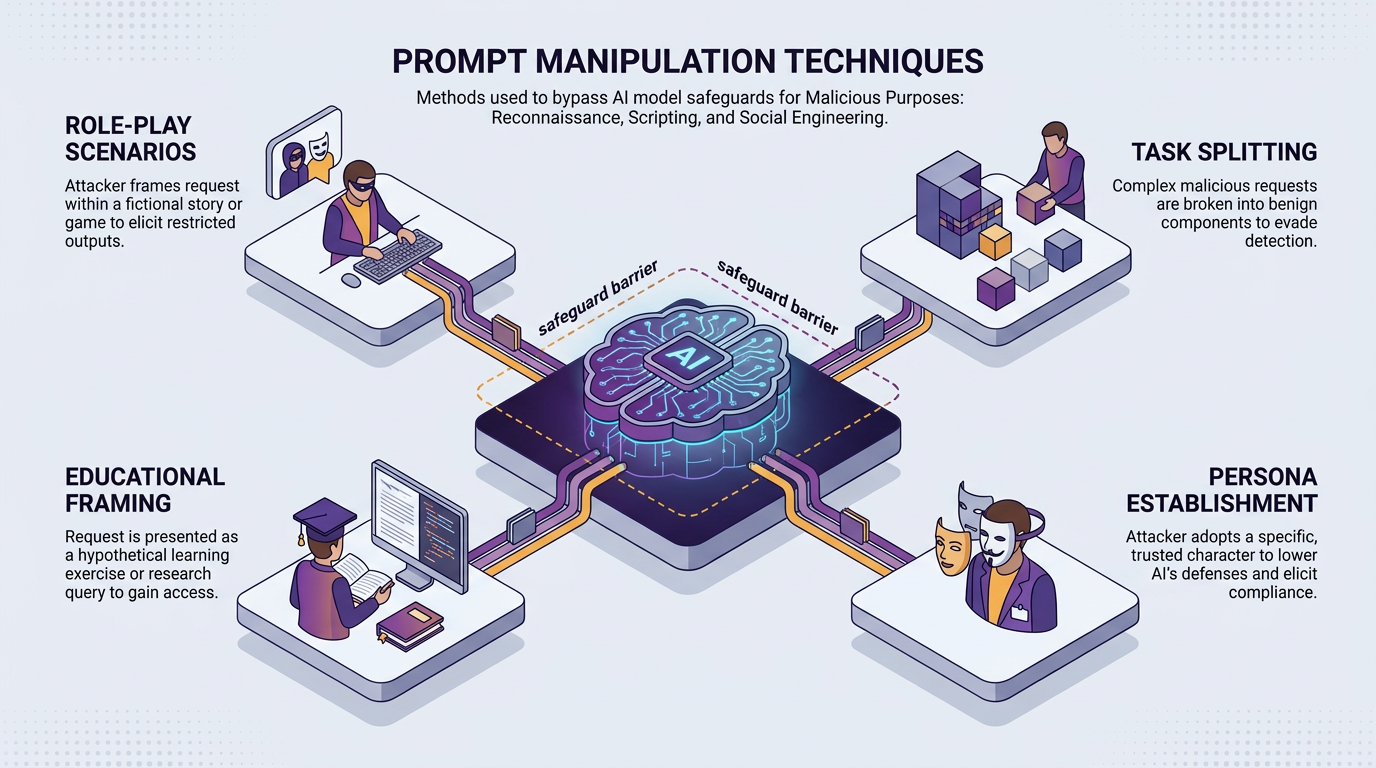
Attackers use prompt manipulation to obtain outputs that a model's safeguards would otherwise restrict. Common approaches include rephrasing requests, splitting a malicious objective into apparently routine tasks, using role-play scenarios, and claiming an educational or defensive purpose.
Piotr Wojtyla, Head of Threat Intel and Platform at Abnormal, explained in the webinar that an attacker may ask a model to treat a request as educational or pretend to operate in a malicious role. More capable operators can establish personas and present isolated technical tasks without revealing the broader intrusion objective.
This approach can support reconnaissance, vulnerability analysis, scripting, data interpretation, or social engineering. Human operators still define goals, select targets, validate results, and make consequential decisions. AI primarily increases the speed at which they can test ideas and complete repetitive work.
Organizations running internal AI services can manage this risk with access controls, logging, and output review, governance that sits outside email security entirely.
Infrastructure Generation
Attackers can use design, presentation, and content-generation services to build convincing phishing attack infrastructure. Professional-looking landing pages can redirect a recipient away from the inbox and into an environment that appears familiar or trusted.
The attack chain often follows a consistent pattern:
Legitimate Domain Delivery: The email arrives through a recognized service or compromised account and may pass traditional filters.
Trusted Platform Redirect: The recipient opens a professional-looking presentation or hosted document on a familiar platform.
Embedded Phishing Link: The hosted content includes a call to action that leads to credential theft, malware, or another fraudulent destination.
Reduced Scrutiny: The recipient applies less caution after leaving the inbox, where security training usually concentrates attention.
This exposes a gap in security awareness training, which usually stops at the inbox rather than following the interaction path onto the landing page itself.
AI-Optimized Extortion Targeting
Automated victim profiling can help threat actors tailor ransom demands, negotiation language, and communication frequency to a target. A model can summarize public information, classify likely pressure points, and suggest messaging that reflects a victim's industry or operating context.
Criminal groups have advertised negotiation interfaces that analyze evidence of encryption, initiate communications, and adapt their tone as discussions progress. This workflow makes extortion more systematic without making it fully autonomous.
The same mechanism can support social engineering attacks by email. A model can match a recipient's professional register, generate plausible follow-ups, and maintain consistency across a conversation. Ransomware execution, host compromise, and payment negotiation occur in separate systems and require endpoint, network, backup, identity, and incident-response controls.
Real-World Examples of AI-Powered Cyber Attacks Security Teams Are Already Tracking
Documented cases already show AI supporting payment fraud, extortion, espionage, and hiring fraud.
Deepfake Video and Voice Fraud
The Arup deepfake case remains one of the most widely discussed AI-enabled payment fraud incidents. Attackers used generated video and voice synthesis to impersonate company leaders during a live call and convinced an employee to authorize a reported $25 million loss.
The attack succeeded because it combined technical impersonation with weak authorization protocols. Martinez raised the underlying control question in the webinar: "How come an amount like this has the sign of just one individual in the bank?" The lesson extends beyond the quality of the deepfake. High-value transactions need independent approval paths that do not rely on the apparent identity of a person in a call.
Voice cloning follows the same pattern, letting attackers impersonate executives or vendors over the phone to request payments or credentials that email security alone can't validate.
AI-Assisted Extortion Campaigns
Threat intelligence teams have documented extortion campaigns in which attackers used coding assistants and language models across reconnaissance, intrusion support, data analysis, and victim communications. Targets included organizations in healthcare, emergency services, government, and religious sectors.
Humans still selected targets and controlled escalation; AI mainly coordinated repetitive tasks and tailored communications. The resulting model resembles an industrialized service operation more than a fully autonomous attack.
The phrase "vibe hacking" describes how attackers can use AI to match tone and context throughout a campaign, producing technical scripts, summarizing stolen material, and shifting into persuasive extortion language without a separate specialist for each task. Abnormal explores the defensive implications in its vibe hacking analysis.
For defenders, the case reinforces the value of layered controls. Inbound email security can help identify suspicious email interactions, while endpoint, network, data-loss prevention, backup, and incident-response controls address intrusion and extortion activity outside the inbox.
AI-Orchestrated Espionage
A state-sponsored espionage campaign used a coding model as an intrusion assistant against technology, financial, manufacturing, and government targets. The model supported reconnaissance, vulnerability discovery, exploitation, lateral movement, credential harvesting, data analysis, and exfiltration tasks.
The disclosure changed the conversation because it showed how an operator could delegate substantial portions of a workflow to an AI agent while retaining human control over key decisions, though outside researchers questioned how autonomous the campaign really was.
CISOs should treat those caveats as part of the risk assessment: AI can accelerate intrusion workflows without proving that autonomous agents can reliably run complete campaigns without skilled operators. Autonomous AI risks within network intrusion require separate endpoint, identity, cloud, network, and application controls, while Abnormal can help with email-based reconnaissance, phishing, and account-compromise signals.
North Korean Hiring Infiltration
North Korean threat actors have used generative AI to support fraudulent applications for remote technology roles. AI can help operators build false identities, prepare for technical assessments, answer culturally specific questions, and maintain professional communications after hiring.
A DOJ remote worker action identified more than 100 U.S. companies affected by the broader scheme. The operation used laptop farms and identity fraud to place remote workers inside company systems and payroll processes.
This pattern creates access before a conventional account takeover occurs, since the attacker receives legitimate credentials through employment itself. Organizations can respond with identity verification during interviewing and onboarding, completed background checks before system access, controlled equipment delivery, and continuing review of payment or address changes.
Abnormal's coverage of nation-state hiring fraud explains the background-check and communication blind spots these operatives exploit. Russian and Iranian state-linked actors have used similar AI-assisted tradecraft across phishing, reconnaissance, and command generation.
AI-Enabled Account Takeover and Lateral Movement
AI can support persistent access by helping attackers obtain, operate, and communicate through legitimate identities.
The North Korean remote worker pattern represents an evolution of traditional email account takeover, one that begins before the account exists. Operatives can use AI to create false identities, complete technical assessments, and maintain employment at technology companies.
The implications extend beyond the initial fraud:
Legitimate Credentials: Access obtained through employment may pass controls designed to stop unauthorized external logins.
Insider Access: Reconnaissance from inside can inform future attacks, including lateral phishing campaigns targeting colleagues.
Sanctions Violations: Salary payments routed to prohibited operatives can create legal and compliance exposure.
Supply Chain Risks: Compromised workers who access customer environments can extend risk to clients and partners.
Employment screening, sanctions compliance, endpoint monitoring, privileged access, and payroll validation sit outside email security.
Why AI-Powered Cyber Attacks Are Hard To Catch
Fluent language, machine-speed production, personalized manipulation, and accessible tooling make AI-enabled campaigns harder to assess through content alone.
Reduced Linguistic Detection Signals
Fluent language, machine-speed production, personalized manipulation, and accessible tooling make AI-enabled campaigns harder to assess through content alone. Grammar errors, awkward phrasing, and stilted language once provided useful signs of malicious communication. Language models can produce fluent text in multiple languages and adapt it to a professional setting, weakening content-based filters that rely on known wording, signatures, or previously observed payloads.
Awareness programs that teach users to equate poor writing with fraud face the same limit. Security teams can update those programs to emphasize request context, sender behavior, urgency, credential prompts, and unexpected changes in established workflows. Abnormal's signature detection comparison explains how behavioral context can complement content inspection.
Scalability Beyond Manual Review
AI helps attackers generate and revise content faster than a manual operation. A single operator can create variants for different recipients, languages, industries, and pretexts without drafting each message independently, increasing the burden on analysts who investigate alerts one at a time.
Automation also lets attackers test and iterate, adjusting subject lines, landing pages, and follow-ups after failed attempts faster than analysts can track. Automated SOC operations can help speed up repetitive email investigation work, while behavioral detection can surface higher-value deviations for analyst review.
Personalization and Low-Cost Tooling
AI systems can tune manipulation to the person receiving it. An attacker can use public information, prior messages, or stolen content to match a recipient's professional register and create a plausible sense of urgency, varying follow-up language instead of sending identical reminders. This capability applies to email-based social engineering techniques, extortion negotiations, job scams, and executive impersonation.
Criminal marketplaces sell jailbroken or retrained language models, phishing kits, identity materials, malware services, and automated support. These services can substitute for skills that previously took substantial time to develop, giving less experienced actors a working playbook and skilled groups a faster development path. Defenders can reduce reliance on subjective judgments by establishing repeatable verification paths for sensitive requests and assuming that polished language and professional design no longer indicate a trustworthy message.
Industries Facing the Highest Exposure
Some organizations face greater risks of AI-enabled targeting for different operational reasons:
Financial Services: These organizations hold identity records, banking credentials, and direct access to payment workflows. That combination supports identity theft, account takeover fraud, executive impersonation, and fund-transfer scams. Compliance teams can extend transaction monitoring to deepfake and impersonation scenarios.
Critical Infrastructure: Electricity, transportation, healthcare, and other essential services may face attackers seeking disruption, espionage, or extortion rather than a direct payment. AI-assisted social engineering can target employees and contractors who hold access to operational environments, though operational technology and network environments require dedicated controls.
Cryptocurrency and Fintech: Irreversible transactions and digitally managed assets make these organizations attractive targets for impersonation, credential theft, and account compromise. Attackers can use AI to create convincing support messages, executive requests, and investment scams, while wallet, transaction, identity, and fraud systems require separate safeguards.
Recognizing where exposure concentrates helps security leaders match investment to the assets and workflows attackers actually pursue. Sectors that combine high-value transactions, sensitive access, or irreversible actions need controls calibrated to those specific failure modes rather than a uniform baseline.
How Security Teams Can Respond
Effective defense combines contextual email detection with identity, payment, endpoint, hiring, voice, and video controls.
Email Detection and Posture Controls
Email detection can incorporate behavioral and identity context alongside existing signatures and gateway controls. Abnormal provides inbound email security that uses identity, contextual, and risk signals to establish normal patterns for users, vendors, and communication activity. These patterns include workflow cadences, vendor interaction patterns, recipient behavior, timing, and engagement flows.
When an email deviates from those patterns, Abnormal is designed to help surface signals such as wiring instructions sent outside business hours, a sudden change to banking details, or unusual urgency from a known sender. This approach complements an existing email gateway (SEG) by adding behavior-based context to content and signature inspection, and Abnormal deploys through API integration with Microsoft cloud email or Google Workspace without requiring MX record changes.
Security posture management can help find and remediate configuration weaknesses that attackers rely on after obtaining credentials, including over-permissioned third-party application access, weak multi-factor authentication settings, and mail rules that quietly forward or delete messages. Automated SOC operations address a related resourcing problem: user-reported phishing and low-confidence alerts consume investigation time, so automated triage can help analysts focus on higher-value behavioral deviations while preserving analyst visibility and escalation paths.
Complementary Channel Controls
AI-enabled campaigns increasingly blend email with voice calls, text messages, collaboration tools, hosted web pages, and deepfake video. Abnormal can help identify email and account-based components, but each additional channel needs controls aligned with its own signals and failure modes.
Organizations can pair email detection with:
Voice Verification: Organizations can use trusted call-back paths or pre-established verification methods for sensitive requests.
Videoconferencing Controls: Separate-channel confirmation can help verify participant identity before teams approve financial or access-related actions.
Payment Authorization: Independent approval and documented validation can help verify payment requests outside the conversation that initiated them.
Identity and Endpoint Controls: Dedicated security systems can monitor authentication, privileges, devices, applications, and host activity.
Collaboration Protection: Organizations can apply appropriate controls to Teams, Slack, and other integrated platforms where deployed.
Abnormal's messaging security guidance addresses malicious content in supported collaboration environments.
Human-Centered and Verification-Based Defenses
Training can extend beyond email-focused awareness because AI-enabled scams often move between inboxes, web pages, calls, messages, and video meetings. Employees need practical verification habits that follow the request across those channels.
Abnormal's AI Phishing Coach provides just-in-time training that adapts to a user's observed email risk. This approach can reinforce lessons at the point where a user engages with a suspicious message rather than relying only on periodic exercises.
High-value transactions also benefit from verification protocols that operate independently of the requesting message or call. Code words, trusted call-back procedures, and secondary approval channels can reduce reliance on a convincing voice or face. The CISA deepfake threat guidance recommends verification capabilities, protection for high-priority personnel, and rehearsed response plans.
For hiring fraud, the FBI advises organizations to verify identity during interviewing, onboarding, and continued remote employment, cross-check duplicate resume content, investigate unusual address or payment changes, and ship equipment only to verified employee addresses. These controls sit outside Abnormal's email detection scope, but email and account signals can provide supporting context when a fraudulent applicant or insider communicates through company systems.
The Future of AI-Powered Cyber Attacks
Agentic AI is likely to increase the speed and coordination of familiar attack workflows before it creates wholly new offensive methods.
Attackers can connect models to tools that perform reconnaissance, generate scripts, summarize outputs, and recommend next steps. Human operators will continue to define objectives and intervene when a task requires judgment, but the amount of repetitive work delegated to AI may grow.
For defenders, this shift supports investment in contextual detection and workflow automation. AI-powered email attacks can vary language and pretexts quickly, while automated SOC operations can help teams manage repetitive investigation tasks without treating AI as a substitute for analyst oversight.
Organizations adopting agentic AI should govern data access, tool permissions, and human approval points before connecting models to sensitive systems, separately from email security, which addresses only the communications and account layer.
Building a Defense That Matches the Threat
Security leaders can respond to AI-powered attacks by aligning each control with the channel and behavior it can actually observe.
These cases show a pattern: AI makes established attacks faster, more polished, and easier to adapt, while weak verification and authorization processes determine whether the campaign succeeds. Organizations can reduce exposure by combining behavioral email protection with identity controls, transaction approval, employee training, endpoint security, and channel-specific verification.
Abnormal's behavioral AI is designed to identify email-borne threats through established behavior patterns. It integrates alongside existing email infrastructure, including an email gateway (SEG), to add contextual detection without positioning email security as a replacement for payment, voice, video, hiring, endpoint, or network controls.
Abnormal was named a Customers' Choice in the 2026 Gartner® Peer Insights™ Voice of the Customer for Email Security. Schedule a demo to see how Abnormal's behavioral AI is designed to help identify email attacks that may evade traditional controls.
Frequently Asked Questions
What Are the Most Significant AI-Powered Cyber Attacks Examples to Date?
The most documented examples include deepfake executive impersonation, AI-assisted extortion, state-sponsored intrusion support, and fraudulent remote-worker infiltration. Email security can address malicious messages and account activity, while payment, hiring, voice, video, endpoint, and network components require separate controls.
Why Do Legacy Email Filters Struggle With AI-Generated Phishing?
Content-based filters often evaluate known signatures, suspicious wording, and previously observed indicators, and language-model messages may contain fewer obvious linguistic warning signs. Abnormal's behavioral email detection complements those controls by evaluating whether an interaction fits established email patterns.
How Does Abnormal Help Defend Against AI-Powered Cyber Attacks?
Abnormal's behavioral AI builds context around normal email activity for users and vendors, then helps surface deviations such as unexpected payment requests, unusual timing, or changes in established communication behavior. Abnormal inbound email security deploys through API integration with major cloud email platforms and works alongside existing email gateways.