Points clés
How many cyberattacks happen per day? In April 2026, U.S. victims reported a daily complaint average of roughly 2,763. The global volume of blocked attempts and unreported incidents runs much higher. Attackers also use generative AI to sharpen phishing, deepfake technology and scams, and investment fraud.
Understanding daily attack volumes alongside the sectors facing the most pressure helps security leaders prioritize defenses. This distinction provides the foundation for evaluating attack types, industry exposure, business impact, and defensive investments.
This article breaks down what the available cyberattack numbers actually measure, which attack types and industries carry the most weight, and how automation and commoditized criminal services continue to push daily volume upward. It also examines the business consequences that follow a successful attack and the practical controls that address the vectors behind the current numbers. Along the way, we'll explain why vendor telemetry, government complaint data, and confirmed breach counts should never be collapsed into a single daily figure.
Key Takeaways
Cyberattacks operate at an industrial scale, but telemetry, victim complaints, and confirmed breaches measure different layers of activity.
Phishing and business email compromise combine persistent attack volume with substantial financial and operational risk.
Manufacturing, finance, professional services, healthcare, and critical infrastructure face sustained targeting for different strategic reasons.
Generative AI helps attackers create convincing and personalized social engineering campaigns faster.
Behavioral detection can help surface unusual email activity that static signatures and rules often miss.
How Many Cyberattacks Happen per Day?
FBI complaint data provides the clearest public benchmark. Worldwide attack attempts are far more numerous, since no authoritative global figure combines automated activity and realized harm.
Two data sources clarify what this benchmark includes and omits:
Victim Complaints: The FBI's Internet Crime Complaint Center covers victim complaints across phishing, spoofing, investment fraud, ransomware, business email compromise attacks, and other categories. In 2025, the center's annual report recorded 1,008,597 complaints and $20.877 billion in reported losses. Because many victims never report incidents, even this benchmark understates actual harm.
Threat Telemetry: Security providers process large streams of threat telemetry and signals across cloud, enterprise, and email environments. Most of that activity never reaches a person because automated controls filter or block it, so organizations should not treat those events as confirmed compromises.
Together, these sources show why reported complaints provide a useful benchmark without representing total attack volume.
Attempts vs. Incidents: How to Read Daily Cyberattack Numbers Correctly
Daily cyberattack figures become useful only when the measurement method is clear. Vendor telemetry counts signals and blocked attempts within a provider's environment; government complaint data counts victims who reported harm; breach reports count confirmed intrusions.
These categories form distinct measurement layers:
Telemetry: Vendor telemetry data captures automated scans, unwanted messages, suspicious authentication activity, malware delivery, and blocked threats.
Reported Incidents: Government complaint systems record events that victims choose to report, including attempted and completed fraud.
Confirmed Breaches: Investigations and breach reports document verified unauthorized access, data exposure, or operational compromise.
The layers are not additive because providers may observe the same campaign, victims may submit multiple reports, and many incidents remain undisclosed. Treating them as a single total would inflate the apparent volume and obscure the difference between exposure and harm.
For security leaders, telemetry measures pressure on the control environment; complaint and breach data measure realized consequences. Email security controls sit at the center of this distinction because email carries both automated noise and targeted social engineering.
Breaking Down Daily Cyberattacks by Attack Type
Daily attack activity spans several vectors, so security teams should prioritize controls according to both frequency and potential impact. The most important categories involve email deception, ransomware, supply chain compromise, cryptocurrency fraud, and investment fraud.
Phishing and Business Email Compromise (BEC)
Email remains one of the most common attack vectors, and many successful compromises begin with a targeted phishing email. Phishing campaigns impersonate trusted organizations or individuals to steal credentials, deliver malware, or manipulate recipients into taking risky actions.
Business email compromise (BEC) uses many of the same social engineering techniques but focuses on payments, account access, sensitive information, or changes to established business processes. Attackers may impersonate executives, compromise supplier accounts, or use trusted domains to make fraudulent requests appear legitimate.
Vendor email compromise is a persistent BEC pattern. These attacks arrive through trusted supplier relationships rather than obvious external impersonations, making vendor email compromise protection an important part of email risk management. Effective email security practices should address both malicious content and unusual communication behavior.
Ransomware
Ransomware attacks continue to create disproportionate risk for organizations with limited security resources or a low tolerance for downtime. Phishing email remains a common delivery mechanism, but attackers also exploit public-facing applications, exposed remote services, and compromised credentials.
The criminal ecosystem behind ransomware continues to evolve through specialized operators, affiliates, access brokers, and service-based delivery models. This structure lowers the technical barrier to entry and gives attackers multiple routes into a target environment.
Generative AI attack tactics increasingly support the phishing and impersonation that deliver ransomware, though defense still requires controls across email, identity, endpoints, networks, and backups.
Supply Chain Attacks
Supply chain attack methods extend risk through software providers, service partners, contractors, and other trusted third parties. Attackers exploit these relationships to reach multiple organizations or bypass controls that place excessive trust in known vendors.
The risk increases as organizations rely on complex ecosystems with limited visibility into vendor security. Common concerns include vulnerable third-party software, compromised cloud accounts, stolen supplier credentials, and attacks that spread through shared infrastructure.
A third-party risk program can help address this exposure by combining due diligence with ongoing monitoring. Vendor questionnaires provide useful governance evidence, but security teams should also evaluate identity controls, access paths and vendor email behavior.
Cryptocurrency Fraud
Cryptocurrency gives fraudsters a fast and difficult-to-reverse transfer method across many cybercrime categories. Criminals use it in investment schemes, extortion, BEC, ransomware, and technical support scams.
The payment mechanism does not create the fraud by itself. Social engineering usually persuades the victim to transfer funds, disclose credentials, or move assets to an attacker-controlled wallet. When a fraud campaign includes email, social engineering attack detection can help identify suspicious requests before the recipient acts.
Cryptocurrency losses often affect older adults heavily, but attackers target victims across age groups. Organizations should pair email and identity controls with transaction verification procedures and employee education about irreversible payment methods.
Investment Fraud
Investment fraud causes severe financial harm by combining false opportunities with sustained relationship-building. Cryptocurrency investment schemes often use professional-looking websites, fabricated account balances, and repeated contact to convince victims that an investment is generating returns.
Pig-butchering scams represent a prominent version of this model. Attackers use prolonged social engineering techniques to build trust before directing victims to fraudulent investment platforms. Once the victim deposits funds, the attacker controls the account, blocks withdrawals, and ends contact.
Email security can address the inbox-based components of these campaigns, but organizations also need complementary controls for text messages, social platforms, voice calls, and financial transactions.
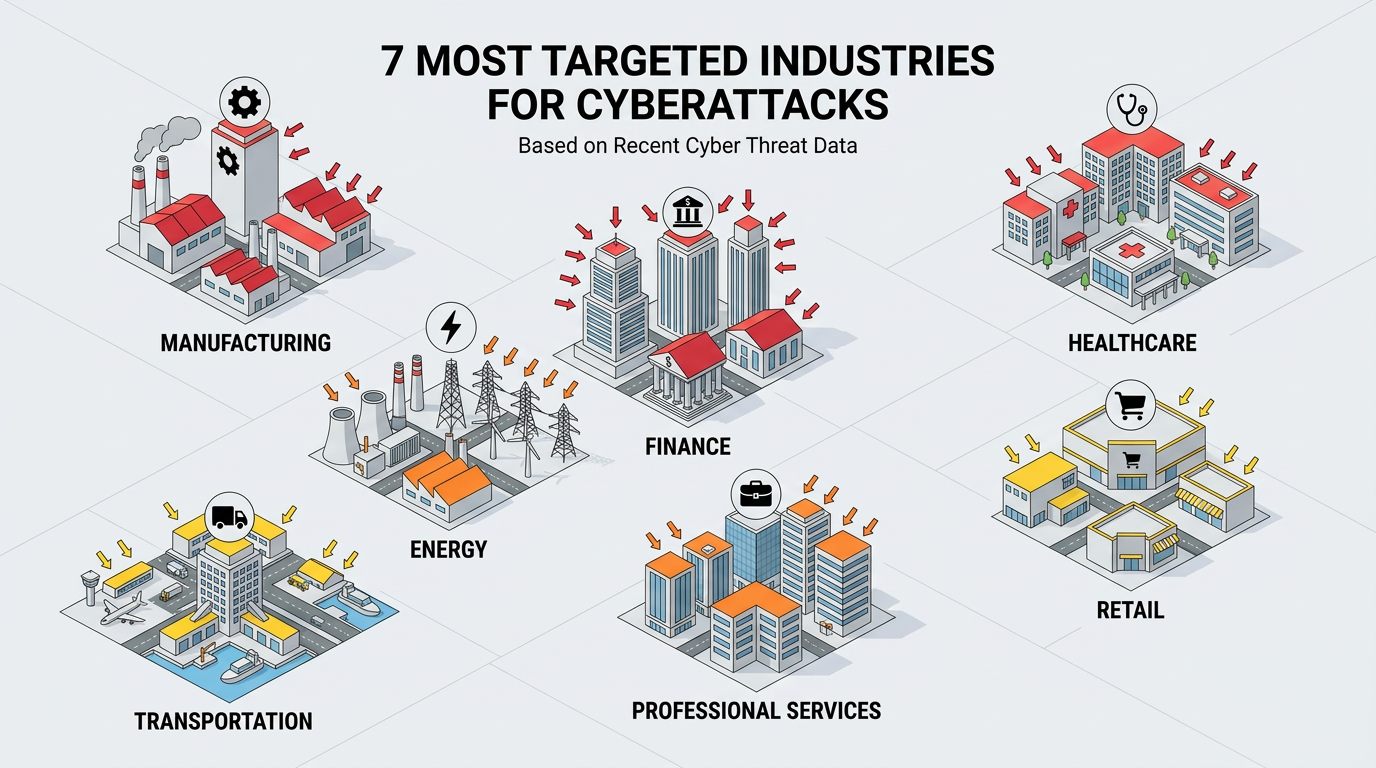
7 Most Targeted Industries for Cyberattacks
Attackers prioritize industries according to valuable data, operational dependencies, intellectual property, financial access, and geopolitical importance. Public-facing applications, compromised accounts, phishing, and remote services remain common entry points.
Critical infrastructure reporting consistently places healthcare, manufacturing, finance, government, and IT among the sectors under sustained pressure:
Manufacturing: Supply chain dependencies, valuable intellectual property, exposed operational systems, and low tolerance for downtime make manufacturers attractive targets for ransomware, espionage, and data theft.
Finance and Insurance: Attackers pursue financial access, credentials, sensitive customer data, and opportunities for fraud through phishing, account compromise, and credential harvesting methods.
Professional, Business, and Consumer Services: These organizations hold valuable client information and often provide trusted access to other businesses, opening paths for phishing, application exploitation, and data theft.
Energy: Attackers target energy organizations for data theft, extortion, espionage, and service disruption through application vulnerabilities, compromised accounts, and ransomware.
Transportation Services: Transportation providers face risks to operational continuity, logistics data, and customer information.
Healthcare: Healthcare organizations hold sensitive patient information and depend on continuous operations, which makes them attractive targets for ransomware, data theft, and extortion.
Retail: Retailers face credential theft, social engineering, payment fraud, and web application attacks that target customer data and transaction systems.
Across these sectors, stolen credentials and exposed data create paths for deeper compromise. Strong identity controls, supply chain risk management, and email threat detection can help reduce the attack paths that begin with trusted accounts or messages.
The Business Impact Behind the Numbers
Cyberattacks affect the business long after technical containment ends. Direct financial loss, operational disruption, legal obligations, and reputational harm can continue throughout investigation, recovery, notification, and litigation.
The primary business impacts include:
Financial Impact: Costs can include fraudulent transfers, ransom payments, forensic investigation, system recovery, legal support, customer notification, and business interruption.
Operational Impact: Ransomware and destructive attacks can halt production, disrupt services, block access to essential systems, and force teams into manual recovery processes. Extended attacker dwell time gives threat actors more opportunity to exfiltrate data and deepen damage.
Reputational and Regulatory Impact: Breaches can weaken customer trust, trigger contractual disputes, attract regulatory scrutiny, and create disclosure obligations. Regulated organizations may also face corrective action plans and long-running oversight.
These consequences compound when detection and containment move slowly. A clear incident response process can help teams coordinate technical recovery, legal review, communications, and regulatory reporting.
Why Cyberattack Volumes Keep Rising
Attack volumes continue to grow because automation reduces the cost of creating, testing, and distributing malicious content. Generative AI helps attackers write polished phishing messages, personalize pretexts, and translate campaigns quickly.
The enterprise attack surface has also expanded through remote work, cloud services, public APIs, and third-party access. Unsanctioned AI tools introduce additional governance challenges when employees use services without security review or clear data-handling policies.
Ransomware-as-a-service and other commoditized criminal models further lower the barrier to entry. At the same time, human behavior risks remain relevant because attackers often target trust, urgency, authority, and established workflows rather than technical vulnerabilities alone.
How to Protect Against Cyberattacks
Organizations can reduce daily cyberattack exposure by combining employee preparation, identity security, patching, behavioral email detection, and tested incident response. No individual control covers every attack path.
Here are practical steps security teams can take:
Staff Training: Employees receiving security awareness training can learn to recognize social engineering, verify unusual requests, and report suspicious activity. Training should cover email, voice, text, and collaboration tools.
Identity Hardening and Patching: Move beyond passwords and SMS codes with phishing-resistant multi-factor authentication, enforce session timeout policies, and keep systems consistently patched to reduce credential abuse and vulnerability exploitation.
Behavioral Detection Technology: Behavioral detection technology can help surface socially engineered email threats that evade static rules.
Transaction Verification Procedures: Require out-of-band confirmation for wire transfers, vendor payment changes, or access requests, especially when urgency appears in the message.
Unusual Login Pattern Monitoring: Watch for off-hours access, unfamiliar locations, or rapid credential use across multiple services.
Updated Asset Inventories: Track software dependencies, API connections, and vendor access paths to assess exposure quickly when vulnerabilities or supplier compromises surface.
Network Segmentation and Backup Testing: Limit lateral movement if attackers gain initial access, and test backup restoration under realistic conditions rather than assuming recovery will work during an incident.
Quarterly Vendor Permission Reviews: Revoke unnecessary vendor permissions rather than granting persistent access.
Incident Response Planning: Tested incident response plans can help organizations assign responsibilities, preserve evidence, coordinate communications, and contain incidents more efficiently.
Together, these controls address human decisions, exploitable systems, deceptive messages, and recovery coordination.
How Behavioral AI Reduces Cyberattack Exposure Around the Clock
Abnormal's behavioral AI can reduce email attack exposure by identifying suspicious deviations from established communication patterns. Traditional rule-based detection often struggles with personalized, grammatically polished attacks that lack known malicious signatures. The platform applies behavioral AI to cloud email and supported collaboration environments. By learning how employees and vendors normally communicate, it can help identify unusual requests before a user clicks a malicious link or approves a fraudulent payment. This approach focuses on intent and behavior rather than relying only on static indicators.
Abnormal also integrates through APIs with Microsoft 365 and Google Workspace without requiring MX record changes or endpoint agents. It works alongside the email gateway (SEG), security information and event management tools, and other existing security controls rather than replacing them.
Gartner Peer Insights reviewers named Abnormal a Customers' Choice in the 2026 Gartner® Peer Insights™ Voice of the Customer for Email Security. To see how Abnormal's behavioral AI can help cut daily exposure to cyberattacks across your email environment, book a demo.
Frequently Asked Questions
What Is the Difference Between Telemetry-Based Cyberattack Counts, Reported Incidents, and Confirmed Breaches, and Why Shouldn't They Be Combined?
Each measurement captures a different stage of the threat lifecycle and answers a different operational question. Telemetry tracks control effectiveness, complaint data signals patterns in realized harm, and breach confirmations support long-term risk modeling. Combining them creates a false aggregate because a single campaign can generate thousands of telemetry events, dozens of victim reports, and one confirmed breach entry.
How Is Generative AI Changing the Volume and Sophistication of Phishing and Social Engineering Attacks in 2026?
Generative AI lowers the skill threshold for sophisticated campaigns, letting attackers iterate quickly and personalize at scale across languages. It also produces convincing business documents, meeting summaries, and polished messages that bypass traditional red flags like poor grammar. The result is a higher volume of attacks that look indistinguishable from legitimate correspondence, making human review alone insufficient.
Why Does Manufacturing Consistently Rank as One of the Most Targeted Industries for Cyberattacks, and What Specific Vulnerabilities Make It Attractive to Attackers?
Manufacturers combine high downtime sensitivity with legacy operational technology that resists patching and segmentation, which gives attackers immediate extortion leverage. Design files, process specifications, and supply chain positioning also make them valuable targets for espionage and downstream compromise. Tight budgets and production-first priorities often leave security underfunded, and attackers know ransoms get paid quickly to protect delivery commitments.
How Does Behavioral AI-Based Email Security Differ From Traditional Rule-Based Detection in Preventing Business Email Compromise and Vendor Email Compromise?
Rule-based systems check messages against known malicious indicators like blacklisted domains and attachment signatures, which BEC and vendor email compromise attacks usually lack. Behavioral AI instead baselines each user and vendor relationship to surface deviations in workflow cadence, timing, and request patterns. That difference matters when an attacker uses a legitimate account or lookalike domain to request a banking change or wire transfer with no technical markers to flag.In 2025, the FBI's Internet Crime Complaint Center began tracking artificial intelligence as a complaint descriptor for the first time, logging 22,364 AI-related complaints with $893 million in adjusted losses. The question of how many cyberattacks happen per day has no single answer, because the number shifts depending on whether it reflects victim complaints, blocked attempts, or confirmed breaches. Attackers also use generative AI to sharpen phishing, deepfake technology and scams, and investment fraud, which pushes the volume of attempts even higher.