
Key Insights
Account takeovers don't end the moment a session is revoked. Security teams still face the difficult work of containment and investigation, reconstructing what files a threat actor reached, what repositories were accessible, and what was exposed at the time of compromise. According to the IBM 2025 Cost of a Data Breach Report, it takes an average of 246 days to identify and contain a breach originating from compromised credentials.
Abnormal solves the critical need of detecting and remediating email account compromise. Abnormal’s behavioral AI detects account takeover by continuously correlating subtle anomalies in behavior, identity, and communication patterns, then auto-remediates the compromised account. But auto-remediation doesn't address what was exposed: the sensitive data still sitting in SaaS, cloud storage, and file repositories.
The new integration between Abnormal and Cyera closes the loop. After remediating the compromised account, Abnormal's alerts flow directly into Cyera Omni DLP, tightening sensitive data access for the compromised user and surfacing the full blast radius for the SOC.
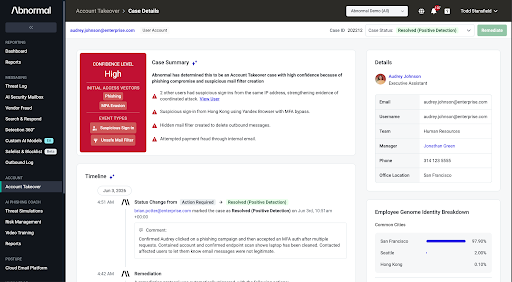
What the Abnormal and Cyera Integration Delivers
The integration connects three steps in one workflow. Abnormal’s Account Takeover (ATO) Protection detects and remediates the compromised account. Cyera autonomously surfaces the sensitive data the compromised user can access, highlights potential exposure and blast radius, and helps enforce stricter data protection controls to limit further risk. Joint customers get a connected response across email, identity, and data.
Detect and Remediate Compromised Accounts in Seconds
Account takeovers are difficult to detect because the indicators are subtle. An attacker might log in from an unusual location, use a new device, or add a mail filter rule to hide outbound communication. Individually, these signals get lost in alert noise. Even after a compromise is confirmed, manual remediation takes hours.
Abnormal is able to detect and correlate subtle indicators because it builds a per-identity behavioral model of every person in your organization. By analyzing thousands of unique signals per user, from login patterns and device history to communication behavior and relationship context, Abnormal understands what normal looks like for each individual. When it detects a compromise with high confidence, it automatically remediates the takeover, revoking active sessions, disabling the account, and resetting the password.
Outcome: Abnormal’s ATO Protection automatically remediates compromised accounts seconds after a detection is made, cutting off the attacker's email and identity foothold before they can pivot.
Reveal the Blast Radius and Tighten Data Controls
While Abnormal’s ATO Protection secures the compromised email account, it doesn’t address what crown jewels the attacker may have already reached across SaaS, cloud storage, and file repositories. Legacy data loss prevention (DLP) tools typically apply uniform policies to every user, missing the high-risk window where context matters most.
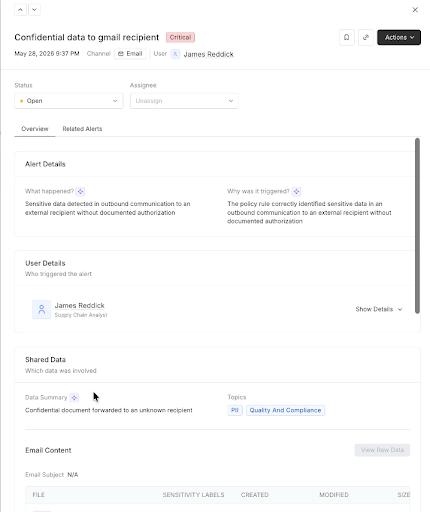
The integration sends Abnormal's high-confidence ATO alerts directly to Cyera Omni DLP. Cyera correlates the identity risk signal with sensitive data context, surfacing what data the compromised user can access, assessing the potential blast radius, and prioritizing the highest-risk exposures. It then recommends stricter controls for that specific user—such as blocking downloads of sensitive files, disabling external sharing, and restricting access to sensitive repositories.
Outcome: Security teams gain immediate visibility into what data is at risk while Cyera helps contain and stop sensitive data movement associated with the compromised identity within minutes.
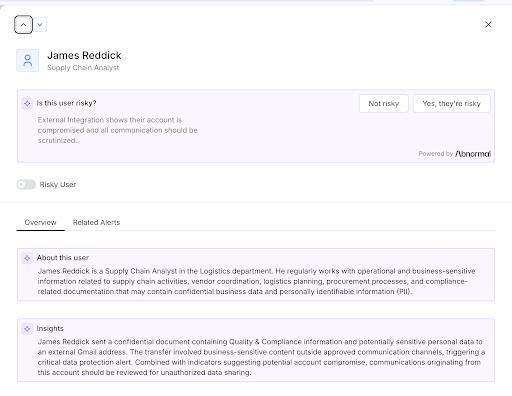
Expose the Blast Radius for Forensic Investigation
After remediation, the key question is what the attacker actually touched. Without data context, analysts can spend hours tracing permissions across SaaS, cloud, and file systems—and many incidents close with that question unanswered.
Cyera surfaces the compromised user's full data footprint inside the investigation view. Security teams see what sensitive data was in reach, what was accessed during the incident, and what was already overexposed before the compromise began. The investigation shifts from reconstruction to prioritization.
Outcome: Mutual customers gain immediate visibility into data exposure, accelerating forensic investigation and focusing the SOC on incidents that carry real business risk.
Why This Partnership Matters
Attacks often begin with a compromised email account before expanding to the systems and repositories where data lives. Detecting and remediating the compromised account is necessary but not sufficient, security teams also need to contain and investigate data exposure across SaaS and cloud.
The Abnormal and Cyera integration turns three sequential problems—identifying compromise, assessing data exposure, and remediating it—into one connected response. The result: a smaller blast radius, less time spent reconstructing what happened, and faster forensic resolution.
See how Abnormal and Cyera work together to stop account takeover before data moves.
