
Key Insights
Abnormal AI is included as a Notable Vendor in The Human Risk Management Solutions Landscape, Q4 2026, Forrester's overview of the human risk management (HRM) market, published October 20.
The overview defines the market, describes what security leaders look for in HRM solutions, and lists Notable Vendors. It also maps the functionality vendors offer to core and extended use cases.
Here is what stood out, and where Abnormal AI fits.
What Matters Most in Human Risk Management Today
1. Continuous Interventions Are Replacing Periodic Training
The report describes what replaces the periodic model as continuous, threat-informed quantification of and response to human risk. The Forrester report states:
"Periodic training and static simulations have had their day."
AI Phishing Coach works this way. Precision Training adjusts simulation cadence and difficulty for each employee based on their Phishing Risk Score, so people with elevated risk signals get more coaching and people who are progressing get less friction.
2. Measurable Outcomes Matter More Than Completion Rates
Security awareness programs have traditionally been measured by activity: who finished the module and who clicked the test email. The Forrester report states:
"CISOs see flaws in traditional metrics like training completion, engagement and click rates."
A completed module shows that someone watched a video, not whether they would catch a vendor email that quietly changes where an invoice gets paid. Phishing Risk Scores in AI Phishing Coach combine simulation interactions, training completion, and reporting behavior into company-wide and per-employee trends over time.
3. Training Should Reflect How Attackers Operate
Attackers go after different people in different ways, so a program that gives everyone the same training leaves gaps. The Forrester report also states that HRM programs:
"must reflect how adversaries operate by preparing employees for the attack techniques they are uniquely likely to encounter."
AI Phishing Coach starts from the real attacks Abnormal stops in each customer's environment and turns them into simulations tailored to each employee, including BEC and vendor fraud scenarios. When someone interacts with a simulation, just-in-time coaching explains what made it risky.
What the Overview Covers
Beyond market trends, the overview organizes human risk management around use cases. It identifies two core use cases, human risk identification and response and security education and training, and six extended use cases: agent relationship risk; AI impersonation simulations; AI system usage risk management; regulatory, insurance, and third-party compliance; security culture improvement; and social engineering simulations. It also maps the functionality vendors offer to each.
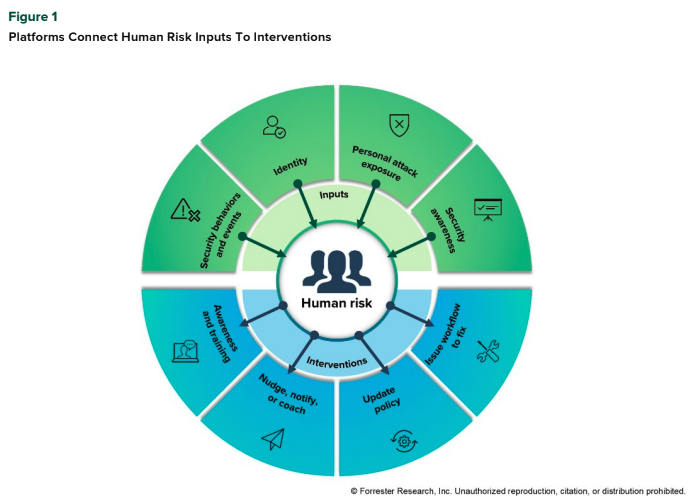
Source: Forrester Research, Inc., The Human Risk Management Solutions Landscape, Q4 2026.
Abnormal and Human Risk Management
Abnormal already understands how people communicate across an organization, and that understanding is the foundation for our detection. AI Phishing Coach applies the same intelligence to training, so simulations and video content reflect the threats and the environment employees actually work in.
In practice, that means coaching built around growth, not gotchas, simulations drawn from real BEC and vendor fraud attempts, and dashboards and downloadable reports that show whether risk is moving.
Access the Report
Abnormal believes human risk management is critical to the success of any cybersecurity program, and we will keep building AI Phishing Coach around real attacks and real behavior data.
Access The Human Risk Management Solutions Landscape, Q4 2026 to learn how Forrester describes the market and where Abnormal AI is included.
Get the Report
Forrester does not endorse any company, product, brand, or service included in its research publications and does not advise any person to select the products or services of any company or brand based on the ratings included in such publications. Information is based on the best available resources. Opinions reflect judgment at the time and are subject to change. This report is part of a broader collection of Forrester resources, including interactive models, frameworks, tools, data, and access to analyst guidance. For more information, read about Forrester's objectivity here.