重要なインサイト
When an AI-powered endpoint detection and response (EDR) tool quarantines a critical production system overnight, the first question from a CEO may not be "Did it work?" It may be "Why did it do that?" This is the AI black box problem, and it has become a pressing challenge for security leaders.
As organizations deploy AI systems that take autonomous actions, such as blocking traffic, isolating endpoints, or flagging insider threat indicators, limited visibility into how the system reached those decisions creates strategic, operational, and regulatory risks that Chief Information Security Officers (CISOs) need to address. Getting that visibility right determines how confidently a security leader can defend an automated action to a board, an auditor, or their own team.
The guide ahead breaks down where opacity originates in security tooling, how it collides with GDPR and EU AI Act obligations, and which explainability techniques and governance controls help teams keep automated decisions defensible. Left unaddressed, the same opaque logic that speeds up detection can quietly shift liability onto the security team when an automated action disrupts the business or draws regulatory scrutiny.
This article draws on insights from Abnormal's webinar on best practices for utilizing AI in cybersecurity, featuring Dan Scheebler, Head of Machine Learning at Abnormal, and Lamont Orange, CISO at Cyera.
Key Takeaways
The AI black box problem occurs when security tools produce decisions without transparent reasoning or auditable decision paths.
Auto remediation and auto orchestration capabilities require reliable reversal mechanisms when AI lacks business context.
Proof of concept (POC) testing and first-principles analysis provide a practical method for evaluating AI tool transparency.
Organizations need to balance the simplicity of black box systems against the debuggability of transparent ones.
Regulatory requirements such as General Data Protection Regulation (GDPR) Article 22 and the EU AI Act are driving transparency mandates.
What Is the AI Black Box Problem?
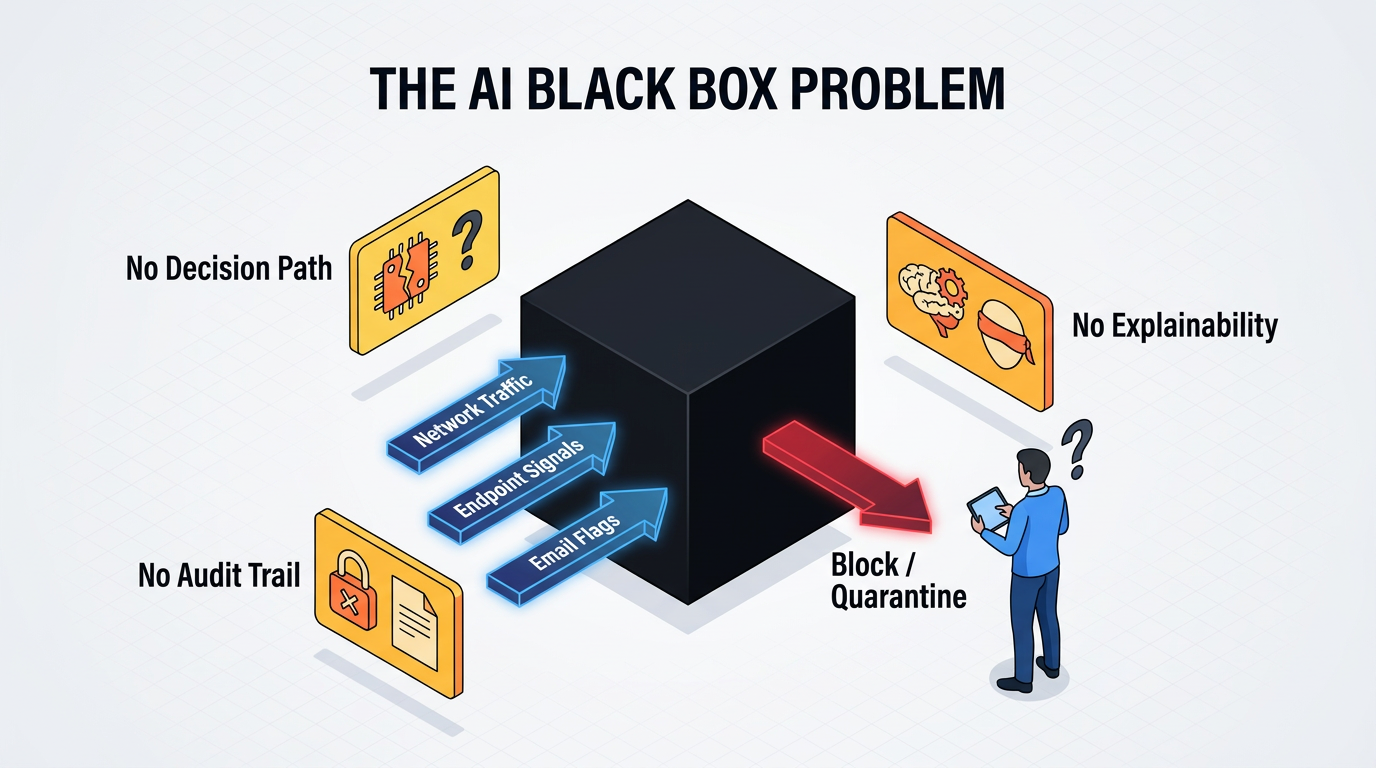
The AI black box problem describes AI systems that produce outputs, including threat detections, risk scores, and automated incident response, without providing transparent reasoning or auditable decision paths. In cybersecurity, this appears when an EDR quarantines systems, a security orchestration, automation, and response (SOAR) platform blocks traffic, or inbound email security flags threats without explaining the underlying logic.
For security leaders, the central challenge is defending decisions they struggle to explain. When boards or auditors ask why an AI system acted, "the AI decided" does not provide enough detail. These opaque decisions create operational disruption, compliance documentation gaps, and blind spots in threat exposure.
The problem intensifies as AI tools move from advisory roles to autonomous action. Systems that provide guidelines or source information operate differently from those executing auto remediation. The latter benefit from visibility into action traces, descriptions, reasoning, and justification.
Why the AI Black Box Problem Matters for Security Leaders
The AI black box problem creates liability, compliance exposure, and trust gaps when organizations cannot reconstruct the reasoning behind security decisions.
Strategic Liability
Security leaders remain accountable to boards and stakeholders when decisions covered by AI governance responsibilities cause business disruption. Under NIS2, management bodies of covered entities need to approve and oversee cybersecurity risk-management measures and may face liability for infringements.
When auto remediation shuts down a production system that was performing legitimate business functions, explaining that the AI lacked context may not satisfy stakeholders. Experienced security leaders recognize the need for "unscrew" mechanisms that let teams rapidly reverse AI decisions when they conflict with business operations.
Regulatory and Compliance Exposure
The General Data Protection Regulation (GDPR) includes Article 22, which grants individuals the right not to face solely automated decisions that significantly affect them, along with rights to obtain human intervention and contest the outcome. The CJEU's SCHUFA judgment extended Article 22 to automated scores that downstream decision-makers rely on heavily, meaning an automated insider-threat flag HR acts on may qualify.
The EU AI Act's transparency requirements have applied since 2 August 2026. They cover notice that a user is interacting with an AI system, disclosure of deepfakes, and machine-readable marking of synthetic content. Explainability-related duties come later: record-keeping, transparency to deployers, and human oversight for stand-alone high-risk systems apply from 2 December 2027 under the Digital Omnibus deferral, according to the consolidated EU AI Act. Organizations using black box AI in security operations may struggle to produce the records those obligations require.
Eroded Stakeholder Trust
Business leaders increasingly question security decisions that teams cannot justify. When marketing asks why campaign automation created a data breach risk, or when sales wants to know why a prospect's emails were quarantined, "trust the algorithm" can weaken the collaborative relationships that security programs depend on.
How the AI Black Box Problem Occurs in Security Tools
Technical opacity, proprietary vendor controls, and fragmented integrations can each limit a security team's view into AI decision logic.
Technical Opacity
Deep learning and neural networks, the technologies powering many modern threat-detection systems, create inherent opacity. These models learn complex patterns in ways that resist direct human interpretation, and their developers may struggle to explain why particular inputs produce specific outputs.
During the webinar, Dan Scheebler, Head of Machine Learning at Abnormal, put it this way: "Black boxes are simple. Open boxes with lots of integration points are complex. But open boxes with lots of integration points are debuggable and black boxes aren't."
Vendor Constraints
Security vendors often treat detection algorithms as proprietary intellectual property. That approach can protect a vendor's methods, but it also creates transparency barriers for customers who need to understand and validate security decisions. When vendors expose only a risk score, teams struggle to tune detections or provide audit evidence. But clear action traces can preserve proprietary details while giving customers operational context.
Integration Fragmentation
Traditional security tools can operate in silos, particularly when vendors designed legacy solutions for out-of-the-box deployment and limited communication across organizational boundaries. When AI systems operate across fragmented data sources, understanding their decision logic becomes harder, and contextual signals may sit across endpoints, web gateways, and collaboration systems. Fragmentation can therefore leave an otherwise transparent AI system working from incomplete context, reducing both detection quality and the team's ability to explain what the system observed.
Key Challenges Created by the AI Black Box Problem
Opaque AI creates operational blind spots, documentation gaps, and recurring false positives that security teams may struggle to diagnose.
Operational Blind Spots
Each organization has eccentricities, including unique business processes, legacy integrations, and exceptional workflows that differ from what tool designers anticipated. Black box AI offers limited visibility into where these organizational specifics conflict with its assumptions.
The SANS SOC Survey found that 42% of security operations centers rely on AI and machine learning tools "out of the box" with no customization. A tool that has never been tuned to a specific environment and cannot explain its reasoning leaves the team guessing whether a false positive reflects a real anomaly or a mismatch between the vendor's assumptions and internal workflows. Visibility into AI reasoning lets teams calibrate tools to their environment and gives analysts a concrete basis for tuning or escalation.
Compliance Documentation Gaps
Security decisions increasingly require audit trails that demonstrate appropriate controls and decision rationale. Black box systems that cannot provide explainable outputs can create documentation gaps that regulators and auditors may reject. Security posture management can help identify and document configuration risks, but teams still need transparent reasoning behind the resulting findings.
A complete audit record needs more than a timestamp and final action. Compliance teams may need to document these elements:
Decision Inputs: The record shows what information informed the decision.
Human Review: The record indicates whether a person reviewed the decision.
Policy Authority: The record identifies which policy authorized the response.
Appeal or Reversal: The record explains how the organization handled an appeal or reversal.
When a system exposes only its output, security and compliance teams often need to reconstruct the missing context manually, leaving uncertainty about whether the record accurately represents the original decision.
False Positive Cascades
When AI systems generate false positives, teams need to understand why they occurred to reduce recurrence. Black box systems provide a limited path from "this was wrong" to "here is how we adjust it," turning similar false positives into repeated incidents rather than learning opportunities.
Transparent detection changes that dynamic. A systematic review of explainable intrusion detection found that explainability lets analysts "validate system outputs, identify false positives, and refine detection strategies with confidence." The practical difference appears when a team encounters a second false positive of the same type: one system produces another unexplained ticket, while the other gives analysts enough context to adjust the signal that misfired.
Explainable AI Techniques That Open the AI Black Box
Explainable AI methods provide several layers of visibility into what a system did, how it reached a decision, and why that decision matters to an analyst. These layers can also make automated incident response easier to evaluate before analysts act on it.
Distinguishing Transparency, Explainability, and Interpretability
The National Institute of Standards and Technology's (NIST) AI Risk Management Framework separates three properties that vendors often blur together. These properties answer different questions and support different operational needs.
Property | Primary Question | Security Application |
|---|---|---|
Transparency | What happened in the system? | Logs show the action the system took. |
Explainability | How did the system make the decision? | Signal details show what drove a quarantine. |
Interpretability | Why does the decision matter? | An analyst can understand and act on the explanation. |
The framework lists accountable and transparent, and explainable and interpretable, among its trustworthiness characteristics. It also states: "Trustworthy AI depends upon accountability. Accountability presupposes transparency."
Applying SHAP and LIME to Threat Detection
Two post-hoc methods appear frequently in academic work on explaining detection models: SHapley Additive exPlanations (SHAP) and Local Interpretable Model-Agnostic Explanations (LIME). The systematic review of explainable intrusion detection found these to be the most popular XAI techniques applied to intrusion detection systems.
The methods serve different explanation needs:
SHAP: In the reviewers' words, "SHAP successfully highlights influential features in threat classification, allowing analysts to see why certain network behaviors are flagged as suspicious." It produces global and local feature attributions based on Shapley values at higher computational expense.
LIME: LIME works well for instance-level explanations that let an analyst audit a single detection output. It produces quick local explanations using linear approximations.
During evaluation, security teams can ask whether explanations reflect the model's own reasoning or an approximation layered on top.
How to Address the AI Black Box Problem: A Framework for CISOs
CISOs can assess AI transparency through environment-specific testing, risk-based governance, and integration requirements that preserve decision context.
Vendor Evaluation Criteria
A POC provides a practical method for evaluating AI transparency because it tests tools in the organization's actual environment against real data. First-principles analysis adds another layer by examining what technology powers the tool, how it processes data, and what decision logic it applies.
Security teams can use several questions to assess vendor transparency:
Can the tool provide action traces that explain specific decisions?
What data inputs inform each detection or response?
How does the system adapt to organization-specific patterns?
What explainability features support audit and compliance requirements?
Does the explanation reflect the model's reasoning or a post-hoc approximation?
These questions are most useful when teams verify the answers during a POC rather than relying only on a datasheet. Testing can reveal whether explanations remain useful under real operating conditions and whether analysts can trace a verdict to relevant inputs.
Internal Governance Frameworks
Not every AI decision requires the same level of transparency. Teams can develop a decision matrix that distinguishes when black box AI represents acceptable risk and when explainability is necessary for cybersecurity regulatory compliance.
Situations with high transparency requirements include:
Decisions that affect production systems
Actions that affect customer data
Responses subject to regulatory scrutiny
Automated actions with business impact
Situations where limited opacity may be acceptable include:
Advisory recommendations that analysts review
Low-impact detection alerts
Threat intelligence enrichment
For systems classified as high risk, the EU AI Act's human-oversight provisions can turn this matrix into both an operational control and a compliance artifact.
Integration and API Requirements
Security teams can require strong API integration capabilities during vendor evaluation. Modern security operations depend on data moving between platforms so analysts can gain unified visibility into what AI systems observe and decide. These requirements encourage more transparent architectures and can help automate SOC operations without sacrificing explainability.
Integration reviews can examine whether a tool:
Exports decision context alongside alerts
Preserves timestamps and action histories
Supports existing escalation and reversal workflows
Retains explanations when data moves into a SIEM or SOAR platform
An integration that exports only a severity score may automate routing while losing the reasoning analysts need. APIs that preserve inputs, rationale, and action traces make automation easier to audit and troubleshoot.
Moving Forward With AI Transparency in Cybersecurity
AI transparency is quickly becoming a core criterion for vendor selection, regulatory readiness, and the design of integrated security operations. Security leaders who require transparent decision records, build internal governance frameworks, and treat AI as an extension of human judgment will be better positioned to defend automated actions to boards, auditors, and business stakeholders.
Abnormal supports that standard by pairing behavioral AI with clear decision context across email and identity signals, so analysts can see why a message was flagged and act on it with confidence. Recognized as a Customers' Choice in the 2026 Gartner® Peer Insights™ Voice of the Customer for Email Security, Abnormal integrates with existing Microsoft and Google environments to strengthen detection without adding opacity.
Book a demo to see how behavioral AI can bring transparency to your email security decisions.
Frequently Asked Questions
Does GDPR Article 22 Cover Automated Security Flags?
Yes, when downstream reviewers rely strongly on an automated flag rather than making an independent decision, such as an insider threat flag that HR acts on with minimal scrutiny. To stay defensible, document what reviewers see, their authority to overturn the result, and the appeal path available to the affected person.
When Do EU AI Act Obligations Start Affecting Security Tooling?
Transparency duties apply now, and record-keeping and human-oversight obligations for high-risk systems follow on 2 December 2027. Identify which of your systems may qualify as high-risk and confirm vendors preserve the inputs, rationale, and action history behind each decision.
What Should I Ask a Vendor About Explainability?
Ask for action traces, decision inputs, the explanation method, reversal controls, and whether context survives handoffs to a SIEM or SOAR platform. Validate those answers in a POC using your own legitimate messages and known threat patterns rather than relying on a datasheet.