重要なインサイト
Every click, every send, every upload puts sensitive data in motion, and today's enterprises are generating it faster than any team can track by hand. That's where data loss prevention (DLP) comes in: the high-stakes discipline of identifying, monitoring, and protecting critical information across data in use, data in motion, and data at rest.
For security leaders, the mission is clear and urgent. Building a DLP program that actually reduces risk means uniting governance, visibility, and enforcement into a single, coordinated defense across every channel where sensitive data flows.
Key Takeaways
- DLP covers data in use, data in motion, and data at rest. Comprehensive coverage across all three states is essential to eliminate the blind spots that lead to accidental exposure or intentional exfiltration.
- Misdirected email is the single most frequent error type in breach data. Even well-intentioned employees can trigger a data loss event simply by selecting the wrong recipient or attaching the wrong file.
- Rule-based DLP creates tension between detection coverage and alert noise, producing a binary system that may struggle to distinguish routine activity from genuine risk. Without situational context, these tools often flag harmless behavior while missing the patterns that signal real threats.
- NIST, CISA, and ISO 27001:2022 all recognize DLP as a mandatory or named security requirement. Aligning your program with these frameworks helps ensure both regulatory compliance and a stronger overall security posture.
What Is Data Loss Prevention?
Data loss prevention is the set of technologies and processes used to identify, monitor, and protect sensitive data across its full lifecycle. NIST's glossary defines DLP as a system's ability to identify, monitor, and protect data across all three states: in use, in motion, and at rest, through deep content inspection and contextual analysis of transactions within a centralized management framework. Below is a breakdown of each state.
- Data In Use: Data actively accessed, processed, or modified on endpoints and applications.
- Data In Motion: Data traveling across networks, including email, web uploads, and API calls.
- Data At Rest: Data stored in cloud repositories, databases, file servers, or archives.
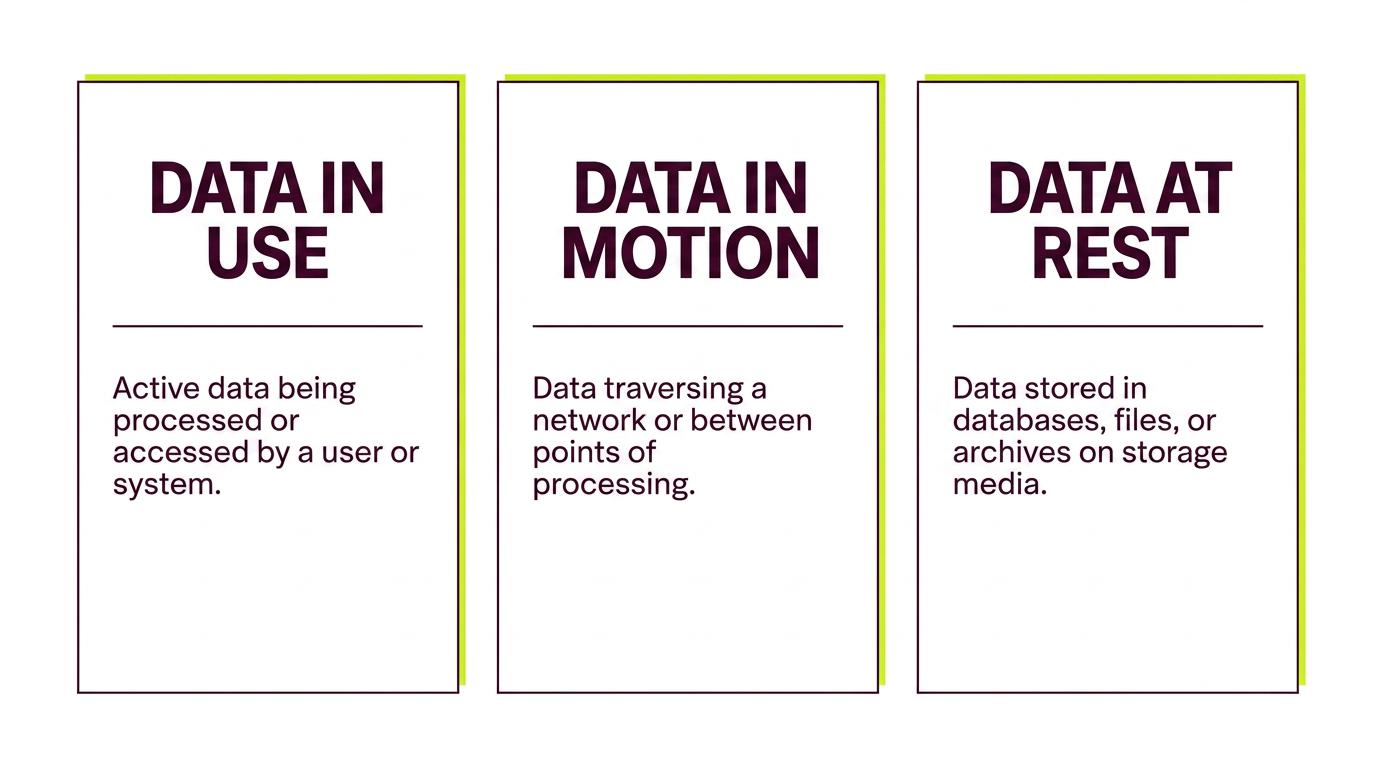
Each state demands distinct monitoring and protection approaches, and together they define the scope of any DLP program. A gap in coverage for any single state creates blind spots that attackers and accidental exposures can exploit.
Common Causes of Enterprise Data Loss
Enterprise data loss usually comes from a mix of user mistakes, malicious activity, external attacks, and control failures. Understanding the cause taxonomy helps security leaders prioritize DLP investments.
- Human Error and Negligent Insiders: Misdirected emails, wrong attachments, and accidental sharing with unauthorized recipients all fall into this category.
- Business Email Compromise (BEC): The most financially damaging email-based data loss vector tracked by U.S. federal law enforcement.
- Malicious Insiders and Privilege Misuse: Departing employees, disgruntled staff, and compromised accounts represent the intentional side of insider risk across regulated sectors.
- Inadequate Access Controls: Overly permissive access rights, shared credentials, and failure to enforce least-privilege policies expose sensitive data to users who have no operational need for it.
- Unmanaged Cloud and Shadow IT: Employees using unsanctioned cloud storage, personal devices, or unauthorized SaaS applications create data flows outside DLP monitoring coverage.
Types of Data Loss Prevention Solutions
Modern DLP programs usually require multiple control types because sensitive data moves across endpoints, networks, cloud services, and applications. DLP solutions span multiple categories beyond the traditional network, endpoint, and storage framework.
- Network DLP: Monitors data packets across the network to detect sensitive information in transit.
- Endpoint DLP: Agents on endpoints monitor user actions and block prohibited data transfers.
- Cloud DLP: Scans, classifies, and monitors data in cloud repositories through CASB and API connections.
- Email DLP: Inspects outbound and inbound email for sensitive data using content scanning and analysis.
- Web and Browser DLP: Controls data movement through browsers, preventing uploads to unauthorized sites or personal cloud storage.
- Storage and Discovery DLP: Crawls file servers, databases, and cloud buckets to identify and classify sensitive data at rest.
- SaaS and Application DLP: API-based integration with specific platforms to inspect content, enforce sharing restrictions, and prevent unauthorized exports.
- Generative AI and LLM DLP: NIST IR 8505 explicitly names "Large Language Model traffic data protection" as a protection domain. Prompt-level controls intercept sensitive data submissions before they reach AI services.
Why Rule-Based Data Loss Prevention Falls Short
Rule-based DLP can help classify and control known data patterns, but it often loses accuracy when context determines whether an action is risky.
Consider a finance employee who routinely emails spreadsheets containing customer account numbers to an internal auditor: the same content sent to a personal Gmail address late at night poses a vastly different risk, yet a rule-based system may treat both actions identically or block both, generating noise.
Legacy DLP tools rely on two primary detection methods, each with structural limitations that tuning alone may not resolve. Understanding how these methods work, and where they break down, is essential for evaluating whether your current DLP stack can keep pace with modern data flows.
Pattern Matching, Tags, and Data Maps
These core detection methods each provide useful coverage, but each can break down as data changes form, location, or context.
- Regex-Based Content Inspection: This method matches data against known patterns. Minor formatting changes can cause the pattern to miss a match, while broader matching can flag benign content and generate alert noise.
- Tags and Labels: These track file containers rather than the data inside them. When sensitive content is extracted from a tagged file and placed into a new document, the tag does not follow.
- Data Maps: These provide a point-in-time snapshot of where sensitive data resides. As data moves, is copied, or is reformatted, the map becomes stale.
These methods provide useful signals, but they can become less reliable as data changes form, location, or context.
The Binary DLP Detection Problem
Beyond these mechanism-level failures, rule-based DLP shares a deeper architectural flaw that explains why no amount of regex tuning, label hygiene, or map refreshing can fully close the gap: these tools evaluate content without enough situational context. That single shared root cause is what produces the coverage-versus-noise tension introduced at the start of this section, the dynamic that forces security teams to choose between strict rules that drown the SOC in false positives and loose rules that let real incidents slip through.
Whether the underlying mechanism is regex, labeling, or mapping, these methods all evaluate content in isolation, without regard for who is sending it, to whom, at what time, or whether the action fits established patterns.
The result is a binary system that may struggle to distinguish between routine activity and genuine risk, because the risk profile is categorically different when the same content appears in a normal workflow versus an unusual transfer pattern. Closing this gap requires moving beyond static rules toward context-aware detection, an approach that draws on sender behavior, recipient relationships, timing, and aggregated patterns to make smarter decisions, which is exactly what the email-channel risks and program-level best practices in the next sections are built to address.
Best Practices for Building a Data Loss Prevention Program
Building a DLP program that actually reduces risk requires five disciplines working in concert: governance and compliance mapping, phased channel rollout, accurate data classification, user education, and continuous policy refinement, each addressing a distinct failure mode that derails programs built on technology alone.
Governance, Classification, and Compliance Mapping
Governance and classification determine whether DLP controls align with business risk and compliance obligations. NIST CSF 2.0 positions the GOVERN function as foundational to all other security activities. Before deploying any DLP technology, identify stakeholders, define data ownership, and establish risk tolerance thresholds.
ISO 27001:2022 Control 8.12 makes DLP an explicit requirement in the world's leading ISMS standard. Map DLP policies to specific regulatory mandates:
- HIPAA: Protected health information in patient records and clinical data.
- GDPR data flows: EU resident data flows and consent records.
- PCI-DSS: Payment card numbers, CVV, and account data.
- CCPA: California consumer personal information and opt-out records.
- SOX: Financial statements and audit trails.
Phased Rollout and Channel Prioritization
A phased rollout reduces business disruption and helps security teams build operational maturity before expanding DLP scope. Start with the highest-risk channels, typically email and endpoint, where the majority of accidental and intentional data loss occurs, before expanding into cloud storage, SaaS applications, and generative AI tools. Within each phase, begin with monitor-only policies on a limited user population, then graduate to enforcement once detection accuracy is validated. Document rollback procedures for each enforcement policy so that legitimate workflows can be restored quickly when false positives occur.
Data Classification and Discovery
Accurate classification is the foundation that enables every downstream DLP control to be effective. Inventory sensitive data across structured and unstructured repositories, then assign classification labels that map to regulatory categories and business sensitivity tiers.
Automated discovery tools can scan file shares, databases, cloud buckets, and SaaS platforms to surface unknown sensitive data, which often creates the largest blind spots. Refresh the classification regularly so that new data types and shifting business priorities are reflected in the policy logic.
User Education and Just-in-Time Coaching
Even the strongest technical controls cannot fully compensate for users who do not understand the risk of their actions. Pair DLP enforcement with role-based training that focuses on the specific data handling risks employees face in their daily workflows, rather than generic security awareness modules.
When the platform flags risky behavior, deliver in-the-moment coaching that explains why the action was blocked or warned, turning every alert into a learning opportunity. Track training completion and incident recurrence to identify teams or roles that need additional reinforcement.
DLP Simulation, Metrics, and Ongoing Refinement
DLP tuning improves when teams validate policies before enforcement and measure outcomes over time.
Running DLP policies in simulation before enforcement avoids productivity disruptions and lets teams measure false-positive rates before blocking begins. Track policy trigger rates, false positive ratios, and remediation outcomes. Review policy exceptions quarterly to identify patterns that indicate misclassified data or overly broad rules.
Quarterly exception reviews also surface data categories that may need reclassification as business operations change. DLP program metrics should translate directly into risk reduction language that executives and board members can act on.
Data Loss Prevention Trends Shaping the Next Phase
The next phase of DLP is being defined by two forces: exposure to generative AI and the convergence of DLP with insider risk management, both of which are reshaping enterprise DLP architecture and exposing gaps that legacy, content-only controls cannot close.
- Generative AI and DLP Coverage Gaps: Generative AI has created a new DLP channel because users can paste sensitive data directly into browser-based tools. Employees pasting source code, strategy documents, or PII into browser-based LLMs create data flows that legacy inspection cannot intercept before submission.
- DLP and Insider Risk Management Convergence: DLP and insider risk programs are converging because content signals alone rarely explain user intent or behavioral drift. Most organizations still operate fragmented stacks that cannot correlate signals across data movement and user activity. The behavioral patterns that indicate pre-departure risk, accumulated over days or weeks, are invisible to per-message rule evaluation. Closing this gap requires unifying DLP telemetry with insider risk signals in a single detection framework.
How Abnormal Helps Close the Email DLP Gap
Abnormal is designed to help organizations address email-based data loss scenarios that often require more context than static content rules provide. Abnormal's Misdirected Email Prevention is designed to detect misaddressed emails and mis-attached files with no rules or policies required. When the platform flags an issue, it automatically routes the message to Microsoft quarantine and alerts the sender with details to self-remediate. This reduces the operational burden on the SOC team.
Because the same behavioral AI that powers Abnormal's inbound email protection also drives outbound detection, organizations gain a unified view of email risk without deploying a separate engine. The platform integrates with Microsoft 365 via API in minutes, complementing native Microsoft defenses and existing security infrastructure rather than replacing them.
Turn DLP Strategy Into Action
Strong DLP programs combine governance, content controls, and context-aware detection across the channels where sensitive data moves. Data loss prevention works best as an operational program that spans governance, monitoring, enforcement, and user education across the channels through which sensitive data moves. Email remains one of the highest-risk channels in that mix.
Security leaders building or maturing a DLP program should prioritize closing detection gaps around misdirected emails, context-dependent exfiltration, and account compromise scenarios.
Recognized as a Leader in the Gartner® Magic Quadrant™ for Email Security Platforms, Abnormal helps security teams shift outbound email security from reactive remediation to proactive control.
Book a demo to see how Abnormal can help address the email-based data loss risks that traditional DLP tools miss.
