Key Insights
Enterprise generative AI spending tripled from $11.5 billion in 2024 to $37 billion in 2025, with more than half flowing to AI applications rather than infrastructure. As those systems move into live workflows, ordinary uptime and error dashboards can show a healthy service while missing consequential model behavior: a fast, error-free response can still be wrong or unsafe, and a single request can cross several components without a conventional failure.
AI observability addresses this problem by attaching model-specific context to the telemetry teams already collect. In this guide, we apply that discipline across the stack and translate it into detection best practices for prompt injection, data leakage, and excessive agency. By the end, you will know what to instrument at each layer, which signals belong to engineering versus security versus the AI system owner, and where observability hands off to the guardrails and runtime controls that actually stop harm.
Key Takeaways
AI observability adds model context (prompts, retrievals, evaluations, agent actions) to existing logs, metrics, and traces.
Telemetry design trades forensic detail against privacy through content capture, redaction, access, and retention choices.
Agentic systems need action-level records: acting identity, permissions used, approvals, and exact tool parameters.
Observability supplies detection and evidence but blocks nothing, so it sits beside guardrails and runtime enforcement.
What Is AI Observability?
AI observability is the ability to monitor, understand, and troubleshoot AI systems by tracing how inputs, context, models, and actions combine into an outcome. Standards bodies often call the same capability monitoring and logging.
Before release, teams score the system against evaluation sets and red-team runs. The National Security Agency (NSA) and the Cybersecurity and Infrastructure Security Agency (CISA) publish joint guidance on deploying AI systems securely that supports tracing and alerts for live production traffic. Teams should retain records across model updates and retirement so investigators can reconstruct old requests.
AI Observability Extends Logs, Metrics, and Traces with Model Context
A request record extends traditional telemetry by attaching model-specific context to each call. A useful request record includes the following context:
Content and Grounding: The record includes the prompt and response, or a protected reference, along with retrieved documents.
Model Details: The record includes the model name and version, token counts, finish reason, and evaluation scores.
Agent Actions: The record includes every tool called during the request.
The finish reason exposes truncated or cut-off answers. The model name and version let teams attribute a regression to a specific release. Retrieved documents show what context shaped the answer, and the tool-call record supports review of each action.
AI Observability Differs from Traditional Observability and Model Monitoring
AI observability goes beyond traditional observability and model monitoring by exposing grounding, hidden instructions, and agent actions. Traditional observability focuses on service signals such as error rates and latency. Classic machine learning monitoring adds statistical skew and drift checks against training or recent production data instead.
Neither uptime checks nor drift statistics answer the additional questions raised by generative AI. A drift dashboard can stay flat because inputs haven't shifted. A retrieval-augmented chatbot can still cite a superseded refund policy at the same time, and a groundedness evaluation paired with a source-freshness check can surface that gap.
How AI Observability Works Across the AI Stack
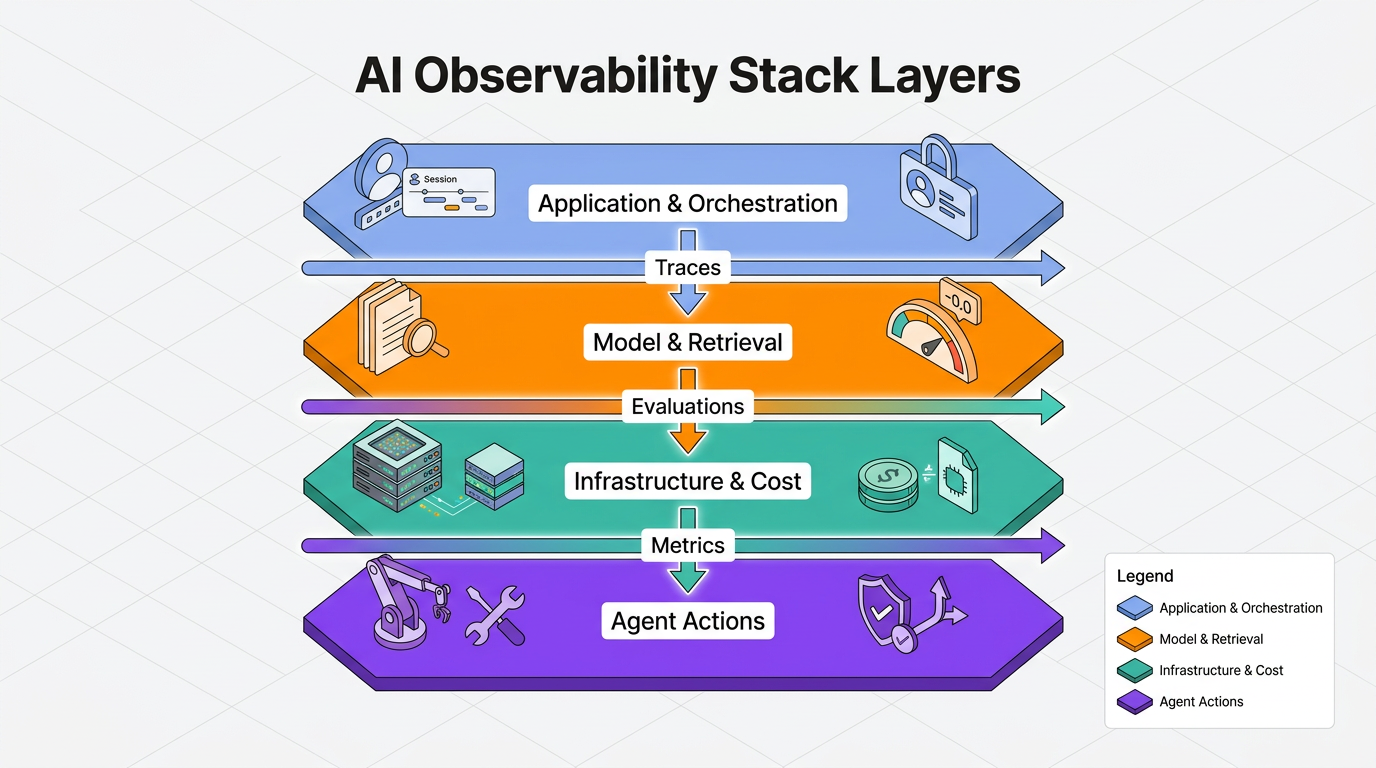
AI observability works across the stack by carrying one trace context through every layer a request touches, from the user session down to infrastructure. Under generative AI telemetry conventions, a support assistant's refund question becomes a top-level agent span. A child span covers the model call. A tool-execution span for the order lookup holds the exact parameters when teams enable content capture. A custom retrieval span can list the returned policy documents. Teams join infrastructure metrics to the trace by time and service to tie latency to the step that caused it.
Application and Orchestration Traces Connect Inputs to Outcomes
The application and orchestration layers connect user activity to system decisions. The application layer records sessions, user identity, prompt and response events, end-to-end latency, and feedback such as thumbs-down ratings. The orchestration layer adds decision structure through retries, branches, fallbacks, tool timing, and errors.
Model and Retrieval Signals Expose Quality and Grounding
Retrieval telemetry records which sources returned, their relevance, and how much context was injected. Evaluations score groundedness and flag likely hallucinations against that context.
Infrastructure and Cost Signals Complete the Causal Chain
Infrastructure and cost signals complete the causal chain by tying failures to the behavior they caused. Endpoint outages, saturated accelerators, and network bottlenecks can degrade outputs directly. Token consumption is a cost and security signal: an agent stuck in a loop may first appear as an unusual token curve.
Benefits of AI Observability for Security Teams
AI observability helps security teams detect, investigate, and scope AI-specific attacks. The table maps selected risks from the Open Worldwide Application Security Project (OWASP) Top 10 risk list for large language model (LLM) applications to signals, records, and decisions.
Risk | Signals to Observe | Record Created | Example Decision |
|---|---|---|---|
Prompt injection | Repeated bypass attempts, instructions in retrieved content, refusal-rate changes | Prompt, retrieval, and policy-event trace | Quarantine the source, tighten filters |
Sensitive patterns in outputs, excessive retrieval, unusual outbound calls | Response hashes and data-access log | Contain the session, notify the privacy owner | |
Data and model poisoning | Sudden behavior shifts, version or data changes, hash mismatches | Model, dataset, and configuration history | Roll back the version, quarantine data |
Excessive agency | Out-of-scope tool calls, missing approvals, unusual permission use | Identity, approval, and tool-parameter log | Revoke credentials, disable the tool |
Improper output handling | Unvalidated output reaching downstream systems | Output-to-consumer trace | Add validation, patch the integration |
Each signal is only as useful as the decision its record supports, which means these records must connect to tools that can act on them. For instance, Abnormal's AI Agent Security and AI Governance are designed to apply this approach to an organization's own AI tools and agents, surfacing shadow AI use and off-task behavior.
Prompt Injection and Jailbreak Signals Reveal Manipulation Attempts
Direct injection arrives in the prompt, whereas indirect injection hides in retrieved documents, emails, or pages. Beyond the table's signals, a plan that departs from the workflow's usual tool sequence points to manipulation. Because the record keeps the retrieved source, analysts can trace an indirect injection to its document and find every session that pulled it.
Data Leakage and Poisoning Signals Expose Integrity and Privacy Failures
Leakage leaves pattern and volume evidence. Poisoning shows up as a behavior change that lines up with a new model version, fine-tuning run, or retrieval-index update.
Tool Abuse and Excessive Agency Require Action-Level Visibility
Once a model can call functions, including tools available through protocol servers, records should describe actions: acting identity, permissions used, approval status, and exact parameters. Those fields reveal out-of-task actions, like a summarization agent writing to a database. Attackers can also encode stolen data into the arguments of an otherwise legitimate call.
Agentic AI Observability Follows Decisions, Memory, and Tools
Agentic AI observability extends tracing from single model calls to an agent's plans, memory lookups, tool calls, and handoffs, because agent risk accumulates across steps.
Agent Traces Preserve the Full Decision Chain
Agent traces preserve the full decision chain by recording every step from goal to final action. For an agent reconciling a vendor invoice, the trace records the goal, plan, each model call, retrieved memory, tool calls, errors, recovery attempts, the final action, the agent's identity, and whether the payment call required human approval.
If the invoice carried an embedded instruction to change the vendor's bank details, the trace shows where the plan shifted, which document introduced the change, and whether the payment tool received new account parameters.
Multi-Agent Traces Reveal Handoffs and Cascading Risk
Multi-agent traces reveal handoff and cascading risks by recording a distinct identity per agent, the task hierarchy, messages exchanged, and the permissions and context passed at each handoff. OWASP's Top 10 for Agentic Applications separates memory and context poisoning, insecure inter-agent communication, and cascading failures.
Without handoff data, teams cannot see a loop between two agents or a low-privilege agent feeding poisoned context to a high-privilege one. Handoff attributes remain proposals, so teams need custom fields for now.
Agent Security Signals Support Human Intervention
Agent security signals support human intervention by routing suspicious actions to the right person before they take effect. In the invoice scenario, an out-of-scope payment call triggers an approval checkpoint that the accounts-payable workflow owner controls. However, that pause is easy to reverse.
Suspicious retrievals force the agent into read-only mode until review. Confirmed compromise justifies the less reversible steps of revoking credentials, disabling tools, or isolating the service, and security makes that call. The trace should record tool outputs as well as calls. Abnormal's AI Agent Security component is designed to flag this handoff risk by correlating agent identity and permission changes.
Privacy-Safe Telemetry and Audit Evidence
Privacy-safe AI observability captures enough context to investigate, and it treats the telemetry store as sensitive data. Prompts and responses often hold the personal or confidential data the AI system processes, so a full-content log creates another sensitive copy.
Content Capture Requires Explicit Data-Minimization Choices
The following controls help teams minimize data and retain useful evidence:
Selective Capture: Teams capture full content only for high-risk workflows, flagged sessions, or a sample.
Redaction and Routing: Pipelines mask personal data before storage and route full content to a restricted store.
Encryption and Access Controls: Teams limit content access to named investigators and log each access.
Retention Tiers: Teams can keep metadata longer than raw content, with legal and data-protection rules setting periods.
After a confirmed incident, teams can place raw content under legal hold to keep it from expiring.
Tamper-Resistant Records Support Forensics and Accountability
Teams create forensic-grade records with synchronized timestamps, the acting identity (human, application, or agent), model and policy versions in force, content hashes, approvals, and configuration changes. Centralized, tamper-resistant logging can apply redaction where needed. Hashes prove a record is unchanged without exposing its content, and each evidence set needs a named owner for retention and release.
Governance Mapping Turns Telemetry into Control Evidence
Telemetry is control evidence only when teams map monitoring requirements to specific records and owners. The National Institute of Standards and Technology (NIST) sets voluntary guidance, and frameworks often call for monitoring without specifying telemetry. Three requirements show how that mapping works:
NIST Monitoring Plans: The NIST AI Risk Management Framework calls for production monitoring and post-deployment monitoring plans.
Management System Monitoring: The International Organization for Standardization and International Electrotechnical Commission's AI management system standard, commonly known as ISO/IEC 42001, lists performance evaluation and monitoring among its requirements.
European Union Event Logs: The EU AI Act requires high-risk systems to support automatic event logging. Deployers of high-risk systems must keep those logs for at least six months unless Union or national law, notably data protection law, provides otherwise.
Teams can keep an evidence index that maps each requirement to the record that satisfies it (monitoring plan, event logs, incident records, and change history) and to that record's owner. Telemetry is necessary evidence, not proof of conformity.
How to Convert AI Observability Signals to Security Response
AI observability signals become security outcomes only when each one has an alert rule, an owner, and a defined response path.
Detection Rules Combine Behavior, Content, Identity, and Context
Single signals produce noise, so stronger rules correlate several. One direct-injection rule alerts when an identity's refusals or policy blocks exceed its workflow cohort's normal hourly range across repeated rephrasings of a request. An indirect-injection rule alerts when a newly indexed or external document containing imperative text precedes a tool call outside the workflow's usual set. Each rule needs testing against benign traffic and adversarial variants.
Security Operations Workflows Route AI Events to the Right Owners
A defined security operations workflow routes the invoice agent's signal to the right owners and moves it through containment and recovery in this sequence:
Detection: The payment tool receives new account parameters without approval, triggering an alert that attaches the trace ID.
Enrichment: The workflow adds the agent identity, model version, invoice document, and recent tool calls.
Routing: The workflow sends the alert to the security information and event management (SIEM) platform and the accounts-payable workflow owner.
Human Review: A reviewer confirms the embedded instruction.
Containment: The team disables the payment tool and quarantines the document.
Recovery: The team re-enables the tool after copying evidence to a legal-hold store and confirming the fix with a test invoice.
This sequence keeps the evidence, business owner, and recovery decision connected to the original signal.
Post-Incident Learning Improves Evaluations and Controls
Post-incident learning turns a single failure into lasting improvements across evaluations, detection rules, and permissions. The failed invoice trace becomes a regression test that the next release must pass. Attack prompts join red-team suites, analysts retune detection thresholds, and tool permissions narrow.
AI Observability Challenges and Common Misconceptions
AI observability faces unstable baselines and imperfect automated judges.
Non-Determinism Complicates Baselines and Root-Cause Analysis
The same input can produce different outputs. However, some hosted models stay nondeterministic even at the lowest temperature setting with a fixed seed. One expected answer cannot serve as a baseline, so teams track ranges, compare cohorts of similar requests, and score fixed evaluation sets over time.
Automated Evaluators Can Drift, Inherit Bias, or Be Gamed
Model-based judges score groundedness and safety but carry their own biases, and crafted outputs can manipulate them. Teams measure their reliability by comparing their results with human reviewers, so they calibrate judges against labeled samples, version them like any model, and test them adversarially.
Observability Does Not Replace Guardrails or Runtime Enforcement
Preventive controls, not observability, stop harm before it happens. Identity and access control, input and output filtering, approval gates, and action blocking all act before damage occurs. In contrast, telemetry confirms whether they worked.
A Vendor-Neutral AI Observability Implementation Framework
An AI observability program starts from the risks and decisions it must support, then instruments for them and tests the result.
Scope Begins with Systems, Owners, Risks, and Decisions
Implementation scope starts with an inventory of AI systems, including agents and unapproved shadow AI tools, plus an accountable owner and the business process each system supports. Threat scenarios per system define the evidence required and the decisions telemetry must support, such as who can pause an agent. Responsibilities commonly divide as follows:
Engineering: Engineering owns instrumentation.
Security: Security owns detection rules and incident records.
AI System Owner: The AI system owner owns the monitoring plan.
This split gives each part of the observability program a clear owner.
Instrumentation Prioritizes End-to-End Correlation and Open Schemas
Trace context that spans every layer comes first. Open schemas reduce lock-in, although generative AI telemetry conventions remain in development and may change.
Validation Tests Whether Signals Produce Useful Action
Tabletop exercises and injected test attacks reveal whether detections fire, privacy controls hold, alerts reach the right owner, and traces are complete enough to reconstruct events.
AI Observability Makes AI Behavior Accountable
Useful observability connects technical records to ownership and decisions, and it preserves the boundary between evidence and enforcement. A useful near-term benchmark is whether one production workflow's traces can answer an investigator's questions, identify the responsible owner, and support a safe response before the next release expands the system's reach.
Abnormal's AI Security suite extends this observability discipline to an organization's AI tools, agents, and cloud identities. AI Governance discovers approved and shadow AI tools with ownership attribution, while AI Agent Security maps agent privileges and tool access, monitors prompts, and flags off-task runs or rogue agent behavior across AI platforms.
Explore the AI Security platform to see how Abnormal correlates identity, service account, and VM activity anomalies to contain compromised agents and AI-driven attacks against cloud infrastructure.
Frequently Asked Questions
What Data Should AI Observability Collect?
Teams should create a lightweight metadata record for every request and limit full prompt and response content to high-risk workflows, flagged sessions, or a sample. Advance sampling decisions determine what an investigator can reconstruct later.
How Does AI Observability Support Compliance Audits?
Telemetry supplies event logs, incident records, and change history that teams can map to applicable frameworks and laws. Audits typically also draw on the monitoring plan and its periodic review.
What Is the Difference Between AI Observability and AI Security Monitoring?
AI observability is the shared telemetry foundation for engineering, cost, quality, and security. AI security monitoring builds detection rules, alert routing, and response workflows on those traces to find misuse and attacks.