An insider threat is difficult to catch because it exploits trust rather than breaking through it. Most security controls face outward, screening strangers at the firewall or the login screen, while someone already inside walks past all of it with valid credentials.
The actions that eventually cause damage often look identical to an ordinary day's work. Many organizations extend this kind of trust to thousands of people and systems without a reliable way to tell when it starts working against them. The question is not whether that trust exists, but whether anyone would notice if it were misused.
Key Takeaways
- An insider threat is the potential for anyone, or anything, with current or former trusted access or organizational knowledge to cause harm, whether deliberately or by mistake.
- Legitimate permissions make harmful insider activity difficult to separate from routine work without added context and an established baseline.
- Insider risk measures the likelihood and cost of that harm, describing exposure rather than a distinct kind of actor.
- Layered mitigation combines governance, least-privilege access, proportionate monitoring, training, and confidential reporting to interrupt harm before it escalates.
What Is an Insider Threat?
An insider threat is the potential for someone or something with trusted access to an organization's assets, or knowledge of how those assets work, to cause harm, whether intentionally or unintentionally.
The scope reaches well beyond current employees:
- Former employees who retained credentials or know where weaknesses lie
- Contractors and business partners with system access
- Compromised accounts that an outside attacker now controls
- Non-human identities, including service accounts, application programming interface (API) keys, and artificial intelligence (AI) agents that hold standing permissions
Insiders can compromise data confidentiality and integrity or make data unavailable, and incidents also reach facilities, physical operations, and intellectual property through theft, fraud, sabotage, espionage, and unauthorized disclosure. Careless acts and planned ones both qualify.
Insider Threat vs. Insider Risk
Insider threat names the pathway to potential harm, while insider risk measures how likely that harm is and how much it would cost. In everyday security conversation the two terms blur, and that mix-up is mostly harmless.
Insider threat should stay distinct from an external attack, which is always an intentional intrusion from outside. It also differs from shadow IT, unapproved software or services that create exposure without malicious intent. Privilege misuse, using authorized access in unapproved ways, is how many insider incidents actually unfold.
How Insider Threats Develop
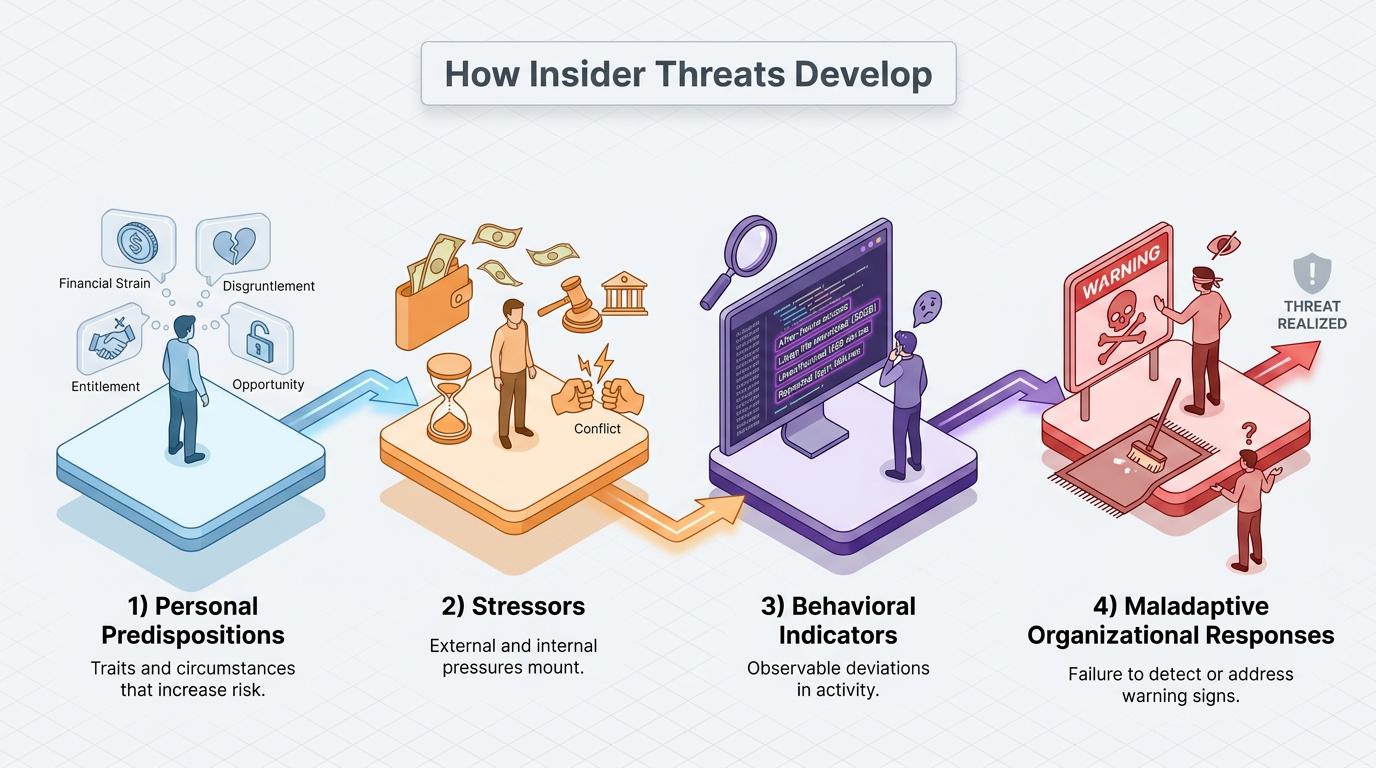
Insider threats develop when trusted access lets harmful activity resemble legitimate work until context reveals a deviation. The trigger might be a grievance, financial pressure, recruitment by an outsider, or nothing more than a rushed mistake. These acts are rarely spontaneous: people who go on to cause harm tend to move along a recognizable pathway before the incident happens.
That progression generally breaks into four stages:
- Personal Predispositions: Traits, biases, and past experiences shape how a person responds to pressure long before any incident occurs.
- Stressors: Financial pressure, a grievance, a disputed role change, or another life event activates an existing vulnerability.
- Behavioral Indicators: Observable changes deviate from the person's established baseline, and this is the stage where most detection programs can still intervene.
- Maladaptive Organizational Responses: Ignoring or mishandling early warning signs pushes someone further along the pathway instead of redirecting them.
The harmful action itself frequently requires no exploit, because valid permissions defeat perimeter defenses by design. Early on, intent is genuinely unclear: a large download might be theft, or it might be a sanctioned project. The pathway is not irreversible, so sound programs try to interrupt it at several points rather than betting everything on catching the final act.
Types of Insider Threats
Insider threats fall into three broad categories: malicious action, unintentional harm, and threats introduced through compromised, third-party, or collusive relationships. Each demands a different response mindset.
Malicious Insiders and Deliberate Misuse
Deliberate insider attacks fall into four classes: information technology (IT) sabotage, intellectual property (IP) theft, fraud, and espionage. Each follows a familiar pattern:
- IT Sabotage: Often driven by revenge, the classic case is a system administrator who plants destructive code before or after termination.
- IP Theft: Clusters around departure, when engineers copy source code, designs, or trade secrets on their way to a competitor or a foreign venture.
- Fraud: Exploits access to financial systems for personal gain.
- Espionage: Moves protected information to a foreign government or rival.
Unauthorized disclosure and, in extreme cases, workplace violence round out the deliberate category. Financial gain is a common driver behind most of these acts, with grievance a frequent secondary motive.
Planning and concealment tie these attacks together: malicious insiders often route files through personal accounts or convert them into different formats to dodge data loss prevention (DLP) tools, since they understand which controls exist. That knowledge advantage is part of why deliberate misuse gets investigated more like a hunt than a routine audit.
Unintentional Insiders and Preventable Harm
Most insider incidents involve no malice at all, which changes the response entirely. Unintentional cases fall into four recurring forms:
- Malicious code introduced through social engineering, such as a phishing link or a planted USB drive.
- Disclosure of sensitive information to the wrong audience.
- Improper disposal of physical records.
- Loss or theft of portable equipment.
Each starts the same way: a routine task goes slightly wrong.
Day-to-day negligence also includes forwarding work files to personal email or storing regulated data in unapproved cloud folders. Some employees skip a required procedure to save time. There is also a gray zone between negligence and intent: the employee who knows the policy and bypasses it to get work done faster. None of these people set out to hurt the organization, and a damaging outcome does not prove that they did.
That distinction matters during triage. Teams can compare the conduct with the person's role and normal pattern, then identify whether workflow friction encouraged the bypass, and choose guardrails or simpler procedures instead of treating a mistake as proof of malice. For unintentional and victimized insiders, the job is to enable better behavior through training and guardrails that support simpler, more secure workflows.
Compromised, Third-Party, and Collusive Insiders
An external attacker can phish or steal an insider's credentials, then operate inside the network as a legitimate user, an account masquerade in security terms. The person is blameless, but their account is dangerous until contained, and the activity logs point at the wrong human.
Third-party insiders are contractors, vendors, and business partners working inside shared systems. One organization grants the access, but people from another organization actually use it.
Collusive insiders present a different problem. Cybercriminals persuade one or more people to enable fraud, IP theft, or espionage, and these cases are hard to detect because the external partner understands how detection works. The hiring pipeline itself can become the vector, particularly for remote roles where an employer never meets a candidate in person.
In all three patterns, figuring out who did this is a harder question than figuring out what happened.
Behavioral and Technical Indicators of Insider Threats
A contextual deviation from a person's established baseline can signal risk, but it cannot prove malice by itself. Indicators cluster into three groups:
- Behavioral: People work odd hours without authorization, access the network remotely while on vacation or sick leave, take unusual interest in matters outside their duties, or show a sudden decline in performance, hostility, or repeated policy violations.
- Organizational: An impending termination or a disputed role change raises risk, as does visible financial stress, a common escalation trigger in documented insider cases.
- Technical: Logins land at unusual times, data transfers run large, someone attempts access to systems unrelated to their role, unauthorized devices or software appear, security tools get disabled, or proprietary material is copied without explanation.
Only correlation across signals, weighed against the person's baseline, justifies a closer look.
Real-World Insider Threat Examples
Documented cases show how these patterns play out, and each carries a specific lesson for building a program.
- Malicious IP Theft: Engineer Linwei Ding moved confidential Google AI trade secrets to personal accounts using methods designed to evade data loss prevention tools; a federal jury convicted him in January 2026. Egress controls need to anticipate this kind of evasion.
- Post-Termination Sabotage: Timothy Lloyd's software time bomb detonated at an engineering manufacturer after his firing and caused substantial losses, a reminder to use same-day deprovisioning and independent change review.
- Attempted Recruitment: In 2020, a foreign national conspired to recruit a U.S. company's employee to introduce malware into its network; the employee reported the approach, and the plot collapsed before it could do harm.
Together, these cases span the motive categories covered above: theft for personal gain, retaliation after termination, and recruitment that failed because someone spoke up.
Insider Threat Risks and Business Impact
An insider incident can produce financial, operational, legal, privacy, safety, intellectual-property, and reputational damage, and its severity tracks two variables: how much access the insider held and how long the activity ran before containment. The patterns distribute differently across insider types.
Negligent insiders drive volume: individually modest incidents accumulate into the largest share of annual cost. Malicious insiders and stolen credentials are less common, but credential theft can be especially expensive per event, because concealment stretches the timeline. The Ponemon Institute puts average annual insider-incident costs at $19.5 million per organization, with containment averaging 67 days. Budgets have to cover both ends: everyday guardrails for frequent negligence, and detection depth for the rare, costly deliberate event.
Insider Threat Investigation and Response
A sound insider investigation validates the signal, limits further harm, preserves evidence, and coordinates decisions across disciplines without deciding intent prematurely. That work typically moves through five stages:
- Triage: Confirm the flagged activity actually deviates from the person's baseline and rule out a benign explanation, such as a sanctioned project.
- Containment: Suspend credentials or narrow permissions in proportion to the risk, without assuming guilt.
- Evidence Preservation: Capture logs and files under chain of custody, and secure relevant devices before remediation begins.
- Contextual Review: Examine the person's role, recent human resources (HR) events, and prior conduct.
- Multidisciplinary Decision: Security, IT, HR, legal counsel, privacy, physical security, and the affected business owner each weigh in before the team acts.
Remediation and a lessons-learned review close the loop, feeding any gaps back into the control set. Credible signs of violence escalate straight to physical security and, where warranted, law enforcement, and the team keeps anyone who reported a concern confidential and protected throughout.
How to Prevent Insider Threats
Prevention works by shrinking unnecessary access, catching meaningful deviations early, making it safe to report concerns, and governing the monitoring itself responsibly. The frameworks that hold up in practice layer organizational, personnel, physical, and technical measures.
Governance, Access, and Critical-Asset Controls
Inventory critical assets, their locations, the damage their loss could cause, and everyone who can access them. From that inventory flow the access rules. Least privilege grants each person and system only what the role requires, with privileged access made time-bound rather than standing. Separation of duties splits sensitive functions so no one person can request, approve, and audit the same action.
Over time, scheduled access reviews, plus a joiner-mover-leaver process tied to HR events, keep entitlements from silently accumulating over years. Together, these controls connect the value of each asset to the level and duration of access it requires.
Structure matters as much as the controls. A governance group drawn from security, HR, legal, privacy, and the business owns the policies and their enforcement, and the Cybersecurity and Infrastructure Security Agency (CISA) publishes a self-assessment tool organizations can use to gauge program maturity. This structure also establishes who approves and reviews access and who acts when circumstances change. For example, when an employee moves from finance to product management, the transfer triggers a review that strips finance-system permissions, and the product data owner approves access for the new role.
Monitoring, Training, and Privacy Safeguards
Detection depends on baselines. Monitoring that compares activity to a person's normal patterns, backed by regular audit review, surfaces deviations without treating every large download as a crisis. People matter as much as telemetry: role-based training for privileged users, insider-threat awareness for everyone, confidential reporting pathways that are easy to use, and employee assistance programs that address the stressors behind many incidents. Response procedures earn their keep only if teams test them first.
Governance must cover monitoring too. Proportional collection scoped to genuine risk, policies employees can actually read, consultation with legal counsel and privacy officers, whistleblower protection, and oversight of the program itself keep it lawful. Intrusive employee surveillance can erode trust.
Emerging Insider Risks From AI and Non-Human Identities
Generative AI tools and autonomous identities widen the insider boundary because trusted entities now include software that can read, transform, and disclose sensitive data at machine speed. Shadow AI is the human half of the problem: employees paste confidential material into personal generative AI accounts that sit outside company monitoring and retention controls.
The non-human half includes AI agents, copilots, service accounts, API keys, and other machine identities holding standing permissions across enterprise environments. An overprivileged agent behaves like a tireless insider, and shared identities create an attribution gap when something goes wrong.
The controls extend familiar ones to machine identities:
- Least Agency: Least privilege applied to autonomy, so an agent holds only the permissions its task requires.
- Distinct Identity: Every agent and service gets its own identity rather than sharing credentials.
- Human Approval: Consequential actions require sign-off from a person before they execute.
- Complete Activity Logging: Every action an agent takes is recorded and attributable.
Applied together, these controls keep a compromised or overprivileged agent from operating with the same invisibility as an unmonitored human insider.
Trusted Access Requires Accountable Design
Programs that hold up treat mistakes and compromise as problems distinct from malice, all resting on one shared foundation of governed access. They pair prevention and detection with investigation, privacy safeguards, and oversight. A worthwhile next step is a standing review of how each identity, human or not, receives access, uses it, and loses it.
