Key Insights
SaaS security risks can stay hidden behind the convenience of vendor-managed software. When organizations assume the provider covers more than it does, they create blind spots that often remain invisible until a security event exposes them. Understanding where that exposure sits is what turns SaaS from a source of uncertainty into something that can be assessed and managed.
Key Takeaways
- SaaS customers own a narrow but high-impact risk surface in identity and configuration controls, with data governance shaping the impact.
- The most common SaaS attack paths exploit OAuth token grants and API authorization flaws; misconfigured access controls expand the same exposure.
- Compliance frameworks such as GDPR, HIPAA, SOC 2, and FedRAMP impose obligations that a vendor's certification does not satisfy on the customer's behalf.
- Ongoing risk management depends on continuous SaaS inventory and automated configuration monitoring, with clearly defined incident response roles across the shared responsibility boundary.
What SaaS Security Risks Cover
SaaS security risks cover the threats and exposures within the customer's control when using software delivered as a service.
Shared Responsibility as the Boundary of the SaaS Risk Surface
The customer's SaaS risk surface begins where the provider's responsibility ends. In every SaaS relationship, the provider secures the underlying infrastructure and platform layers, including the operating system and application code. The customer retains responsibility for user and access management and for available configuration settings that govern data. NIST guidance on public cloud computing explains that security responsibilities are shared between the provider and the customer, with the division of responsibility varying by service model.
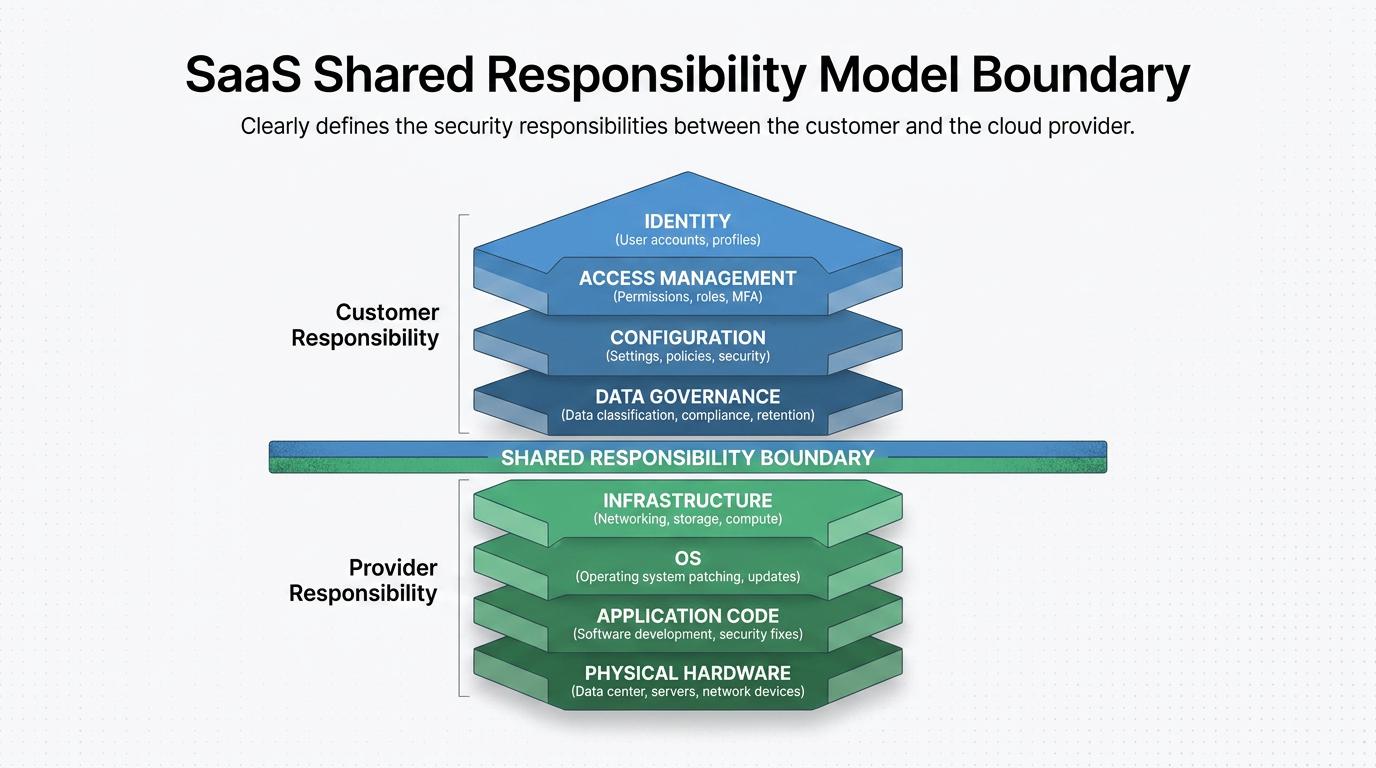
SaaS Versus On-Premises and IaaS in Customer Control Scope
SaaS narrows customer control to the settings the vendor exposes, and that reduced visibility is where risk accumulates. With on-premises systems, the organization controls everything from the physical server to the application layer. Infrastructure as a Service (IaaS) shifts infrastructure management to the provider but leaves the customer responsible for operating systems and the software stack above them. In SaaS, those layers are invisible, and the customer's control is limited to the settings the vendor exposes in its admin console. The tradeoff is operational simplicity in exchange for reduced visibility.
A Practical Taxonomy for SaaS Security Risks
The customer-controlled risk surface clusters around five categories, each tied to decisions only the customer can make:
- Identity and Access Gaps: Who can reach data and systems, and whether those permissions match current job functions.
- Misconfiguration: Security settings a vendor exposes but a customer fails to harden.
- Data Security: Data classification and sharing controls, including exposure created by multi-tenant architectures.
- Integration and Supply Chain Risks: OAuth grants and API connections, including marketplace apps, linking SaaS platforms to each other and to external services.
- Compliance and Governance Risks: Regulatory obligations that remain the customer's responsibility but are mistakenly treated as covered by the vendor's certification.
The Core SaaS Security Risks Organizations Need to Identify First
The customer retains controls across identity, configuration, data, integrations, and compliance.
Identity and Access Gaps as the Leading Breach Vector
Weak or misconfigured identity controls are a consistent root cause of SaaS breaches. Identity and access security remain central concerns in cloud environments and third-party risk. Privilege creep is persistent because many platforms offer coarse permission scopes rather than granular controls. MFA adoption remains inconsistent across SaaS tenants, and a single administrator's decision to defer enforcement can leave an entire tenant exposed to credential-based attacks.
Misconfiguration as a Common SaaS Risk
Misconfigured application settings create a parallel exposure path even when identity controls are properly set. A file-sharing site set to "Anyone with the link" when it should be restricted to internal users, or a collaboration workspace with external sharing enabled by default, can expose sensitive data without any attacker involvement. A federal directive mandates deployment of CISA's SCuBA tools for SaaS configuration hardening across federal agencies.
Data Exposure Amplified by Multi-Tenant Architecture
Multi-tenant SaaS architectures introduce a structural risk that traditional perimeter controls cannot address. SaaS platforms typically rely on application-layer logical isolation instead of hypervisor-based separation between customers. If that logic fails, data from one tenant could become accessible to another. Shadow data has also emerged as a distinct challenge because unnoticed copies, exports, and downstream syncs can expand exposure beyond the application a team thinks it is managing.
OAuth Grants and Non-Human Identities as Ungoverned Entry Points
SaaS-to-SaaS integrations create a supply chain risk surface that most organizations do not fully inventory. OAuth grants can give an application ongoing access with its own permissions, and that access often persists until the grant or related tokens are revoked or otherwise expire. OAuth refresh tokens are typically longer-lived than access tokens and often remain valid until they expire, are rotated, or are explicitly revoked, but their lifetime and revocation behavior are implementation-dependent.
Organizations should also consider including them in regular access review cadences. A compromised OAuth token in one integration can provide access to downstream systems, meaning an attacker who breaches a single marketing automation tool connected to a CRM and a data warehouse gains a path into both without targeting either directly.
Regulatory Obligations That Do Not Transfer to the Provider
Regulatory obligations remain with the enterprise even when data resides in a provider's infrastructure. Under GDPR Article 28, the controller is primarily responsible for its own compliance and for ensuring the compliance of its processors, including authorizing sub-processors and requiring that they meet the same data protection obligations.
HIPAA requires a Business Associate Agreement with any SaaS provider that creates, receives, or transmits electronic protected health information (ePHI), and the customer must confirm BAAs are in place. SOC 2 reports cover the vendor's controls only, not the customer's configuration or access decisions. FedRAMP authorization also does not remove the customer's need to map vendor controls to its own requirements and address any gaps. In each case, the customer must independently map vendor certifications against their own control requirements and close the gaps.
How SaaS Security Risks Commonly Happen
Most SaaS compromises follow a small number of repeatable patterns across the customer-controlled risk surface.
OAuth Grants and Token Abuse
Compromised refresh tokens can give attackers ongoing access that behaves like long-term credential theft without triggering conventional authentication alerts. In supply chain scenarios, a single compromised OAuth connection between two SaaS platforms can give attackers access to downstream customer environments.
API Weaknesses Such as Broken Object Level Authorization
API weaknesses can expose data across tenants or let attackers escalate privileges even when customers cannot patch the API layer directly. Many SaaS applications rely on APIs, so the OWASP API Security Top 10 is a useful reference for evaluating API-related risks. Broken Object Level Authorization (BOLA), where an API fails to verify that a requesting user has permission to access a specific object, remains the top-ranked API vulnerability. Broken authentication and security misconfiguration also apply to SaaS environments, as does unrestricted access to sensitive business flows. These flaws often let an attacker access another tenant's data or escalate privileges by manipulating API parameters.
Shadow SaaS and Unapproved App Connections
Shadow SaaS amplifies SaaS attack risk because unapproved applications can still request OAuth grants to corporate platforms during setup. Each unapproved connection creates an ungoverned integration.
Multi-Tenant and Cross-Environment Exposure Paths
Credential-based cloud data exfiltration incidents show why enforcing MFA across accounts is an important security control in SaaS environments. SaaS platforms typically rely on application-layer logical isolation rather than the hypervisor-based separation used in IaaS. The breach exploited the gap between the provider's available MFA controls and customers' failure to enforce them.
How to Assess SaaS Security Risks in a Real Environment
Effective SaaS risk assessment starts with knowing what you have, then systematically evaluating identity, configuration, integrations, and compliance posture.
SaaS Inventory and Tenant Discovery
No assessment can succeed without a complete inventory. Federal SaaS security guidance lists tenant identification as the first compliance step before subsequent assessment tool deployment and baseline implementation. For any organization, this means cataloging every SaaS application in use, including those adopted outside formal procurement. Discovery should draw on automated discovery tools and SSO login records.
Access Review and Privilege Mapping
With the inventory complete, the next step is mapping who has access to what and whether those permissions are appropriate. This means reviewing user roles, identifying accounts with administrative privileges, and checking whether MFA is enforced across all SaaS tenants. The review should identify dormant accounts and unnecessary administrative privileges, including service accounts with overly broad scopes. Access reviews should run on a regular cadence for high-risk applications.
Configuration Review and Baseline Validation
Each SaaS application should be compared against a known secure baseline. Center for Internet Security (CIS) Benchmarks provide platform-specific configuration standards, and the SCuBA project offers open-source, no-cost configuration assessment tools for Microsoft 365 and Google Workspace, alongside Secure Configuration Baselines for both platforms.
Third-Party Integration Review
Every connected application and OAuth grant, including marketplace plugins, represents a potential entry point. The review should catalog all integrations and document the permissions each one holds. It should also identify integrations that are no longer in use but still have active tokens.
Compliance Boundary Review
This same review should verify GDPR data processing agreements, HIPAA BAAs, FedRAMP authorization status, and SOC 2 Type II report coverage. Repeat this review whenever vendors change sub-processors or when new regulations take effect.
How to Manage SaaS Security Risks Over Time
Identifying SaaS security risks is a point-in-time activity; managing them requires continuous processes that adapt as the environment changes.
Secure Configuration Management
Configuration baselines only provide value if they are monitored on an ongoing basis. Federal agencies are required to deploy automated configuration assessment tools and begin continuous reporting for SaaS configuration monitoring. In practice, this means deploying tooling that detects configuration changes and compares current settings against approved baselines, with alerts for deviations. Without automated baselines, configuration reviews default to annual audits that miss the changes occurring between review cycles.
Continuous Monitoring and Logging
SaaS logs must be collected and analyzed continuously to detect suspicious behavior. SaaS environments generate log and activity data that must be collected and analyzed to detect suspicious behavior. Security teams should integrate logging and monitoring with configuration analysis in a centralized SIEM platform. Monitoring should cover user sessions, authentication events, third-party integration activity, and administrative changes.
Incident Response Across the Shared Responsibility Boundary
SaaS IR requires pre-negotiated roles between the customer and provider before an incident occurs. A practical SaaS IR plan defines which logs the provider will supply and on what timeline. It also assigns authority to revoke OAuth tokens and disable user accounts, and specifies how forensic evidence will be preserved in an environment the customer does not control at the infrastructure level. Establishing clear roles, responsibilities, and incident response plans for cloud environments before incidents occur is critical. Common failures emerge during incidents rather than before them: discovering that a vendor's audit log retention is shorter than expected, or that the vendor's IR communication channel is a general support queue with no escalation path. Tabletop exercises that test these coordination points before a breach avoid delays that extend breach lifecycles and increase costs.
Vendor and Supply Chain Assessment
Organizations should evaluate log availability and retention during procurement, since not all vendors provide equivalent depth. Vendor assessment should extend beyond initial procurement to include periodic review of SOC 2 Type II reports and monitoring of sub-processor or ownership changes.
What Strong SaaS Security Programs Get Right
Strong SaaS security programs turn governance into assigned, repeatable work.
Clear Ownership Between Security, IT, and Compliance
Strong programs assign clear responsibility for SaaS inventory maintenance, configuration monitoring, access reviews, and vendor assessment across security, IT, and compliance teams. ISO 27017 addresses this directly, requiring that shared roles and responsibilities be "allocated to identified parties, documented, communicated and implemented."
Fewer Standing Privileges and Better Identity Hygiene
These programs also minimize standing administrative access and move toward just-in-time provisioning. They enforce MFA across all SaaS tenants without exception and close parallel authentication paths by eliminating local accounts alongside SSO. Non-human identities, including service accounts and token-based credentials such as OAuth tokens or API keys, receive the same review rigor applied to user accounts.
Ongoing Review of Connected Apps, Data Flows, and Exceptions
Mature programs maintain a living inventory of all SaaS-to-SaaS integrations and review that inventory on a regular cadence. They track data flows between applications and flag integrations with permissions that exceed functional requirements. They also document security exceptions with expiration dates. Shadow SaaS discovery should run continuously.
Moving From SaaS Sprawl to Governed SaaS Security
SaaS security risk management works best as a continuous loop of inventory, assessment, remediation, and monitoring. Organizations that treat SaaS governance as an operational discipline are better positioned to catch drift early, close gaps faster, and keep pace with an expanding application footprint.
