
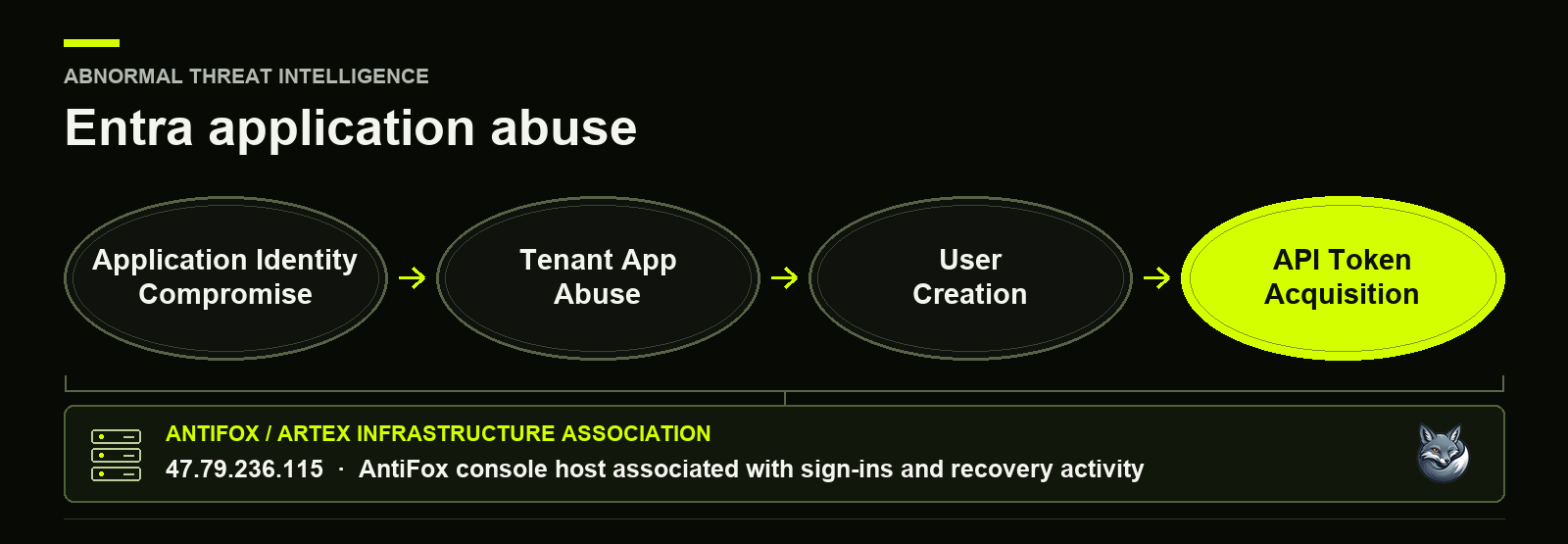
In October 2026, Google and Microsoft each documented a new class of intrusion driven by ARTEX, an agentic offensive framework that automates attacker tradecraft at machine speed. That month, inside a US financial-services tenant, Abnormal Intelligence observed activity that fits the pattern: an operator abused an existing Microsoft Entra application to create three accounts and obtain tokens for an internal business API, with every successful sign-in arriving within seconds from a host that had just exposed a console for AntiFox, a fork of ARTEX. Abnormal assesses with moderate confidence that the activity is linked to ARTEX and AntiFox tooling. The evidence does not establish that either framework executed the attack or how the operator first came to control the application.
A novel exploit isn’t what makes the case worth studying. It’s how ordinary the building blocks were. A legitimate application, a standard token grant, and a few minutes of directory writes combined into a repeatable machine for producing disposable, fully working identities inside a tenant that trusted the application completely.
Why a Tenant Application Is a Powerful Thing to Control
The application acted entirely as itself. Microsoft Entra recorded the application's service principal as the initiator of each directory action, with no signed-in user behind it. This is application-only access: the application was authorized to make changes in the tenant on its own authority, and the operator was exercising that authority directly.
The application had a tenant-specific registration in the organization's directory, and its identifiers did not match the list of Microsoft first-party applications checked during the investigation. Its original business purpose could not be verified. What mattered was its permissions. It could create users and held an Exchange Online application role, full_access_as_app, that grants access to mailboxes across the tenant.
That combination made the compromise repeatable. As long as the operator retained control of the application, disabling one account changed nothing: the application could create another and obtain a fresh token on demand. The accounts were consumable. The application was the asset.
Create, Sign In, Disable: An Account's Five-Minute Life
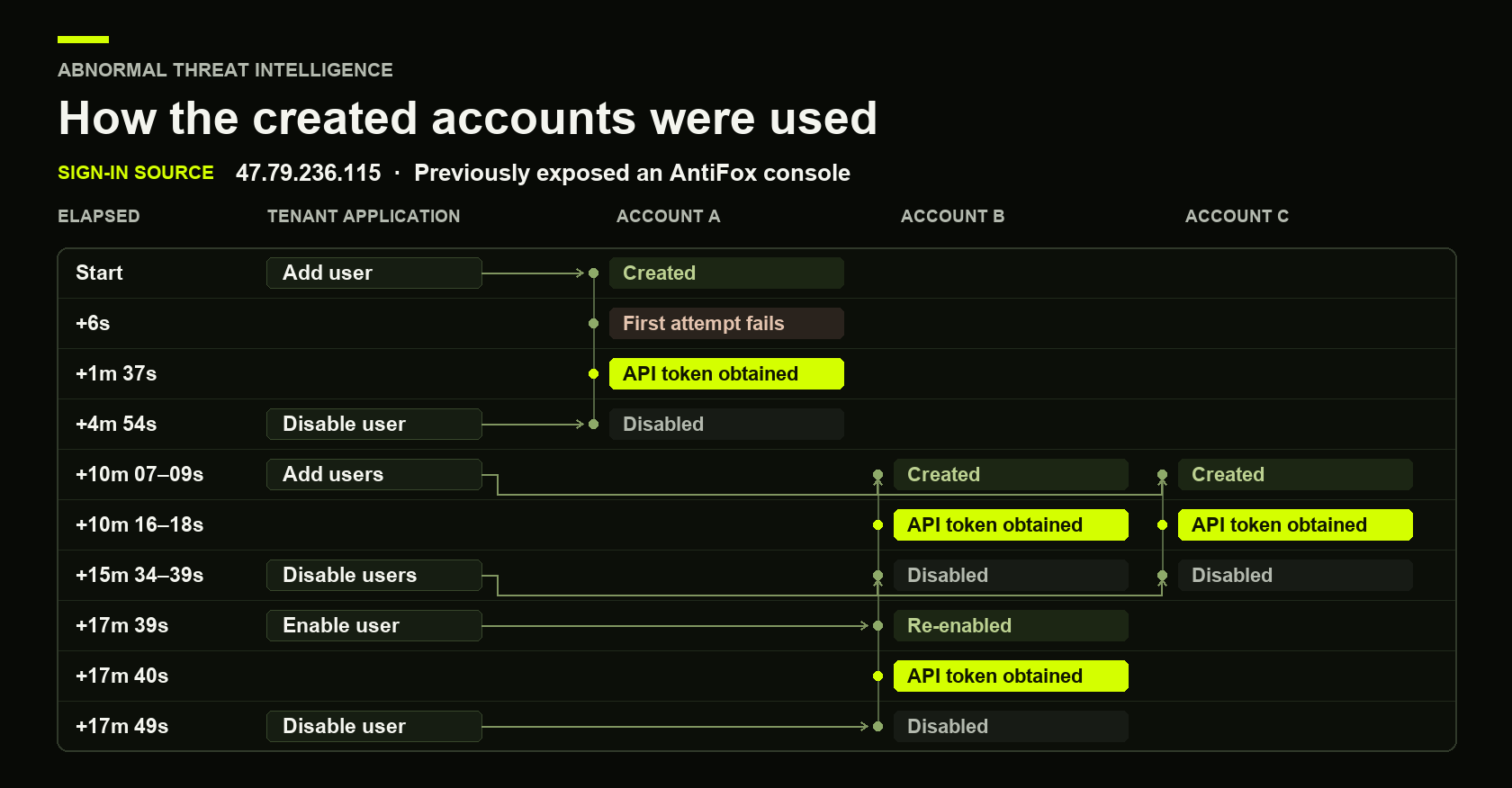
The directory activity ran as a tight, scripted burst. The first observed action was a failed Add user operation for a user that already existed. The application then successfully created users. Each new account was created with a password set at the same time, through an accompanying Update PasswordProfile audit event.
The accounts were used almost immediately. Sign-in attempts arrived within six to nine seconds of each account's creation, using the resource owner password credentials grant, which submits a username and password directly to the token service. For the first account, several client applications failed before authentication succeeded through Microsoft Graph Command Line Tools and then Teams; the same Teams client appears in the successful sign-ins for the other accounts. Each successful sign-in obtained a token for the same internal business API.
The accounts did not survive. The application disabled each one roughly five minutes after creating it. One account was briefly re-enabled, used to obtain another token, and disabled again within seconds. The records establish that tokens were issued; they do not establish what, if anything, was done with those tokens afterward, because the downstream API logs were not available for review.
The Application Could Access Any Mailbox in the Tenant
Beyond creating users, the application held the Exchange Online role full_access_as_app, which permits an application to access any mailbox in the tenant under its own identity. The role-removal audit records the role assignment shortly after the application's first directory action and before the successful user creations, placing broad mailbox authority in the operator's hands during the same window.
The available records do not show any mailbox access, and no mailbox audit trail was available to confirm or exclude use of the role.
How the Activity Was Linked to ARTEX and AntiFox
The link runs through infrastructure, not through the frameworks themselves. Every successful sign-in to the created accounts came from a single host that had recently exposed a web console for AntiFox, a fork of the ARTEX agentic offensive framework publicly documented by Google and Microsoft. Across the hosts involved in the wider activity, Abnormal observed the same console presence before the activity began, the same AntiFox console page (same title and page size, largely the same build files), and a single TLS client fingerprint seen on three sign-in attempts across two of those hosts. One was running an AntiFox console and the other an ARTEX console.
The behavior also matches the documented class of ARTEX tradecraft: abuse of an existing application identity, rapid account creation with passwords, password-reset persistence attempts, and compressed, trial-and-error bursts measured in seconds rather than minutes. The user agent curl/7.88.1 appeared on the first account's creation records and on later recovery attempts; it is the default curl build shipped in Debian 12 and is not unique to these frameworks, so it supports the picture without proving it.
The console presence, shared console template, and TLS fingerprint show the activity ran from AntiFox and ARTEX infrastructure.
The sign-ins came from hosts running AntiFox and ARTEX consoles. Abnormal assesses the activity as the work of an operator using this tooling, though the specific framework actions were not captured in the available telemetry.
One Host Was Reused Across Victims
Three of the hosts involved in this activity were observed only against this organization. One, 186[.]240[.]201[.]168, was also seen targeting two other organizations within days, indicating that at least part of this infrastructure was reused across victims rather than stood up for a single target. For defenders, that reuse is the more actionable signal: an indicator that appears at one organization and then at another is worth sharing and blocking before it appears again.
Detection Opportunities for Security Teams
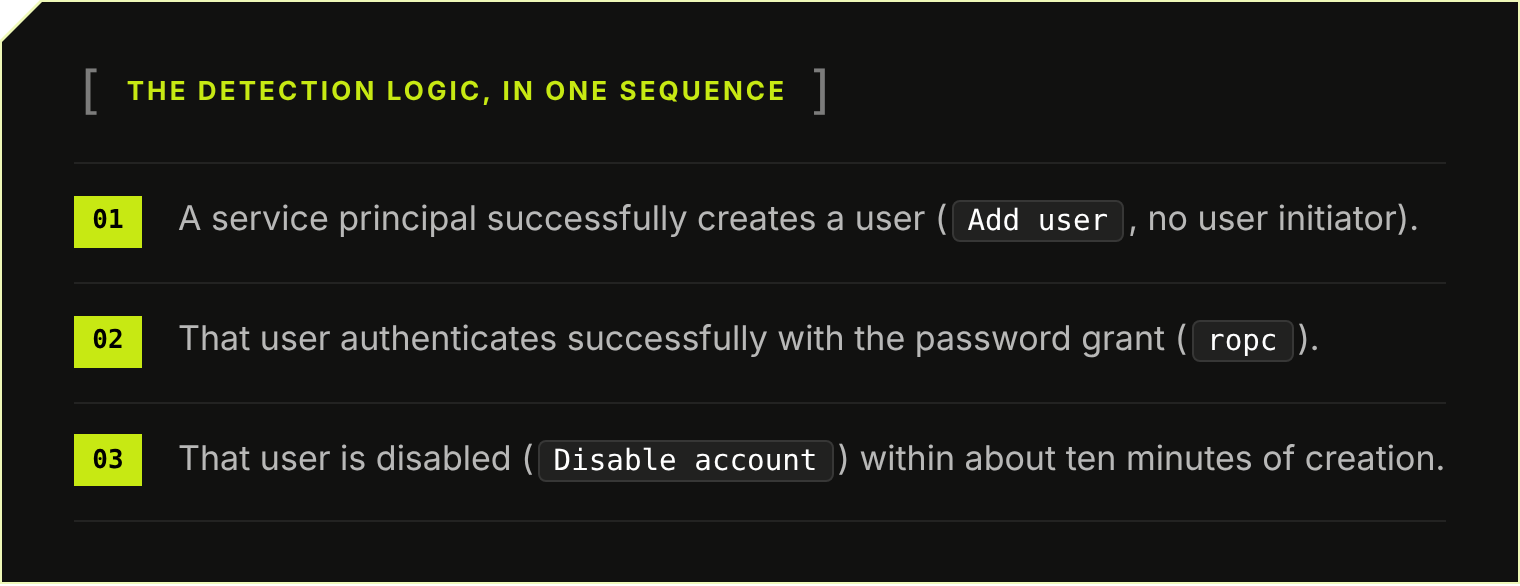
The strongest signal in this case is not any single event. Each building block (an application creating a user, a successful password-grant sign-in, an account being disabled) is common and noisy on its own in a healthy tenant. The attack shows itself in the sequence. Security teams should look for the following, treating each as an investigative lead whose meaning depends on context rather than as a confirmed compromise.
Correlated create-sign-in-disable sequence
A service principal successfully creates a user; that same user signs in using the resource owner password credentials (ROPC) grant; and that same user is disabled, all within roughly ten minutes and tied together by the tenant and user object identifiers. This ordered correlation across the Entra audit and sign-in logs is the high-fidelity detection; the individual events are not.
Application-only directory writes
Add user and Disable account operations initiated by a service principal with no signed-in user behind them. Baseline the provisioning applications that legitimately do this, then alert on the ones that do not.
Short-lived accounts and rapid password grants
Accounts that sign in within seconds of creation, then are disabled minutes later
Accounts that are re-enabled briefly and used again
Successful ROPC sign-ins, especially by freshly created users
New Exchange application-role assignments
Grants of full_access_as_app or similar mailbox-wide application roles, reviewed alongside any service-principal credential or ownership changes in the same window.
Why the Five-Minute Burst Is Only Part of the Risk
A burst of accounts that lasted five minutes each can look like a failed or minor incident. The accounts were disposable by design, and treating them as the whole story misses the point. The durable exposure is the application itself.
An application the operator can act as is a standing capability. The application can keep creating identities even after earlier accounts are gone. The Exchange role in this case lets the application access mailboxes under its own identity for as long as the role is assigned. Resetting the passwords of the users it created leaves the application’s own authorization intact. The organization in this case contained the activity by removing the Exchange role and the application's credential and revoking affected sessions, which is the right shape of response.
For teams that find similar activity, the priorities are:
Treat the application as a compromised identity. Revoke its credentials and remove any roles and grants it should not hold, rather than focusing only on the accounts it created.
Investigate every account the application created, including those already disabled or deleted, and revoke the sessions and tokens tied to them.
Review which applications in the tenant can create users or hold mailbox-wide Exchange roles, and scope those permissions to what each application's approved function actually requires.
Check resource and mailbox audit logs for activity under both the created users and the application identity during the exposure window, since the issuance of a token is established but its downstream use is not.
Indicator | Association | Observed Role |
47[.]79[.]236[.]115 | AntiFox (ARTEX fork) | Source of the successful sign-ins to the created accounts and of later password-recovery attempts. |
45[.]204[.]71[.]168 | AntiFox (ARTEX fork) | Failed sign-ins against an integration service account; earliest attempt recorded a correct password. |
34[.]61[.]246[.]29 | AntiFox (ARTEX fork) | Failed sign-in activity against an executive account. |
186[.]240[.]201[.]168 | AntiFox (ARTEX fork) | Failed sign-ins and related activity; also seen targeting two other organizations. |
154[.]36[.]154[.]63 | ARTEX | Failed sign-in activity; shares a TLS client fingerprint with one of the AntiFox hosts. |
Abnormal Intelligence is Abnormal's threat research and data hub, tracking how attackers abuse identity, email, and the applications that connect them. For the full technical details, including detection content, see the source intelligence in Abnormal Intelligence.
Check Your Exposure to ARTEX
Abnormal Intelligence can run a one-time ARTEX exposure health check for your organization. Abnormal researchers review the sign-in records, Entra audit logs, and email header data already connected to Abnormal for ARTEX-family infrastructure and the application-creates-account pattern described above. Organizations that are not yet Abnormal customers can use the same form to discuss an assessment.
Request Your ARTEX Exposure Health Check
For protection beyond a single check, Abnormal Identity Threat Protection (ITP) extends Abnormal’s behavioral AI into Microsoft Entra ID and Okta, detecting identity-stage techniques that agentic tooling like ARTEX automates, such as password spraying, MFA tampering, session hijacking, and privilege abuse.
Learn More About Identity Threat Protection
Indicators are defanged. This analysis anonymizes the affected organization and the application involved. The attribution assessment carries moderate confidence and reflects an infrastructure association, not proven framework execution.