Key Insights
Most cyber attacks don't kick off at 9 AM on a Tuesday. They start at 2 AM on a holiday weekend, when the SOC is running a skeleton crew and the on-call analyst is three hours into an uneasy sleep. That timing isn't a coincidence; it's a strategy.
Building 24/7 cybersecurity support requires deliberate decisions about staffing, technology, processes, and metrics.
Organizations that maintain continuous monitoring and response are better positioned to limit damage when incidents emerge after hours. This guide outlines the operating models, staffing choices, core technologies, and response structures that can help security leaders build around-the-clock coverage that holds up in practice.
Key Takeaways
- Match your operating model, in-house, hybrid, or fully managed, to your team's maturity and budget.
- Staff shifts for sustainability using realistic schedules, clear escalation paths, and follow-the-sun models where possible.
- Automate Tier 1 triage to preserve analyst capacity. NIST guidance reinforces automation as a foundation for continuous monitoring.
- Track MTTD, MTTR, false positive rate, and dwell time to tie SOC performance to business risk.
- Integrate email triage into the core detection workflow as email is still a primary entry point for attacks.
Why 24/7 Cybersecurity Support Is an Operational Necessity
24/7 cybersecurity support is an operational requirement when attackers exploit off-hours gaps in monitoring and response.
Continuous support is no longer limited to the largest enterprises. Attackers routinely time campaigns for weekends, holidays, and overnight windows when analyst coverage is thinnest. The Marks & Spencer breach presented as an example of how off-hours attacks can exploit these gaps.
Teams are already stretched thin during business hours, and off-hours coverage is often where monitoring gaps appear first. Without 24/7 coverage, overnight and weekend windows can become unmonitored attack surfaces.
CISA's roadmap formally identifies the lack of skilled analysts and difficulties in hiring experienced personnel to support the operational tempo of modern Security Operations Centers. Organizations need to plan for continuous operations with the staff and budgets they actually have.
Choosing the Right Cybersecurity Support Model
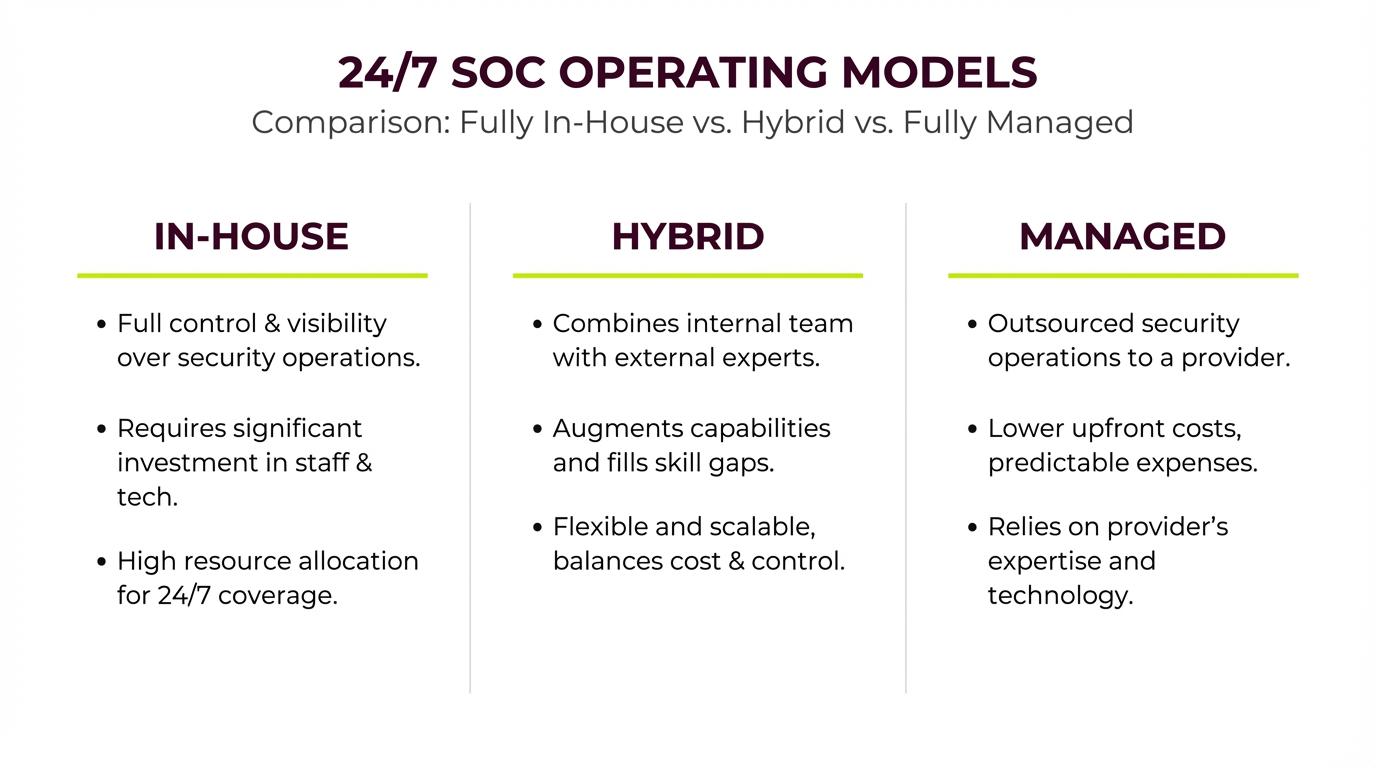
The right 24/7 cybersecurity support model depends on how much control, staffing, and operational responsibility your team can sustain. The first decision is determining how much you build versus how much you buy. Three models exist, each with distinct operational profiles.
- Fully In-House SOC: The organization staffs, tools, and operates all security functions internally. This model provides maximum control and institutional knowledge retention but demands the highest investment. However, many organizations might struggle to find willing, available, experienced, and properly skilled people to participate, particularly in 24-hour support. This model is best suited to organizations with mature security programs and sufficient budget to attract and retain talent across three shifts.
- Hybrid Model: A common approach. Organizations outsource 24/7 monitoring of intrusion detection systems, firewalls, and security devices to a managed security services provider while retaining core incident response, remediation, and threat hunting in-house. The model works for organizations that want strategic control over incident response while offloading the monitoring workload that drives overnight staffing requirements.
- Fully Managed (MDR/MSSP): Complete outsourcing to a managed detection and response provider or MSSP. This path offers faster time to value and reduced overhead but requires internal supervisory oversight. It fits organizations that need 24/7 coverage quickly but lack the headcount or expertise to build internally.
Building the Team: Staffing Structures and Shift Design
Sustainable 24/7 cybersecurity support starts with realistic staffing design, clear roles, and handoffs that hold up under pressure. Sustainable coverage starts with realistic staffing math, not aspirational org charts.
Tiered Analyst Structure
A tiered structure helps teams separate high-volume triage from deeper investigation and advanced response. A common SOC model uses three analyst tiers:
- Tier 1 (Alert Triage): Real-time SIEM alert monitoring, initial severity assessment, and escalation of suspicious alerts. This tier handles the highest volume of work and faces the greatest burnout risk.
- Tier 2 (Investigation and Response): In-depth correlation, threat intelligence integration, endpoint forensics, and detection engineering. Tier 2 analysts assess targeted systems and direct recovery.
- Tier 3 (Threat Hunting and Advanced Response): Proactive threat hunting, memory forensics, reverse engineering, and major incident handling. This tier also recommends detection and monitoring optimizations.
Depending on the environment, SOCs may also need SOC leaders, engineers to manage tools and automation, and analysts who can escalate behavior.
Shift Models for Continuous Coverage
Shift design should reduce fatigue and support clean handoffs across the day. Two shift models dominate:
- Single-Location Rotation: Eight- or twelve-hour shifts using a 4-on, 4-off schedule to maintain analyst alertness. This approach is simpler to manage but concentrates the overnight burden on a subset of the team.
- Follow-the-Sun: Monitoring responsibilities transfer across time zones as shifts change, providing continuous coverage without overnight shifts for any single team. This model is described as a way to provide continuous coverage without imposing overnight shifts on one team. The primary risk is handoff miscommunication, creating monitoring gaps during transition windows.
Core Technology Stack for Continuous Cybersecurity Support
Effective 24/7 cybersecurity support depends on a technology stack that can centralize signals, automate response, and preserve analyst capacity. The technology foundation centers on integrated detection, correlation, orchestration, endpoint, and identity-aware capabilities.
- SIEM (Security Information and Event Management): Central log aggregation, correlation, and alerting hub. NIST CSF 2.0 explicitly references SIEM in multiple Detect function subcategories.
- SOAR (Security Orchestration, Automation, and Response): Automates and orchestrates response workflows through playbooks. This is critical for scaling Tier 1 operations, but static playbooks can fail on novel attack vectors.
- EDR/XDR (Endpoint Detection and Response): Endpoint telemetry is a core detection input in many SOCs. XDR extends detection across endpoints, the network, and cloud layers.
- UEBA (User and Entity Behavior Analytics): Employs machine learning to establish baseline behavior and detect deviations indicating insider threats or account compromises.
- Email Security Platform: Email remains a common delivery mechanism for phishing, BEC, and credential theft. Gateway-layer detection capabilities need to feed telemetry into the broader SIEM and SOAR workflow for correlation and automated response.
Incident Response Playbooks and Escalation Frameworks
Documented playbooks turn continuous monitoring into coordinated action during off-hours incidents. NIST CSF 2.0's Respond function provides a structural framework that every playbook should map to:
- Incident Management (RS.MA): Activation criteria, roles, and escalation paths.
- Incident Analysis (RS.AN): Evidence collection, scope determination, and impact assessment.
- Reporting and Communication (RS.CO): Notification chains, regulatory reporting timelines, and external communication protocols.
- Incident Mitigation (RS.MI): Containment actions, eradication steps, and recovery sequence.
Playbooks should address the most frequent types of alerts your team is likely to see, such as phishing campaigns, business email compromise attempts, signs of unauthorized account access, and malware delivery.
After an incident is resolved, organizations should put new safeguards in place to catch similar threats going forward and continue watching for any signs that the attacker may still be present. Run practice exercises with your team, and conduct annual reviews that incorporate lessons learned from real incidents.
KPIs That Measure Cybersecurity Support Effectiveness
The most useful cybersecurity support metrics show how quickly the SOC detects, investigates, and contains meaningful threats. Tracking the right metrics connects SOC performance to business outcomes. IBM's report provides a benchmark for measuring your own program's performance.
- Mean Time to Detect (MTTD): Time from incident occurrence to SOC detection. Maps to NIST CSF 2.0 DE.AE.
- Mean Time to Respond (MTTR): Time from detection to containment or remediation. Maps to RS.MA and RS.MI.
- False Positive Rate: Percentage of alerts that are not genuine threats. Continuous monitoring technologies should be tuned regularly to reduce false positives and false negatives to acceptable levels.
- Dwell Time: Total time an attacker has access from entry to removal.
Report these metrics to leadership regularly to demonstrate operational value and justify investment.
Where Email Threats Expose Gaps in Traditional SOC Coverage
Email remains one of the most common attack vectors, and gaps in email triage can weaken otherwise mature 24/7 coverage. Many SOC frameworks still treat email triage as a secondary concern, which creates a detection gap.
BEC and account takeover attacks are specifically engineered to evade signature-based and rule-based defenses. They often involve no malware, no malicious links, and no known-bad indicators. Instead, they exploit legitimate accounts and contextually plausible communication patterns. Rule-based defenses often struggle to detect these attacks because there is no traditional detection surface to match against.
The operational consequence is straightforward:
- Analysts can spend hours processing low-value email alerts.
- Subtle social engineering attacks can continue moving through the environment.
- Legacy email gateways evaluate message attributes at delivery but may miss attacks that rely on behavioral manipulation rather than malicious payloads.
That is why email triage works best when it is integrated into the core detection workflow rather than handled as a side queue.
How Abnormal Helps Automate Email Cybersecurity Support
Abnormal is designed to help SOC teams reduce manual email triage and strengthen email coverage within 24/7 cybersecurity support. Traditional email security tools rely on rules, signatures, and known-bad indicators, which means they often struggle to detect socially engineered attacks that carry no malicious payload.
Abnormal is designed to help close this gap by applying behavioral AI to cloud email security. Rather than matching messages against static rules, Abnormal builds behavioral baselines for identities across the organization, modeling workflow cadences, vendor interaction patterns, recipient behavior, timing, and engagement flows. When a vendor suddenly requests payment to a new account or an executive sends a wire transfer request at an unusual time, the platform is designed to flag the deviation and can help surface threats that rule-based tools may miss.
For SOC teams running continuous operations, Abnormal helps reduce repetitive email triage. Its AI Security Mailbox is designed to automatically investigate, classify, and remediate user-reported phishing emails, helping redirect analyst time toward deeper investigation.
Recognized as a Leader in the Gartner® Magic Quadrant™, Abnormal is designed to help security teams maintain continuous email protection without scaling headcount linearly with alert volume.
Making 24/7 Cybersecurity Support Sustainable
Sustainable 24/7 cybersecurity support comes from aligning operating model, staffing, automation, and measurement over time. Building 24/7 cybersecurity support is not a one-time project. It is a continuous program that evolves with your threat environment, staffing reality, and technology stack.
A practical path usually includes a few steps:
- Select the operating model that matches your current maturity and budget.
- Staff for sustainability with realistic shift math.
- Invest in automation where it has the highest leverage, particularly Tier 1 triage and email detection.
- Measure performance with metrics that connect to business risk.
- Revisit playbooks, detection rules, and the staffing model regularly.
Organizations that treat cybersecurity support as an ongoing operational discipline are better positioned to reduce dwell time, limit blast radius, and support team resilience.
Book a demo to see how Abnormal can help automate email security within your 24/7 operations.