
Most companies will tell you they're "AI-forward" or "building with AI." They'll show you what they've made, maybe even demo it for you. We wanted to give a deeper look at how our engineering and product teams actually work, so you can see not just what we’re building, but how we’re doing it, AI-natively, to fight cybercrime with AI.
Here's a first look, straight from the people solving hard problems every day - and check out our new blog, Abnormal Builders, for more in-depth technical stories.
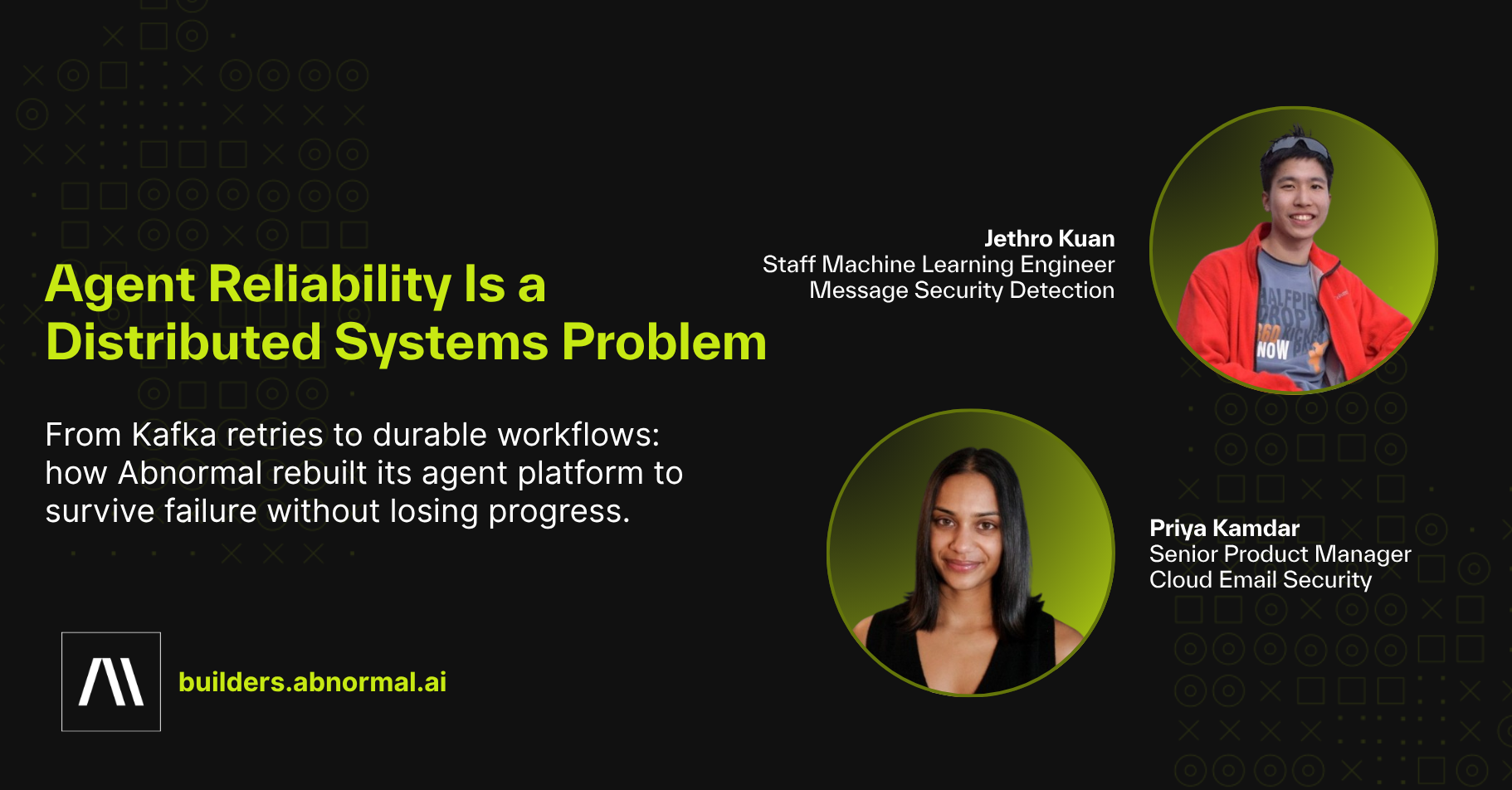
Hear from Jethro Kuan and Priya Kamdar on:
Why complex AI agents fail in ways a simple chatbot never does, and why that failure gets more expensive as agents get more capable
What happened every time a single step broke deep into a long agent run, before this fix
How Abnormal rebuilt its platform so a failure doesn't erase everything that came before it
What changed for other teams building agents once recovery stopped being something they had to solve on their own
Exactly how much wasted work disappeared once this shipped
Read More
.png)
Hear from Udayan Sarin and Meera Ramakrishnan on:
Why the attacks with no link or attachment to catch are often the hardest to detect at all
The tradeoff between fast and accurate that forces most companies to only check the riskiest-looking messages
How a 128MB model was taught to make the same judgment calls as one many times its size
How close that smaller model actually came to matching it
What that means for coverage across every message Abnormal sees, not a sample
Read More

Hear from Michel Chatmajian on:
Why a passing test and a green checkmark don't actually prove a change works
What Abnormal's agents now have to show before a pull request can merge
How engineers built a way to generate that kind of proof hundreds of times a day
What a "testbox" actually is and why they had to invent it
How much faster this is than a normal deploy cycle
Read More
Curious to hear more about how work actually gets done inside an AI-native company? New posts land on Abnormal Builders twice monthly.