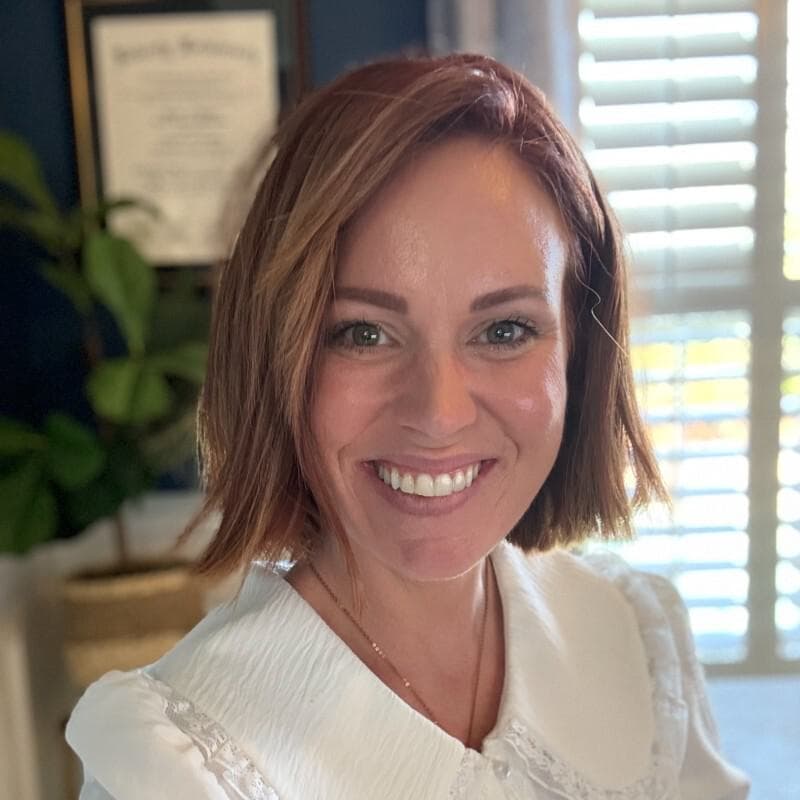
Amanda Lawing's career has never followed a straight line. She joined the Army at 18, deployed to Qatar, spent almost a decade in law enforcement with the last two and a half years as a detective, and then pivoted into workplace investigations and employee relations. Each chapter looked different. The thread connecting them was always the same: protecting people.
Now, as a Senior People Success Partner supporting Abnormal's Go-to-Market teams, she's applying that same conviction in a new context. And the shift in how she defines "great work" tells the story of what that journey taught her.
What the Uniform Taught Her
Amanda's military and law enforcement background gave her a unique skill set that translated directly into her current role: situational awareness, de-escalation, clear communication under pressure, and a deep discipline around making decisions grounded in facts rather than assumptions.
"I'm very used to walking into complex, high-emotion situations," she said. "Quickly having to read the dynamics and then focusing on what is most important in that moment."
Those instincts translate directly into her employee relations work, where she partners with managers through performance issues, conduct concerns, and sensitive situations that require both rigor and care.
"De-escalation, listening first, and then making decisions that are based on facts rather than assumptions, I think translates directly into what I do here."
Permission to Show Up Whole
At past companies, Amanda felt pressure to lead with her HR credentials and downplay everything that came before. The military and law enforcement chapters of her career didn't fit the traditional corporate mold, and she worried they made her seem too intense or too different.
At Abnormal, the opposite happened.
"My non-traditional path is seen as a real asset," she said. "People are genuinely curious. They ask thoughtful questions and recognize that those experiences have shaped how I show up today, how I lead, how I support, and how I protect our people here at Abnormal."
That shift matters more than it sounds. When people can bring their full history into the room, they bring better judgment, sharper instincts, and a willingness to engage with problems other people avoid. Amanda's background isn't something she softens for her audience anymore. It's what makes her effective.
"At Abnormal, my non-traditional path is seen as a real asset. People are genuinely curious. They recognize that those experiences have shaped how I show up today."
From Perfect Execution to Scalable Impact
Early in her career, Amanda defined great work as flawless execution. Hit every mark. Never fail. Handle it yourself. Don't ask for help.
"I thought doing great work meant doing it all, doing it all right, and doing it without asking for help," she said. "Looking back, I can see that that is a pretty high bar to set for yourself, and truthfully a pretty unhealthy one."
Since joining Abnormal, that definition has changed. Great work is no longer about perfection. It's about clarity, purpose, and building systems that empower others.
One example: Amanda helped create a repeatable framework for performance and growth conversations across Abnormal's sales organization and the broader Go-to-Market teams. Shared questions, templates, and a consistent cadence so that employees get the same quality of coaching and feedback regardless of who they report to.
"Now leaders can run those conversations confidently on their own," she said. "My role is more about refining the system and supporting edge cases than being in every room where those tougher performance conversations are taking place."
That's the shift she's most proud of. Not the system itself, but what it means: managers building confidence, employees getting consistency, and Amanda operating as the architect rather than the operator.
"Great work is no longer about perfection. It's about clarity and purpose, collaborating with my stakeholders and my partners, and building systems that empower others."
Finding the Squad Again
"Squad-level trust is knowing that the people around me will both challenge me and have my back when it's needed," Amanda explained. "Day to day, it means we can be honest with each other when something isn't working. We have a space to ask for help early and the space to admit when we don't know the answer without fearing that it's going to be used against us."
On her People Success team, that trust shows up in how they share context openly, assume positive intent, and follow through on commitments. It feels less like a collection of individual contributors and more like a unit moving toward the same mission.
The click moment for Amanda was realizing that the camaraderie she thought was unique to the military and law enforcement was actually about something more universal: shared mission and mutual respect. She'd assumed that bond required a uniform. Turns out, it required people who show up for each other when things get hard.
"Our team feels less like a collection of individual contributors and more like a unit that's moving toward the same mission."
AI as the Quiet Co-Pilot
At Abnormal, AI isn't reserved for the product or engineering teams. Amanda and her People Success partners use it across how they support managers, document complex situations, and identify patterns in their work. It’s used not as a flashy tool but as a way to surface insights faster so the human conversations land better.
She uses AI to synthesize themes from exit surveys, manager feedback, and employee input, spotting patterns across teams without losing the nuance of individual voices. That means more time in real conversations: coaching leaders, problem-solving with employees, making the calls that require human judgment.
"We're very intentional about using AI to augment judgment, but not replace it," she said.
Same Mission, New Meaning
When Amanda wore a uniform, protecting people meant physical safety. Clear roles, immediate response, tangible presence in the moment something happened.
Now, protecting people looks different. It's about psychological safety, fair systems, sustainable work environments where people grow without burnout and feel valued for what they contribute.
The mission hasn't changed. The definition of protection has expanded.
"Protecting people now is about making sure that our policies and our leaders and our culture protect people's dignity."
From Reactive to Ready
When Amanda looks back on her first year, the shift she's proudest of isn't a single moment. It's a change in how the work itself operates.
Early on, her days were case-by-case: supporting managers through individual situations, helping them write performance documentation, navigating one tricky conversation at a time. Over time, that evolved into something bigger. Building clearer performance frameworks and proposed operating models so the team isn't reinventing the wheel every time something comes up.
What stands out to her now is seeing leaders start to use that structure. Aligning on what "good" looks like. Talking about expectations the same way across teams. Using consistent paths for when something needs to escalate.
It's not finished. But the trajectory has shifted from purely reactive problem-solving to putting foundations in place that make performance and employee relations conversations clearer, fairer, and less intimidating for everyone involved.
What She's Building Next
Looking ahead, Amanda wants to create a more proactive approach to employee relations across Go-to-Market, particularly for new and emerging managers. Simple playbooks, training paths that blend practical ER skills with peer learning and real scenarios so leaders can navigate those situations confidently and fairly from the start.
"Helping leaders build that muscle will pay dividends for our teams, our customers, and our culture over the long term," she said.
It's the same instinct she's carried through every chapter: build the thing that makes other people better at their jobs. The parachute you rig for someone else. The framework that holds up when you're not in the room. The system that protects people long after you've moved on.
Her career has never been a straight line. She sees that as a strength, not a flaw. And for anyone else with a nontraditional background considering Abnormal, her message is clear.
"Your experience is not a hurdle here. It's a differentiator. People who think differently, who've taken diverse paths, bring a nuance and grit that we thrive on. You'll find people who want to learn from you, not just classify your resume."
