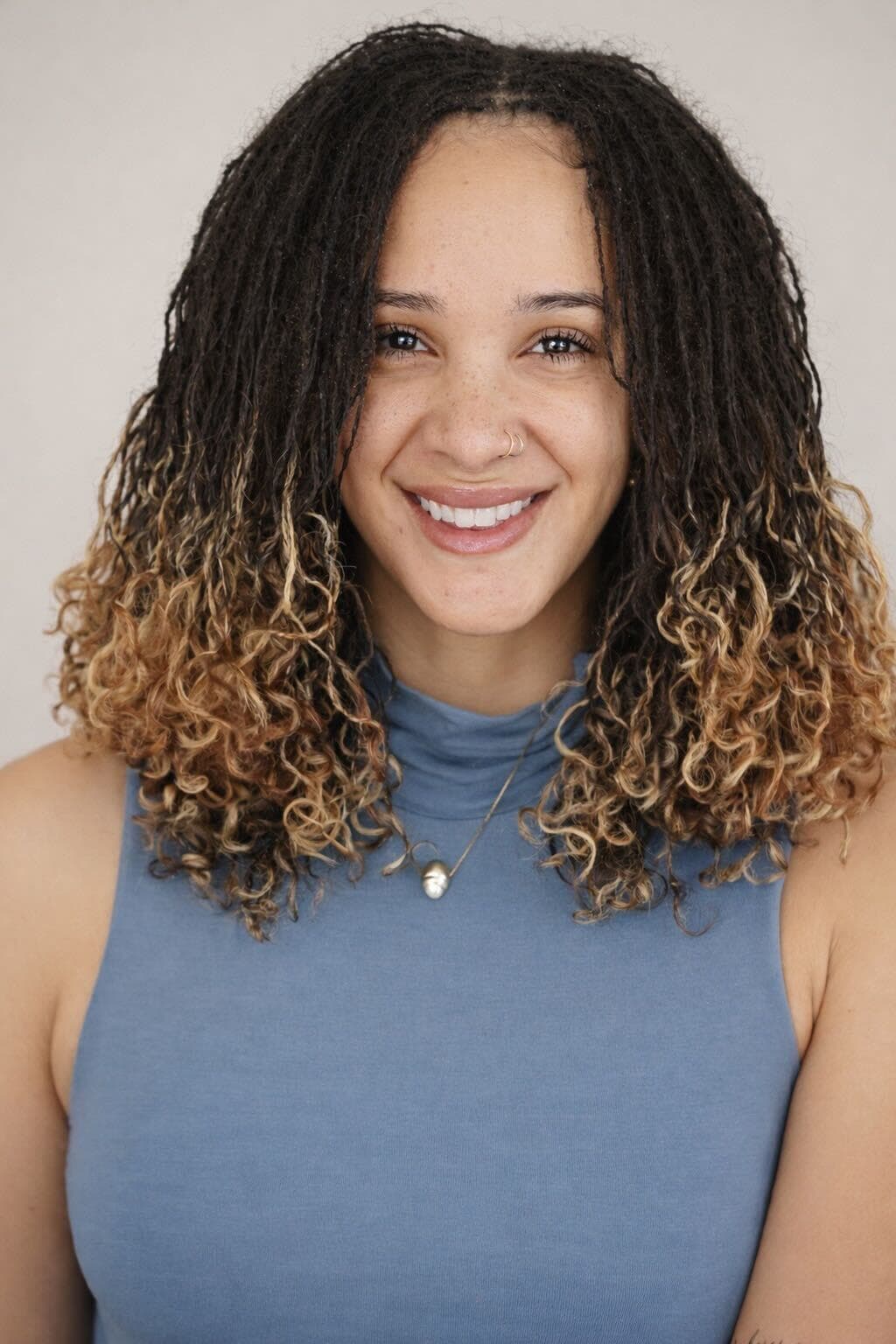
Chanel Green has spent her career studying what makes people tick. Twelve years in healthcare, five years at Instacart, and now a role at the intersection of AI and cybersecurity. Each leap was a calculated risk. Each one taught her something about how people learn, adapt, and grow when the conditions are right.
So did becoming a mom of two. "Parenting has sharpened my ability to hold many competing priorities at once," she said, "but more than that, it's deepened my empathy. It's hard to lose sight of the human experience when you're responsible for two small humans navigating their own." At Abnormal AI, she's applying all of it to one of the company's most ambitious bets: transforming how an entire R&D organization works with AI.
A Glutton for Change
Chanel doesn't shy away from chaos. Her jump from healthcare to tech happened at the start of COVID, when the world was in collective survival mode. "In hindsight, maybe not the most logical timing," she said, "but it made sense to me." She landed at Instacart during hypergrowth, grew from an individual contributor to Senior Manager, and worked across pricing, ads, growth, and hardware innovation through the company's smart cart.
Five years in, she started asking herself the honest question: what's next? She'd always been a strong operator, and the skills that quietly became the backbone of her work at Instacart, research, program management, building structure out of ambiguity, pointed her toward a full pivot into technical program management.
Abnormal was that opportunity. "Not only could I step fully into the TPM lane, I'd get to do it at the intersection of AI and cybersecurity," she said. "I've always trusted my gut on big moves, and every instinct I had said this was the right one."
The Operating System Behind R&D
Chanel's team, R&D Engine, is the structure, processes, and communication frameworks that keep Abnormal's product development moving and connected to what matters for customers. Her slice of it sits at what she calls one of the most interesting intersections in the company right now: R&D AI Transformation and AI Enablement.
The team's north star is shifting from AI-assistance to AI-initiation, moving from AI as a helpful copilot to AI doing the first pass on core execution. Think initial design drafts, pull request generation, first-cut resolutions for engineering alerts. "It's a fundamental change in how an engineering organization works," Chanel explained, "and my role is helping bring our people along on that journey."
In practice, that means running programs designed to build real AI fluency and confidence across R&D. In Q4, she helped stand up the first AI Champions cohort, a peer-led community where engineers learn from each other in real time through roundtables, shared practices, and case studies. Her team also evolved AI-first onboarding, with more than 50 new hires already through the program, and built a centralized usage dashboard so leadership has a shared, data-backed view into where adoption is taking hold and where more support is needed.
One Week In, Front Row Seat
Chanel started at Abnormal one week before AI Ascent, the company's engineering-wide hackathon spanning North America, APAC, and the UK. "Safe to say it was quite the introduction," she said.
What struck her most wasn't the logistics. It was the people. "I remember overhearing engineers pulling each other in, debating ideas, picking what they wanted to tackle together. There was this organic, almost electric energy in the room that you can't manufacture."
One of her favorite moments was the AI Talent Demo component, where people shared how they use AI in their personal lives. "The ways some of these engineers had woven it into their everyday lives, the creativity, the practicality, the range of it, was honestly inspiring," she said. "It reminded me that some of the best proof points for AI aren't in a slide deck. They're how real people are actually living with it."
Building Onboarding That Learns From Itself
Onboarding 2.0 started as something relatively straightforward: making sure new hires had the right sessions scheduled and the right tools on day one. It became something bigger. Working alongside her HRBP, Chanel helped close the gaps that early feedback surfaced, eliminating access delays, building self-serve content that freed up synchronous time, and ensuring AI enablement sessions had the right support structure.
More than 50 new hires have now come through the evolved program, and each cohort directly benefits from what the team learned in the one before it. "Rapid iteration in action," Chanel said.
She also saw an opportunity on the automation side and took it. Using Claude Code and Google Apps Script, she built an AI-assisted scheduling tool that took what used to be over 30 minutes of manual weekly work down to under two minutes. Next up: an onboarding guide generator that creates personalized, role-specific guides for managers automatically.
But the building is only one dimension of how AI shows up in Chanel's work. She also uses it as a perspective-taking tool before high-stakes conversations, running scenarios through AI to get a more grounded read on where stakeholders might be coming from before she walks into the room. "It's not replacing my judgment," she said. "It's helping me show up more prepared and more empathetic at the same time."
When Vulnerability Becomes the Unlock
The moment that shifted Chanel's thinking about AI adoption happened during an AI Champions roundtable.
The format is intentionally peer-led. Champions from across different teams come together, and the most important moments happen when someone gets vulnerable enough to say: here's something I'm struggling with, specific to my role, specific to my team. And then they share their screen and show the room exactly what they mean.
"People don't just listen," Chanel said. "They jump in. They demo what they've built, share how they've approached a similar problem, riff on solutions in real time. The person who raised their hand in vulnerability walks away with concrete ideas and the relief of knowing they're not alone."
That's when it clicked for her that AI adoption isn't primarily a technology problem. "It's about confidence," she said. "And confidence doesn't always come from a training deck or a product demo. It comes from being in community with people who understand your specific challenges and can coach you through them in real time."
A Recovering Perfectionist Finds Her Pace
For most of her career, Chanel operated in environments where things had to be polished before they ever saw the light of day. “I spent years deep in process-heavy, high-stakes work, which wires you to believe that shipping something unfinished is the same as shipping something wrong."
Abnormal changed that equation. "The 'good enough' mentality here isn't about lowering the bar," she explained. "It's about recognizing that momentum is part of the process. Share it early, get real feedback, and iterate."
The shift showed up in how leadership operates, too. The weekly AI Demo Hour hosted by Abnormal's CEO caught Chanel off guard when she was first asked to present. "I immediately went into full preparation mode. My slides had to be right, every talking point locked in," she said. Despite being assured the forum was low-key, she over-prepared anyway.
Then she watched people demo things without slides. Without finished products. Sometimes without something that was technically ready yet. "And then our CEO showed something he hadn't planned to share yet, completely off the cuff, because the moment felt right," Chanel recalled. "When your own CEO is willing to show their unfinished work, it gives everyone else permission to do the same."
Recognition That Creates Momentum
Starting somewhere new is equal parts exciting and vulnerable. What made the difference for Chanel wasn't grand gestures. It was people being genuinely available. It was being given autonomy to run with something and then receiving feedback in context, in the moment. It was cross-functional partners who treated her like a collaborator from day one rather than someone still finding her footing.
"As a former manager, I know how much that kind of support costs, which is almost nothing, and how much it's worth, which is everything," she said. "Recognition doesn't always look like a shoutout. Sometimes it looks like someone making time, or trusting you with real work early, or caring enough to give you honest feedback instead of just letting things slide."
The low-ego accessibility of senior leadership stood out immediately. "I could walk up to someone several levels above me, ask a genuine question, and get a genuine answer," she said. "No posturing, no politics. Coming from environments where that kind of access had to be earned over time, that stood out."
What's Next
Looking ahead, Chanel is focused on putting experimentation directly in people's hands. AI Day, an extension of the AI Ascent energy embedded into team offsites, will give people intentional space to explore and apply new tools to the work they do every day. The AI Showdown, a friendly competition pairing engineers and leaders around real challenges, is designed to flatten hierarchy around a shared problem. "When hierarchy flattens around a shared problem," she said, "people may surprise each other. And themselves."
She's also continuing to evolve the onboarding program, which she doesn't think is ever finished. "Each cohort teaches us something new and we keep building from there."
When asked what makes Abnormal the right place for her right now, Chanel's answer is simple. "It's the rare place where my curiosity, my background, and this exact moment in history all converge. AI, cybersecurity, a culture that rewards experimentation over perfection. I couldn't have designed a better next chapter if I tried."
And her advice for someone considering joining? "Come curious and come humble. The access you'll have to brilliant, low-ego people at every level of this company is rare. But you have to be willing to ask the questions, show the unfinished work, and lean into the community around you. The people here will meet you more than halfway."
Everything Chanel has carried with her, the research background, the years of managing people, the career risks, the creativity, even parenthood, wasn't a winding path. It was preparation.