Información clave
Security teams must protect HR platforms where sensitive employee data, financial information, and critical business processes converge across integrated systems that connect payroll, benefits, and identity management tools. Attackers target these environments through sophisticated techniques, such as compromised accounts masquerading as legitimate users, social engineering campaigns that exploit third-party integrations, and insider threats that use authorized access for data exfiltration. These threats blend into normal HR operations, making detection particularly challenging without specialized behavioral monitoring.
Organizations need full visibility across their Workday deployments to identify anomalies before data breaches or financial fraud occurs. Effective threat detection extends beyond basic authentication to analyze access patterns, integration behaviors, and administrative activities that indicate potential security incidents.
Key Takeaways
- Workday environments require monitoring that goes beyond login events, since sophisticated attacks increasingly rely on valid credentials and legitimate integration channels rather than obvious intrusions.
- Full API-based logging paired with SIEM integration turns Workday's cloud architecture from a blind spot into a source of actionable security data.
- Third-party integrations, from CRM platforms to identity providers, often carry more risk than Workday itself because they operate with elevated, less-scrutinized access.
- Detecting social engineering and payroll fraud requires correlating behavioral signals across email, identity, and Workday activity logs rather than relying on any single system alone.
Why Workday Demands Specialized Threat Detection
Workday environments require specialized security monitoring because their cloud-native architecture and concentration of sensitive data create vulnerabilities that traditional network-based tools cannot address effectively.
The platform processes highly regulated employee data while maintaining complex integrations with payroll systems, benefits platforms, and customer relationship management (CRM) tools. Every transaction involves sensitive personal information requiring compliance with the General Data Protection Regulation (GDPR), the Health Insurance Portability and Accountability Act (HIPAA), and the Sarbanes-Oxley Act (SOX) requirements simultaneously. A single unauthorized access event triggers regulatory investigations across multiple jurisdictions, and delayed detection compounds both the financial and compliance exposure.
Threat actors have evolved tactics to exploit trust relationships between integrated SaaS platforms. Adversaries target weaker links in the integration environment to access Workday data through CRM systems, identity providers, and third-party connectors that provide lateral access to HR information. Security teams must implement detection capabilities to monitor the full network of connected applications and human factors that social engineering campaigns exploit.
What Makes Workday a High-Value Target
Workday concentrates sensitive business data and trusted operational channels, making it a prime target for sophisticated attackers seeking to establish footholds in enterprise networks.
These platforms contain strategic workforce information, financial records, and personal employee data, all of which are accessible through a single compromised account. Enterprise implementations typically integrate with dozens of business applications, creating expanded attack surfaces through API connections, identity providers, and third-party connectors that each represent potential entry points for malicious actors. Third-party involvement in breaches has grown sharply in recent years, directly reflecting the growing risk posed by integrated application environments like those Workday deployments depend on.
The platform's operational importance creates optimal conditions for financial fraud and data exfiltration. Attackers exploit existing trust relationships within integration, using authenticated access to move laterally across connected systems. These targeted campaigns bypass traditional security controls because they operate within already-authenticated environments. Business email compromise and payroll diversion in particular have grown into major categories of reported cybercrime, with payroll diversion representing one of the fastest-growing subcategories.
Security incidents on HR platforms can trigger cascading impacts, including operational disruptions during incident response, regulatory scrutiny for compliance violations, and erosion of employee trust in the organization's data protection. The convergence of centralized sensitive data, extensive third-party integrations, and critical business processes turns these environments into high-value targets where a single compromise yields enterprise-wide access.
Why Traditional Security Approaches Fall Short
Legacy security tools designed for on-premises environments with defined network perimeters cannot adequately protect cloud-native HR platforms, and signature-based detection cannot identify social engineering campaigns that exploit legitimate system credentials.
When threat actors use compromised but valid credentials obtained through social engineering, signature-based systems see only legitimate authentication events. Network-based monitoring provides no visibility into actual user activities within cloud-native HR platforms. Security teams remain blind to insider threats, account compromises, and data exfiltration occurring through legitimate system interfaces.
Workday's cloud architecture eliminates the need for a network perimeter that traditional monitoring tools require, necessitating API-based monitoring approaches instead. Real-world incidents from 2025 illustrate these detection gaps clearly.
In August 2025, threat actors linked to the ShinyHunters extortion group used voice phishing to trick Workday employees into approving a malicious OAuth application disguised as a legitimate Salesforce integration, gaining API-level access to Workday's CRM environment. The exposed data was limited to business contact information rather than customer tenant records: Workday's own incident disclosure confirmed the app was disconnected, its tokens invalidated, and a forensic investigation launched once the exposure was discovered on August 23, 2025. The attack would still have been entirely invisible to conventional perimeter tools, as reported by BleepingComputer and confirmed on Workday's own blog.
Separately, Microsoft documented the Storm-2657 "Payroll Pirate" campaign throughout 2025, in which threat actors used adversary-in-the-middle phishing to capture credentials and multifactor authentication (MFA) tokens, pivot via single sign-on into Workday, and silently redirect employee direct deposit payments. Inbox rules were created to delete Workday's own warning emails. Microsoft's assessment was direct: these attacks succeeded because of "the complete lack of multifactor authentication (MFA) or lack of phishing-resistant MFA," not any platform vulnerability, as documented in Microsoft's own analysis. Both incidents require behavioral analytics to distinguish between legitimate user activities and malicious actions using compromised credentials, because signature-based detection sees only valid authentication events throughout the entire attack chain.
5 Best Practices for Workday Threat Detection
The following practices address the specific gaps that make Workday environments uniquely difficult to defend: cloud-native architecture, deep third-party integration, and attackers who operate with valid credentials. Together, they shift detection from perimeter-based assumptions to the behavioral and API-level visibility that modern HR platform threats actually require.
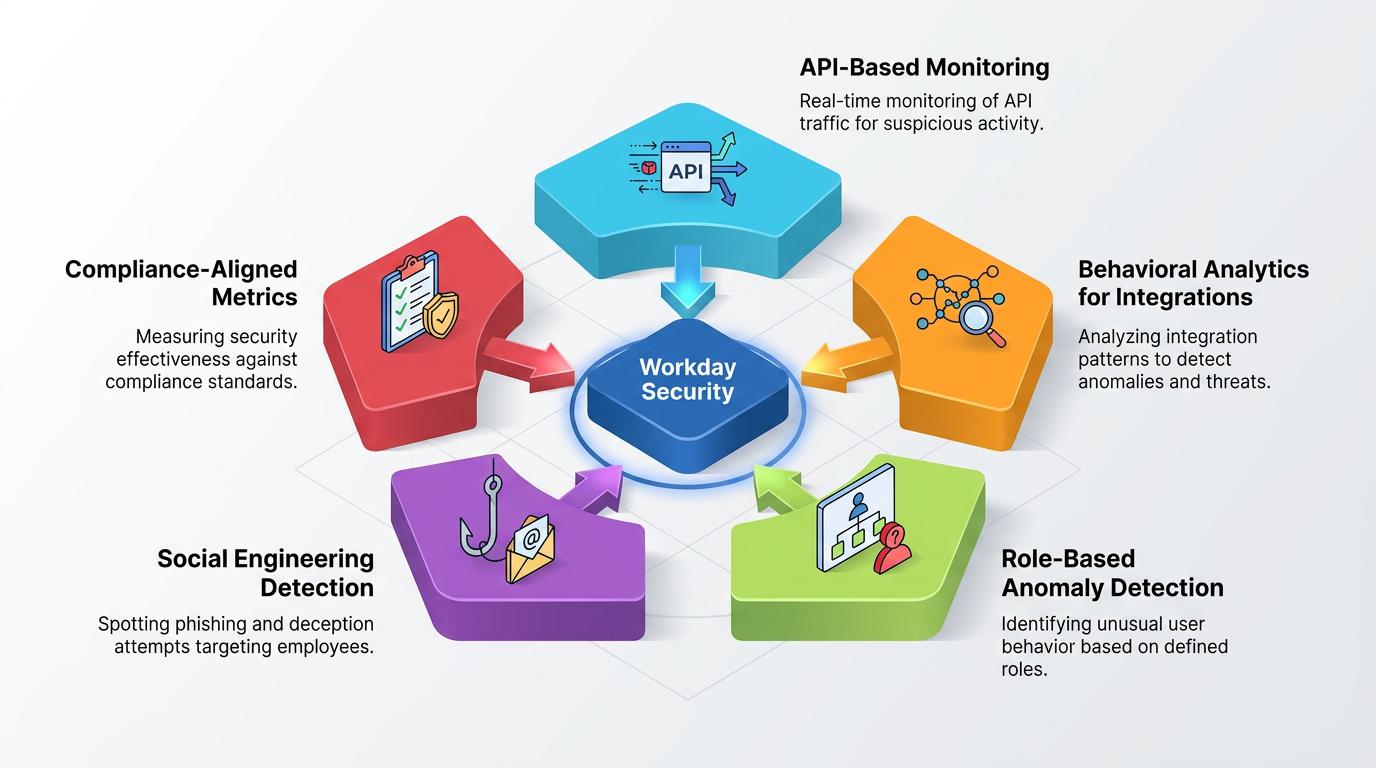
1. Implement Full API-Based Monitoring
Cloud-native Workday deployments operate beyond traditional network perimeters, where standard monitoring tools provide zero visibility into actual platform activities.
Organizations must use Workday's User Activity API with OAuth 2.0 authentication to capture detailed logs of user actions, data access events, and configuration changes. This API integrates directly with security information and event management (SIEM) platforms, creating centralized visibility across your security infrastructure. Workday's User Activity Logging is not turned on by default, and must be activated in Workday's tenant settings before any SIEM integration can ingest meaningful security data. SIEM platforms with documented Workday integrations include Rapid7 InsightIDR, Datadog Cloud SIEM, Google Security Operations (Chronicle), Sumo Logic, and Palo Alto Cortex XSIAM. CISA's Cloud Security Technical Reference Architecture recommends automating log collection rather than relying on manual export and retaining logs in line with federal log-retention guidance.
- Setting up an Integration System User account with carefully scoped permissions extracts logs without exposing sensitive employee data.
- Configuring OAuth 2.0 bearer tokens for secure, real-time streaming to your SIEM, which lets it immediately correlate other security events across your environment.
- Watching for employees downloading unusually large datasets that deviate from their normal work patterns can flag early signs of data exfiltration.
- Flagging administrative changes made during weekends or holidays, when IT staff rarely work, helps catch unauthorized changes early.
- Detecting sudden permission escalations early could indicate an attacker establishing persistence before launching broader attacks.
This API-driven approach turns blind spots into complete audit trails, supporting both real-time threat detection and regulatory compliance through complete activity logging.
2. Deploy Behavioral Analytics for Third-Party Integration Monitoring
Connected applications represent the weakest links in HR security. Attackers compromise less-protected systems to pivot into Workday through trusted integration channels.
Behavioral analytics must span every connected platform, including CRM systems, identity providers, and data-synchronization tools. These integrations maintain privileged access that bypasses many security controls, making them attractive entry points for patient attackers. The ShinyHunters supply chain campaign of 2025 (detailed above) demonstrates this risk concretely: a single third-party app connection, once abused, gave attackers a path into Workday's own data without touching Workday's authentication layer at all. A single misconfigured or poorly governed integration can expose large volumes of employee or financial data without clear warning.
- Creating detection logic that identifies suspicious sequences across platforms (e.g., unusual CRM queries followed by HR data exports) helps catch coordinated abuse that no single system would flag on its own.
- Establishing baselines for normal integration traffic during payroll processing versus quiet periods makes deviations easier to spot.
- Raising an alert when service accounts activate outside maintenance windows or access data unrelated to their functions is one of the more reliable signs of a compromised integration key.
- Flagging massive data transfers through integration APIs that exceed monthly averages by large margins.
- Identifying automation patterns that suggest scripts harvesting employee information systematically.
- Catching midnight access from service accounts that typically operate during business hours, which can potentially indicate compromised integration credentials.
- Alerting on new Integration System User (ISU) creation, reused API keys, and integration job schedule changes is worth prioritizing. Mitiga's research identifies these as high-risk indicators because "attackers often leverage integration keys because they bypass typical MFA and alerting."
3. Establish Role-Based Access Anomaly Detection
Every Workday role follows predictable patterns that create opportunities for anomaly detection. HR generalists routinely access benefits data, managers review team timecards, and executives analyze compensation during planning cycles.
- Documenting typical access volumes, data fields, and timeframes for each role is the baseline every other check in this section depends on.
- Accounting for seasonal variations such as year-end reporting or reduced summer activity avoids flagging normal seasonal spikes as incidents.
- Triggering automated alerts when staff view executive compensation, bulk-download department records, or perform tasks at atypical hours or from unexpected locations.
- Investigating payroll processors accessing systems at 3 AM or from foreign IP addresses, both common signs of compromised credentials.
MITRE ATT&CK's guidance on cloud account abuse (T1078.004) recommends detecting anomalous authentication from impossible geolocations or legacy protocols for high-privileged accounts, API calls exceeding normal scope such as IAM changes or access to services never previously used, and unexpected bulk downloads by internal users. For payroll fraud specifically, AppOmni's threat hunting research identifies four specific Workday audit log events that defenders should monitor: a user adding a new bank account to payment elections, a user changing their payment elections, a user updating an existing bank account, and the distinct variant where a compromised privileged user modifies another user's payment election settings. Separating duties between employees who can modify payment accounts and those who approve modifications or issue payments remains a foundational insider-threat control, and it applies directly to Workday payroll workflows.
4. Implement Social Engineering Detection and Response
Social engineering attacks bypass technical controls by manipulating employees into surrendering legitimate credentials. The threat is now operationally scaled and specifically targeted at HR workflows: according to the FBI's 2025 Internet Crime Complaint Center (IC3) report, business email compromise complaints reached 24,768 in 2025, resulting in $3.05 billion in losses, a 15.5% increase in complaints over the prior year — with payroll diversion representing one of the fastest-growing subcategories. Phishing and spoofing remain the single most frequently reported cybercrime category overall, and call center and help desk employees increasingly need training on vishing tactics used against enterprise SaaS platforms.
The Storm-2657 Payroll Pirate campaign described above illustrates the full attack chain that social engineering detection must address: initial phishing contact, credential and MFA-token theft, a pivot via single sign-on into Workday, payroll redirection, and a deliberate step to suppress the behavioral signals — like Workday's own warning emails — that would otherwise reveal the compromise. Okta's April 2025 threat intelligence similarly documented attackers using VPN and residential proxy IP addresses when authenticating to Workday after credential theft, specifically to evade geolocation-based detection. A documented February 2026 incident reported by The Register showed an attacker impersonating a physician to social-engineer the help desk, bypass verification, register new authentication devices, and redirect salary via Workday payroll, entirely through human manipulation rather than technical exploitation.
- Monitoring communication patterns and behavioral changes that signal manipulation (e.g., sudden password-reset requests after phishing emails).
- Correlating email security data with identity-management logs helps reveal users who receive phishing messages and then exhibit unusual login patterns.
- Alerting on new MFA method registrations, inbox rule creation, and OAuth application grants that occur within short windows following a suspicious authentication event.
- Automating response workflows to suspend accounts showing combined indicators can help intercept attacks during the critical window between initial compromise and data exfiltration.
5. Deploy Compliance-Aligned Threat Detection Metrics
Security teams must translate technical detection capabilities into business metrics that demonstrate regulatory compliance and risk reduction across frameworks such as GDPR, HIPAA, and SOX. Each framework carries specific breach notification timelines that make detection speed a direct compliance requirement rather than a general best practice:
- GDPR: Article 33 requires notification to the supervisory authority within 72 hours of becoming aware of a personal data breach.
- HIPAA: The Breach Notification Rule requires notification to HHS within 60 days for breaches affecting 500 or more individuals.
- CPRA: California's California Privacy Rights Act requires notification to the California Privacy Protection Agency and affected residents within 15 days of becoming aware of an incident.
- SOX: For SOX-covered organizations, the Public Company Accounting Oversight Board (PCAOB) holds that "a company's internal control cannot be considered effective if one or more material weaknesses exist"—meaning undetected unauthorized access to Workday payroll and compensation data feeding financial statements represents a direct internal control over financial reporting (ICFR) risk.
The financial case for faster detection is concrete: IBM's 2025 Cost of a Data Breach Report found that breaches take an average of 241 days to identify and contain, at an average global cost of $4.44 million. This underscores why closing that window matters as much for the balance sheet as for compliance.
To connect detection work to compliance and executive reporting, security teams need a small set of metrics that make both risk reduction and regulatory posture visible at a glance. The following measurements translate day-to-day monitoring into evidence auditors, executives, and regulators can act on:
- Tracking Mean Time to Detect (MTTD) for unauthorized access attempts, and comparing it against the industry benchmark above, helps identify where the biggest improvement opportunities exist.
- Maintaining compliance scores showing the percentage of properly authorized data access with complete audit trails.
- Calculating financial exposure prevented through early detection helps demonstrate ROI.
- Delivering monthly scorecards comparing detection effectiveness against industry benchmarks.
- Preparing investigation-ready evidence packages can expedite auditor inquiries and minimize operational disruptions.
Reported consistently, these metrics turn Workday threat detection from a technical function into a defensible compliance program. They also give leadership a clear line of sight into whether detection speed is actually keeping pace with the notification windows regulators impose.
Building Resilient HR Security Operations
HR platform security demands change as perimeter-based defenses fail against attacks that blend technical exploitation with human manipulation. Effective protection means monitoring not just Workday itself, but every connected system, integration point, and human interaction that creates potential vulnerability. Security teams need behavioral analytics to catch subtle cross-platform anomalies, and incident-response planning that treats social engineering as a first-class threat alongside technical exploits. The organizations that close this gap fastest will be the ones that stop treating Workday as a back-office system and start treating it as a primary attack surface.
Frequently Asked Questions
What Is Threat Detection for Workday, and How Is It Different From Standard IT Monitoring?
Threat detection for Workday means continuously analyzing user activity, integration behavior, and administrative changes inside the platform itself, rather than only watching network traffic or login success and failure. Because Workday sits in the cloud and is reached almost entirely through authenticated API and SSO connections, standard network monitoring tools have little to see. Effective Workday threat detection depends on ingesting Workday's own activity logs into a SIEM and building behavioral baselines for each role.
How Does Behavioral Analytics Improve Workday Threat Detection Compared to Traditional Rule-Based Tools?
Rule-based and signature-based tools flag known bad patterns, which does little against an attacker using a valid, compromised credential. Behavioral analytics instead builds a baseline of what normal looks like for each user, role, and integration, then flags deviations such as access at unusual hours, from unexpected locations, or at a volume that doesn't match past behavior. This approach catches novel and socially-engineered attacks that never trip a signature-based rule at all.
What Workday Activity Should Security Teams Monitor Most Closely for Signs of Payroll Fraud?
The highest-value signals are changes to payment elections: a user adding a new bank account, updating an existing one, changing payment elections generally, or a privileged user modifying another employee's payment settings. These events, combined with unusual login timing or location around the same change, are consistently the pattern documented in real payroll diversion incidents.
How Quickly Should Organizations Detect and Respond to a Compromised Workday Account?
There's no universal number, but organizations should benchmark their own Mean Time to Detect against industry data and treat any gap as a direct cost and compliance risk, not just an operational metric. Automating the correlation between suspicious authentication events and subsequent account or payment changes is what typically compresses that window from days to minutes.