Points clés
AI phishing attacks increasingly slip past detection methods built around spotting typos and broken grammar. As generative tools erase those old warning signs, security teams need playbooks that judge messages by context and behavior instead.
"Check for typos" was once solid security advice. AI-generated messages have made that guidance far less reliable. Large language models (LLMs) can produce polished, contextually appropriate phishing email content in many languages. The grammar cues that once helped flag malicious emails have become less dependable, so security teams need detection methods that analyze more than writing quality.
This guide breaks down how AI is reshaping phishing tradecraft, from polished lures and abused hosting platforms to deepfake-enabled executive impersonation, and outlines the behavioral and procedural controls that can close the gap. Without that shift, the distance between what attackers can produce and what legacy defenses can catch will keep widening.
This article draws on insights from Abnormal's webinar "The Adversary's New Assistant: Weaponizing AI Chatbots."
Key Takeaways
Polished language makes grammar-based phishing heuristics less reliable.
Trusted hosting platforms can conceal phishing lures from email-focused analysis.
Generative AI gives more attackers the ability to create convincing social engineering campaigns at scale.
Signature-based tools often struggle with attacks that lack known malicious indicators.
Behavioral analysis can help identify requests that deviate from established communication patterns.
When Attackers Stop Making Mistakes
AI-generated messages weaken the language-based heuristics that once helped users identify suspicious emails. Traditional security awareness training emphasized three checks:
Analyze the email header
Verify the sender
Scan for typos
The assumption behind these checks was that attackers, often operating from non-English-speaking countries or working at scale, would make mistakes that careful readers could catch. AI-generated language has made that assumption less reliable.
These techniques depend on attackers leaving recognizable errors. AI-enabled attackers can now avoid many of them.
The traditional approach essentially tells users where to look for suspicious details. When AI-generated phishing emails contain polished phrasing and few obvious red flags, that framework becomes much less reliable. The NCSC assessment of AI threats explains how AI lowers the barriers to effective cyber operations.
As Inma Martinez, AI scientist and global chair for GenAI and Agentic AI projects at the Global Partnership on Artificial Intelligence (GPAI), put it during the webinar: "We're trying to find a new challenge with wooden tools. These are not the tools for this. We need to build new ones."
How Attackers Exploit Trust in Hosting Platforms
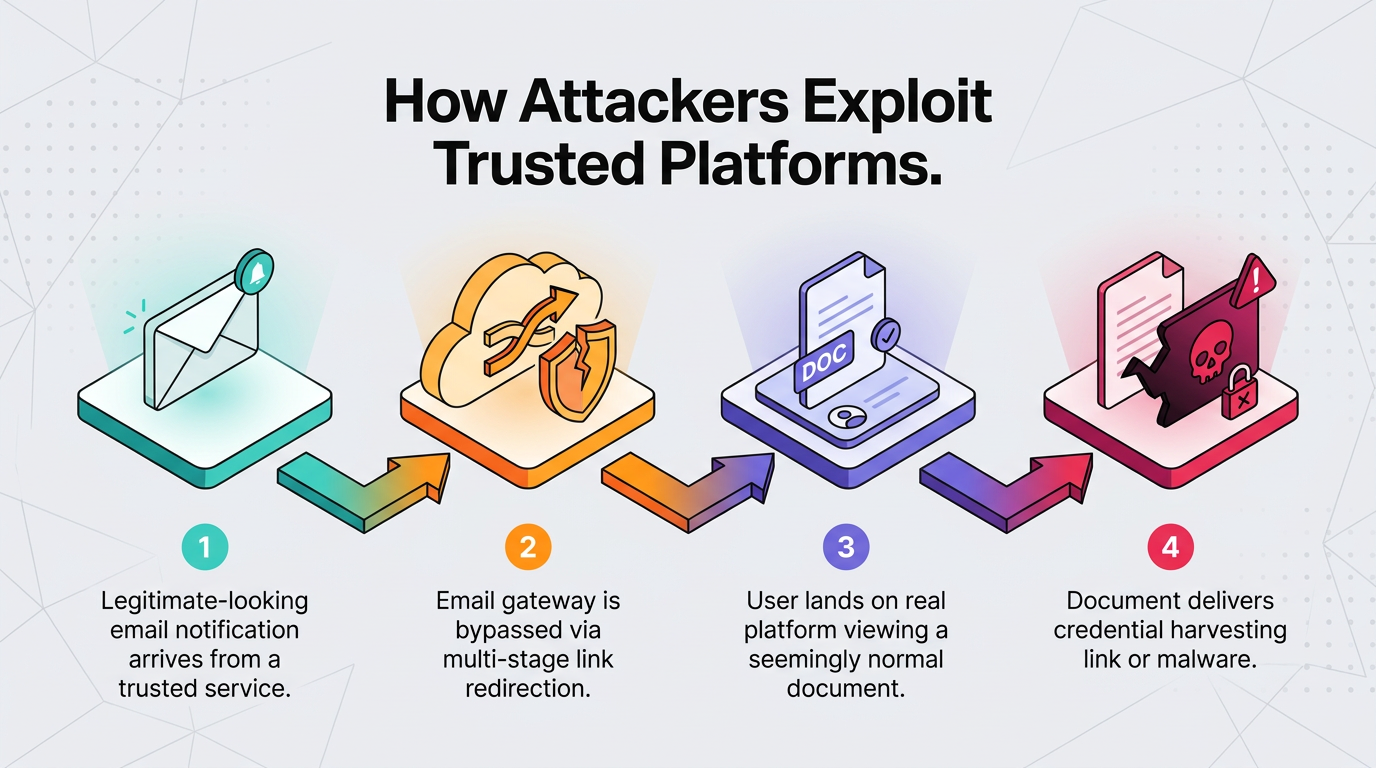
Modern attackers can exploit the trust users place in legitimate hosting and collaboration platforms. The chain is short, and each step can look routine.
Here's an example of how an AI-enabled phishing attack might happen:
An email arrives from a legitimate application or trusted service, inviting the recipient to view a shared presentation or document.
Because the notification comes from that service, it may slip past email gateway technology, and the multi-stage link redirection that follows can hide the true destination from static link analysis.
The user clicks through, lands on the real platform, and sees what looks like a normal document.
The document holds the actual lure, such as a link to credential harvesting attacks or malware delivery tactics.
After the initial click, several factors can make these attacks harder to recognize:
Reduced Email Visibility: The lure may not appear directly in the email body, leaving the gateway with less message content to evaluate.
Layered Credential Theft: In one observed campaign exploiting Gamma, attackers sent emails from a compromised account linking to a presentation hosted on a legitimate domain. Victims who opened it were routed to a spoofed cloud sign-in page that captured credentials in real time through an adversary-in-the-middle attack, with finance and professional services executives as the primary targets.
Lower User Vigilance: Users who reach a familiar platform may lower their guard. Security training focused on scrutinizing email content does not always transfer to documents hosted on trusted services, especially when the notification and destination initially appear legitimate.
AI can also support more convincing human impersonation. Operatives can feed real-time interview subtitles into AI models to generate contextually relevant answers. That closes the cultural and language gaps that might otherwise expose a deceptive job applicant. This use case shows how generative AI can strengthen social engineering beyond written email content.
What Makes AI Phishing Attacks Different
AI phishing attacks expand access to capabilities that once required greater technical skill and cultural knowledge. The barrier between intent and capability has narrowed. Previously, executing sophisticated social engineering attacks required substantial expertise. Generative tools now allow a wider range of attackers to craft convincing, contextually appropriate campaigns at scale.
Three examples illustrate how this shift is playing out:
Criminal Experimentation: Black Basta leaked chats show operators exploring uncensored generative AI tools and using chatbots to write convincing messages during active intrusions.
State-Sponsored Operations: State-sponsored threat groups use LLMs for reconnaissance, stolen-data analysis, and AI-assisted malware development. For instance, Microsoft and OpenAI's joint research identified groups tied to Russia, China, North Korea, and Iran, such as Forest Blizzard and Crimson Sandstorm, probing LLMs to support their operations.
Financial Impact: Business email compromise (BEC) attacks produced $3.046 billion in reported losses in 2025, making it the second-largest cyber-enabled fraud loss category in the FBI's 2025 Internet Crime Report.
These examples show how AI can improve attack quality, accelerate criminal workflows, and increase the potential reach of social engineering operations.
Deepfakes, Voice Calls, and Collaboration Channels Widen the Attack Surface
AI phishing no longer stops at the inbox: deepfake video, voice cloning, and compromised collaboration accounts now extend executive impersonation into channels that email controls cannot see. Security teams need to treat these adjacent channels as part of the same attack chain, since a convincing email is often paired with a follow-up call, chat, or video meant to close the deal.
Live Executive Impersonation
An FBI public service announcement warned that threat actors circulated an AI-generated deepfake video of a senior FBI leader directing viewers to a spoofed government site that harvested personal information. The warning also described scammers using AI-generated video in live calls to impersonate executives or officials.
These tactics can reinforce business email compromise by adding a familiar voice or face to an urgent financial request. A polished email may establish the pretext, while a synthetic call creates the appearance of independent confirmation. Because voice and video occur outside email systems, organizations need separate verification controls for those channels.
Collaboration Channel Exposure
Collaboration platforms carry similar risk. A message that appears to come from a colleague or an IT help desk has the perceived legitimacy of an internal conversation, and it may sit outside an email gateway's view. If attackers gain control through account takeover fraud, they can use that trusted identity to distribute links or payment requests.
While these campaigns increasingly blend email with voice phishing, text messages, and deepfake video, email remains a primary entry point for cyberattacks. Behavioral AI can help detect the email and account-based components of these scams. Where organizations deploy integrated collaboration coverage, that protection can also support specific connected platforms, while voice and SMS channels still require complementary controls.
How to Defend Against AI Phishing Attacks
Effective defense against AI phishing requires behavioral context alongside signatures, content analysis, and user vigilance.
Behavioral Pattern Detection
Abnormal's behavioral AI threat detection for email-borne threats learns what normal communication looks like for a specific organization and helps surface deviations from it.
Piotr Wojtyla, Head of Threat Intelligence and Platform at Abnormal, frames it in operational terms: effective defense requires "understanding what is known good" and detecting what deviates from that baseline. This means building behavioral profiles that capture workflow cadences, vendor interaction patterns, recipient behavior, timing, and engagement flows, then flagging deviations that may signal compromise or malicious intent.
Concrete deviations include:
Unusual Sender-Recipient Pairings: A first-time exchange between people whose roles have no history of direct contact.
Requests Outside Historical Patterns: Wiring instructions sent outside business hours or a sudden change to a vendor's banking details.
Unexpected Urgency: Pressure to act immediately in a context where the sender has not previously applied it.
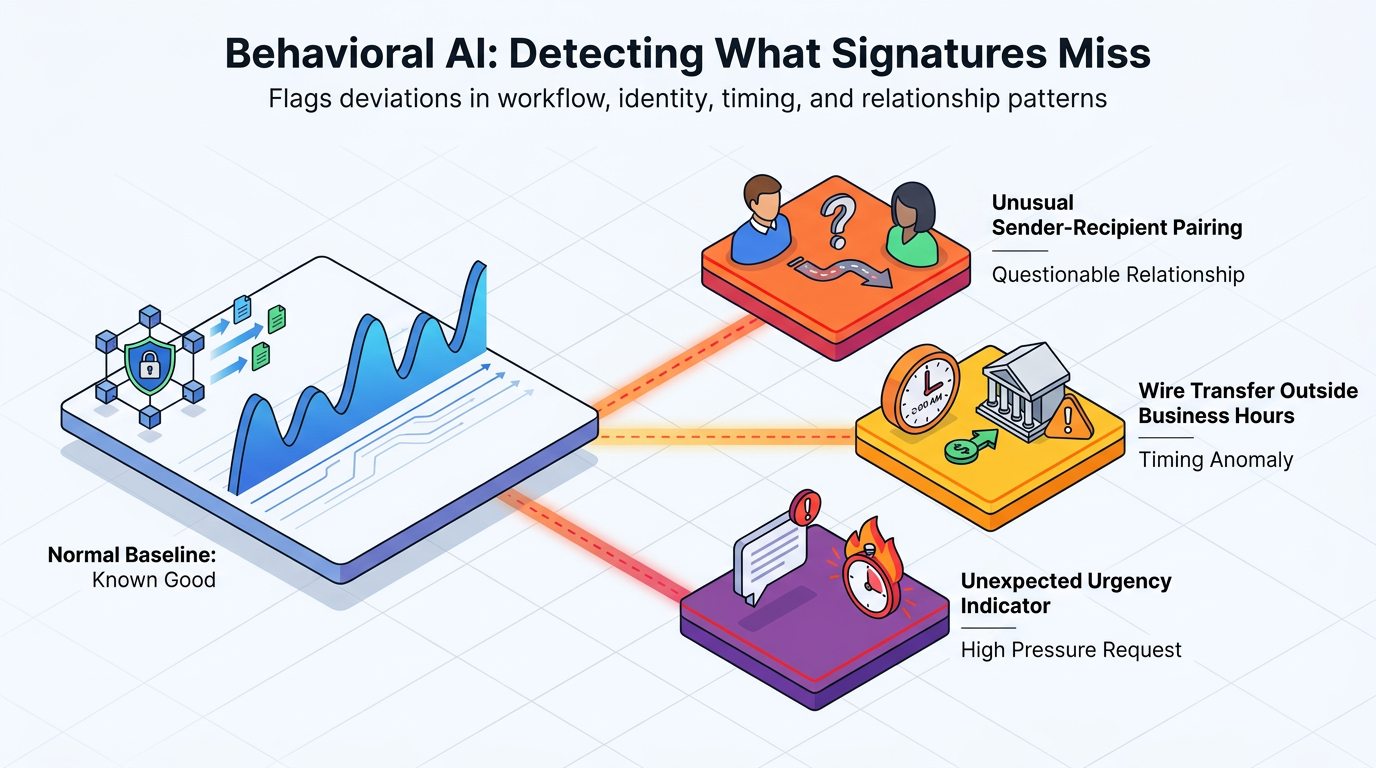
Comparing these signals with established organizational behavior can make them stronger indicators.
Pairing behavioral analysis with procedural controls can further reduce risk. A standing verification process can confirm changes to payment details or banking instructions through a phone number already on file rather than one supplied in the request. The Cybersecurity and Infrastructure Security Agency (CISA) recommends phishing-resistant multi-factor authentication (MFA) for privileged and email accounts in its phishing-resistant MFA guidance, which can help limit credential theft when a user submits credentials to a spoofed sign-in page.
Layered Email Security
Abnormal's detection engine applies large language models alongside behavioral and identity signals to interpret a lure's context: who sent it, who received it, and whether the request matches prior communication patterns. This design can help identify suspicious email behavior without relying entirely on known-bad signatures.
Traditional email gateways scan for known threats such as malicious attachments, suspicious URLs, and blacklisted senders. AI-native email security adds a behavioral layer alongside that model and can help identify attacks that use new techniques or legitimate infrastructure. This complementary approach enhances the existing security stack rather than requiring teams to discard controls that still address common threats.
Stay Ahead of Evolving AI Phishing Attacks
Security teams need to evolve their email defenses as attackers use AI to improve the scale and quality of social engineering. Organizations hesitant to adopt AI-powered defense risk widening the gap between what attackers can create and what defenders can evaluate.
A layered approach that combines AI-native email security, identity controls, established verification procedures, and security awareness training can address more of that gap. Grammar checks can still contribute one signal, but effective phishing detection now requires controls that evaluate message context, identity, communication patterns, and requests that do not fit established behavior. Systems designed to evaluate communication context can help identify suspicious messages before users act on them, while phishing-resistant authentication and out-of-band verification give security teams additional opportunities to disrupt an AI-assisted attack.
Abnormal's behavioral AI models what normal communication looks like for each organization, then surfaces the workflow, identity, and relationship deviations that AI-generated lures rely on to succeed. Deployed via API alongside Microsoft 365 or Google Workspace, the platform complements existing gateways and identity controls to help your team identify sophisticated phishing, business email compromise, and account takeover activity that signature-based tools often miss.
Abnormal was also named a Customers' Choice in the 2026 Gartner® Peer Insights™ Voice of the Customer for Email Security, the only email security platform to earn this recognition for three consecutive years. Ready to see how Abnormal's behavioral AI can help identify threats that legacy tools often miss? Request a demo to learn more.
Frequently Asked Questions
What Makes AI-Generated Phishing Harder to Spot Than Older Phishing Emails?
AI-generated messages remove the grammar mistakes and awkward phrasing that once served as easy warning signs. Attackers can also generate fluent messages in languages they don't speak, which widens the pool of people who can run convincing campaigns.
Can Grammar and Spelling Checks Still Help Identify Phishing Emails?
Grammar checks can still catch a subset of unsophisticated attempts, but they no longer work as a primary filter. Security teams need to weigh sender identity, communication history, and request context alongside writing quality.
How Does Behavioral AI Differ From Traditional Email Security Tools?
Traditional tools compare messages against known-bad signatures, such as flagged domains or malicious attachments. Behavioral AI instead builds a model of what normal communication looks like for an organization and flags requests that deviate from it, which can help catch attacks that don't match any known pattern.
What Steps Can Organizations Take to Defend Against AI-Powered Phishing?
Pairing behavioral email detection with phishing-resistant multi-factor authentication (MFA) and a standing process to verify payment or banking changes through a known phone number can close several gaps at once. Extending verification practices to voice and video channels also helps, since attackers increasingly use those alongside email.