重要なインサイト
Under the EU AI Act, fines for prohibited AI practices reach EUR 35 million or 7% of worldwide annual turnover, whichever is higher, and its duties fall on the organizations deploying AI systems as well as the companies building them. AI safeguarding is the set of controls that protects an organization, its data and its people when employees use AI tools and when AI agents act on the organization's behalf. It covers which tools are in use, what data can enter them, what agents may do, and how the organization detects, contains and evidences problems.
Each layer of AI safeguarding gets its own treatment in this guide, from inventory through to audit evidence. It also sets safeguards against the neighboring terms they get confused with, and ends on a rollout sequence that lets lower-risk AI use proceed while higher-risk uses get closer review.
What Does AI Safeguarding Cover in an Enterprise?
Enterprise AI safeguarding keeps AI use inside the organization's risk tolerance, whether an employee is prompting a chatbot or an agent is acting with delegated access. Its scope is wider than any provider setting, because a model provider can filter harmful outputs while having no record of which file holds regulated data or which employee may approve a payment.
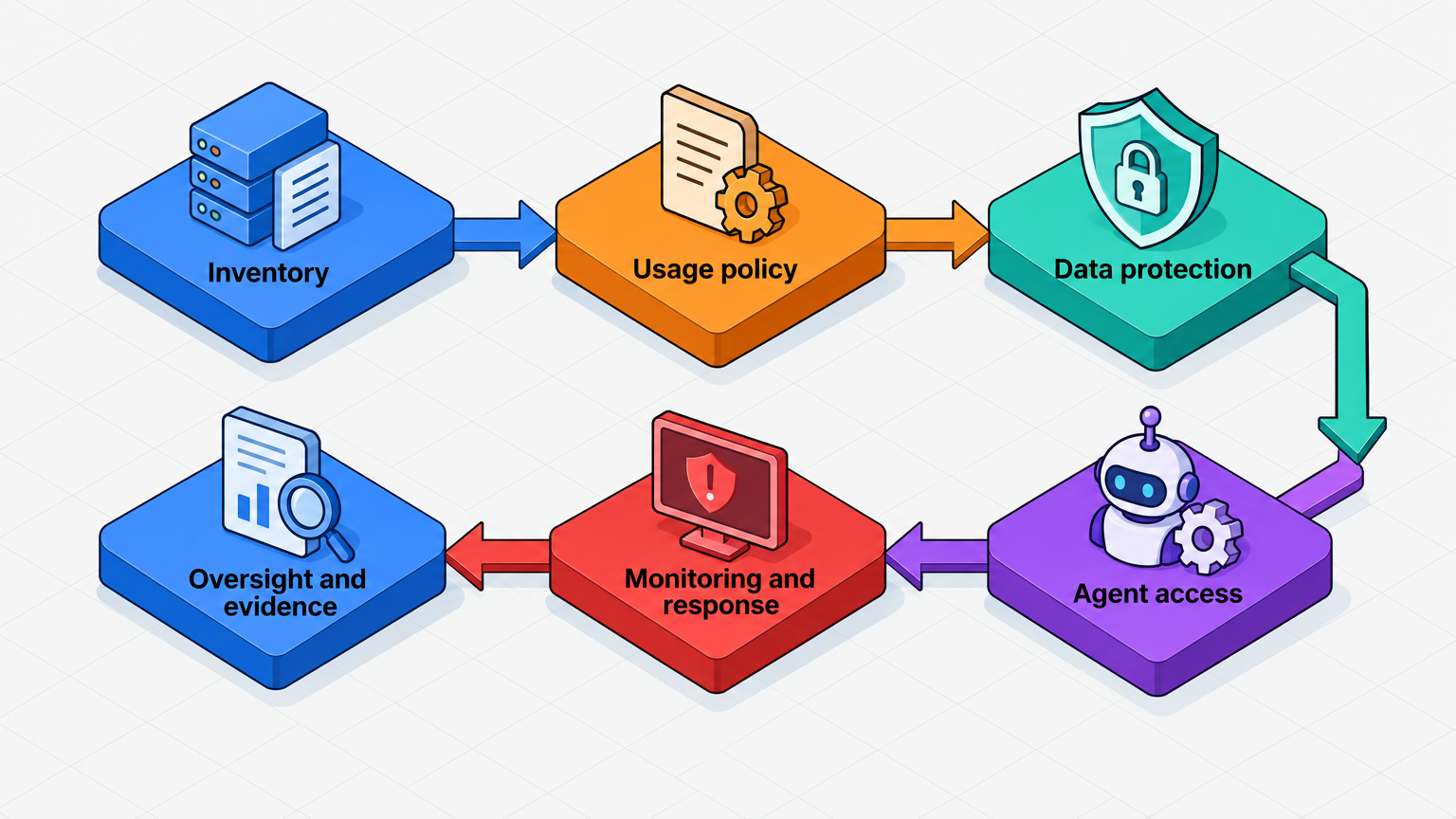
The controls sit in layers, each answering a different question: what is in use and who owns it; which tools and data classes are allowed; what can enter a prompt or upload; what agents can touch and do; how problems surface and get contained; and who is accountable, with what proof that the controls work.
Which Risks Do AI Safeguards Address?
AI safeguards address exposure that ordinary, well-intentioned AI use creates, not deliberate misuse. Each risk here starts with someone doing their job and ends somewhere the organization cannot see:
Employees Expose Sensitive Data Through Prompts and Uploads: Pasting a customer list, a patient record or an unreleased document into a chatbot hands that data to a third party under terms nobody reviewed, and the exposure is complete before anyone reports it.
Shadow AI Bypasses Security Oversight: Tools adopted through personal signups sit outside procurement, data processing agreements and logging, which removes an organization's visibility into where its information went.
Over-Permissioned Agents Widen the Blast Radius: An agent granted more tools, permissions or autonomy than its task requires can take damaging actions, which OWASP's 2026 LLM risk list files as Excessive Agency.
Unvalidated Outputs Trigger Unapproved Actions: Model output passed downstream without checks can set off actions nobody approved, built on manipulated or flawed responses.
Compliance Lags When Use Outpaces Documentation: Personal data in prompts can trigger obligations around lawful basis and data minimization, plus processor agreements, and the EU AI Act adds deployer duties for high-risk systems.
An unknown tool carries every one of these at once, and discovery comes before any other control.
What Are the Main Layers of AI Safeguarding?
The layers run from visibility and usage policy through data protection at the point of use and agent access, to monitoring, response and oversight backed by audit evidence. Each one closes a specific exposure, and they depend on each other: data controls cannot cover a tool nobody has discovered, and audit evidence is only as good as the logs monitoring produces.
Visibility and Inventory of AI Tools and Agents
Every other safeguard depends on knowing what AI is in use. NIST's Generative AI Profile suggests enumerating generative AI systems in the organization's AI inventory, recording details such as data provenance, human oversight roles, and the underlying foundation models and versions.
For shadow AI, organizations can review signup confirmation emails, OAuth grants, identity provider logs and browser activity, and the methods behind shadow AI detection differ in what each signal reveals. Agents belong in the same inventory, recorded with the credentials and connected systems each one uses. Abnormal's AI Governance, which is generally available, can help discover sanctioned and shadow AI tools, attribute ownership and track compliance gaps.
Usage Policy for AI Tools
A usage policy turns the inventory into decisions: which tools are approved, for which work, and with which data classes. Account type matters as much as the tool, because consumer tiers of many assistants reserve the right to train on submitted content while business tiers typically do not by default.
An example control from an AI security policy is a three-status register, marking each tool sanctioned, tolerated or unsanctioned, that routes anyone requesting an unsanctioned tool to an approved alternative. The EU AI Act also requires providers and deployers to support the AI literacy of staff using AI systems, which makes the policy a training artifact as well as a control.
Data Protection at the Point of Use
Some data should never reach an external AI tool: credentials and secrets, special category personal data, customer account details, unreleased financials and restricted source code.
Controls at this layer inspect a prompt or upload at the time of the request and apply a decision tied to who is asking: allow, warn, redact or block. Abnormal's AI Employee Guardrails, in private preview within the AI Security suite, is a policy-based control designed to guide or block risky actions in the moment and log activity for review.
Access and Permissions for AI Agents
Agents act, which makes their safeguards look like identity controls. Treating each agent as a managed non-human identity makes the usual identity controls apply: short-lived, task-scoped credentials issued per run, human approval for high-privilege or irreversible actions, and immutable, signed logs of agent actions and tool calls. The OWASP guidance on excessive agency adds that authorization belongs in downstream systems rather than in the model's own judgment, and it names broad or unrestricted agent access to sensitive data and critical systems as the condition those controls exist to prevent.
Monitoring and Incident Response
Monitoring runs continuously, since AI behavior changes in production as data, models and permissions drift. The NIST AI Risk Management Framework calls for monitoring AI system functionality and behavior once deployed, and the Generative AI Profile adds tracking of errors and incidents with fields such as system identifier, description, impacts and stakeholders affected.
Response needs a way to stop an agent, and keeping the ability to halt autonomous activity immediately, rather than waiting for a deployment cycle, separates a monitored agent from a merely logged one. Data provenance tracking, encryption and digital signatures make an investigation possible afterward, since they establish what an agent touched and whether the record of it has been altered.
Oversight and Audit Evidence
Oversight assigns ownership and produces proof. Legal, IT and security share the work, while business owners remain accountable for the tools and agents their teams use.
Documented roles and lines of communication carry that work, and responsibility for AI risk decisions sits with executive leadership. ISO/IEC 42001, the certifiable AI management system standard, covers the same ground for organizations that need an audited management system instead of a framework.
EU AI Act Article 26 requires deployers of high-risk systems to assign human oversight to competent people, use systems according to provider instructions, and retain automatic logs under their control for at least six months. Data protection law adds impact assessments where processing is likely to pose a high risk to people's rights.
How Do AI Safeguards Relate to AI Guardrails and AI Governance?
An AI governance program sets the rules and ownership, guardrails enforce rules at runtime on a model or request, and safeguarding is the umbrella covering both plus monitoring and response. The three terms are easy to confuse, and purpose, owner and examples separate them:
Term | Purpose | Owner | Examples |
AI governance | Set rules, risk tolerance and accountability | Executives, legal, compliance | AI policy, inventory requirements, assigned roles |
AI guardrails | Enforce rules on a model or request at runtime | Security, platform engineering | Prompt filters, output validation, request-time data policies |
AI safeguarding | Protect the organization across all AI use | Shared across security, legal, compliance, IT | Governance, guardrails, monitoring, incident response, audit evidence |
Teams that buy guardrails without governance end up with filters nobody can explain, and teams that write governance without guardrails end up with a policy nothing enforces.
How Do Teams Put AI Safeguarding in Place Without Blocking Adoption?
Proportionate safeguards let low-risk AI use move quickly and reserve stricter review for uses touching sensitive data or taking consequential actions. Sequencing matters more than coverage here, because each step narrows what the next one has to police:
Discover what is already in use, including shadow AI and agents built by business teams, before writing restrictions.
Risk-tier tools and agents. Higher priority goes to systems handling sensitive data or producing outputs that affect people, and lower priority to systems interacting only with other computational systems on non-sensitive data.
Apply stricter controls to higher-risk uses. A drafting assistant may need only an approved enterprise account and a policy, while an agent with payment access warrants scoped credentials, human approval and documented review.
Review regularly. Controls need regular reassessment, because approved applications can add AI features or change their data terms between reviews.
AI impact assessments, which evaluate effects on individuals and groups before deployment, run alongside this sequence rather than inside it.
Safeguards That Let Teams Adopt AI With Confidence
The controls work in layers, from inventory, usage policy and data protection at the point of use to agent permissions, monitoring and response, and oversight backed by evidence that maps to NIST, ISO/IEC 42001 and the EU AI Act. Risk-tiering keeps the controls proportionate, letting everyday AI use continue while high-risk uses get the review they need.
Abnormal's AI Employee Guardrails, in private preview, is designed to connect AI requests to employee identity and business context and apply data policies at request time. Explore AI Employee Guardrails to see how Abnormal applies data policy at the moment of the request.
Frequently Asked Questions
Are AI safeguards required by regulation?
Yes, in specific cases. The EU AI Act places duties on deployers of high-risk AI systems, including human oversight, use according to instructions and log retention. Data protection law applies whenever personal data enters AI tools, requiring a lawful basis and data minimization, plus processor agreements where a processor is used. Frameworks such as the NIST AI RMF and ISO/IEC 42001 are voluntary, though many organizations use them to structure and evidence their safeguards.
Who owns AI safeguarding in an organization?
No single team owns AI safeguarding. Security typically runs discovery, data controls, agent permissions and incident response, while legal and compliance interpret regulatory obligations and maintain audit evidence. IT manages approved tools and accounts, and business owners answer for the specific tools and agents their teams use. Executive leadership takes responsibility for AI risk decisions.
Do AI providers' built-in safeguards cover enterprise risk?
No, provider controls cover the model and the account, not the organization's own context. A provider cannot know which data is restricted, who may approve an action, or which uses the business permits, leaving the organization to set its own data classifications, user roles and business rules. Organizations apply their own risk tolerances to third-party generative AI.
How do you measure whether AI safeguards are working?
Measurement focuses on coverage and outcomes. Useful measures include the share of AI tools and agents in the inventory with a named owner, policy violations caught at request time, containment times for AI-related incidents, and open audit findings. The appropriateness of AI metrics and the effectiveness of existing controls need regular review, and these measures need revisiting whenever tools, models or permissions change.