Red team penetration testing shows how adversaries combine tactics across email, cloud identity, on-premise systems, vendors, and physical facilities. It evaluates whether layered controls and response processes hold up under realistic attack conditions.
Traditional penetration tests provide a point-in-time vulnerability view. Red team exercises emulate patient, creative threat actors over extended periods, revealing paths to privileged access, persistence, fraud, or ransomware. Programs that get these elements right turn red team findings into measurable improvements in detection and response, rather than a report that gathers dust after the engagement ends.
This guide explains what separates a red team program that shifts an organization's security posture from one that produces a static deliverable. The difference between the two often decides whether a security team catches a real intrusion in hours or discovers it months later in a breach notification.
Key Takeaways
- Successful programs connect realistic adversary testing to measurable defensive improvements.
- Red team exercises model persistent adversaries beyond point-in-time assessments.
- Measurable objectives connect testing to business risk.
- Focused scope aligns critical surfaces with available resources.
- Diverse expertise turns findings into defensive improvements.
What Is Red Team Penetration Testing?
Red team penetration testing validates your organization's ability to detect and respond to sophisticated, persistent threats. It assesses detection, response, and resilience capabilities across people, processes, and technology at the same time.
This approach validates incident response procedures, assesses employee security awareness, and reveals how well your organization handles complex threat scenarios beyond technical vulnerabilities alone.
The following elements provide a foundation for a successful red team penetration testing program.
Clear Objectives and Success Criteria
Effective red teaming starts with clear definitions of learning goals, success metrics, and operational guardrails. Without this foundation, sophisticated attack simulations can become theater rather than actionable intelligence.
Two categories of decisions anchor the framework: what the exercise will target and how success will be judged. The target side includes:
- Target Assets: Teams can identify servers, cloud tenants, or business workflows where compromise would seriously disrupt operations. A concise asset list keeps exercises focused on what matters and away from low-value outliers that drain resources without revealing meaningful risk.
- Rules of Engagement: Teams can document boundaries, timelines, and escalation paths in the rules of engagement (ROE). The rules-of-engagement section below details the phases and permissions the ROE should govern.
On the measurement and compliance side:
- Measurable Success Metrics: Programs can define quantifiable goals that mirror real adversary objectives, such as reaching privileged access, demonstrating controlled data exfiltration, or persisting through an agreed detection window. Precise metrics help teams track detection performance and report progress to the board.
- Compliance Alignment: Teams can map planned actions to frameworks such as PCI DSS (Payment Card Industry Data Security Standard) and the EU's DORA requirements (short for Digital Operational Resilience Act). This can validate required controls and uncover new gaps. PCI DSS's Requirement 11.4 calls for recurring internal and external penetration testing, while DORA requires in-scope financial entities to run threat-led penetration testing under frameworks such as TIBER-EU (Threat Intelligence-Based Ethical Red Teaming). The National Institute of Standards and Technology (NIST) describes red team exercises as extending penetration testing objectives by examining organizational security posture and defensive capabilities, so a mature program runs both.
Together, these components keep the engagement focused, controlled, measurable, and relevant to compliance obligations.
Realistic Attack Scenarios and Threat Modeling
Emulating real adversaries can improve security testing return on investment (ROI) by exposing vulnerabilities that might otherwise remain hidden. Teams can start with adversary profiling linked to the MITRE ATT&CK framework, covering credential phishing, social engineering pretexts, and the wider set of threat actor tactics, techniques, and procedures (TTPs) relevant to your industry.
Adversary profiling through MITRE ATT&CK grounds those scenarios in documented behavior. Current ATT&CK updates add coverage of:
- Credential and identity token theft
- Attacks on cloud and developer environments
- Phishing kits that steal OAuth tokens and session cookies
These additions help teams model campaigns that extend beyond endpoint exploitation into identity and cloud workflows. MITRE's Center for Threat-Informed Defense publishes an Adversary Emulation Library with full plans that emulate a named adversary end to end, plus automated micro emulation plans designed to extend the library's value beyond organizations with sophisticated red teams.
Realistic attack scenarios can identify blind spots in detection capabilities. By simulating multivector attacks, teams can evaluate defense mechanisms against campaigns that combine social engineering, technical exploits, credential abuse, and persistence tactics.
Business Workflow and Attack Chain Mapping
Mapping those scenarios back to email and identity workflows is where the exercise becomes operationally relevant. Email remains a common delivery mechanism for attacks such as business email compromise (BEC) and account takeover. Teams can map these scenarios directly to business-critical workflows, such as invoice approval, banking detail changes, and payroll updates, to ground security efforts in operational risk. Threat intelligence can inform scenario development with current insights into adversaries targeting your industry.
A scenario might open with a vendor-impersonation email, move to a stolen session cookie, and end with a forged payment request. This sequence exercises email, identity, and finance approval in one run while showing stakeholders how separate weaknesses can form a connected attack path.
How to Scope Red Team Penetration Testing Across Critical Attack Surfaces
Red team engagements can expose more meaningful risk when the scope reflects the paths adversaries are likely to exploit, as illustrated in this CISA advisory. Programs can start with business-critical processes and extend coverage to relevant technology, people, and partners to create tests that pressure defense-in-depth strategies instead of isolated controls. A detailed asset inventory turns that map into an actionable scope.
Cover Priority Attack Surfaces
Teams can enumerate environments that store or transport sensitive data:
- Email platforms
- Cloud applications
- On-premise networks
- Physical facilities
- Third-party vendors
- Integration platforms
- Privileged access management systems
- Data collaboration environments
Cloud identity deserves explicit treatment. The ATT&CK Cloud Matrix covers office suites, identity providers, software as a service (SaaS), and infrastructure as a service (IaaS) platforms, with credential access techniques including password spraying, credential stuffing, forged Security Assertion Markup Language (SAML) tokens and web cookies, and modification of multi-factor authentication (MFA) or conditional access policies. Organizations with operational technology or industrial control systems should scope those environments explicitly and identify which live-production actions the team cannot perform.
Continuous Automated Red Teaming (CART) tooling can retest key domains between engagements, though automated validation complements periodic red teaming rather than replacing it. When teams scrutinize these surfaces, they can uncover attack paths that combine phishing, cloud misconfigurations, lateral movement, and badge cloning.
Size the Scope to Resources
Programs can balance ambition with available time, tooling, and budget. Teams can rank attack surfaces by business impact and recent threat intelligence and focus depth on those that could halt revenue or jeopardize regulated data. According to the FBI's Internet Crime Complaint Center (IC3), BEC losses reached $3.046 billion in 2025, which puts email-driven payment workflows in the top tier of many risk models.
Some programs use a tiered model instead:
- Highest-Priority Assets: Full adversary simulation
- Secondary Assets: Targeted probing
- Remaining Assets: Vulnerability scans
This allocation helps teams preserve testing depth where compromise would create the greatest operational, financial, or compliance impact.
Essential Roles for a Successful Red Team With Diverse Expertise
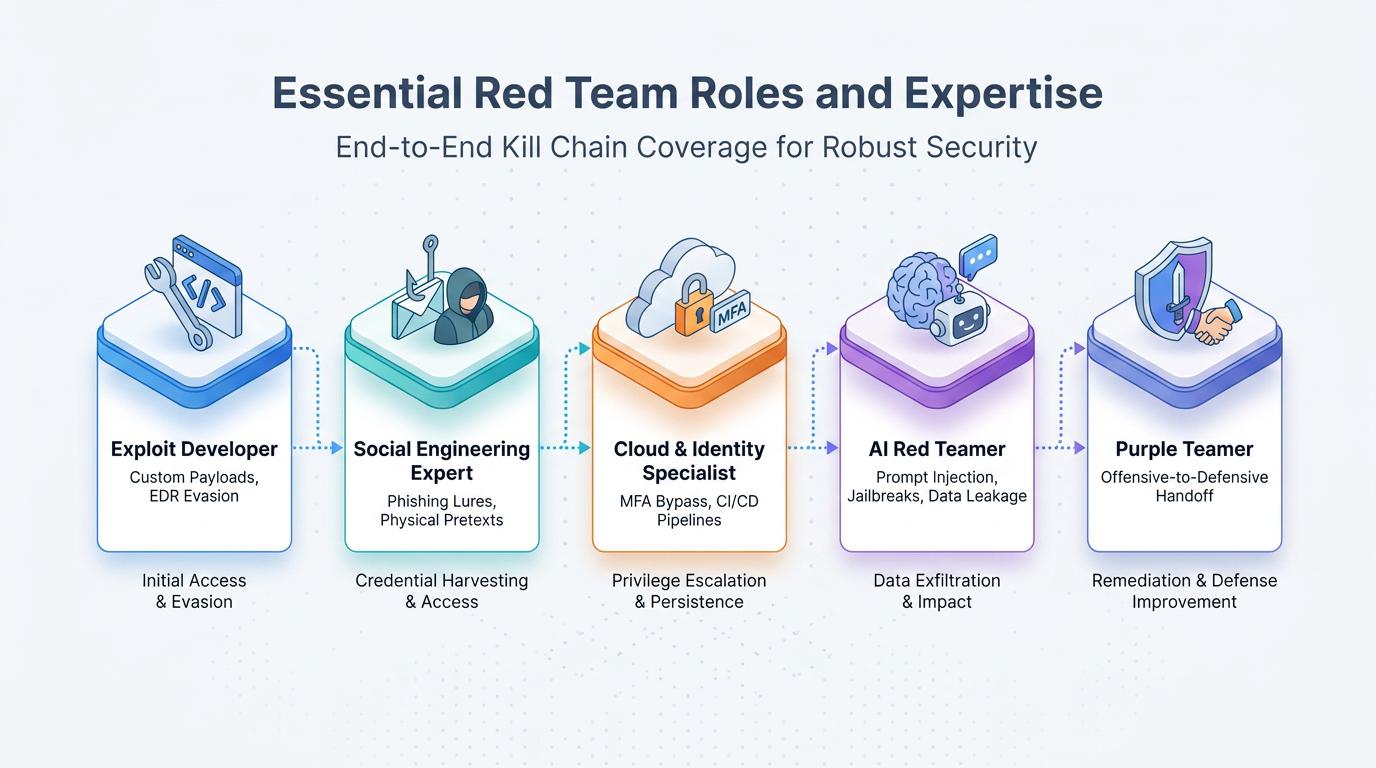
Multidisciplinary red teams mirror real attackers' creativity, persistence, and tooling better than homogenous groups or automated scanners.
Core Offensive Expertise
When experts own different slices of the kill chain, they can uncover attack paths that single-skill teams may miss. Red teams also benefit from people who can evaluate AI systems and prompts alongside traditional exploitation skills. Essential roles include:
- Exploit Developer: Writes custom payloads, evades endpoint detection and response (EDR) tooling, and pivots across platforms to demonstrate how attackers maintain persistence and escalate privileges without triggering traditional security controls.
- Social Engineering Expert: Crafts phishing lures and on-site pretexts that pressure human defenses and reveal gaps in security awareness training and credential theft prevention.
These specialists test the initial-access, exploitation, persistence, and human elements that underpin many connected attack paths.
Cloud, AI, and Defense Expertise
Modern engagements also require specialists who can evaluate identity, cloud, AI, and defensive workflows together:
- Cloud and Identity Specialist: Targets identity providers, continuous integration and continuous delivery (CI/CD) pipelines, and hybrid identity configurations for persistent, high-privilege access, and tests MFA bypass paths that pure network testers may overlook.
- AI Red Teamer: Probes generative AI features and model-driven controls in the security stack for prompt injection, jailbreaks, and data leakage, then documents those findings alongside traditional attack results.
- Purple Teamer: Coordinates offensive findings with defensive teams and manages the handoff from demonstrated attack paths to validation and remediation workflows.
This mix of skills helps the engagement reflect the technical, human, identity, and AI-assisted tactics that modern adversaries can combine.
How to Turn Red Team Findings Into Actionable Reporting and Remediation
Crisp, audience-specific reports bridge successful red team exercises and measurably stronger security postures. A report that drives action typically follows this structure:
- Reports can start with executive summaries that distill risk and business impact in plain language.
- They can follow with complete scope documentation, the ROE, and tactics mapped to MITRE ATT&CK for full transparency.
- Teams can build narrative attack paths that show how they moved from initial foothold to objective, making threat progression clear to stakeholders.
- Reports can include finding-by-finding detail with evidence, CVSS ratings from FIRST (the Common Vulnerability Scoring System), and clear business impact statements. Teams can enrich base scores with threat and environmental context before ranking fixes.
Together, these reporting practices turn the exercise record into a clear explanation of technical exposure and business risk.
How to Sequence Red Team Engagement Phases and Rules of Engagement
A signed ROE document should govern each named, sequenced phase of a red team engagement to support reliable results.
Sequence the Phases
A practical sequence begins with:
- Planning that sets objectives, scope, and legal safeguards
- Discovery that maps the environment and potential entry points
- Attack activities that execute the agreed scenarios
- Reporting that documents findings and feeds them into remediation
In practice, these phases often loop, because further attacks can send teams back into discovery.
Under NIST's ROE definition, the ROE document gives the test team authority to conduct defined activities without seeking permission each time. It should also name emergency contacts, permitted testing windows, and off-limits systems so the organization has an agreed escalation path for an outage or suspected real intruder.
Choose the Engagement Model
Choosing the engagement model deliberately can make the exercise more relevant to the organization's priorities.
| Engagement Model | Starting Point | What It Tests |
|---|---|---|
| Full-Scope | Outside the perimeter | Whether the red team can gain initial access |
| Assumed-Breach | A foothold granted up front | Lateral movement, privilege escalation, and detection of post-compromise activity |
A CISA advisory documented full domain compromise and inconsistent detection across assessed environments. Programs typically choose between full-scope and assumed-breach models based on whether the priority is testing initial-access prevention or post-compromise detection. Teams can also alternate models across engagements to evaluate different parts of the defensive lifecycle.
How to Create a Purple Team Feedback Loop From Red Team Findings
A purple team pairs the red team with the blue, or defensive, team so that offensive findings feed directly into detection engineering and response tuning rather than sitting in a report. Red team findings reduce risk when they change what the blue team detects, and the purple team model is the mechanism that makes that translation happen in a structured, repeatable way. Without that connective tissue, the same attacker techniques that succeeded during the exercise will keep succeeding in production, because nothing about the defensive stack has actually changed between engagements.
Translate Findings Into Detection Changes
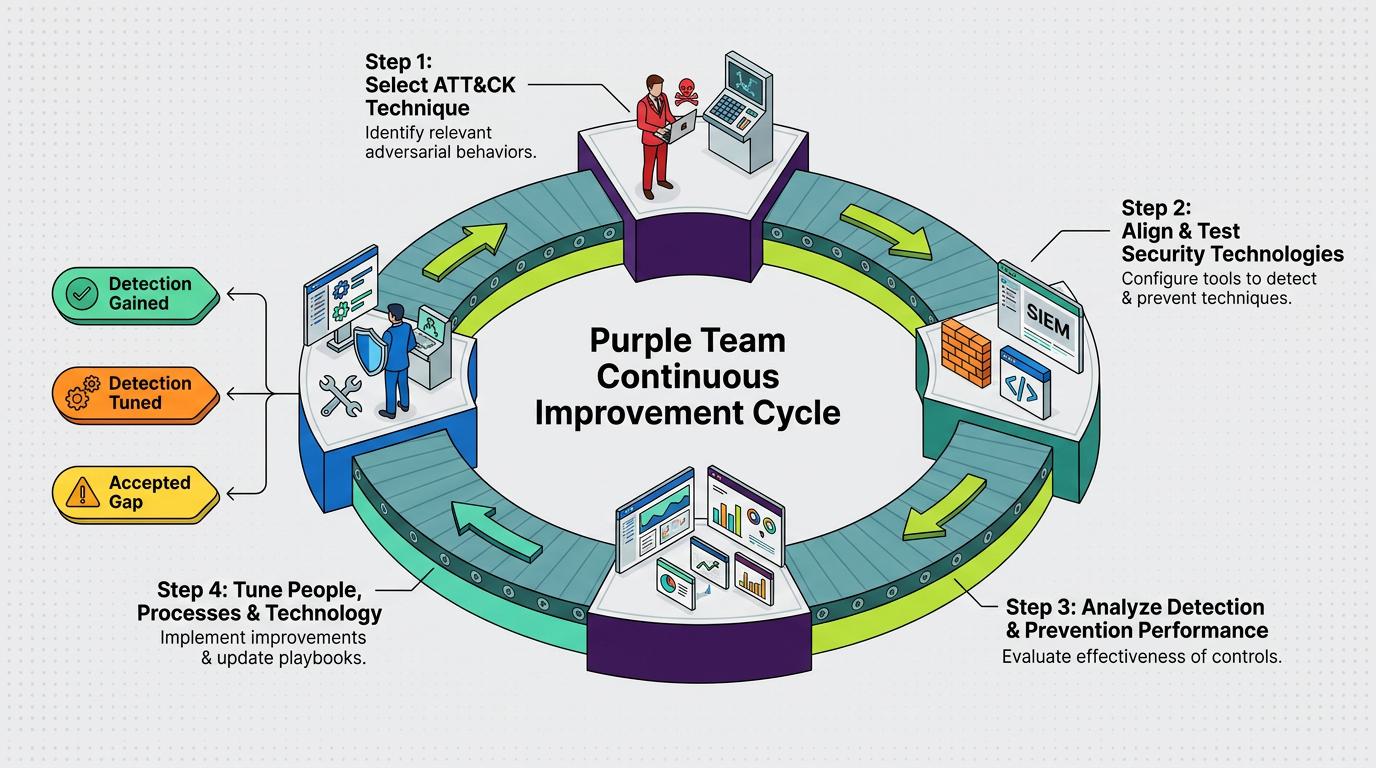
Purple teaming puts attackers and defenders in the same room to emulate TTPs and tune controls that fail to fire.
CISA's assessment process gives the loop structure:
- Select an ATT&CK technique
- Align and test security technologies against it
- Analyze detection and prevention performance
- Tune people, processes, and technology based on the results
Teams can run that cycle for each technique the red team used to reach an objective and log the outcome as a detection gained, a detection tuned, or an accepted gap.
This structure gives offensive and defensive teams a shared method for measuring whether each demonstrated technique now produces the intended response.
Validate Remediation Through Retesting
The following actions can make that feedback loop accountable:
- Teams can convert each recommendation into a ticket with a service-level agreement (SLA), named owner, and deadline.
- They can track metrics such as mean time to fix and schedule retests to confirm that teams closed identified gaps.
- Teams can use red team indicators to tune detections, update playbooks, and refine relevant analytics.
These practices connect offensive findings to measurable remediation rather than leaving them in a static report.
Teams can replay the red team's phishing lures and account takeover sequences against email security controls, then record whether controls flagged or quarantined each message or allowed delivery. They can feed the results into email threat detection tuning and the security awareness program. Starting purple teaming early in program maturity can also reduce the risk of unowned findings that never reach a ticket.
Strengthen Defenses Through Continuous Red Team Testing
Red team penetration testing uncovers gaps that traditional security tools often miss and gives you a clearer picture of your organization's exposure. Converting each finding into a ticket with a named owner and a scheduled retest, rather than a line item in a report nobody revisits, is what turns a red team engagement into a program instead of a one-time event. Consistent engagements keep remediation on a schedule and give the board evidence of progress against defined detection goals.
Frequently Asked Questions
What Is the Difference Between a Red Team and a Purple Team?
A red team acts as the attacker, running scenarios without tipping off defenders in order to test detection and response under realistic conditions. A purple team is a deliberate collaboration between that same red team and the blue, or defensive, team, working together in real time to turn what the red team found into tuned detections and updated playbooks.
How Often Should Organizations Run Red Team Penetration Testing Engagements?
Cadence typically depends on regulatory requirements, the pace of change in the environment, and how quickly prior findings get remediated. Many programs run a full engagement annually, supplemented by continuous or automated validation between cycles so that newly deployed systems and configuration changes don't go untested for a full year.
How Long Does a Typical Red Team Engagement Last?
Most engagements run from a few weeks to a few months, depending on scope, the number of attack surfaces involved, and how long the rules of engagement allow the team to operate before reporting findings. An assumed-breach engagement can move faster than a full-scope one, since it skips the initial-access phase entirely.
Can Automated Tools Replace Red Team Penetration Testing?
Automated and continuous validation tools can retest known techniques between engagements and catch drift faster than an annual exercise alone. They don't replicate a skilled adversary's creativity or ability to chain unrelated weaknesses into a single attack path, which is why most mature programs run both rather than choosing one over the other.