Key Insights
In simultaneous 2026 red-team assessments of two critical infrastructure organizations, one security operations center received endpoint alerts and never acted on them, and CISA's advisory on the exercise points to missing baselines and alert filtering as the reason routine alerts and false positives bury defenders. A baseline deviation is a measurable departure from the normal range a security tool has learned for a user, device, application or account.
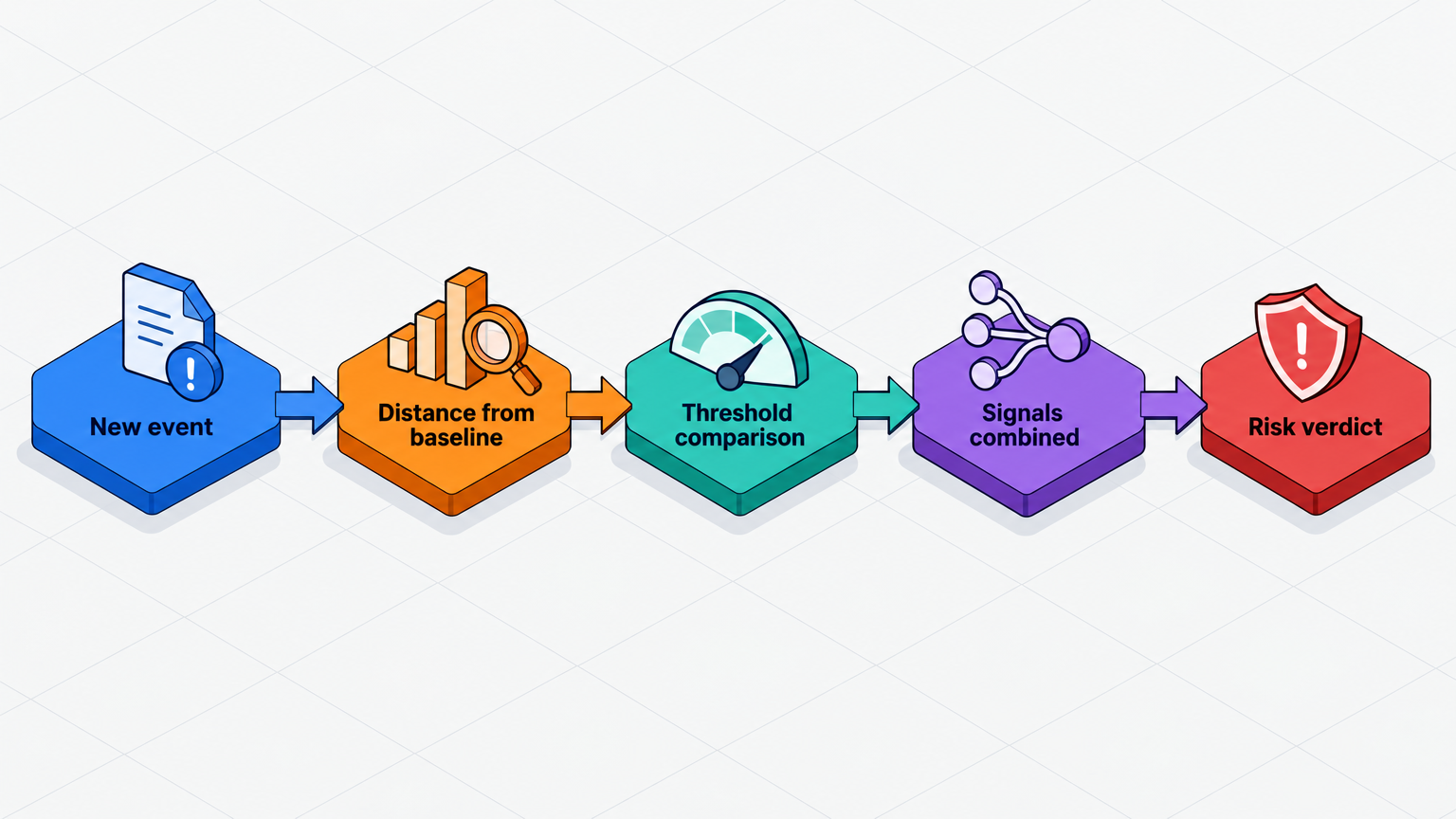
Detection built on it compares each new event, such as a login, a mail rule change or a file download, against that range and scores how far outside it falls. The score is a signal that still needs context before anyone calls it an attack.
This guide explains how security tools build and score baselines and how teams keep false positives manageable, using impossible travel and new forwarding rules as the worked examples.
What Is a Security Baseline and What Does It Measure?
A security baseline is the normal range and spread of a metric over time, not a single number. Two users can average the same 40 logins a day while one varies by two logins and the other by twenty, and a fixed threshold treats them identically.
Identity baselines record how an account normally authenticates and works: login hours, sign-in countries, devices, multi-factor authentication methods, and how much data it reads. Email adds relationship data, including who the account writes to and which vendors send it invoices. Privileged accounts warrant more detailed baselines still, down to the commands admins run and the devices they touch.
Device and network baselines describe how infrastructure behaves: bandwidth per host, connection frequency, response times and the protocols each segment uses. Network monitoring leans on those baselines, flagging a process that sends far more data than it receives.
How Do Security Tools Build a Baseline?
Tools build a baseline by observing historical activity for a learning period before they alert, then updating it as new events arrive. How long that period runs, and whether the profile keeps moving, decides what the baseline can catch.
Learning Windows and Rolling Baselines
A baseline needs a learning window before it can judge anything, and anomaly-based tools generally build an initial profile over days, sometimes weeks, of observed activity. A monthly job with large file transfers may never appear during that window, and malicious activity already running when it opens can settle into the profile as normal.
Static profiles stay fixed until regenerated and drift out of date, while dynamic profiles adjust with every event but can be gamed by slow increases. A rolling window uses recent history, such as the trailing 28 days. Seasonality needs separate handling: comparing Monday at 9 a.m. with previous Mondays avoids flagging a weekly payroll run, though each slot gains one data point per week and needs several weeks before it is reliable.
Per-Identity and Peer-Group Baselines
A per-identity baseline compares an account with its own history. A peer-group baseline compares it with others in the same role or department.
Peer comparison gives new accounts a reference before they have history, and surfaces access that is normal for one person but unusual for everyone in their role. Groups built from HR attributes go stale when people change teams, groups rebuilt from behavior shift too often, and many detectors score both.
How Is Baseline Deviation Measured and Scored?
A tool measures how far an observation sits from the expected range and compares that distance to a threshold. A static 500 MB download threshold flags a data engineer's routine work while missing an unusual increase for a clerk whose normal is 20 MB, so thresholds scale to each entity's own spread instead. False positives climb when nobody maintains those threshold values.
Statistical Distance and Alert Thresholds
Standard methods turn that distance into a number, each suited to different data:
Method | How it works | Best fit |
z-score | Value minus mean, divided by standard deviation | Roughly normal metrics |
Modified z-score | Median and median absolute deviation | Skewed data with outliers |
Percentile band | Flags values above a high percentile of history | Ordered historical data |
Shewhart control limits | Mean plus or minus 3 standard deviations | Large, sudden shifts |
EWMA (exponentially weighted moving average) chart | Weighted moving average with its own limits | Small, sustained shifts |
The choice follows how the data behaves, since standard deviation estimates spread well when data sit close to normal, the median absolute deviation holds up better when tails are extreme, and Shewhart charts miss the half-sigma shifts EWMA charts catch.
Weak Signals Combined Into One Verdict
Some attacks produce one large spike, others several small deviations that each stay under the threshold. In one example, a sign-in arrives from a new device at 2 a.m. local time, and minutes later the account emails finance asking to update payment details. Each signal alone looks like a traveler with a new laptop; scored together inside a short window, they cross a risk threshold. Combining signals also cuts noise, because travel rarely arrives alongside the other indicators.
What Does Baseline Deviation Look Like in Practice?
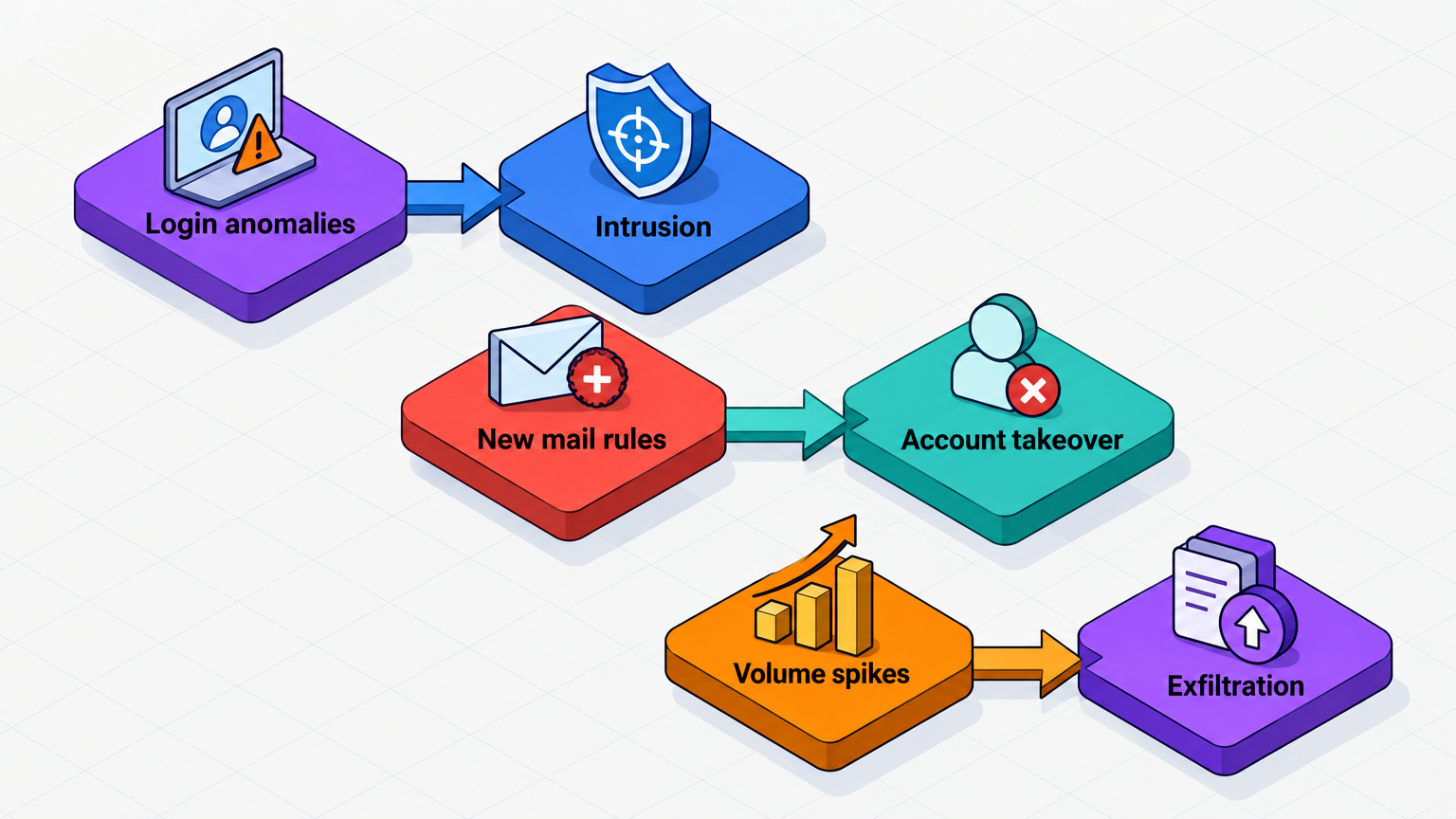
Specific deviations map to specific threats: login anomalies to intrusion, new mail rules to account takeover, volume spikes to exfiltration. How strongly each one reads depends on the account's own history rather than on the event type alone.
Identity and Account Deviations
Impossible travel divides the distance between two login locations by the time between them, and flags the login when the implied speed exceeds what a commercial jet could manage. VPNs and cloud proxies move apparent location without any travel, and velocity checks work better paired with a new device or network owner.
Forwarding rules are the quieter deviation, and the technique is documented in MITRE ATT&CK T1114.003, which states that "Adversaries may setup email forwarding rules to collect sensitive information," notes that rules can be hidden through the Messaging API, and warns that they can preserve access after a password reset. ATT&CK records LAPSUS$ setting a tenant-level rule that sent all mail to a newly created account.
A first-ever rule forwarding to an external domain is a strong deviation and a common step in how account takeover works. Abnormal's Account Takeover Protection is designed to model known-good behavior across an organization's accounts, vendors and connected applications, and to identify activity that falls outside it.
Email and Data Deviations
An account downloading far more data than usual is the classic volume deviation. Cloud storage detections look for an OAuth token granted to an external app followed by high-volume downloads, and flag uploads sized well outside an account's baseline.
Payment changes are the email equivalent, as when a vendor that has billed the same account for two years asks mid-thread for the next invoice to go to a new bank. The 2025 IC3 Annual Report puts business email compromise (BEC) losses at $3.046 billion for 2025, which is what makes this deviation worth catching.
The baseline signals are first-ever banking language from that sender, a changed reply-to address and a lookalike domain. Abnormal's Inbound Email Security uses behavioral AI that can help flag a vendor's sudden payment-detail change against that vendor's normal communication patterns.
How Do Teams Reduce False Positives From Baseline Deviation?
Teams reduce false positives with context and baseline upkeep instead of tighter thresholds alone. Eliminating all false positives is not possible, and reducing them typically raises false negatives.
Context Checks Before Escalation
Most benign deviations have a business explanation an analyst can confirm in minutes:
Deployments: An administrator starts a new service during a release window recorded in a change ticket.
Travel: A booked trip matches a login from an unfamiliar city.
Role Changes: A promotion into finance brings legitimate access to payment systems.
Quarter-End: Closing the books raises file access and email counts.
Peak Hours: A Monday morning surge belongs to that hour's baseline.
Enrichment makes these checks fast: HR systems supply role and status, identity providers supply device and location, and change tickets supply planned work. Teams that review change management records regularly and adjust settings prevent many false positives.
Baseline Refreshes and Threshold Tuning
A baseline needs a deliberate refresh after a migration, a new application or a reorganization. Behavior analysis settings should reflect new hosts and services, and marking the change date keeps that period from reading as either normal or suspicious.
Thresholds work best per asset, with policies set per host group and tighter limits on a domain controller than on a test server. Teams also monitor suppressions, since an unchecked allow-list hides real activity. Behavioral drift detection handles gradual change across weeks.
How Does Baseline Deviation Fit With Signature-Based Detection?
Baseline deviation complements signature-based detection rather than replacing it. Signatures work well against known threats and less reliably against unknown ones and many variants, while anomaly-based methods catch previously unknown threats at the cost of more false positives, and most intrusion detection products combine the two.
A text-only payment request carries no malicious link or attachment, which gives signature tools little to match, while a baseline can still flag it as unusual for that sender. Anomaly-based detection carries those cases, and signatures carry the known ones at lower cost.
From Baseline Deviation to Confident Detection
Baseline deviation turns unusual activity into something a team can rank and act on. The baselines that hold up capture range and spread rather than a single number, account for weekly patterns, and compare each account with its own history and its peers. Scoring works best when weak signals combine into one verdict, confirmed against business context before anyone escalates.
Abnormal's Account Takeover Protection and Inbound Email Security are designed to model known-good behavior across an organization's accounts, vendors and connected applications, then evaluate messages, logins and mail rule changes against it. Explore Account Takeover Protection to see how Abnormal surfaces account activity that falls outside an organization's normal patterns.
Frequently Asked Questions
Is every baseline deviation an attack?
No, a deviation can have a benign cause such as business travel, VPN egress, a new role or seasonal volume. It shows that activity differs from the learned normal range, not why. Analysts confirm intent by checking context and looking for other deviations tied to the same account in the same window.
How often should a baseline be updated?
A baseline on a rolling window updates continuously, with recent weeks carrying more weight than older behavior. Planned changes such as migrations or reorganizations call for a deliberate refresh, with the change date marked. Static profiles that are never regenerated grow less accurate and produce more false alerts.
What is the difference between baseline deviation and anomaly detection?
Anomaly detection is the broader method of comparing observed events against a definition of normal. Baseline deviation is the measured signal inside it, the distance between one event and the learned range for that entity. A program uses anomaly detection as its approach and scores baseline deviations as its evidence.
Can attackers slowly shift a baseline to avoid detection?
Yes, an attacker can start small and increase activity gradually until a constantly updating profile treats it as normal. Defenses include comparing an account with its peer group, keeping a longer-term reference baseline, and reviewing steady growth in sensitive activity.