Key Insights
The OECD's February 2026 working paper Trends in AI incidents and hazards reported by the media found that media-reported AI incidents and hazards rose from 92 to 324 a month on average between 2022 and 2025. An AI impact assessment is a documented review of how an AI system, used for a specific purpose in a specific setting, could affect individuals, groups and society.
The assessment covers rights, safety, fairness and access to services across the system's lifecycle. One is needed when a regulation or standard calls for it: EU AI Act Article 27 for certain high-risk deployments, ISO/IEC 42001 certification, and Canada's directive on automated decision-making.
This guide settles where an AI impact assessment ends and an AI risk assessment or a data protection impact assessment (DPIA) begins. It then sets out where the EU AI Act, ISO standards and Canada's federal directive require or expect one, and how to run, staff and maintain it.
What Does an AI Impact Assessment Evaluate?
An AI impact assessment evaluates what a system does to people, while testing evaluates whether it works. For example, a credit scoring model passes its accuracy benchmarks yet declines a disproportionate share of applicants from one postcode. Only the impact view asks who absorbs that outcome and whether they can contest it.
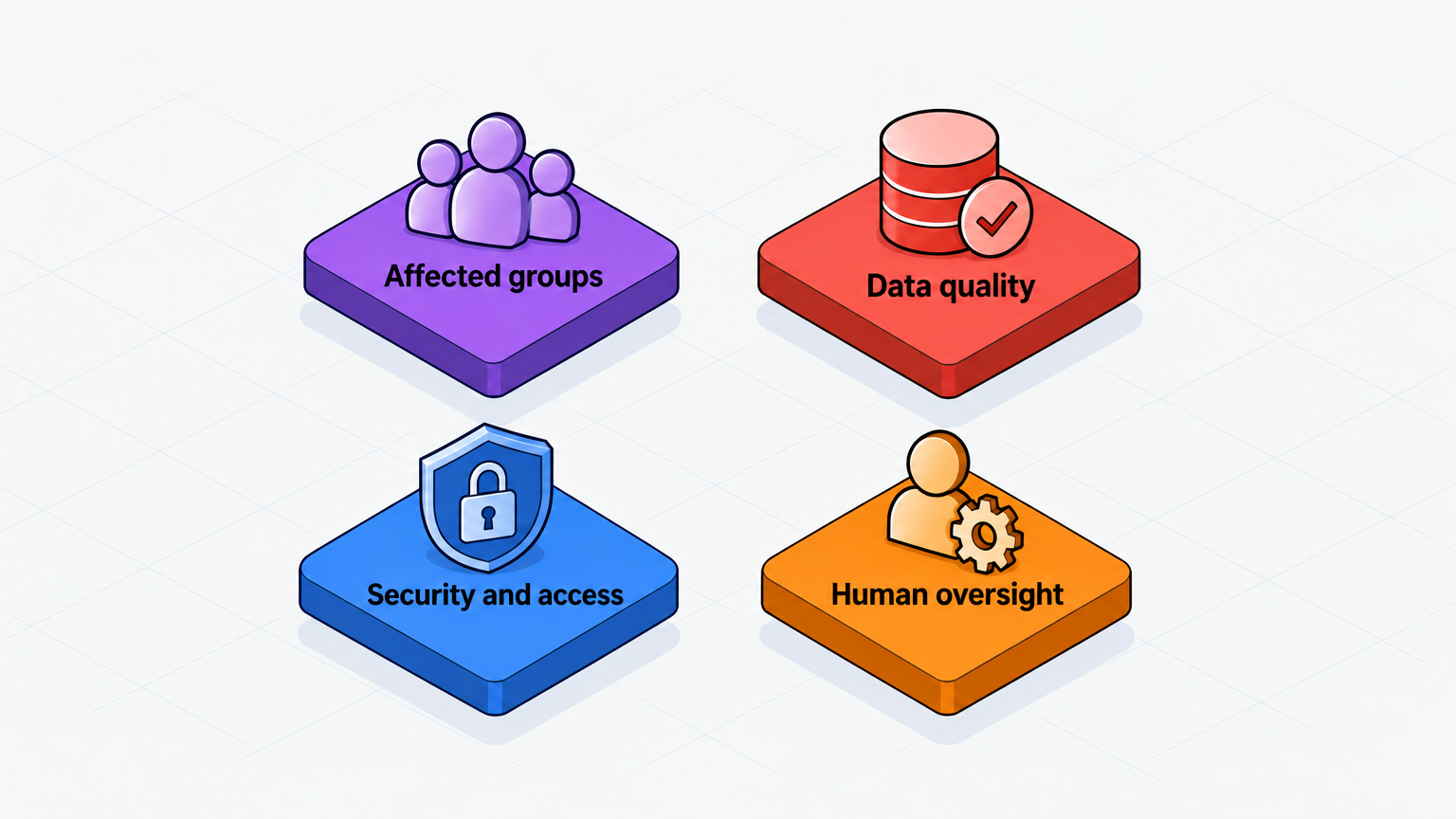
Impacts on People, Groups and Rights
Impacts are assessed against the system's purpose and intended use, not against the technology in the abstract. EU AI Act Article 27 asks deployers to describe the processes the system will be used in, how long and how often it runs, which categories of people are likely to be affected, and the specific risks of harm to those groups.
The analysis turns on a few questions about oversight, fairness and severity. Does the system produce a recommendation a human reviews, or an outcome applied directly? Could it treat groups unequally, through skewed training data or proxies for protected traits? How severe is a wrong outcome, and can it be reversed? The likelihood and magnitude of each impact belong in the record alongside the answers.
Data, Security and Oversight Factors
Data quality, security and oversight are where an assessment turns from who is affected to how the system could fail them. The EU AI Act requires deployers, to the extent they control input data, to keep it relevant and sufficiently representative for the intended purpose. Privacy questions follow: what personal data the system processes, and whether a DPIA already covers it.
A security review covers which data stores and tools the system can reach, who can change its configuration, and what a compromised account could do through it. Accuracy belongs here too, measured against the affected population rather than an average.
Article 27 requires a description of oversight measures following the provider's instructions, and Canada's directive ties how much human involvement a decision needs to the system's impact level. Whatever remains afterward is the residual risk the business owner has to formally accept.
How Does an AI Impact Assessment Differ From a Risk Assessment and a DPIA?
An AI impact assessment looks outward at people and society, an AI risk assessment looks at risks to the organization, and a DPIA looks at personal data processing. ISO/IEC 42001:2023 treats AI risk assessment, AI impact assessment and risk treatment as separate activities. Each has a different trigger and a different owner:
Assessment type | Scope | Trigger | Owner |
AI impact assessment | Effects on people, groups, rights, society | Before deployment; on material change | System owner, with legal and privacy |
AI risk assessment | Risks to the organization and its AI objectives | AI management system planning cycle | Risk or security lead |
DPIA | Personal data processing and data subjects | GDPR high-risk processing | Controller, advised by the data protection officer |
The DPIA and the EU fundamental rights impact assessment (FRIA) overlap most, because GDPR requires a DPIA for automated processing that produces legal or similarly significant effects, and many high-risk AI deployments meet that test. A deployer may cross-reference DPIA sections in the FRIA, but a combined document still has to address both the data-protection issues and the wider fundamental-rights ones.
When Is an AI Impact Assessment Required?
Article 27 of the EU AI Act applies from December 2027 to specified EU deployers, Canada already requires an Algorithmic Impact Assessment for covered federal automated decisions, and ISO and NIST set expectations rather than mandates. Whether a rule reaches a particular organization turns on facts counsel should review.
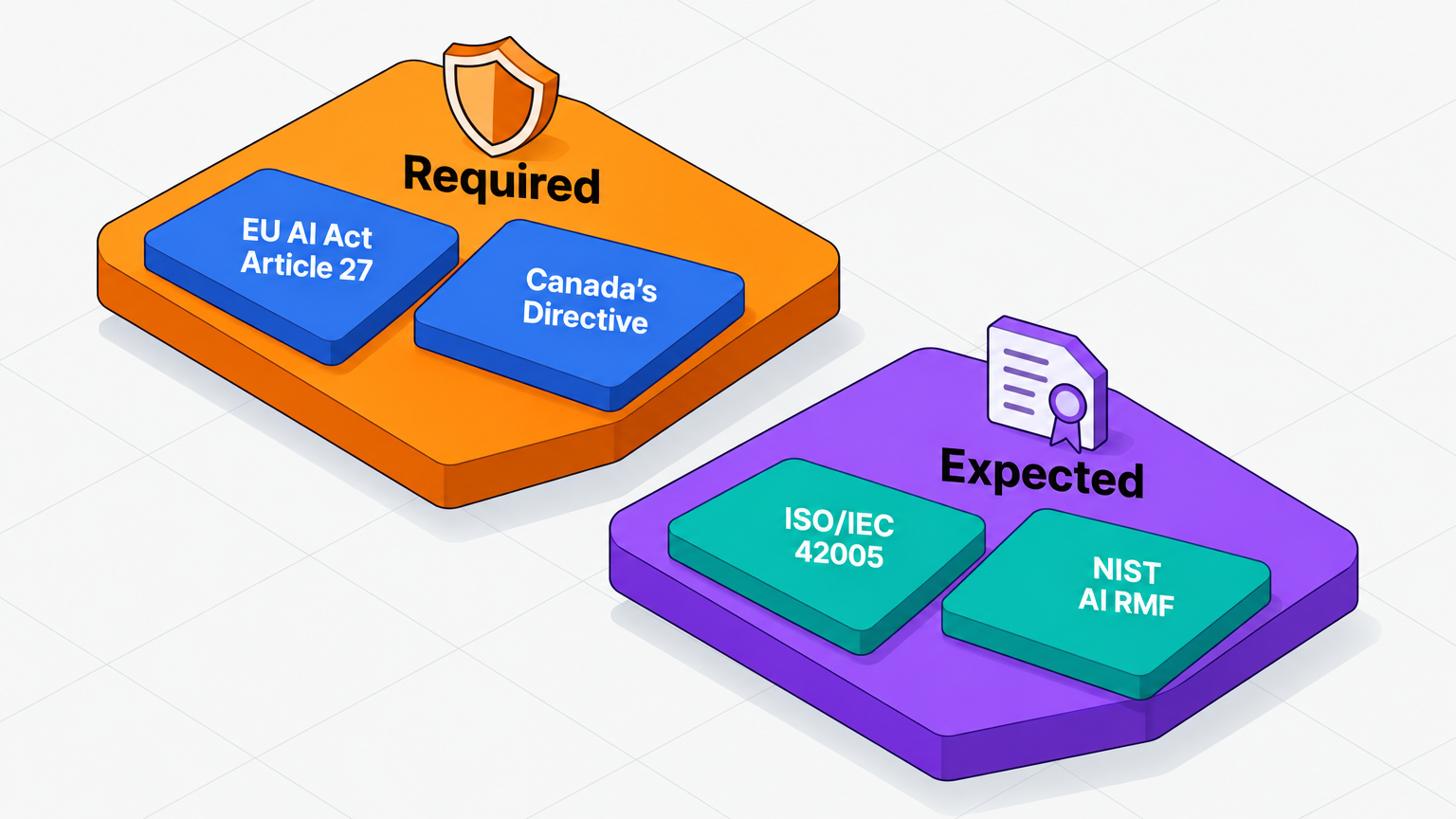
EU AI Act Fundamental Rights Impact Assessment
Article 27 applies before deploying a high-risk AI system listed in Annex III. Its scope covers bodies governed by public law, private entities providing public services, and deployers of systems evaluating creditworthiness or pricing life and health insurance. Safety components in critical infrastructure are excluded.
The assessment must also cover the measures to take if risks materialize, including internal governance and complaint mechanisms. Deployers then notify the market surveillance authority of the results.
ISO/IEC 42005 and ISO/IEC 42001 Standards
ISO/IEC 42005:2025 offers guidance and sets no certifiable requirement. It covers identifying, evaluating and documenting impacts on individuals, groups and society, with assessments performed from design through post-market monitoring. Its clauses address timing, scope, responsibilities, thresholds for sensitive uses, approval and review.
ISO/IEC 42001:2023 is where the requirement sits for organizations seeking certification. Its clauses 6.1.4 and 8.4 require an AI system impact assessment, and ISO/IEC 42005 guides the method.
Canada and US Frameworks
Canada's Directive on Automated Decision-Making applies to any automated decision system in production used to make an administrative decision about a client. Institutions must complete, approve and publish Algorithmic Impact Assessment results before production, and the resulting impact level drives peer review, human involvement and who approves operation.
The United States has no federal equivalent, and state law has moved in both directions, which makes state-by-state review part of any deployment plan. The NIST AI Risk Management Framework remains voluntary, and its Map and Govern functions call for documenting impacts on individuals, groups and society.
How Do You Run an AI Impact Assessment Step by Step?
A workable assessment moves from inventory to a recorded decision, with a short screening pass deciding how deep the full review goes. The work sits inside a wider AI governance program and follows this sequence:
Screen and Scope the System: Record its purpose, users, data, connected tools, vendor and the decisions it touches, then apply the triage thresholds to choose between a light review and a full assessment.
Map Stakeholders and Impacts: List the individuals and groups affected, including people who never use the system directly, and describe each plausible harm and benefit.
Rate Severity and Likelihood: Score each impact on magnitude, reversibility, duration and probability, using one scale across systems so results stay comparable.
Set Controls and Owners: Assign each control, whether an oversight step, a data restriction or a complaint route, to a named person with a due date.
Record a Go or No-Go Decision: Capture the residual risk, the conditions attached to approval and the executive who signed off.
Step one depends on an inventory most organizations do not have in full. Abnormal's AI Governance, generally available, is designed to discover the AI tools and agents already in use and attribute ownership, giving the screening step its starting list.
Who Should Be Involved in an AI Impact Assessment?
The business owner is accountable for the assessment, and each supporting role answers a distinct question within the organization's AI governance responsibilities:
Legal Confirms Which Rules Apply: Counsel determines whether the deployment falls under Article 27, GDPR or sector rules.
Privacy Ties the Assessment to the DPIA: The privacy team aligns personal data analysis with any existing DPIA so findings are cross-referenced instead of duplicated.
Security Tests What the System Can Reach: Security reviews access, integrations and failure modes, including what an attacker could do through a compromised account.
Compliance Holds the Evidence: Compliance maintains the record, the review schedule and the link to audit requirements.
The Business Owner Accepts Residual Risk: The owner defines intended use, signs the decision and answers for outcomes.
The Build Team Explains How It Works: Engineers or the vendor contact describe data, model behavior, limits and oversight features.
Sign-off scales with impact, and independent review strengthens the high-impact cases. Internal experts who were not front-line developers, or independent assessors, should take part, and Canada ties qualified expert peer review to a system's impact level.
How Do You Keep an AI Impact Assessment Current?
An assessment stays current when defined events force a review and a calendar catches what those events miss. Article 27 requires an update when any assessed element has changed, Canada's directive requires review on a schedule and when functionality changes, and ISO/IEC 42005 recommends updating as needed.
In practice, each of these changes alters an element the assessment recorded:
A new data source or training dataset.
New tool access, integrations or permissions for the system.
A model change, including a vendor's version update.
An incident, complaint or near miss involving the system.
A vendor change, including new terms or data processing agreements.
A new user population or purpose.
Between triggers, a periodic review catches scores that drift from current use. Logging each system's residual risk, owner and next review date in the risk register, and naming those triggers in the AI security policy, turns reassessment into a routine control.
AI Impact Assessments as Standing Governance Work
From December 2027 the EU AI Act makes a fundamental rights impact assessment mandatory for specific deployers, and Canada already requires an Algorithmic Impact Assessment for federal automated decisions. ISO/IEC 42005 offers guidance on method and ISO/IEC 42001 sets the requirement for certification, and all of them assume the organization can name the AI systems it runs.
An assessment program depends on knowing which tools are in scope. Abnormal's AI Governance, generally available as part of the AI Security suite, is designed to discover approved and shadow AI tools and attribute ownership. Explore AI Governance to see what gets recorded against each tool.
Frequently Asked Questions
Do internal and third-party AI tools need an impact assessment?
Yes, both do, because impact depends on how a system is used, not who built it. Under the EU AI Act, deployers of vendor-supplied high-risk systems carry their own duties. A deployer may rely on a provider's assessment in similar cases, but must still cover its own processes, affected groups and oversight arrangements.
How long does an AI impact assessment take?
The time follows the depth of review, which follows the system's impact. A light screening of a low-impact tool is short, while a full assessment of a system influencing credit, benefits or insurance needs stakeholder mapping, privacy alignment, independent review and executive sign-off.
Is an AI impact assessment the same as a fundamental rights impact assessment?
No, a fundamental rights impact assessment is a legally defined type of AI impact assessment under Article 27 of the EU AI Act. It applies to specific deployers of high-risk systems, has mandatory contents and must be notified to a market surveillance authority. A general AI impact assessment can follow the same structure for systems outside that scope.
What evidence should an AI impact assessment keep?
The record keeps the system scope and intended use, the stakeholder and impact map, severity and likelihood scores, and the controls with their owners. It also holds the go or no-go decision with residual risk and the approver's sign-off. A review log showing each reassessment and its trigger completes the evidence.