Key Insights
Internet security watchdog Shadowserver currently tracks more than 400 internet-exposed Cisco Secure Email Gateway appliances, each one a potential foothold for the latest actively exploited flaw in the product line. CVE-2026-76461 is a secure email gateway zero-day vulnerability that attackers were already using when the vendor published its advisory on September 14, 2026, and the Cybersecurity and Infrastructure Security Agency (CISA) added it to the Known Exploited Vulnerabilities catalog the same day. Because the gateway parses every inbound message on arrival, a single crafted email can run commands as root on the device, which puts both message flow and the appliance's connection to internal systems in play at once.
This guide covers what the flaw does, how to tell whether a specific gateway was compromised, which evidence to preserve before patch management decisions, and how to choose between upgrade, rebuild, and replacement for each node. The same framework applies the next time a critical edge-appliance advisory lands with exploitation already underway.
Key Takeaways
A complete inventory must cover every physical and virtual gateway, including clustered nodes and test instances.
Preserving evidence before patching or rebooting protects intrusion traces that later changes can erase.
Active exploitation moves remediation outside normal change windows and into the emergency schedule.
Off-device evidence, credential rotation, and known-good rebuilds provide the basis for restoring trust.
What Is CVE-2026-76461 and Why Does It Matter?
CVE-2026-76461 is an unauthenticated SQL injection vulnerability in the code a secure email gateway (SEG) appliance uses to parse every inbound message, and it matters because a single crafted email can turn that flaw into root access on the device.
The National Vulnerability Database (NVD) entry classifies the flaw as SQL injection and scores it 9.8 on CVSS 3.1, reflecting a network attack with low complexity, no privileges, and no user interaction. Exposure spans physical and virtual appliances regardless of configuration, with NVD listing the following affected models:
Hardware Appliances: C195, C395, and C695.
Virtual Appliances: C100V, C300V, and C600V.
Out of Scope: The vendor's email and web management appliance and its web proxy are not affected.
The operational stakes follow directly from that reach. With root, the highest operating-system privilege, an attacker could read or alter mail in transit, change filtering rules, extract stored credentials and keys, plant persistence, and edit logs.
How the Email Gateway Zero-Day Reaches Root Access
A single crafted email travels through an unsafely built database query, and the attacker's injected SQL ends up running commands that execute as root.
Crafted Email as the Initial Delivery Method
The gateway parses every inbound message automatically on arrival, so the crafted email itself is the entire attack. No click, attachment opening, or login is required from anyone on the receiving end.
SQL Injection in Email-Parsing Logic
SQL injection flaws occur when software inserts untrusted input into a database query without adequate validation; here, the attacker's statements run with the database's privileges rather than the sender's.
Transition from Database Commands to Operating-System Control
Official sources confirm that the commands execute as root but do not explain how they gain that privilege. The vendor's indicator, "COPY.TO PROGRAM" commands in mail logs, suggests the injected SQL uses a database feature that pipes query output to an external program.
Confirmed Mechanism and Unconfirmed Database Details
Secondary reporting has tied the indicator to a specific open-source database engine, but no official source names it, so detection should rest on the confirmed indicator alone.
Email Gateway Zero-Day Timeline and Known Unknowns
Disclosure, fixes, and the KEV listing all came on September 14, 2026; the exploitation start date, scale, and attribution remain unknown.
Disclosure, Patch, and KEV Sequence
The vendor published its advisory and fixes on September 14 alongside the NVD entry and CISA listing. International agencies warned before the vendor marked the advisory final on September 17.
Federal Remediation Window
CISA set the September 17 due date after listing the flaw; the required action references vendor mitigations and forensic triage requirements. Private organizations can treat it as a minimum.
Unknown Exploitation Start Date, Scale, and Attribution
No official source states when attackers began exploiting the flaw, how many appliances they exposed or compromised, or who is responsible. The absence of public data is not evidence of limited scope. Any gateway that ran a vulnerable release belongs in the compromise-assessment queue.
How to Detect Compromise on an Exposed Email Gateway
Effective compromise assessment starts with the vendor's mail-log indicator and ends with off-device evidence.
Suspicious Mail-Log Pattern
Teams can search each node's mail logs and their forwarded copies for suspicious SQL queries, particularly the vendor's indicator, "COPY.TO PROGRAM" commands.
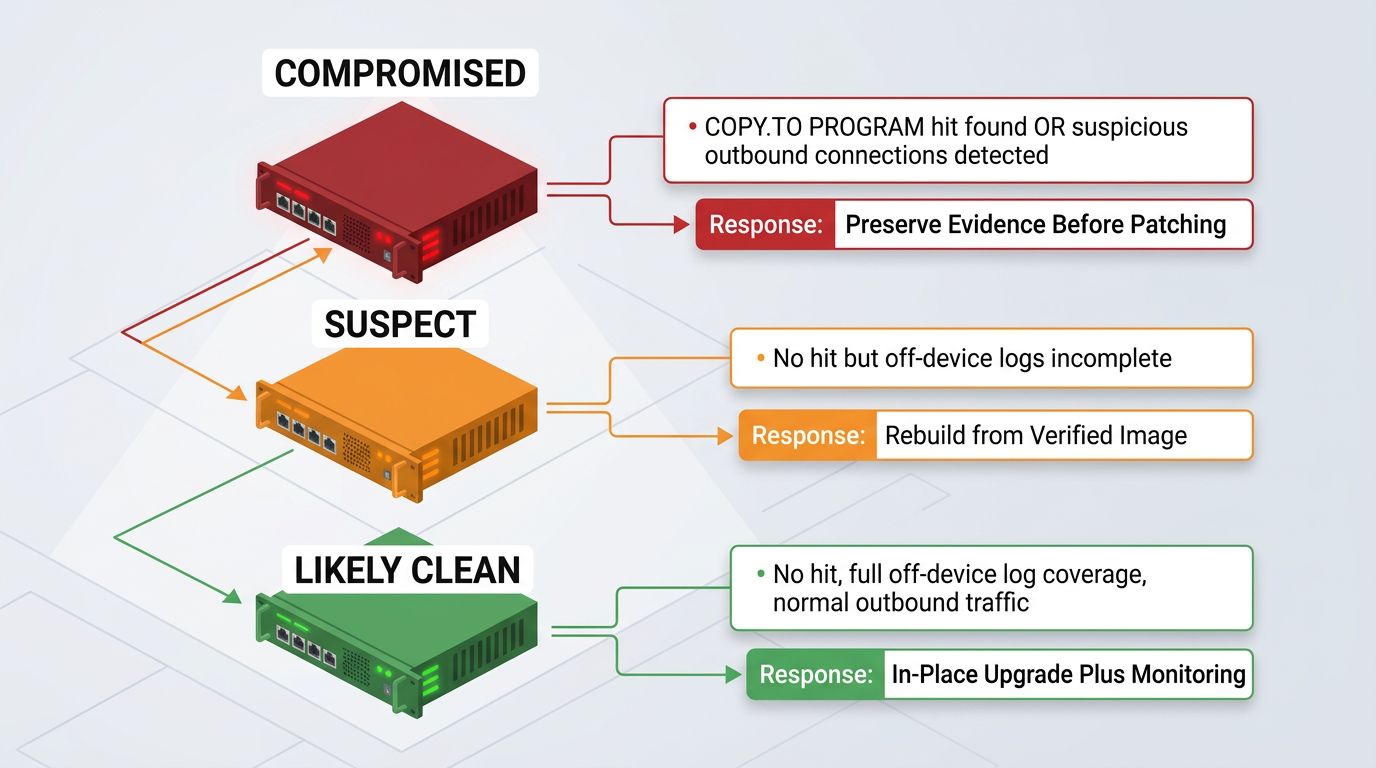
Three tiers turn "we patched" into a recorded judgment about each device:
Compromised: A hit, or off-device records of outbound connections or administrative sessions the gateway has no reason to make, marks a device compromised. It takes the compromise path, with evidence preserved before any patch or reboot.
Suspect: No hit appears, but off-device logs do not reach back to when a vulnerable release first ran. Because a root-level attacker could have edited the clean local log, the safest path is a rebuild.
Likely Clean: No hit appears, off-device logs cover the full exposure window, and outbound traffic stays within expected mail and directory destinations. The device can take an in-place upgrade with close monitoring.
These tiers give each device a documented response path based on the evidence available.
Off-Device Network and Firewall Evidence
Firewall logs, flow records, Domain Name System (DNS) queries, and copies of appliance logs forwarded to a central collector before any suspected intrusion sit outside the attacker's reach.
Cluster-Wide Review Requirement
The indicator lives in each device's own mail logs, and a peer not forwarding logs off the box may hold the only record of an intrusion. Each node therefore gets its own search, off-device review, and tier.
Limits of On-Box Integrity Checks
Prior CISA appliance compromise guidance found that root-level access can survive factory resets and upgrades and can deceive integrity-checking tools, so teams can judge integrity only against a clean installation.
How to Respond to a Potentially Compromised Gateway
An effective response follows an existing incident response plan, where evidence preservation comes first and trust restoration comes last.
Physical and Virtual Appliance Inventory
CISA inventory guidance puts model, serial number, software version, and network location first for every gateway. In practice, teams most often miss virtual instances in test and disaster-recovery environments. Any gap carries forward, since teams never search or patch a node left off the list.
Volatile Evidence Preservation Process
Evidence collection covers memory, running and boot configuration, local logs, and core dumps before any reboot, patch, or configuration change, which keeps volatile evidence intact. In comparable appliance incidents, departing from a planned collection order, including unplanned reboots, has triggered warnings about anti-forensic routines. Teams should hash forensic images when they capture them and track them with chain-of-custody records.
Evidence-Preserving Appliance Containment
Isolation guidance supports disconnecting a suspect device from the network while leaving it powered on to keep memory intact. A lighter option is firewall rules that block the gateway's outbound traffic while mail shifts to a known-clean node. The tradeoff in each case is evidence preservation against mail availability.
Credential, Key, and Certificate Rotation
Teams should treat anything the appliance stored or used as compromised, including:
Administrator Passwords: Every local admin account needs a new password.
Directory-Service Bind Accounts: Each bind account needs new credentials.
Application Programming Interface Tokens: Each application programming interface (API) token needs reissuing.
Simple Network Management Protocol Strings: Each Simple Network Management Protocol (SNMP) string needs a new value.
Shared Secrets: Remote Authentication Dial-In User Service (RADIUS) and Terminal Access Controller Access-Control System Plus (TACACS+) secrets need replacing.
Transport Layer Security Keys: Transport Layer Security (TLS) private keys and their certificates need reissuing.
If enterprise privileged accounts ever managed the gateway, their use elsewhere deserves review.
Patch, Reimage, and Replacement Paths
The recorded compromise tier determines the appropriate recovery path:
Likely Clean Gateway: An in-place upgrade plus close monitoring provides the cheapest option and keeps mail flowing.
Suspect Gateway: A verified image and documented baseline support a rebuild without relying on a backup the attacker may have touched, but this path requires a maintenance window.
Compromised Gateway: Replacement provides the most complete response when a device shows a rootkit or persistent root access, although it is the costliest path.
These paths align the recovery cost and disruption with the evidence available for each gateway.
Recovery Validation Before Service Restoration
Teams should restore service only after a rebuilt gateway runs a fixed release, carries fresh credentials, forwards logs off the box from startup, and shows normal outbound traffic. Fresh credentials make stolen ones useless, and immediate forwarding gives teams a trustworthy baseline. Before production cutover, teams can compare outbound traffic against the allowed mail and directory destinations.
Affected Versions, Fixed Releases, and Remediation Priorities
Three release branches have fix points, the flaw has no workaround, and closing it differs from removing an attacker.
Affected Version Ranges and Fix Points
The NVD lists every release below its branch's fix point as affected:
Release Branch | Fixed Release |
|---|---|
15.5 and earlier | 15.5.5-014 |
16.0 | 16.0.4-302 |
16.5 | 16.5.0-780 |
Pre-15.5 branches past end of support may first need to move to a supported branch, and 16.5.0-780 is the most current target.
Absence of Workarounds
Segmentation and similar controls limit what an attacker reaches afterward, but the vendor offers no setting that blocks exploitation itself.
Difference Between Closing Exposure and Eradicating Persistence
An upgrade removes the vulnerable code but can leave accounts, scheduled tasks, or implants that an attacker added while the flaw was open. Hunt instructions for a prior appliance campaign state that updating may not remove a compromise from a device that previously ran pre-fix software.
Why Internet-Facing Email Gateways Attract Attackers
Internet exposure, privileged access to sensitive traffic, and weak monitoring make email gateways high-value footholds.
Gateway's Position at the Network Trust Boundary
Because the gateway sits between untrusted internet senders and trusted internal systems, controlling it puts an attacker inside the perimeter. Its trusted connections to internal mail servers and the directory make attacker traffic look like normal mail flow.
Visibility Gap Outside Endpoint Detection
Endpoint detection and response (EDR) agents typically cannot run on these appliances, and edge-device forensic limitations mean most on-box activity lands in logs a root-level attacker can edit.
Credentials, Traffic, and Internal Access at Risk
Gateways may hold directory credentials for recipient lookups, TLS keys for encrypted delivery, and a live view of message content. An attacker could harvest that material, monitor threads, or relay convincing mail internally.
Broader Pattern of Edge-Appliance Exploitation
CISA added another root command execution flaw in this product line to the CISA Known Exploited Vulnerabilities catalog in December 2025. That repetition fits a wider pattern. For instance, Five Eyes agencies have jointly described edge-device targeting as a tactic of choice, including for state-sponsored actors. Internet exposure, privileged traffic, and missing endpoint agents are the same traits that draw attackers to every class of edge appliance.
This pattern is one reason some organizations are rethinking appliance-based email security altogether. Abnormal takes a cloud-native, API-based approach that sits outside the mail flow rather than inline, and it's designed to reduce this class of on-premises attack surface, since there's no comparable device to patch, harden, or forensically assess.
5 Essential Features for Architecture That Limits the Blast Radius
Architecture decides how far an attacker moves after root compromise and how much evidence survives.
1. Segmented DMZ Placement
DMZ placement guidance puts a mail gateway on a demilitarized zone (DMZ) segment between the external firewall and the internal network. In one example layout, the internal firewall permits only Simple Mail Transfer Protocol (SMTP) from the gateway to named mail servers and lookups to one directory server; the internal firewall denies and logs everything else.
2. Isolated Management Plane
Organizations should allow access to networked management interfaces only from internal or isolated management networks. In the example layout, that is an isolated virtual Local Area Network (VLAN) open only to privileged access workstations.
3. Remote Logging and Forensic Evidence Path
Forensic logging guidance supports streaming logs in real time to an append-only or write-once collector the gateway cannot alter. The feed should include mail logs, authentication and administrative session logs, and configuration changes. Retention should reach back across the full exposure window.
4. Restricted Administrative Access Model
Administrators should use unique named accounts with multi-factor authentication controls and key-based Secure Shell (SSH), or strong passwords where keys are impossible. Administrators should store no credentials on the appliance, domain-administrator accounts should stay off it, and organizations should limit and technically constrain third-party and vendor access.
5. Known-Good Recovery Images and Validation Process
Teams can store verified installation images offline with recorded hashes to make reimaging fast. Documented configuration baselines let teams rebuild without copying back settings an attacker may have altered.
Best Practices for Zero-Day Vulnerability Management and Governance
Effective vulnerability management ranks issues by real-world risk and separates "exposed" from "compromised."
Prioritize by Real-World Risk, Not Just Severity Score
The National Institute of Standards and Technology's (NIST) patching guidance puts active exploitation in the emergency patching tier, and internet exposure and system role raise urgency beyond what a score captures.
Maintain Asset Inventory and Lifecycle Discipline
NIST maintenance guidance connects defined asset groups and maintenance plans with response timeframes established before an emergency starts. Lifecycle tracking follows the same logic, since end-of-support devices appear repeatedly in breach investigations. As a result, federal device lifecycle rules now direct agencies to remove them.
Separate Exposure Status From Compromise Status at the Board Level
Each gateway needs two board-level statuses. "Flaw closed" carries the date and fixed release; "compromise status" carries the tier (compromised, suspect or likely clean) and its evidence. A closed but unverified gateway counts as open risk, not resolved.
Track Metrics for Remediation and Recovery Readiness
Effective remediation and recovery metrics measure both response speed and evidence coverage. Teams can track the time required to apply emergency fixes and the share of edge devices forwarding logs off-box. Recovery-readiness measures include rebuild time from a known-good image, the share of gateways with verified offline images, and whether log retention covers the full exposure window.
From Emergency Patching to Durable Resilience
A durable response starts with complete asset scope and a recorded compromise tier for each node. Evidence preservation, containment, and credential rotation then support a patch, rebuild, or replacement decision that matches the available proof. Off-box logs, isolated management access, and verified recovery images make that process faster and more defensible.
Readiness for the next advisory depends on putting those controls in place before another exposed appliance requires emergency action. Patching closes the vulnerability itself, but it doesn't address what an attacker may have done with any access or credentials gained while the flaw was open.
Abnormal's behavioral AI is designed to help surface that kind of follow-on activity, correlating identity and behavioral signals across cloud email and connected SaaS platforms to flag account activity that doesn't fit an established pattern. Request a demo to see how Abnormal complements gateway-level recovery work like this.
Frequently Asked Questions
Can a Crafted Email Exploit the Vulnerability Without User Interaction?
Yes. The gateway parses the message on arrival, so user training and email filtering don't reduce exposure here; patching is the only mitigation that works.
What Evidence Should Teams Preserve Before Isolating a Gateway?
Memory, disk images, running configuration, and local logs come first because a reboot or isolation step can erase them. Outside firewall, DNS, and flow records follow. Legal teams can manage the evidence hold. Mail and directory owners coordinate credential rotation separately.
Are Cloud-Managed Email Services Affected in the Same Way?
Official coverage includes physical and virtual appliances. Hosted instances running the affected software stay in scope until the provider confirms the fixed release, upgrade date, and log-review results.