Key Insights
A prompt injection attack against a large language model (LLM) agent can end with an attacker's SQL queries running against a backend database, a path NIST's adversarial machine learning taxonomy documents for agents whose tool use an attacker can manipulate. The main LLM cybersecurity risks are prompt injection, where planted text redirects the model and least privilege limits the damage; data leakage through prompts or retrieval, which authorization before retrieval contains; tampered training data, models and supply chains, which provenance checks counter; and unsafe output or excessive agency, which output validation and human approval gate. Unlike traditional applications, which keep code and data in separate channels, an LLM reads instructions and data as one stream.
The OWASP Top 10 for LLM Applications 2026 lists the full set of risks: prompt injection, sensitive information disclosure, excessive agency, supply chain, data and model poisoning, improper output handling, unbounded consumption, misinformation, hidden context exposure and vector and embedding weaknesses.
This guide explains why these risks differ from ordinary application flaws, how each one works and which control addresses it. It closes with how organizations can govern LLM use, including what to expect from the providers whose models they deploy.
Why Do LLM Cybersecurity Risks Differ From Traditional Application Risks?
LLM cybersecurity risks differ because a model reads instructions and data in the same text stream, its outputs vary between runs and its connected tools turn those outputs into actions. Traditional application controls were not designed for any of the three.
Parameterized queries keep code and data in separate channels, which is why SQL injection is preventable in a well-built application. Current LLMs enforce no equivalent boundary inside a prompt, and prompt injection remains a residual risk that design and operating choices contain rather than remove. Nondeterminism also weakens testing, because the same prompt can produce different outputs and a fixed test suite cannot cover them all.
Some OWASP categories have familiar ancestors: improper output handling ends in the cross-site scripting that web teams already test for, and unbounded consumption resembles denial of service. The entry point is new, because the model sits between untrusted content and trusted systems and its tools can turn one manipulated instruction into a sent email or a changed record.
How Does Prompt Injection Work?
Prompt injection places attacker-written instructions where a model treats them as commands, either from the person typing or from content the model reads on someone's behalf. OWASP's 2026 entry (LLM01:2026) counts retrieved documents, tool outputs, images and stored agent memory among those sources.
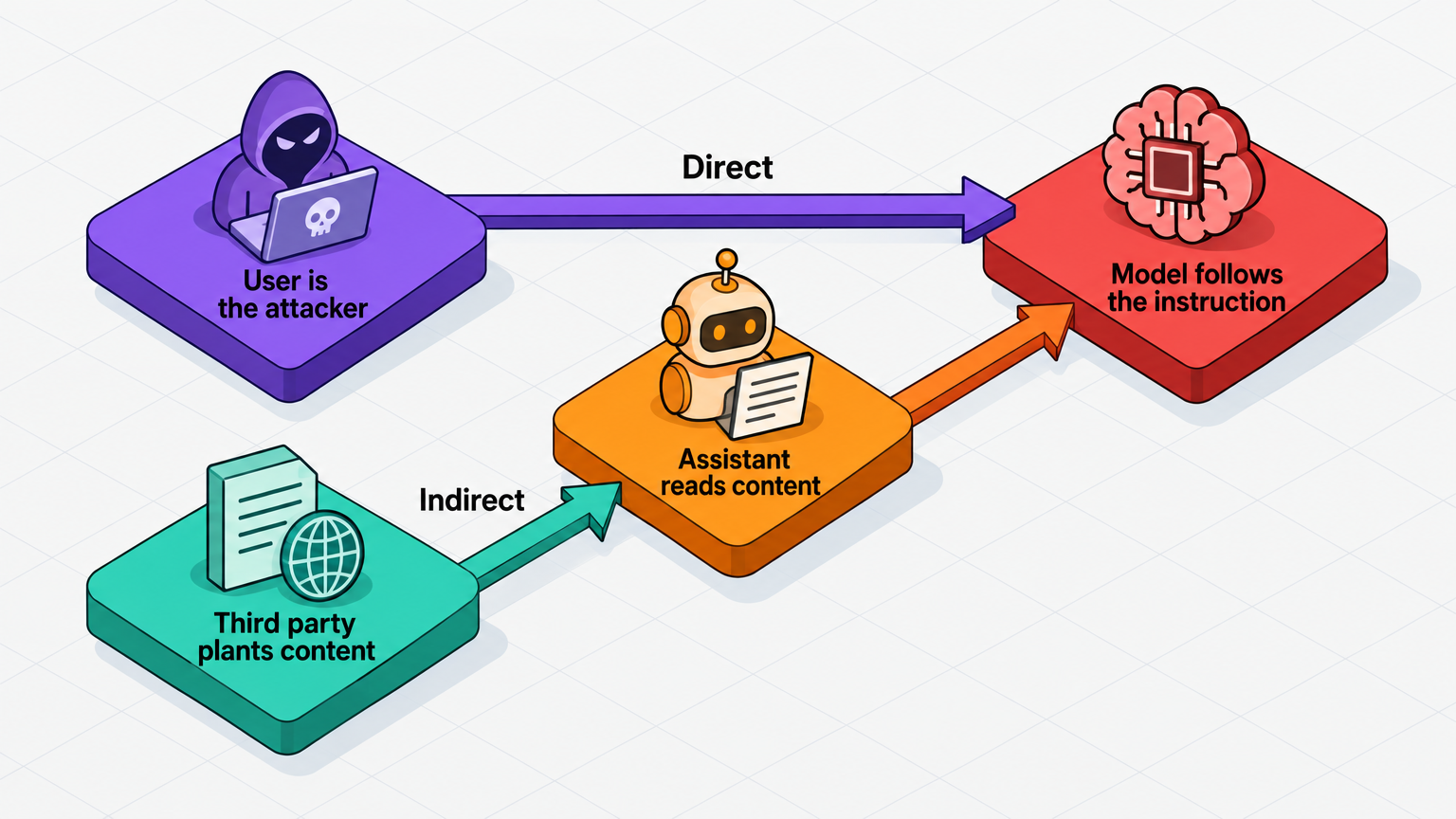
In a direct attack, the user is the attacker, appending instructions that compete with higher-trust instructions such as the application designer's system prompt. A jailbreak is a direct prompting attack aimed at getting around restrictions placed on model outputs, often through role-play framing or encoded text.
Jailbreaks remain effective against current models. The UK AI Security Institute's Frontier AI Trends Report says it has found universal jailbreaks for every system it has tested, though safeguards in some areas have improved. NIST reaches a similar conclusion for prompt injection, stating that current mitigations "do not offer full protection against all attacker techniques."
Indirect injection is mounted by a third party who never touches the application. The attacker plants instructions in a web page, email, document or tool response, and the assistant or agent reads them while doing its normal work. The harm often lands on the model's primary user, whose own access carries out the attacker's task.
The instructions do not need to be visible to a person, and OWASP's 2026 entry points to invisible Unicode characters, text embedded in images and poisoned agent memory that persists across sessions. Its mitigations include stripping invisible characters at ingest, treating memory writes as privileged and pinning the Model Context Protocol (MCP) servers an agent can call. Assuming injection is possible wherever a model reads untrusted input puts the decisive controls in tool permissions and output validation.
How Do LLMs Leak Sensitive Data?
Sensitive data leaves an LLM application through what users paste into prompts, what the model memorized during training and what the application places in the model's context, and each route has a different owner. OWASP's 2026 entry adds tool arguments, reasoning traces and logs to those channels.
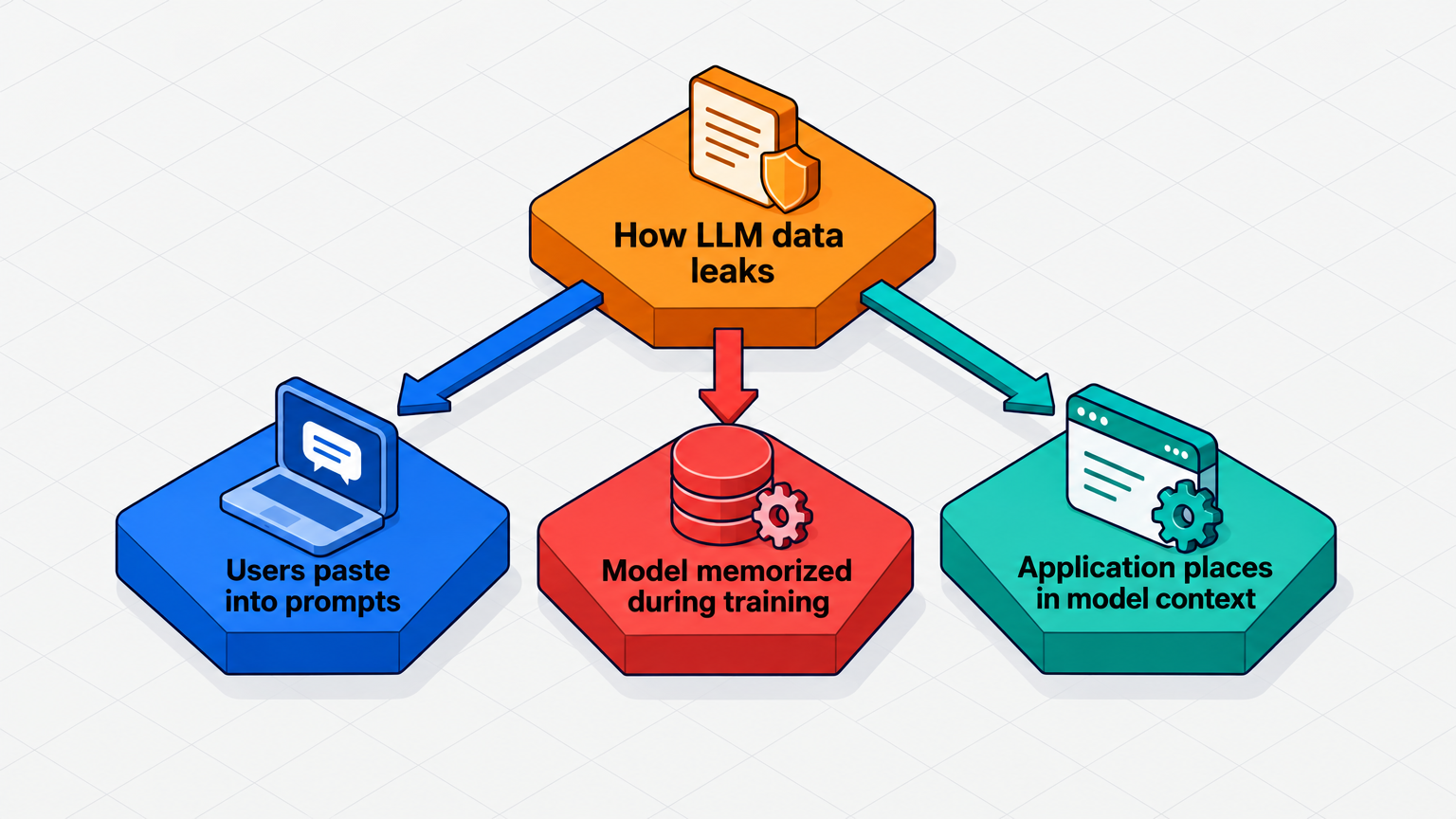
Employees paste source code, contracts and customer records into AI tools nobody reviewed, sometimes because the approved tool does the job less well. An approved-tool list paired with rules on what may enter a prompt addresses that exposure before any model-side control applies.
Models can reproduce text from their training data, and anything placed in a training set should be treated as potentially retrievable. NIST describes training data extraction attacks against generative language models, and attackers also probe for personally identifiable information (PII) in retrieval-augmented generation (RAG) databases.
Scrubbing PII when data is ingested limits what a model can later reproduce. Enforcing authorization before retrieval, rather than filtering results afterward, keeps a user from receiving documents they could not open directly, and restricting access to logs and traces closes a channel that can hold full prompts and outputs.
OWASP's 2026 list renamed System Prompt Leakage as Hidden Context Exposure (LLM08:2026), and the entry now covers tool schemas and policy context as well as system instructions. A system prompt is not a security control, because an attacker can often extract or infer it.
Credentials, connection strings and permission structures do not belong in prompt text. With authorization checks running in deterministic systems outside the model, disclosure of hidden context has little direct security impact.
What Are Data Poisoning, Model Poisoning and Supply Chain Risks?
Poisoning and supply chain attacks put the defect in place before any user interacts with the model, which separates them from risks that arrive through prompts at runtime.
Data poisoning means an adversary controls part of a model's training data by inserting or modifying samples, and NIST notes that such attacks can give attackers control over model behavior through backdoors. OWASP's 2026 entry extends the exposure past pre-training to fine-tuning, embeddings and RAG content.
Defenses such as gradient clipping and differential privacy usually reduce accuracy and do not fully mitigate model poisoning, and a targeted edit can leave benchmark scores unchanged. Provenance does most of the work instead: tracking the lineage of every dataset, versioning data so a bad batch can be rolled back and probing for hidden triggers after each round of tuning.
Model files pulled from outside carry code-execution risk, because some common serialization formats can run arbitrary code when a file is loaded. A model from a public hub deserves the same caution as an unsigned binary, and formats that store weights without executable content remove that path.
Joint NSA and CISA guidance on deploying AI systems recommends cryptographic methods, digital signatures and checksums to confirm each artifact's origin and integrity. OWASP's 2026 entry adds AI bills of materials, which make plugins, adapters and third-party models traceable, and extra scrutiny for services that convert or merge models.
What Happens When LLM Output Is Trusted or Agents Have Too Much Access?
Model output belongs in the same category as user input to whatever system receives it next, and an agent's permissions set the ceiling on the damage a manipulated output can cause.
Improper output handling (LLM10:2026), which earlier OWASP editions called insecure output handling, is the failure to validate and sanitize model output before another system acts on it. Output passed unchecked into a browser, shell, database query or URL fetcher can turn one injected instruction into cross-site scripting (XSS), server-side request forgery (SSRF), SQL injection or remote code execution.
The 2026 entry also covers generated code that an application deploys without human review. Treating the model as any other user means validating its responses before they reach backend functions, encoding output for the context where it lands and running database operations through parameterized queries.
Excessive agency in AI agents is the vulnerability that lets damaging actions follow from unexpected, ambiguous or manipulated model output. Its causes are excessive functionality (tools the agent does not need), excessive permissions (a read-only extension connected to an identity that can also delete) and excessive autonomy (high-impact actions running without approval).
OWASP's 2026 entry pairs those causes with narrow tools, permissions scoped to the user's own context, authorization enforced in code rather than by the model, and human-in-the-loop approval for high-impact actions. Abnormal's AI Agent Security, in private preview as part of the AI Security suite, is designed to discover agents across AI platforms, map ownership and track each agent's privileges and tool access.
Which Other LLM Cybersecurity Risks Should Teams Track?
The remaining categories on OWASP's 2026 list sit in retrieval, in the business process built on the model and in cost:
Vector and Embedding Weaknesses: This risk (LLM09:2026) covers retrieval stores and agent memory that return content a user should not see or accept tampered documents. Stored embeddings can even be inverted to recover source text, and tenant scoping inside the index query and provenance tracking for every embedding limit that exposure.
Misinformation and Overreliance: Misinformation (LLM07:2026) covers incorrect or unsupported output that people or systems act on, a behavior NIST's Generative AI Profile calls confabulation and most people call hallucination. Coding assistants add a security variant by inventing plausible package names that attackers can register in advance. Grounding answers in authoritative sources and verifying claims before acting reduce it.
Unbounded Consumption: This risk (LLM06:2026) covers oversized or high-volume requests that exhaust compute, run up costs or, through mass querying, copy a model's behavior. Token-aware rate limits, hard spending caps and limits on agent steps set the boundaries.
Ownership differs across these risks: retrieval sits with the data platform team, misinformation with whoever owns the process built on the model, and consumption with whoever holds the budget.
How Is Attacking an LLM Different From Attackers Using an LLM?
Attacking an LLM targets the model or its application by injecting it, poisoning it or abusing its tools, while attackers using an LLM treat the model as a productivity aid for phishing, business email compromise (BEC) and malware development. The first is an application security problem for the teams that build and run LLM applications. The second is a detection problem, because AI-written phishing still arrives as email and falls to the controls that inspect messages and identity activity.
Which Controls Reduce Each LLM Cybersecurity Risk?
Each risk pairs with a primary control that limits either the attack path or the blast radius:
Risk (OWASP 2026) | What it looks like | Primary control |
Prompt injection | Hidden instructions in web pages, email or memory | Untrusted-content handling; least privilege |
Sensitive information disclosure | PII or code in prompts, outputs or logs | Approved tools; authorization before retrieval |
Excessive agency | Agent deletes or sends without approval | Narrow tools; human approval |
Supply chain | Executable model files, tampered adapters | Signature and hash checks; AI bill of materials |
Data and model poisoning | Tampered datasets, backdoored weights | Data lineage; versioned datasets |
Improper output handling | XSS, SSRF, SQL injection, code execution | Output validation and encoding |
Unbounded consumption | Request floods, runaway token spend | Token-aware rate limits; spending caps |
Misinformation | Fabricated answers or packages acted on | Trusted grounding; human review |
Hidden context exposure | Secrets in system prompts | Secrets kept out of context |
Vector and embedding weaknesses | Cross-tenant retrieval leaks | Tenant-scoped retrieval |
Agent permissions, secrets embedded in prompts and untrusted content reaching tool-using assistants come first, because each bounds the impact of an injection that gets through. A use case whose security cannot tolerate the remaining risk may not suit an LLM at all.
How Should Teams Govern LLM Risk Across the Organization?
Governance starts with knowing which LLM apps, copilots, agents and unsanctioned tools are in use, who owns each one and what the organization can expect from the providers behind them.
The NIST AI Risk Management Framework organizes this work through Govern, Map, Measure and Manage, and its Govern function calls for mechanisms to inventory AI systems. Shadow AI belongs in that inventory alongside sanctioned tools, and asking why staff adopted an unapproved tool helps a secure alternative replace it.
The same function calls for documented roles and executive responsibility for AI risk decisions, and each inventoried system needs a named owner who can accept or refuse its risk. Abnormal's AI Governance, generally available, is designed to discover approved and shadow AI tools and attribute ownership.
Responsibility for LLM security is split between the provider that builds a model and the organization that deploys it, and the OWASP list says it owns the risk when the model is a component inside the organization's application. A provider can harden a model against jailbreaks, but the deploying organization decides what data the application retrieves, which tools an agent can call and whether a human approves high-impact actions.
The NSA and CISA guidance, written for organizations deploying AI systems built by another entity, has them require a threat model from the system's developer and set deployment security requirements in contracts. NIST's Generative AI Profile adds supplier risk assessments and service level agreements for third-party AI providers.
Turning LLM Risk Awareness Into Lasting Controls
LLM cybersecurity risks come from models that mix instructions with data, vary their output and act through tools, and prompt injection leads OWASP's 2026 list with no current mitigation that removes it. Programs that hold up limit impact instead, through least-privilege agents, validated output, vetted model sources, provider contracts with clear security terms and an inventory with a named owner for every system.
Abnormal's AI Security suite is designed to cover both inventory and agent privileges, with AI Governance generally available and AI Agent Security in private preview. Explore the AI Security suite to see how Abnormal helps inventory AI tools and track what each agent can access.
Frequently Asked Questions
Can prompt injection be fully prevented?
No, prompt injection is a residual risk that detection, training and filtering reduce but do not remove. LLMs process instructions and data in one text stream, and that leaves no reliable boundary to enforce. Layered controls limit the damage instead, led by least-privilege tooling and approval gates on high-impact actions.
Do LLM cybersecurity risks apply to tools employees use, such as ChatGPT?
Yes, the same risks apply to public AI tools used at work. Data pasted into prompts can leave the organization, unsanctioned tools sit outside security review as shadow AI, and assistants that browse the web or read email can follow hidden instructions planted there. An inventory of approved tools and clear data handling rules address most of this exposure.
Which LLM cybersecurity risks matter most for AI agents?
Agents read untrusted content and act on it, which puts excessive agency, indirect prompt injection and improper output handling at the top. An agent with broad permissions can turn one injected instruction into deleted data or sent messages. Narrow tools, downstream authorization, human approval and validation of what the agent passes on reduce that chain.
How does the OWASP Top 10 for LLM Applications relate to NIST AI RMF?
The OWASP Top 10 for LLM Applications catalogs specific technical risks, while the NIST AI RMF is a governance framework for managing AI risk across an organization. Security teams can use OWASP to identify and test for risks inside Map and Measure, then assign owners and treatments under Govern and Manage.