Key Insights
For under $20, researchers extracted the entire projection matrix of OpenAI's Ada and Babbage models through ordinary API access, in Stealing Part of a Production Language Model, a paper presented at ICML 2024. Unbounded consumption is the OWASP LLM risk (LLM06:2026, listed as LLM10 in 2025) in which an LLM application allows excessive and uncontrolled inference. Without limits on volume, input size or cost, users or agents can trigger denial of service, denial of wallet (runaway token bills), model extraction or runaway agent loops. Rate limits and quotas, input and output caps, agent step limits, spend budgets and usage monitoring are the controls that contain it.
Reasoning models and AI agents make the risk harder to contain, and this guide traces where it surfaces as outages, runaway bills and model theft and which limits, budgets and monitoring bound it.
What Is Unbounded Consumption?
Unbounded consumption is the absence of adequate controls over how much inference an LLM application performs, measured in requests, tokens, compute and tool calls. The 2026 entry in the OWASP Top 10 for LLM Applications describes an application that allows excessive and uncontrolled inferences, which lets attackers disrupt availability, impose unsustainable costs or clone the model.
One request can be cheap or expensive depending on prompt length, the output it triggers, the reasoning tokens it consumes and the tools it calls, which makes request counts a poor measure of risk. A limit expressed in requests per minute says little about what an application will actually spend.
How Has Unbounded Consumption Changed in the 2026 OWASP List?
The 2026 entry moves unbounded consumption from LLM10 to LLM06 and puts cost at its center: it names cost asymmetry as a defining characteristic, and reasoning models and agents as factors that compound it. The risk began as Model Denial of Service in the 2023 list, and OWASP renamed it in 2025 to cover resource management and unexpected costs alongside uptime.
Cost asymmetry means an attacker can trigger costly computation through crafted prompts, stolen credentials or manipulated workflows. Under pay-per-token billing, the defender pays for every input and output token while the attacker's cost stays near zero, and falls to nothing when the requests run on a stolen key.
Reasoning models and agents raise the cost ceiling of a single request. The 2026 entry also names multimodal models, tool-use protocols and shared inference infrastructure among the factors that add to it.
In thinking-token exhaustion, short, benign-looking prompts push a model into prolonged or non-terminating reasoning loops, which input-size filters do nothing to catch. An agentic AI system makes the exposure larger, because one request can plan, call tools, retry failures and hand work to other agents, each step billable.
What Are the Risks of Unbounded Consumption?
Unbounded consumption surfaces as denial of service, denial of wallet, model extraction and runaway agent loops, and a single incident can involve more than one.
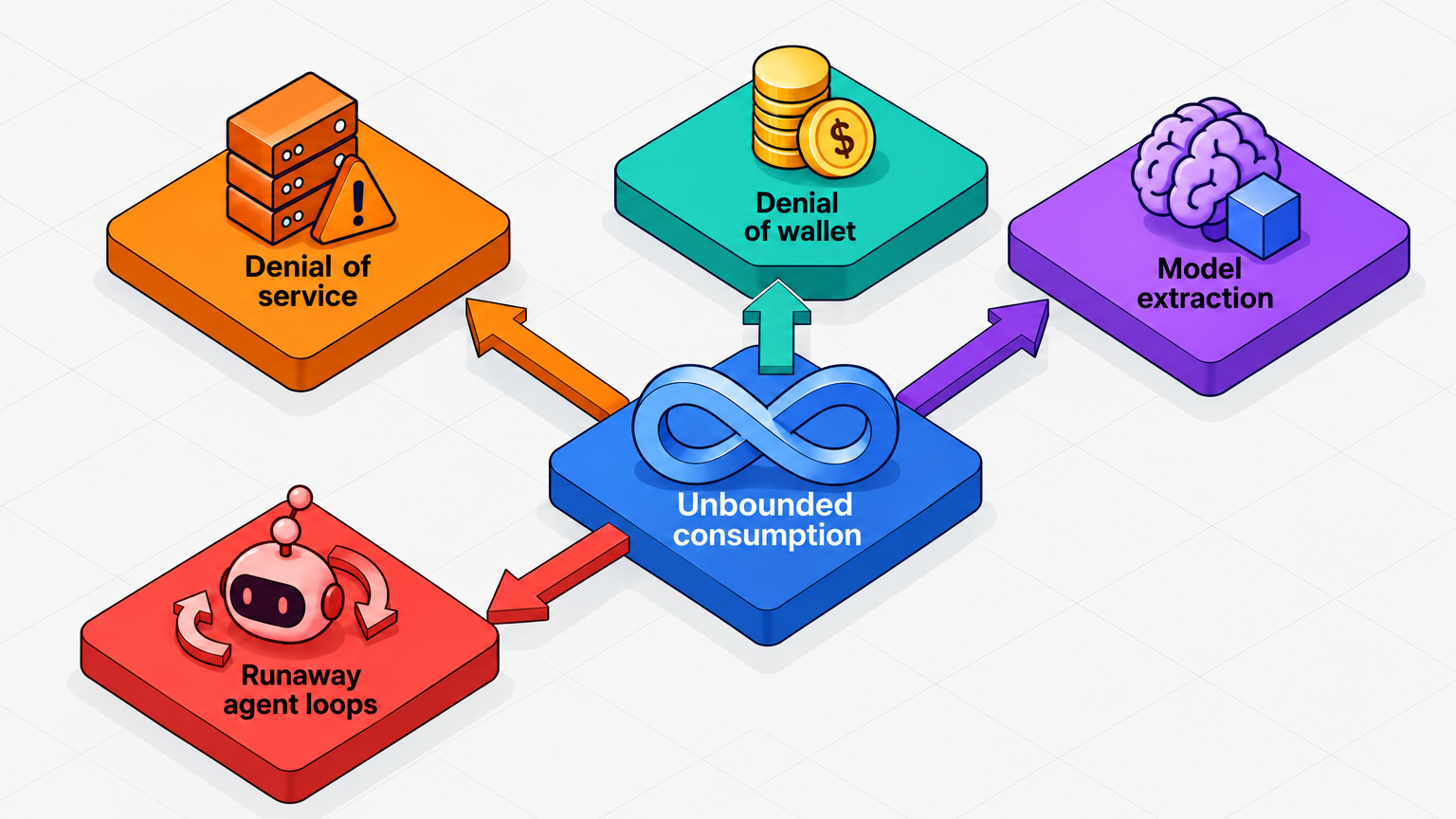
Service Outages and Model Extraction From Mass Querying
LLM denial of service works by exhausting compute. A network flood depends on traffic volume, but an LLM attacker can slow a service with modest traffic because each request is expensive to serve.
Common patterns include variable-length input floods and output explosion, large-context abuse, and reasoning-loop and thinking-token exhaustion. In each case, the model is the expensive bottleneck, and an input costing the attacker almost nothing can consume a large amount of useless compute on the other end.
The same high-volume querying that strains capacity can also copy what a model knows. An adversary with inference API access collects the model's outputs and uses them as labels to train an imitation, which turns metered access into a route for replicating model behavior.
Targeted attacks can recover specific parts of a model, such as a single layer's weights, far more cheaply than a full imitation. Limiting user queries and flagging suspicious ones help, though motivated, well-resourced attackers can work around both. Because each extraction query can look like ordinary traffic on its own, the pattern usually shows only in volume and in how queries spread across accounts.
Runaway Cost From Long Sessions and Agent Loops
Denial of wallet targets the bill instead of the uptime, and the service can stay responsive while token charges accumulate on the victim's account. Long sessions compound the charges because each turn carries the whole growing context, and one OWASP scenario tracks per-turn cost climbing from roughly $0.001 on the first turn to about $0.50 by turn 100.
Agent loops can run up the same bill without any attacker, because they turn one request into an open-ended chain of model and tool calls. A loop keeps triggering model calls, tool invocations or agent runs whenever nothing enforces a termination condition, such as when a tool controls its own retries or the model alone decides when to stop.
In multi-agent systems, the pattern shows up as cascading failures, listed as ASI08 in the OWASP Top 10 for Agentic Applications, with rapid fan-out, oscillating retries between agents and repeated identical intents among the symptoms.
Runaway loops are a consumption problem, distinct from excessive agency in LLM applications, which concerns what an agent is permitted to do. A loop can stay entirely within its permissions and still exhaust a budget.
How Can Teams Keep Unbounded Consumption in Check?
Teams keep unbounded consumption in check by layering limits on volume, size, steps and spend, then monitoring usage for the patterns those limits miss.
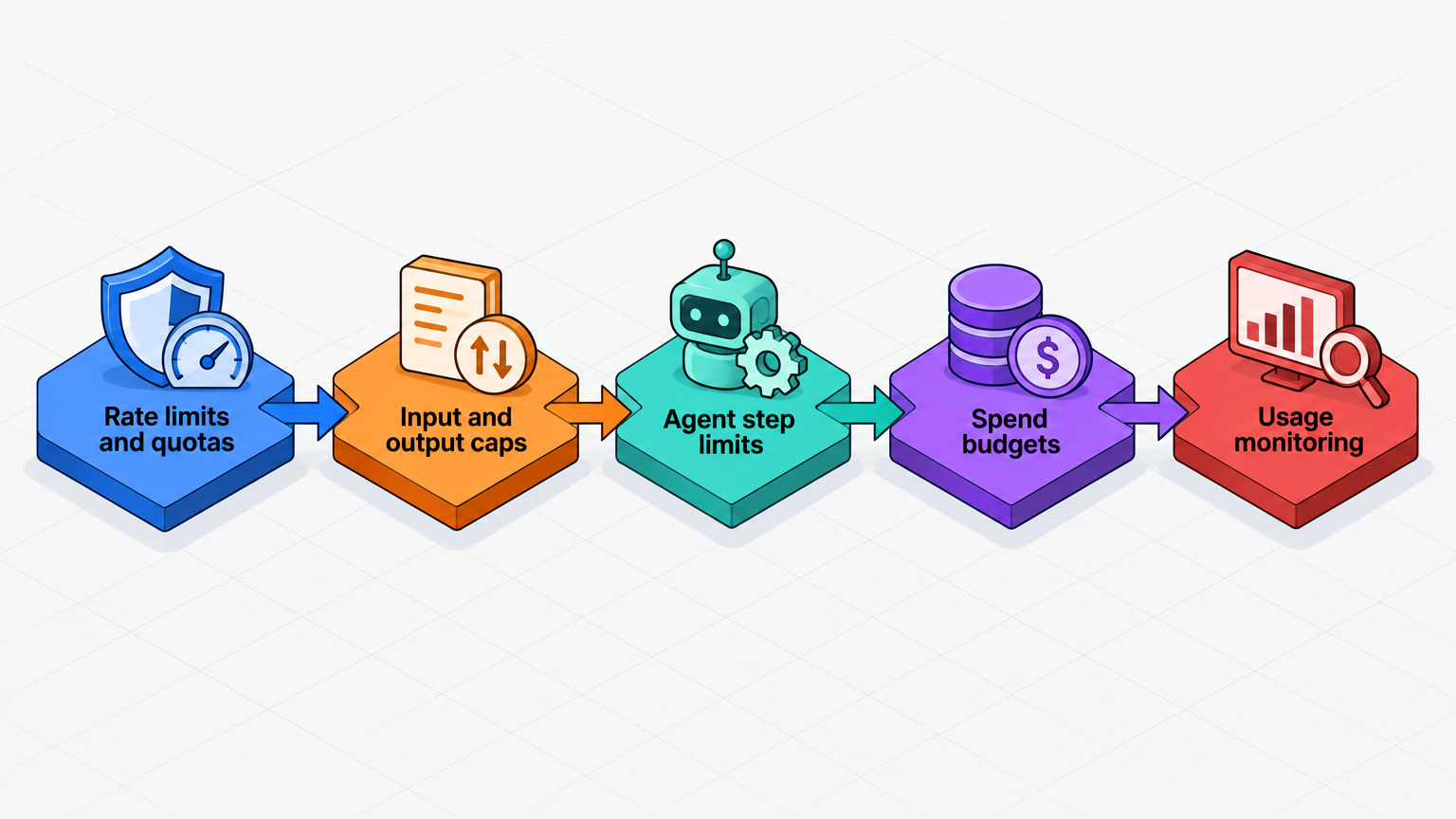
Set Rate Limits and Quotas
Rate limits and quotas bound how much any one identity can consume. Limits applied by user, API key or tenant work best when short-term rate, burst and concurrency ceilings sit alongside longer-term quotas, with evasion through distributed requests, account rotation or stolen credentials monitored separately.
Request-count limits miss prompt-complexity attacks, because one expensive prompt can cost more than many cheap ones. Token-aware cost controls, such as limits on tokens per minute, tokens per day and estimated cost per request, measure what request counts miss.
Key protection belongs with quotas, since a per-key quota only caps a thief at that key's allowance. API keys should never be committed to source code and should live in a secrets manager.
Agents and service accounts need quotas of their own rather than sharing the allowance of the user who launched them. An agent running unattended, overnight or on a schedule, can exhaust a shared quota before anyone notices, and a dedicated quota also shows which workload consumed it. Quotas set from each workload's observed usage, with headroom for normal peaks, tend to hold better than round numbers chosen in advance.
Cap Request Size and Agent Steps
Size caps limit what each individual request can cost, whoever sends it. Strict input validation keeps inputs within reasonable size limits, and output needs the same discipline, since small prompts can produce very large outputs and a maximum output token setting on every call bounds generation. Retrieved content counts toward the bill too, and limiting the number and total size of retrieved chunks keeps retrieval from flooding the context window.
Step limits extend the same idea from a single request to a whole agent run: every agent loop gets a hard stop that does not depend on the model deciding it is finished. Recursion, retry and chain-depth limits suit agentic and tool-using flows, paired with circuit breakers or kill switches for unusual cost, latency or tool-call spikes.
Framework settings such as max_turns, max_iterations and recursion_limit are where those bounds are usually set, alongside a per-run cost ceiling. A wall-clock timeout per run covers what step counters cannot, such as a model that keeps reasoning inside a single step. Progress caps, circuit breakers between planner and executor, and human review of high-risk outputs before they propagate downstream extend the same discipline to multi-agent runs.
Track Spend and Monitor Usage for Anomalies
Spend budgets give consumption an accountable owner. They rest on an inventory of the AI tools, API keys and subscriptions in use, including model provider APIs that developers buy directly, with an owner and a budget assigned to each.
Hard spending caps should halt inference when exceeded, because fast-accumulating workloads can outpace an alerting threshold. Abnormal's AI Governance is designed to show token usage and subscriptions by tool and team and compare month-end forecasts with budgets.
Monitoring catches what static limits and budgets let through, including spend that stays under a cap but rises far faster than usual. Near-real-time usage telemetry with alerts on sudden changes in tokens, requests or spend gives teams a view that fixed thresholds cannot provide on their own.
Tracking token velocity per key against that key's own baseline gives each credential its own reference point. A spike on one key then stands out even when organization-wide totals look ordinary. Per-key baselines have a blind spot, since attackers can spread queries across many accounts until no single key looks unusual. Useful telemetry identifies coordinated behavior across accounts, not just within one.
Consumption Limits as Security and Budget Controls
Containing unbounded consumption takes several limits working together: rate limits and quotas tied to each identity, caps on input and output size, bounded agent steps and timeouts, and hard spend budgets that stop inference instead of only warning. Because each limit attaches to a specific tool or API key, a current inventory with named owners comes first.
Abnormal's AI Governance, generally available as part of the AI Security suite, is designed to surface token usage and subscriptions by tool and team. Explore AI Governance to see AI consumption mapped to the teams driving it.
Frequently Asked Questions
What is unbounded consumption in OWASP?
Unbounded consumption is the OWASP risk in which an LLM application allows excessive and uncontrolled inference, which exposes it to denial of service, runaway costs and model theft. The 2026 OWASP Top 10 for LLM Applications lists it as LLM06. It appeared as LLM10 in 2025 and evolved from the earlier Model Denial of Service entry.
What is a denial of wallet attack?
A denial of wallet attack drives up the cost of a pay-per-use AI service until the bill becomes unsustainable. Classic denial of service aims to knock a service offline, while denial of wallet can leave it running normally as an attacker, often holding a stolen key, consumes tokens at the victim's expense.
How do you prevent unbounded consumption in LLM applications?
Layered limits keep it in check, starting with rate limits and token-aware quotas per user, API key and agent, plus input size limits and maximum output token caps per request. Agents need step limits, retry caps and timeouts. Hard spending caps stop inference at a budget, and anomaly monitoring flags usage that slips past fixed limits.
How do AI agents cause unbounded consumption?
AI agents cause it when loops, retries and calls to other agents keep generating model and tool calls without an effective termination condition. Each step is a billable inference, and often nobody is watching in real time. One faulty decision can fan out into many downstream tasks and multiply cost well beyond what the original request needed.
How do you monitor LLM costs for security?
Security teams track token usage per API key, user, team and agent against a baseline of normal behavior. Alerts on sudden changes in tokens, requests or spend can surface stolen keys, runaway agents and extraction attempts. Billing alerts and month-end forecasts against budget add a financial check on the same signals.