
Why Web 3.0 Starts with the CMS
Abnormal’s Web 3.0 initiative is centered on making Abnormal.ai more modern, more AI-native, and ultimately more effective at turning website traffic into revenue. A major constraint in achieving that is the content management system.
As part of that push, the team made a foundational decision: migrate from Craft to Contentstack, and do it in a way that improves the long-term structure of the site rather than simply copying content over “as-is.” That meant redesigning content types, taxonomies, and layouts so the new system would be optimized for how Abnormal wants to build and scale content going forward.
Migration Plus Redesign
A CMS migration is already a big lift. A CMS migration combined with a taxonomy and content model redesign is where projects usually slow down and become vendor-heavy.
Ellie and the Web Ops + Marketing teams wanted to move quickly and keep the work in-house rather than relying on an outside agency. The only way to do that at velocity was to lean hard into automation and build tooling that could handle both the scale of the migration and the complexity of the redesign.
An AI-Assisted ETL Engine
The centerpiece of the project was a production ETL tool that:
- Extracts content entries from Craft (the legacy CMS)
- Transforms them to match the redesigned structure (new content models, new taxonomies, updated layouts)
- Loads them into Contentstack (the new CMS)
For the demo, Ellie showed a single-entry migration: she pulled a specific blog entry by ID from Craft, ran it through the transformation pipeline, and then verified it appeared in Contentstack immediately afterward: complete with title, hero image, author attribution (including bio), taxonomy fields, and formatted body content.
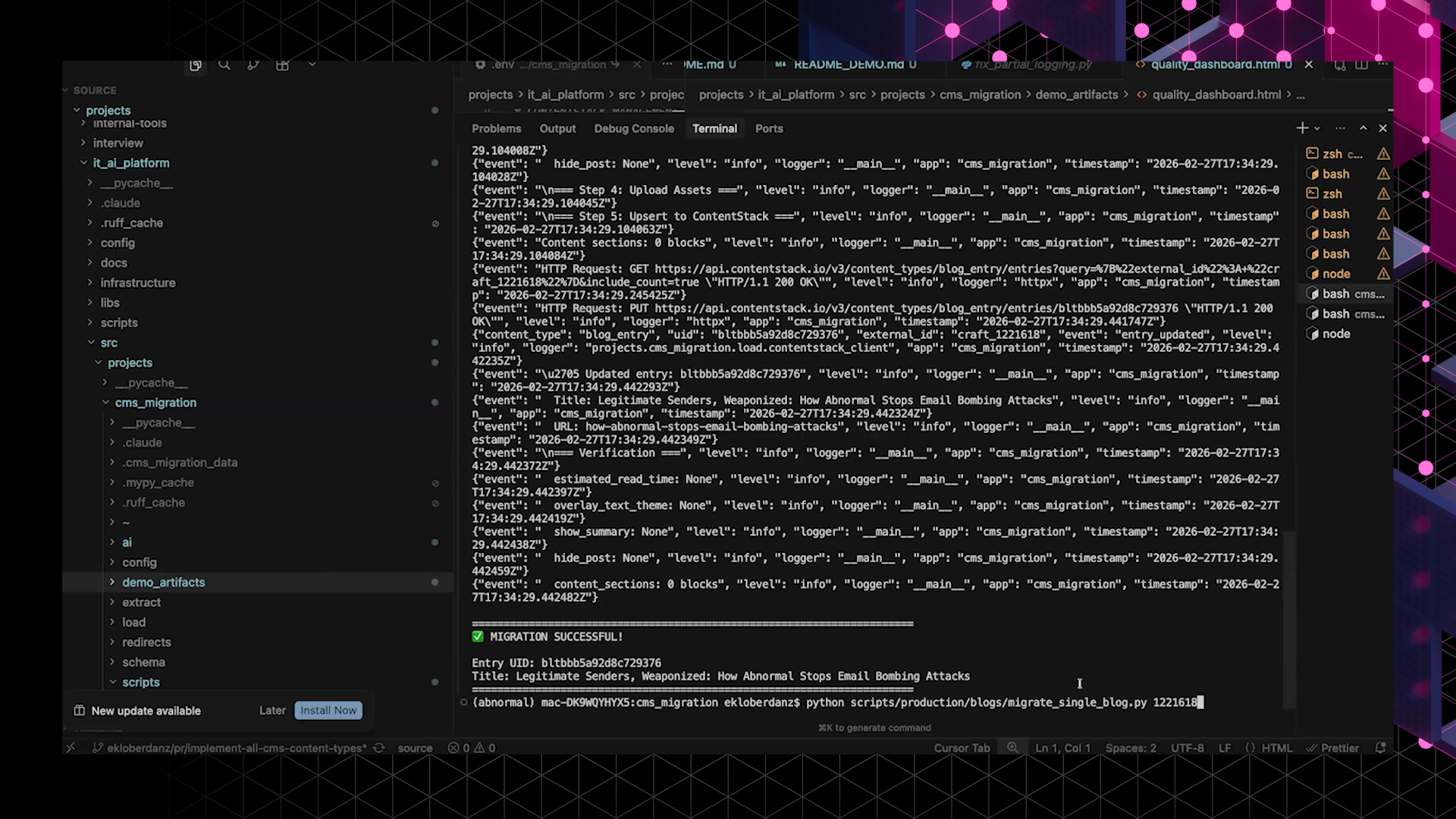
A key detail here is that legacy content wasn’t migrated as “raw text.” It preserved the structure and styling fidelity needed to match how the content renders on the website, including HTML/CSS-backed formatting where necessary.
AI Tools for Content Optimization
Once migration works, the next bottleneck becomes quality and cleanliness, especially when thousands of entries are involved. Ellie added two AI-powered tools to help the content team improve what gets migrated, not just move it.
AI Content Quality Dashboard
This tool analyzes existing entries and flags which ones may need improvements such as readability, SEO quality, or general polish. The output is actionable: it produces a prioritized list of content that needs attention so creators know where to focus.
Semantic Duplicate Detection Heatmap
This tool measures semantic similarity across articles and surfaces potential duplicates or redundancies. It’s designed to catch issues that often show up during migrations: multiple versions of the same content, near-duplicates, or outdated pages that should be consolidated.
Even in the demo (using mock data), the workflow was clear: instead of manually hunting for duplicate content across a large library, the system highlights where cleanup is most likely needed.
Production Scale, Delivered Fast
This project shipped at real operational scale:
- 13+ content types set up in the new CMS (blogs, resources, what’s new, threat intel, and more)
- 21 taxonomies created and structured for the redesigned model
- Thousands of website entries migrated into production
- Built and delivered on a short timeline while keeping ownership internal and avoiding external vendors
This CMS transformation is foundational. It creates the content infrastructure that Web 3.0 depends on: a modern, AI-native website architecture where content can be created, updated, and optimized quickly, without a long manual pipeline.
The migration tooling makes the replatform feasible at speed. The AI quality and duplicate tools introduce something even more valuable: a continuous content governance layer that helps Abnormal’s website stay fresh, coherent, and performance-oriented over time.
What’s Next
With the new CMS foundation in place, the next wave is scaling the Web 3.0 redesign on top of it: improving layouts, enriching taxonomy-driven experiences, and making content creation and optimization even more AI-assisted.
The bigger takeaway is that this approach turns a traditionally slow, vendor-heavy CMS migration into an internal capability: repeatable, automatable, and ready to evolve alongside the website itself.
