
NOTE: Demo visuals use either blurred real data or synthetic placeholders to protect customer privacy.
The Manual Bottleneck Problem
SPM’s mission is to secure email and identity environments across major platforms like Microsoft 365, Google Workspace, and Salesforce. That mission depends on keeping a wide, accurate library of security postures—benchmarks that define how systems should be configured for safety. But creating these postures was slow and manual, requiring both content specialists and engineers.
Three key frictions slowed progress:
- Benchmark analysis, content drafting, and intel integration each required separate handoffs.
- Engineering time was needed to transform drafts into publishable posture evaluations.
- The process limited production to one or two postures per week, leaving coverage gaps.
The result was a backlog that limited Abnormal’s ability to expand posture coverage quickly enough to keep pace with customer and threat landscape demands.
The AI-Powered Workflow Solution
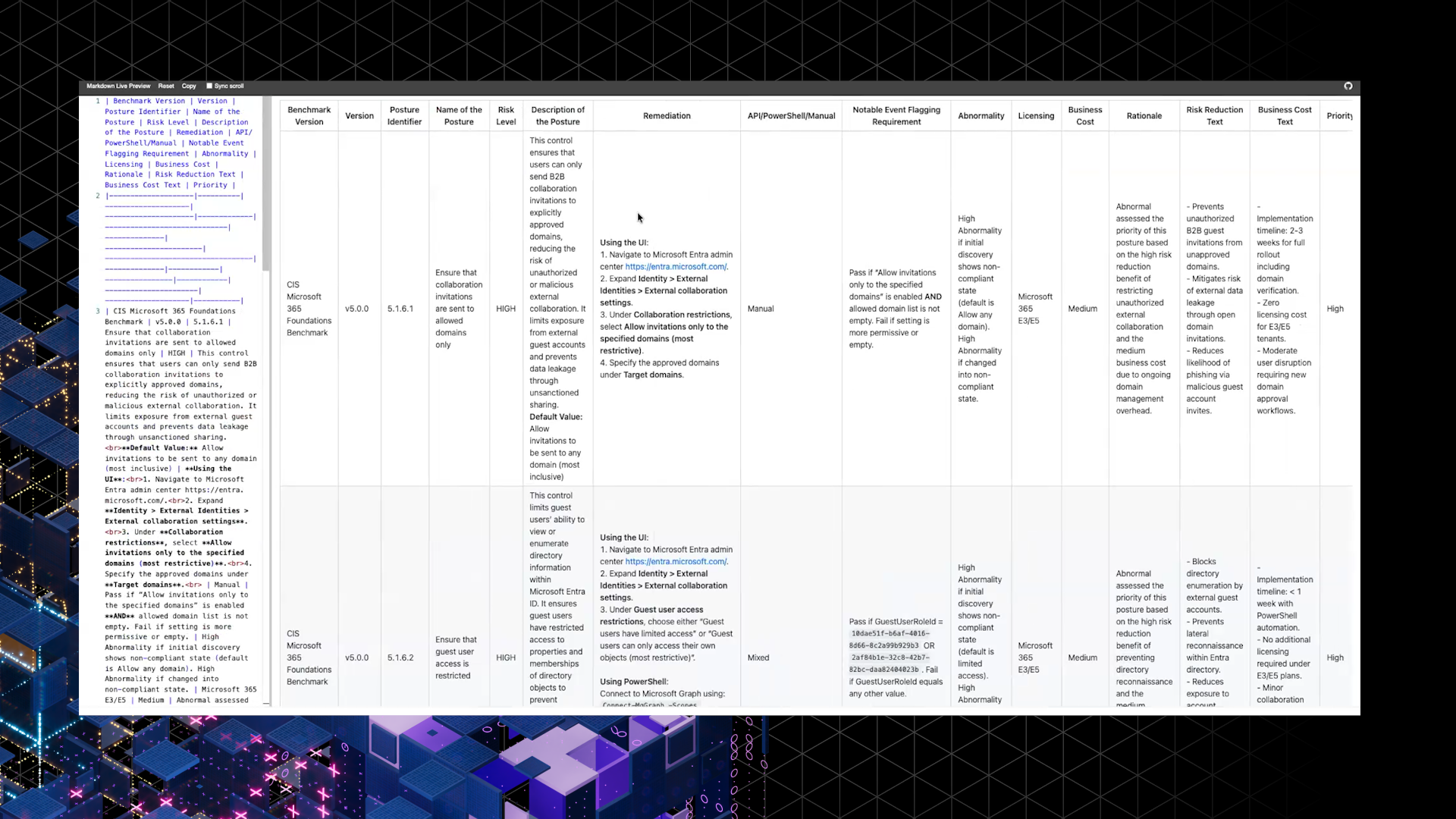
Posture Card GPT replaces this bottleneck with an automated pipeline. It takes any security benchmark—such as CIS or NIST—and converts it into complete posture content in minutes. Each output includes markdown for Abnormal’s posture repo, plus an optional CSV ready for upload into internal tools that generate evaluation logic.
Key capabilities include:
- Parsing and understanding CIS/NIST benchmarks by section.
- Generating full posture descriptions, remediation steps, and risk text.
- Exporting markdown ready for immediate preview and publication.
- Producing CSVs compatible with Engineering’s internal posture evaluation app.
- Allowing Threat Intel teams to create content without coding or engineering support.
In his demo, Rohan showed GPT generating live Markdown and converting it into a ready-to-use CSV. He noted that this first step is part of a broader vision to build a full AI-assisted posture pipeline that automates evaluation logic.
Impact on Speed and Coverage
Early testing shows a 50x increase in velocity, moving from a few postures per week to as many as 100 per quarter. That speed unlocks full coverage across key platforms and removes the engineering dependency from posture creation.
The measurable impact spans several teams and goals:
- Threat Intel: Gains autonomy to build and publish without developer time.
- Engineering: Can focus on higher-value evaluation logic and tooling.
- SPM Leadership: Gains posture velocity as a new operational KPI for coverage growth.
- Customers: Benefit from faster alignment with industry benchmarks and reduced exposure windows.
Next, Rohan’s team plans to complete integration with the internal evaluation app. Once connected, the whole workflow will support end-to-end AI posture creation and validation.
From Demo to Standard Practice
Early reactions from peers across Abnormal highlighted both the technical and cultural shift this represents. The demo showcased not just automation but empowerment: non-engineering teams can now generate production-grade security posture content.
The broader implication is clear. By treating posture creation as a scalable, AI-accelerated pipeline, Abnormal positions itself to cover more environments faster while maintaining consistent quality. As engineering builds the next stage of this flow, Posture Card GPT sets the tone for how Abnormal builds AI tools: focused, measurable, and builder-led.
