
NOTE: Demo visuals use either blurred real data or synthetic placeholders to protect customer privacy.
SDR Admin Slows Pipeline
SDRs are the front door to new revenue. Their job is simple: get on the phone, build relationships, and create a pipeline. The reality includes heavy admin work after each meaningful call.
Three friction points stood out:
- Manual drafting: Follow-up emails can take up to 20 minutes to research and write.
- Content hunting: SDRs jump into Highspot to find battle cards and supporting documentation.
- Transcript review: Rechecking call notes to tailor messaging adds more time.
Multiply that across daily calls, and the cost becomes clear. What feels like small tasks compound into weeks of lost selling time per SDR each year.
Automating SDR Follow-ups
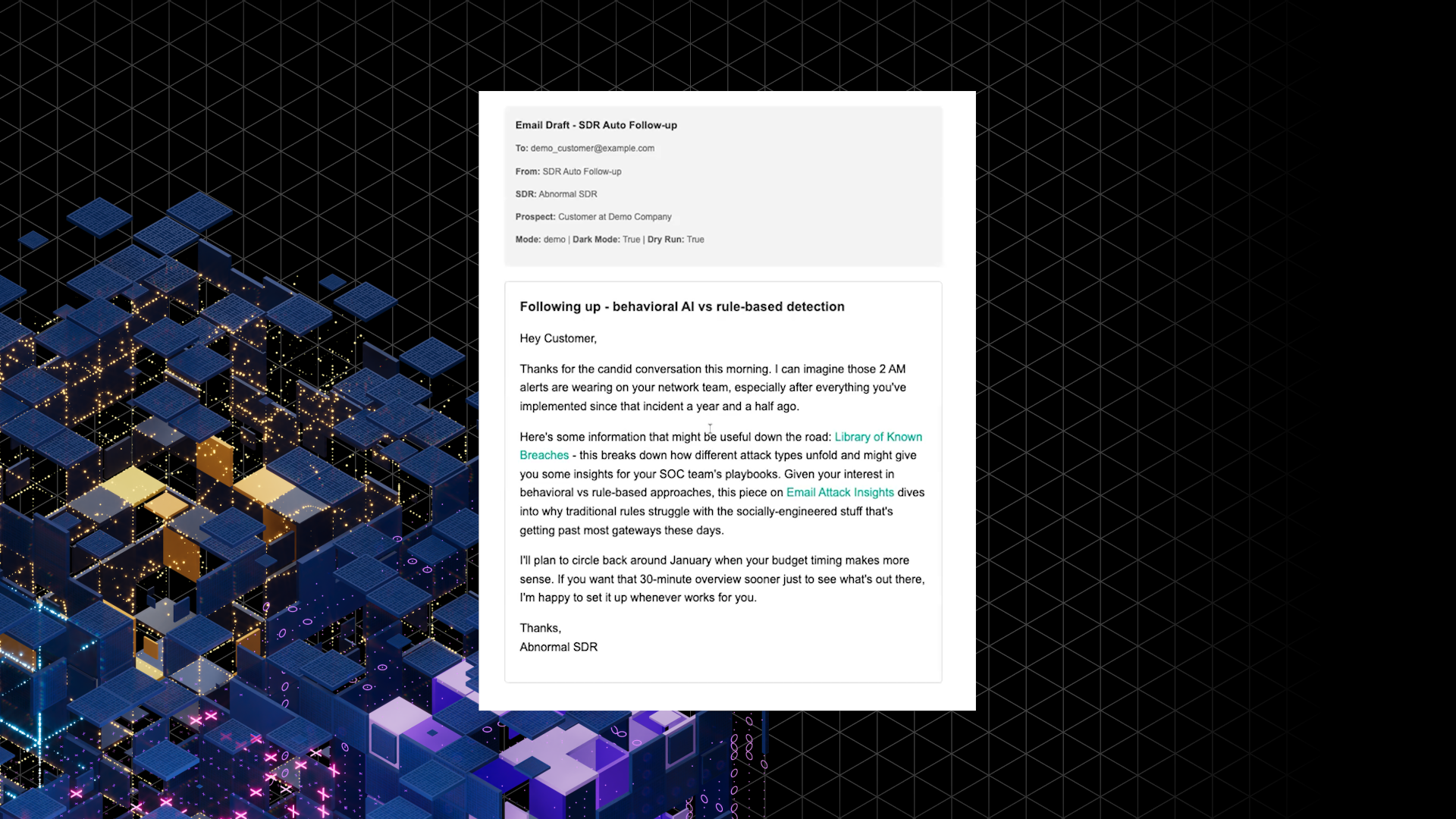
Tim built an AI workflow that triggers off call transcripts from Aurum. When a prospect expresses interest, the system generates a tailored, customer-facing follow-up email and places it directly into the SDR’s draft folder for review.
Key capabilities include:
- Parsing telephone call transcripts for prospect interest and context
- Pulling relevant documentation, such as competitive battle cards
- Personalizing the opening hook based on conversation details
- Formatting a ready-to-send email draft in the SDR’s inbox
- Reducing review time to about two minutes
As Tim explained, “It saves them 18 minutes, seeing they have to spend 2 minutes reviewing this instead of 20 finding all of this.” The system mirrors the logic used in the CSM QBR follow-up: a business event occurs, a transcript becomes the data source, and AI automatically structures expert-informed messaging.
There are technical nuances still being refined, including webhook-based triggers from Aurum. But the core workflow is already functional and ready for pilot users.
More Calls, More Pipeline
The impact is straightforward. If an SDR saves roughly 18 minutes per qualified follow-up, that time goes back into dialing and prospecting. More conversations create more opportunities.
Early value areas include:
- Time savings: ~18 minutes saved per meaningful call
- Speed to follow-up: Draft ready within minutes of transcript availability
- Consistency: Battle cards and positioning are embedded automatically
- Focus shift: More time for outreach, less time on admin
Next, Tim plans to roll this out to 2 or 3 SDR power users, gather feedback on the tone and effectiveness, and refine the automation around Aurum’s webhook flow.
Extending the GTM Engine
Peers reveled at how naturally this fits into the broader AI transformation across GTM. What started as a CSM QBR follow-up has evolved into a reusable engine for multiple teams.
Culturally, this signals a shift: shared AI infrastructure enables fast iteration across roles. The same logic now supports both retention and pipeline generation. The next step is to validate impact with pilot SDRs and measure how reclaimed minutes translate into booked meetings.
